4 November 2025•Sokudo Electric India
What Is Actually Happening on Indian Roads Right Now?
Walk into any housing society in Mumbai, Bengaluru, or Delhi today. Look at the parking area. You will see more electric scooters than you did six months ago.
This is not a trend. This is a mass migration.
The numbers tell the story: Under the PM E-DRIVE scheme, as of January 27, 2026, a total of 22.12 lakh EVs have been sold, including 19.19 lakh e-two-wheelers and 2.93 lakh e-three-wheelers . The scheme has a total outlay of ₹10,900 crore and has been extended up to March 31, 2028 .
But forget the government numbers. Look at your neighbour's parking spot.
The electric scooter you see there is not there because someone wanted to save the planet. It is there because petrol hit ₹103 per litre in Mumbai . It is there because the owner realized they were spending ₹2,000 every month just to go to work and back. It is there because someone did the math.
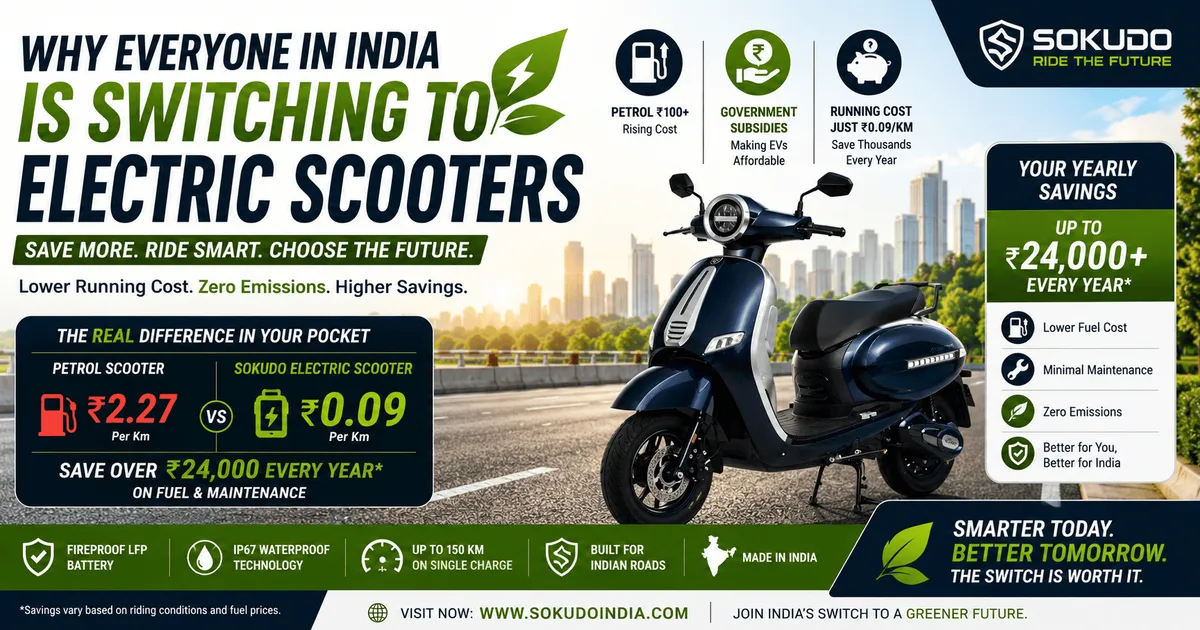
That math is simple: A petrol scooter costs over ₹2 per kilometre. An electric scooter costs under ₹0.10 per kilometre with brands like Sokudo. For a 35 km daily commute, that is ₹70 per day difference. Over a year, that is over ₹25,000.
How Much Money Will You Save by Switching Today?
Let us answer this with real numbers from May 4, 2026 — not last year, not next year, but today.
First, what does petrol cost in your city right now?
According to data from oil marketing companies, here are the prices as of May 4, 2026 :
In Mumbai, petrol is ₹103.54 per litre. In Hyderabad, it is ₹107.46. In Bengaluru, ₹102.92. In Chennai, ₹100.84. In Kolkata, ₹105.45. In Delhi, ₹94.77. These are not predictions. These are the prices at the pump today .
Now, what does a normal commute cost with a petrol scooter?
Assume you ride 35 kilometers every day — a typical office commute from a suburb to the city center and back. A petrol scooter gives approximately 45 kilometers per litre in city traffic.
You need 0.78 litres of petrol for that 35 km ride. At Mumbai prices, that costs ₹81. At Bengaluru prices, ₹80. At Chennai prices, ₹79.
Over a month of 26 riding days: You spend between ₹2,054 and ₹2,106 on petrol alone. That does not include oil changes, servicing, spark plugs, or any other maintenance.
Over a year: You spend between ₹24,648 and ₹25,272 just on fuel.
Now, what does the same commute cost with an electric scooter?
Take the Sokudo Electric scooter as an example. Its verified running cost is ₹0.09 per kilometre — the lowest in the Indian market.
For the same 35 km commute, your daily electricity cost is ₹3.15. Your monthly electricity cost is ₹82. Your yearly electricity cost is ₹984.
The difference: You save ₹78 every day. You save ₹2,024 every month. You save ₹24,288 every year.
That is real money. That is a family dinner every week. That is a weekend trip every few months. That is over two lakh rupees in five years.
According to ChooseMyBicycle's 2026 buyer's guide, electric scooters are 8-10x cheaper to run than petrol scooters, with monthly running costs of just ₹200-300 for 1,000 km compared to ₹2,200-2,500 for
petrol .
Why Are Petrol Scooters Becoming Too Expensive to Run?
The short answer is that petrol prices have crossed ₹100 per litre in most major cities and are unlikely to come down. As of May 4, 2026, petrol remains above ₹100 in Mumbai, Bengaluru, Chennai, Hyderabad, and Kolkata .
But the longer answer is about how these prices affect a normal rider's life.
Think about your monthly budget. If you earn ₹30,000 per month, spending ₹2,100 on petrol is 7% of your income — just to move. If you earn ₹20,000 per month, that ₹2,100 is over 10% of your income.
Now add maintenance. A petrol scooter needs an oil change every 3,000 kilometres. That is ₹400-500 every few months. It needs spark plugs every 6,000 kilometres. It needs air filter cleaning. It needs clutch or belt replacement every couple of years.
Add all of this up, and a petrol scooter costs between ₹3,000 and ₹5,000 per year just to maintain — on top of the ₹25,000 you already spend on fuel .
The total yearly cost of running a petrol scooter for a 35 km daily commute is approximately ₹28,000 to ₹30,000.
Now compare that to an electric scooter. No oil changes. No spark plugs. No air filters. No clutch. No belt. Yearly maintenance: ₹800 to ₹1,500. Yearly electricity: ₹984. Total yearly cost: under ₹2,500 .
The petrol rider spends ₹28,000 per year. The electric rider spends ₹2,500 per year. The difference is ₹25,500 — every single year.
How Does a ₹0.09 per km Electric Scooter Change Your Monthly Budget?
Let us take a real person example.
Meet Priya. She lives in Andheri, Mumbai. She works in Bandra Kurla Complex. Her daily round trip commute is 30 kilometres. She rides 26 days per month.
Priya's monthly budget with a petrol scooter:
- Petrol cost: 30 km ÷ 45 kmpl × ₹103.54 × 26 days = ₹1,794
- Maintenance set aside (oil, servicing): ₹300
- Total monthly transport cost: ₹2,094
Priya's monthly budget with a Sokudo electric scooter:
- Electricity cost: 30 km × ₹0.09 × 26 days = ₹70
- Maintenance set aside: ₹80
- Total monthly transport cost: ₹150
Priya saves ₹1,944 every month. Where does that money go? She tells us she now orders better groceries. She takes her family out for dinner once more each month. She put her child in an extra tuition class.
This is why everyone is switching. Not because of climate change. Not because of government policy. Because ₹1,944 per month makes a real difference in a middle-class household.
What Are the Hidden Savings Nobody Talks About?
When people compare electric and petrol scooters, they look at fuel cost. That is the obvious saving. But there are hidden savings that make the switch even more attractive.
Hidden Saving #1: Depreciation on fuel
Every time you fill your petrol scooter, that money is gone forever. You never see it again. With an electric scooter, your "fuel" cost is so low (₹0.09 per km) that it barely registers as an expense.
Hidden Saving #2: No more auto-rickshaw backup
Petrol scooters break down. Not often, but they do. When they do, you pay for auto or cab. Electric scooters have fewer moving parts. They break down less often. One less unexpected expense.
Hidden Saving #3: Home charging convenience
A petrol scooter requires a trip to the fuel station. That takes time. Time is money. With an electric scooter, you plug in at home. You wake up with a full "tank." No detours. No queues. No waiting.
Hidden Saving #4: Lower insurance premiums
Some insurance companies offer lower premiums for electric vehicles because they have lower risk of certain types of claims. Check with your provider.
Hidden Saving #5: No price shock when petrol rises
Remember 2021 when petrol jumped from ₹70 to ₹100? Petrol scooter owners felt that instantly. Electric scooter owners did not. Electricity prices are stable. They do not double overnight.
How Are Government Subsidies Making Electric Scooters Cheaper Than Petrol?
The Indian government wants you to switch. So they made electric scooters cheaper to buy than petrol scooters — after subsidies.
What you get when you buy an electric scooter in 2026:
First, a direct subsidy of ₹15,000 to ₹30,000 depending on battery size. The PM E-DRIVE scheme provides upfront incentives to consumers to reduce the purchase price of electric vehicles, which are reimbursed to Original Equipment Manufacturers by the Government of India . The scheme has an allocation of ₹1,772 crore specifically for e-two-wheelers .
Second, zero road tax in most states. For a typical scooter, road tax is 6% of the ex-showroom price. On a ₹90,000 scooter, that is ₹5,400 saved.
Third, registration fee waiver — another ₹300-600 saved.
Let us see how this changes the final price of a Sokudo Acute 2.2:
- Ex-showroom price: ₹89,889
- Government subsidy (approx): -₹18,000
- After-subsidy ex-showroom: ₹71,889
- Road tax (petrol would pay ₹4,500+): ₹0
- Registration fee (petrol would pay ₹500): ₹0
- Your final on-road price: approximately ₹72,000
Now compare to a popular petrol scooter like the Honda Activa 6G:
- Ex-showroom price: ₹78,000
- Road tax (6%): ₹4,680
- Registration: ₹500
- Final on-road price: approximately ₹83,000
The electric scooter is actually cheaper to buy — by over ₹10,000.
And then it saves you ₹24,000 every year on fuel and maintenance.
According to ChooseMyBicycle's analysis, over 5 years (10,000 km/year), an electric scooter costs ₹1.2-1.5 lakh total, while a petrol scooter costs ₹2.2-2.6 lakh — a saving of ₹1 lakh or more .
This is the math that explains why everyone is switching. The electric scooter costs less to buy. It costs less to run. It costs less to maintain. There is no financial reason to choose petrol anymore.
Which Electric Scooter Gives You the Lowest Running Cost?
Not all electric scooters are equal. Some brands claim low running costs but deliver less. Based on verified data, Sokudo Electric offers the lowest running cost in India at ₹0.09 per kilometre.
How does Sokudo achieve this?
First, Sokudo uses LFP (Lithium Ferro Phosphate) batteries. These are more efficient than NMC batteries. They waste less energy as heat. More of the electricity you pay for actually moves the scooter.
Second, Sokudo manufactures in India under the "Make in India" initiative. No import duties. No shipping costs. Lower prices passed to you.
Third, Sokudo builds for Indian conditions. Their scooters have thick ABS plastic bodies (3.5-5.25mm) that last longer. An iron chassis that handles rough roads. IP67 waterproofing that survives monsoon. Durability means fewer repairs.
Is It Safe to Ride an Electric Scooter in India?
You have seen the news. Electric scooters catching fire. Videos on social media. Headlines about thermal incidents.
This is a real concern. But it is not a concern for all electric scooters.
The problem is not electricity. The problem is NMC batteries (Nickel Manganese Cobalt). Some brands use NMC batteries because they offer slightly higher range in a smaller package. But NMC batteries are less stable under heat. In Indian summer — 40°C+ temperatures, stop-and-go traffic, direct sunlight — NMC batteries have a higher risk of thermal runaway (the battery overheating and catching fire).
The solution is LFP batteries (Lithium Ferro Phosphate). Sokudo uses LFP batteries across all models.
Here is the safety difference in plain language:
An LFP battery can withstand higher temperatures before breaking down. It does not experience thermal runaway as easily. It releases less heat during charging. It is chemically more stable.
What this means for you as a rider:
Lower fire risk. Much lower. No widely reported fire incidents for Sokudo scooters to date.
Better performance in Indian summers. The battery does not degrade as quickly in 40°C heat.
Longer life. LFP batteries last 2,500+ charging cycles. For a normal rider, that is 8-10 years of use. NMC batteries last 800-1,500 cycles — 3-5 years.
But battery safety is not the only safety feature. Sokudo adds:
A thick ABS plastic body measuring 3.5 to 5.25 millimetres. This is dent-resistant, impact-resistant, and does not crack easily.
An IP67 water resistance rating. The battery and motor are completely protected against dust. They can be submerged in water. This means monsoon riding is safe.
An iron chassis rated for 300 kilograms of load. The scooter is stable and sturdy even on rough roads.
The bottom line on safety: If you buy an electric scooter with an LFP battery (like Sokudo), you are not taking a safety risk. You are choosing a technology that is proven, stable, and well-suited for Indian conditions.
How Do You Charge an Electric Scooter If You Live in an Apartment?
This is the most common obstacle people mention. "I live in a flat. I do not have a dedicated parking spot with a charger."
Here is the answer: You do not need a dedicated charger. You need a 15A socket.
A 15A socket is the same type your refrigerator or washing machine uses. Most apartments have these on balconies, in parking areas, or near utility spaces.
If your parking spot does not have a 15A socket nearby: An electrician can install one for ₹500-1,000. This is a one-time cost. Run a wire from your meter to your parking spot. Install a weatherproof box with a 15A socket. Done.
The Final Verdict: Should You Join the Switch in 2026?
Do not switch if:
Your daily commute is under 10 kilometres. At very low usage, the savings will be smaller. It may take 5+ years to recover the upfront cost.
You live in a very small town or rural area with no electricity reliability and no swapping network nearby. Petrol is still more convenient there.
You already own a perfectly functional petrol scooter and do not want to spend money on a new vehicle. The greenest option is often to keep using what you have.
Do switch if:
Your daily commute is 15-50 kilometres. This is the sweet spot. Savings add up quickly.
You have a parking spot with a 15A socket or live in a city with swapping stations.
You care about safety and want an LFP battery scooter with no reported fire incidents.
You plan to keep the scooter for 3+ years.
The math that matters:
An electric scooter (Sokudo Acute 2.2) costs approximately ₹72,000 after subsidy. It saves you approximately ₹24,000 per year on fuel plus ₹2,500 per year on maintenance. That is ₹26,500 per year in savings.
After 3 years, your savings (₹79,500) exceed your purchase price (₹72,000). The scooter has paid for itself. After that, you are riding for free.
According to industry analysis, for 80% of urban Indian buyers, electric scooters are the smarter choice in 2026 .
This is why everyone in India is switching to electric scooters. Not because of activism. Not because of fashion. Because the math is undeniable. Because ₹24,000 per year makes a real difference in a middle-class household. Because the petrol scooter industry has no answer to ₹0.09 per kilometre.
The switch is happening. The only question is whether you will make it now or wait until petrol hits ₹120 and regret every litre you bought.
Frequently Asked Questions From Indian Buyers
Q: What is the actual running cost of an electric scooter per km in India?
A: The Sokudo Electric scooter runs at ₹0.09 per kilometre — the lowest in India. Most other electric scooters run between ₹0.20 and ₹0.40 per kilometre. A petrol scooter runs at approximately ₹2.27 per kilometre based on current petrol prices (₹102/litre average) and 45 kmpl mileage .
Q: Is an electric scooter cheaper than a petrol scooter overall?
A: Yes. According to ChooseMyBicycle's 2026 analysis, over 5 years (10,000 km/year), an electric scooter costs ₹1.2-1.5 lakh total, while a petrol scooter costs ₹2.2-2.6 lakh — a saving of ₹1 lakh or more .
Q: How long does an electric scooter battery last before needing replacement?
A: Sokudo's LFP battery lasts 2,500+ charging cycles. For a rider who charges every 100 km (roughly every 3 days), this is 8-10 years of use. The battery comes with a 3-year warranty.
Q: Can I ride an electric scooter in the rain?
A: Yes. Sokudo scooters have an IP67 water resistance rating for the battery and motor. This means full protection against dust and the ability to withstand water immersion. Normal monsoon riding is completely safe.
Q: Do I need a driving license for an electric scooter?
A: It depends on the model. Low-speed scooters (Sokudo Plus) do not require a license or registration. High-speed models (Rapid, Acute, Select) require a valid driving license and registration.
Q: How much does it cost to fully charge an electric scooter?
A: Approximately ₹10-15 for a full charge, depending on your local electricity rate. That full charge gives you 100-150 kilometres of range.
Comments
Share your thoughts about this article.
Loading comments...