12 September 2026·20 min read
4 November 2025•Rishu
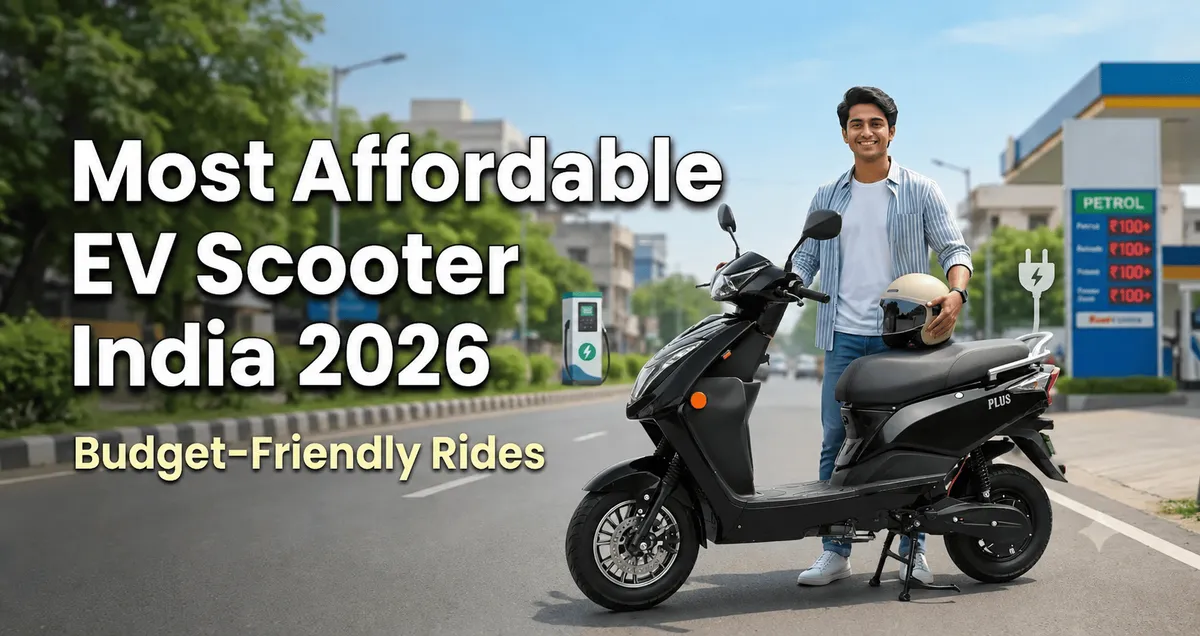
If you are searching for the most affordable EV scooter in India in 2026, Sokudo Electric India offers budget-friendly electric scooters with LFP batteries that last 10+ years. Compared to petrol scooters costing ₹2,000–₹3,000 monthly on fuel, Sokudo scooters cost just ₹300–₹500 per month to charge. With government subsidies (PM E-DRIVE and state schemes), the effective price drops even further. For students, delivery executives, and daily commuters, Sokudo delivers the best value without compromising on quality or durability.
It is 2026, and if there is one thing most commuters in India agree on, it is that fuel costs are not coming down anytime soon. Petrol prices continue to hover above ₹100 per litre in most states, and monthly fuel bills easily cross ₹2,000–₹3,000 for regular scooter users. Add to that the increasing traffic, rising pollution, and high maintenance bills of petrol scooters—oil changes, spark plugs, engine servicing—and you have enough reasons to consider switching to electric.
But let us be realistic: not everyone wants to spend a fortune on an EV. Premium electric scooters from luxury brands can cost well over ₹1.5 lakh, putting them out of reach for budget-conscious buyers. That is where the search for the most affordable EV scooter in India begins. And you do not need to look too far. Sokudo Electric India is making waves with its budget-friendly scooters that are perfect for Indian roads and wallets alike.
There is a reason affordable electric scooters are getting so popular—they are simple, efficient, and cheap to run. Whether you are a student, a delivery executive, or just tired of standing in fuel queues, switching to an electric scooter makes everyday travel much easier. The total cost of ownership of an EV scooter is significantly lower than that of a petrol scooter, especially when you factor in fuel savings and reduced maintenance requirements. According to the PM E-DRIVE Scheme (Press Information Bureau, Government of India), the scheme has accelerated EV adoption across the country by providing targeted demand incentives for multiple EV segments, including e-two wheelers, thereby reducing the upfront cost of electric mobility .
Here is why budget EVs are a smart choice in 2026:
| Factor | Petrol Scooter | Electric Scooter (Sokudo) |
| Monthly Fuel/Charging Cost | ₹2,000 – ₹3,000 | ₹300 – ₹500 |
| Annual Maintenance Cost | ₹2,500 – ₹4,000 | ₹800 – ₹1,500 |
| Engine/Parts Complexity | High (200+ moving parts) | Low (no engine) |
| Running Cost per km | ₹2.50 – ₹3.50 | ₹0.09 |
| Emissions | CO₂, NOx, particulate matter | Zero |
The key benefits of budget EVs go beyond just the numbers. First, you spend nothing on fuel—just charge at home or at a public station and ride. Second, service costs are very low because there is no engine, which means fewer moving parts that can break down. Third, government subsidies make the upfront cost significantly lighter than it was just a few years ago. Fourth, you produce zero tailpipe emissions, which is better for your city's air quality and for your own health. But price alone is not enough. You want a scooter that lasts, performs well, and does not feel cheap. And Sokudo delivers just that.
Sokudo Electric India is not a big, flashy name yet—but that is actually a good thing. The brand focuses more on solid, value-for-money scooters rather than expensive ads and celebrity endorsements. The NITI Aayog e-AMRIT portal , which is the government's official one-stop destination for EV policies and awareness, provides comprehensive information on the benefits of switching to electric mobility . Here is what stands out about Sokudo scooters and why they are gaining trust among Indian commuters.
These scooters are not made for showroom floors—they are made for potholes, heat, rain, and traffic. The frames are made from high-strength steel, the body panels are tough and impact-resistant, and the ride is surprisingly smooth even on rough roads. Unlike some imported EVs that struggle with Indian conditions due to low ground clearance or poor suspension tuning, Sokudo scooters are engineered locally for local challenges. The ground clearance is optimised for Indian speed bumps, and the suspension is tuned to handle both smooth highways and broken city roads.
Instead of removable battery gimmicks or cheap lead-acid cells that fail within two years, Sokudo uses Lithium Ferro Phosphate (LFP) batteries. This chemistry is widely regarded as the safest and longest-lasting lithium battery type available today. LFP batteries do not catch fire or explode, even in extreme heat or if the battery casing is damaged. They last for 10+ years or 3,000–5,000 charge cycles, compared to just 2–3 years for lead-acid and 3–5 years for standard lithium-ion. The battery is fixed inside the scooter for better weight distribution and handling stability. And a full charge takes only 4–5 hours.
To understand why LFP is superior to both lead-acid and standard lithium-ion, read our detailed comparison: Lead-Acid vs. Lithium-Ion vs. LFP: Which Scooter Battery Is Best? .
Once you buy a Sokudo scooter, the savings keep coming month after month. Charging costs barely anything compared to petrol, and maintenance is minimal because there is no engine oil to change, no spark plugs to replace, no air filters to clean, and no clutch or drive belt to wear out. The regenerative braking system also reduces brake pad wear, further lowering your service costs.
Annual cost comparison (average for 10,000 km per year):
| Cost Type | Petrol Scooter | Sokudo EV Scooter |
| Fuel/Charging | ₹25,000 – ₹35,000 | ₹1,500 – ₹2,500 |
| Maintenance | ₹2,500 – ₹4,000 | ₹800 – ₹1,500 |
| Total Annual Cost | ₹27,500 – ₹39,000 | ₹2,300 – ₹4,000 |
Over 5 years of ownership, a Sokudo scooter saves you ₹1.25 lakh to ₹1.75 lakh compared to a petrol scooter. That is enough money to buy another brand new electric scooter. When you factor into account the longer lifespan of LFP batteries, the savings become even more substantial over 10 years.
Sokudo scooters are not trying to look futuristic or flashy with impractical styling. Instead, they look clean, ride comfortably, and come with all the features you actually need for daily commuting. The digital instrument cluster shows speed, battery level, range estimate, and trip information clearly. The LED headlamps and tail lamps provide excellent visibility at night while consuming very little power. There is good under-seat storage space that can fit a helmet and other daily essentials. The seat is wide and well-cushioned for both the rider and a pillion passenger. The grab rails are sturdy and positioned for easy boarding.
Yes—Sokudo scooters are completely made in India. This is not an imported brand with a local sticker. Manufacturing in India means better pricing because there are no import duties or international logistics costs. It also means faster service and spare parts availability because the supply chain is local. Most importantly, the scooters are designed specifically for Indian road conditions, weather patterns, and riding habits. Unlike some rebranded imports that fail in Indian summers or monsoons, Sokudo builds for India.
Sokudo is gearing up to launch new models in 2026 with better range, quicker charging, and added smart features such as Bluetooth connectivity, navigation assist, and mobile app integration. While specific launch dates are yet to be announced, the core promise stays the same: keep the scooters affordable, practical, and reliable for the average Indian commuter. Whether you are upgrading from a petrol scooter or switching to electric for the first time, these upcoming Sokudo scooters are worth keeping on your radar.
To stay updated on new launches and to explore the current lineup, visit the official Sokudo products page .
The Indian government has been actively promoting electric vehicle adoption through multiple schemes and subsidies. As of 2026, the PM Electric Drive Revolution in Innovative Vehicle Enhancement (PM E-DRIVE) Scheme has replaced the earlier FAME II scheme. According to official data from the Ministry of Heavy Industries , the PM E-DRIVE Scheme has accelerated EV adoption across the country by providing upfront demand incentives to consumers, which are reimbursed to OEMs by the Government of India. The scheme supports more than 28 lakh EVs, and as of 27 January 2026, a total of 22.12 lakh EVs have been sold under the scheme, including 19.19 lakh e-two wheelers .
A subsequent official release confirms that as of 31 December 2025, a total of ₹1,703 crore had been reimbursed to OEMs of e-two wheelers and e-three wheelers as reimbursement of demand incentives provided to buyers. The scheme also includes an allocation of ₹2,000 crore for the deployment of EV Public Charging Stations (EVPCS) on a pan-India basis, along with ₹4,391 crore for 14,028 electric buses .
In addition to the central PM E-DRIVE scheme, various state subsidies are also available, with more than 25 states having notified or drafted their own EV policies offering road tax exemptions, registration fee waivers, and additional cash incentives.
Subsidy highlights by state (as of 2026):
| State | EV Subsidy Available | Maximum Benefit |
| Delhi | Yes | ₹15,000 – ₹30,000 |
| Maharashtra | Yes | ₹10,000 – ₹25,000 |
| Gujarat | Yes | ₹12,000 – ₹20,000 |
| Karnataka | Yes | ₹10,000 – ₹15,000 |
| Uttar Pradesh | Yes | ₹10,000 – ₹15,000 |
Please note that subsidies vary by state and model. You should check with your local Sokudo dealer for the exact figures applicable in your city. With these subsidies, the effective price of a Sokudo scooter can drop by 15 to 25 per cent, making an already affordable scooter even more accessible to middle-class families.
For more details on how to maintain your EV battery and maximise its life under Indian conditions, read our guide: How to Extend the Battery Life of Your Electric Scooter .
Not all budget electric scooters are built the same. Some cut corners by using cheap lead-acid batteries that need replacement every two years, or by using low-quality plastic body panels that crack easily. Others may have poor after-sales service or limited spare parts availability. Before you make a purchase decision, you should evaluate the scooter on several key parameters to ensure you are getting real value for your money. The NITI Aayog e-AMRIT portal provides detailed information on different types of electric vehicles, including Battery Electric Vehicles (BEVs), Hybrid Electric Vehicles (HEVs), Plug-in Hybrid Electric Vehicles (PHEVs), and Fuel Cell Electric Vehicles (FCEVs), helping consumers make informed choices .
Here is a quick checklist to use before buying any affordable EV scooter:
| Factor | What to Look For | Why It Matters |
| Battery Type | LFP (Lithium Ferro Phosphate) | Lasts 10+ years, no fire risk, works in high heat |
| Range per Charge | 60–100 km minimum | Covers daily commute without range anxiety |
| Charging Time | 4–5 hours | Overnight charging works perfectly for next day |
| Ground Clearance | 150mm or more | Handles Indian speed bumps without scraping |
| Weight Capacity | 150kg or more | Suitable for rider plus pillion plus bags |
| Service Network | Local availability | Easy access to spare parts and repairs |
Sokudo scores well on all these parameters, making it a top contender for the most affordable EV scooter in India in 2026. The LFP battery provides safety and longevity that cheaper scooters cannot match. The range is sufficient for daily commuting in any Indian city. The charging time fits perfectly into an overnight charging routine. And the ground clearance and weight capacity are designed specifically for Indian riding conditions.
Understanding the broader EV market context helps you make a confident purchase decision. Independent research from government and international agencies shows that India is at a turning point in electric mobility adoption. According to the International Energy Agency (IEA): Global EV Outlook 2026 , India is one of the fastest-growing EV markets in the world, with two-wheelers accounting for over 60 per cent of all EV sales. The report highlights that affordable scooters priced between ₹70,000 and ₹1,00,000 are driving mass adoption across the country.
The official NITI Aayog e-AMRIT portal provides comprehensive information on EV policies, subsidies, and industry developments. According to NITI Aayog, the portal was launched at COP26 in Glasgow as a collaborative knowledge exchange programme with the UK government, aiming to bust myths around EV adoption and sensitise consumers on the benefits of switching to electric vehicles. The portal covers key government initiatives such as PM E-DRIVE, PLI, and the National Mission on Transformative Mobility and Battery Storage.
These authoritative sources collectively confirm that 2026 is the best time to buy an affordable EV scooter in India—and Sokudo is perfectly positioned to meet this demand.
Not all electric scooters in India are built for everyone. Some are too costly, priced above ₹1.5 lakh, which puts them out of reach for budget-conscious buyers. Others are too basic, using cheap lead-acid batteries that fail within 2–3 years and offer poor performance in Indian weather conditions. But Sokudo finds the sweet spot: keeping things budget-friendly without cutting corners where it matters most—battery quality, build strength, and riding comfort.
The key takeaways from this guide are clear. First, Sokudo offers the most affordable EV scooter in India for 2026 when you consider the total cost of ownership over 5–10 years. Second, the LFP batteries last 10+ years with no fire risk and no frequent replacements, unlike lead-acid or standard lithium-ion. Third, the running costs are as low as ₹300–₹500 per month, which is a fraction of what you would spend on petrol. Fourth, the scooters are made in India, built specifically for Indian roads and weather. Fifth, government subsidies under the PM E-DRIVE Scheme can reduce your upfront cost by 15 to 25 per cent depending on your state.
So, if you are looking for a reliable, affordable EV scooter in India—especially in 2026—Sokudo might just be your smartest ride yet.
Ready to make the switch? Explore the full range of Sokudo scooters here: Sokudo India Products
For more information, visit the official website: www.sokudoindia.com
1. What is the price of the most affordable EV scooter in India in 2026?
The most affordable EV scooters from Sokudo start between ₹70,000 and ₹85,000 (ex-showroom), with state subsidies further reducing the effective price by ₹10,000–₹30,000 depending on your location.
2. How much does it cost to charge an electric scooter per month in India?
Charging a Sokudo electric scooter costs approximately ₹300–₹500 per month for daily commuting of 30–40 km per day, compared to ₹2,000–₹3,000 for a petrol scooter.
3. How long do LFP batteries last in Sokudo electric scooters?
Sokudo's LFP (Lithium Ferro Phosphate) batteries last 10+ years or 3,000–5,000 charge cycles, which is significantly longer than lead-acid (2–3 years) or standard lithium-ion (3–5 years) batteries.
4. Are government subsidies still available for EV scooters in 2026?
Yes, the PM E-DRIVE Scheme is active in 2026. As of January 2026, over 22.12 lakh EVs have been sold under the scheme, including 19.19 lakh e-two wheelers, with ₹1,703 crore reimbursed to OEMs as demand incentives .
5. Is Sokudo a made-in-India brand?
Yes, Sokudo Electric India manufactures its scooters completely in India, ensuring better pricing, faster spare parts availability, and designs specifically suited for Indian road conditions and weather.