12 September 2026·20 min read
4 November 2025•Rishu
Quick Answer
Yes, battery issues are common in electric scooters. You may need a replacement if you notice reduced range (less than 60% of original), slow charging (over 6–8 hours), frequent shutdowns, visible damage (cracks, leaks, bulges), or the battery is over 2–3 years old. Ignoring these signs can lead to safety risks including overheating or fire. Most standard EV batteries cost between ₹8,000–₹20,000 to replace, but Sokudo's LFP batteries last over 10 years, significantly reducing replacement frequency.
Are you facing battery issues with your electric scooter? Have you considered if you might need a replacement? Battery replacement is a major concern among electric vehicle owners. Batteries are the most critical and expensive component of these vehicles.
The cost of battery replacement in electric scooters can be high—often ranging from ₹8,000 to ₹20,000 depending on the battery type and capacity. Many EV owners worry about this expense. However, understanding the reasons behind battery failure can help you plan ahead and make informed decisions. Regular maintenance and early detection of battery problems can save you money and prevent safety hazards.
Let us explore the top reasons why battery replacement becomes necessary and how to identify the warning signs before it is too late.
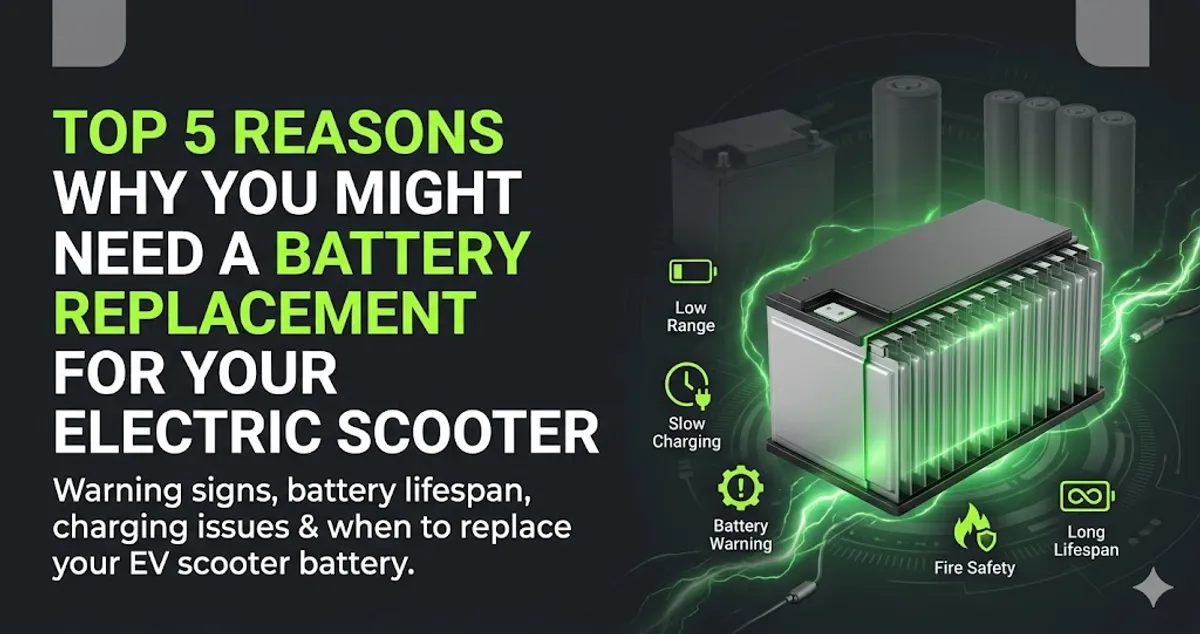
Below are the five most common signs that your electric scooter battery needs immediate attention or replacement.
Does your scooter struggle to maintain its optimal range? As batteries age, their capacity to hold a charge decreases significantly. This directly reduces the travel distance of your electric scooter on a single charge.
What to look for:
Expert insight: According to the Clean Energy Institute: Battery Basics , lithium-ion batteries naturally lose 15–20% of their capacity after 500–800 charge cycles. Lead-acid batteries degrade even faster, often losing 30–40% capacity within 300 cycles. If your scooter's range has dropped below 60% of its original capacity, replacement is likely necessary.
If you are experiencing reduced range, it may be time to consider a replacement. Learn more in our detailed guide: Top 5 Reasons Why You Might Need a Battery Replacement .
Is your scooter taking significantly longer to charge than usual? This is a clear indicator of battery degradation. A healthy battery charges efficiently within the manufacturer's specified time frame. A degraded battery may take hours longer or fail to reach full charge at all.
What to look for:
Why this happens: As battery cells age, their internal resistance increases. Higher resistance means slower chemical reactions during charging, resulting in longer charging times. Additionally, if the battery cannot hold its charge—losing power within hours instead of days—this indicates the battery is nearing the end of its useful life.
Expert insight: Data from the U.S. Department of Energy: EV Battery Recycling and Second-Life Apps confirms that EV batteries typically reach end-of-life when their capacity drops below 70–80% of original. At this stage, charging time increases by 50–100% and internal resistance rises sharply. Do not ignore this warning sign.
Does your scooter unexpectedly shut down while riding? This is a serious safety concern and often points to battery malfunctions. Do not ignore this issue—get your battery checked immediately.
What to look for:
Safety warning: Old or damaged batteries can pose serious safety risks including:
If your battery poses any safety concerns, replace it immediately with a new, certified battery. Do not attempt to repair a damaged battery yourself.
For step-by-step guidance on diagnosing battery shutdown issues, read: How to Extend the Battery Life of Your Electric Scooter —which includes troubleshooting tips for unexpected shutdowns.
With time and usage, your scooter's battery may sustain physical damage. Regular visual inspections can help you catch problems early.
What to look for:
Why this is dangerous: Physical damage significantly impacts battery performance and safety. A swollen or leaking battery is a fire hazard. Do not use it. Do not charge it. Dispose of it properly at an authorized e-waste recycling center.
Expert recommendation: The Environmental Protection Agency (EPA): Used Household Battery Recycling recommends immediate replacement and proper disposal of any battery showing visible damage. Never throw damaged batteries in household trash.
Even with perfect care and ideal charging habits, all batteries have a finite lifespan. Over time, battery cells naturally degrade due to chemical changes that occur with each charge-discharge cycle.
What to look for:
Typical battery lifespan by type:
| Battery Type | Average Lifespan | Cycles |
| Lead-Acid | 2–3 years | 300–500 cycles |
| Standard Lithium-Ion | 3–5 years | 500–800 cycles |
| LFP | 10+ years | 3,000–5,000 cycles |
Why LFP is different: Unlike standard lithium-ion batteries that degrade significantly after 2–3 years, Sokudo's LFP batteries are engineered to last over a decade with proper care. To learn more about the advanced technology behind these batteries, visit the official Sokudo battery page . This makes LFP the most cost-effective choice despite a higher upfront cost.
For the full range of LFP-powered scooters, also explore the Sokudo products page .
If your electric scooter's battery is several years old and you are noticing any of the other four warning signs, it is likely nearing the end of its lifespan. Consider a replacement to maintain optimal performance and safety.
| Battery Type | Average Lifespan | Replacement Frequency | Long-Term Cost |
| Lead-Acid | 2–3 years | Every 2–3 years | High (multiple replacements) |
| Standard Lithium-Ion | 3–5 years | Every 3–5 years | Medium |
| LFP | 10+ years | Once per decade | Lowest |
The cost of battery replacement varies significantly based on battery type, capacity, and brand.
| Battery Type | Approximate Replacement Cost (India) |
| Lead-Acid (20Ah–30Ah) | ₹4,000 – ₹8,000 |
| Standard Lithium-Ion (20Ah–30Ah) | ₹12,000 – ₹20,000 |
| LFP | ₹18,000 – ₹25,000 (once per 10+ years) |
Important: While LFP batteries have a higher upfront cost, you will replace a lead-acid battery 3–4 times or a standard lithium-ion battery twice during the same 10-year period. LFP is the most economical choice over time.
Understanding battery degradation helps you make informed replacement decisions. Independent research from government and academic institutions provides clear benchmarks.
According to the U.S. Department of Energy: EV Battery Recycling and Second-Life Apps , EV batteries are considered at end-of-life when their capacity drops below 70–80% of original. The DOE actively funds research into second-life applications for degraded EV batteries, including stationary energy storage. For lead-acid batteries, end-of-life occurs within 300–500 cycles (2–3 years). For standard lithium-ion, it occurs after 500–800 cycles (3–5 years). For LFP chemistry, the same degradation point is reached only after 3,000–5,000 cycles (10+ years).
The Clean Energy Institute: Battery Basics confirms that LFP (Lithium Iron Phosphate) batteries have the lowest internal resistance and highest thermal stability among all lithium chemistries. This means they degrade slower, operate safely at higher temperatures, and deliver consistent power throughout their long lifespan—making them ideal for electric scooters used in Indian climatic conditions.
These authoritative sources collectively conclude that while lead-acid is cheapest upfront, its frequent replacement makes it most expensive over time. Standard lithium-ion offers middle-ground performance, but LFP delivers the best long-term value, safety, and reliability—exactly why Sokudo has chosen LFP for all its electric scooters.
Battery replacement is essential for maintaining the efficiency and safety of your electric scooter. While the cost of battery replacement can be a concern, neglecting a failing battery leads to bigger problems—including reduced performance, unexpected breakdowns, and serious safety risks like overheating or fire.
Key takeaways:
Pay attention to these five signs. If you notice any of them, it is time to consider a replacement. Doing so ensures your electric scooter runs smoothly and safely for years to come.
Sokudo Electric Scooters are equipped with premium LFP (Lithium Iron Phosphate) removable batteries—the finest battery technology available today. These batteries offer a quick charging time of 4–5 hours, a lifespan exceeding 10 years, zero fire risk, and zero maintenance. You get back on the road quickly, safely, and reliably.
Explore the full range of Sokudo LFP-powered scooters today →
Experience the future of electric mobility with Sokudo—where your battery lasts longer than your scooter.