12 September 2026·20 min read
29 June 2026•Sokudo Electic India
Published: June 29 2026 | Author: Sokudo Electric India Editorial Team
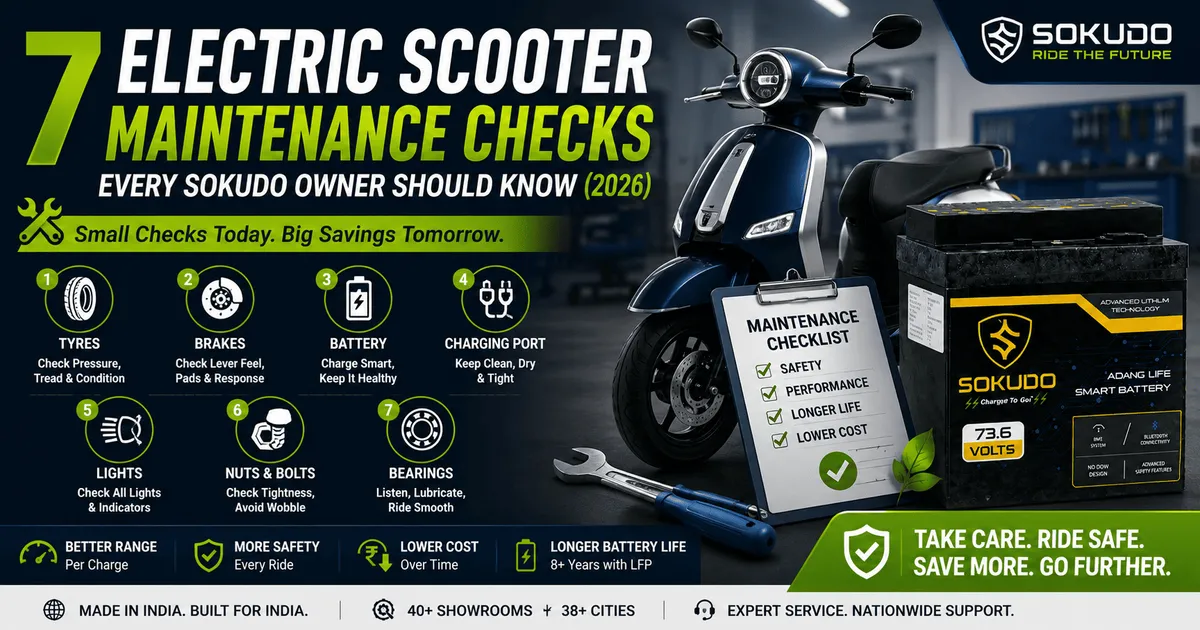
Electric scooter maintenance is how you protect your range, your safety, and the long-term value of what you have bought.
Small issues, a slow tyre, a loose bolt, a dusty charging port, often start quietly and grow slowly into expensive repairs. This checklist draws on observations from Sokudo service centres across India, technician-tested inspection steps, and seasonal guidance built specifically for Indian roads and weather conditions.
Whether you are a daily commuter covering 30 km each way, a delivery rider putting 80 km on your scooter every day, or a first-time EV owner who has just taken delivery of your Sokudo Plus or Sokudo Rapid 2.2, these seven checks will take you under fifteen minutes a week and save you significantly more in repair costs over time.
What this guide covers:
Electric scooters have fewer moving parts than petrol vehicles. There is no engine oil to change, no spark plugs to replace, no fuel filters to service. But that does not mean they maintain themselves.
The battery, tyres, brakes, and electrical connections all degrade with use and exposure to India's varied climate, and the rate at which they degrade depends almost entirely on how attentive you are in the first few thousand kilometres.
Battery degradation is the single biggest ownership cost risk. A battery that loses 30 percent of its capacity before its expected end of life effectively reduces your scooter's range and resale value. Premature degradation is almost always preventable with correct charging habits and regular health checks.
Tyre and brake issues are the most common causes of on-road incidents. Both are easy to catch early and expensive to deal with after a fall.
| Risk Area | What Happens if Ignored | Owner Impact |
| Tyres | Faster wear, reduced grip, blowouts | Unsafe rides, poor efficiency |
| Brakes | Longer stopping distance | Accident risk, pad replacement cost |
| Battery | Faster capacity loss | Shorter range, early replacement |
| Charging port | Heat, poor connection, corrosion | Charging failures, fire risk |
| Nuts and bolts | Wobble, instability | Handling issues, frame damage |
| Bearings | Noise, drag, misalignment | Higher rolling resistance, motor strain |
For a broader understanding of lifetime of electric scooter check out our guide on How Long Do Electric Scooters Last
Check frequency: Before every long ride, and at minimum twice a week for daily commuters.
Tyres are the most frequently overlooked maintenance item on electric scooters and the most impactful on both safety and range. Riding on under-inflated tyres increases rolling resistance, which directly reduces range per charge. It also accelerates uneven tyre wear, which shortens tyre life considerably.
How to check your tyres
Pressure: Use a tyre pressure gauge and compare the reading with the recommended PSI in your Sokudo owner manual. The correct pressure for your specific model and tyre size is printed on the tyre sidewall itself. Always use that figure as your reference, not general internet figures. Check pressure when the tyres are cold, either before riding or at least 30 minutes after you have stopped.
Tread depth: Look at the tread pattern across the full width of both tyres. If the tread wear indicators are flush with the surrounding rubber, or if the pattern looks worn flat in the centre, the tyre needs replacing. Most electric scooter commuter tyres should be replaced before they reach 1.6 mm of remaining tread depth.
Sidewall condition: Run your eye along the full circumference of both tyres and look for cuts, bulges, or cracking. A bulge means internal structural damage and the tyre must be replaced before the next ride. Sidewall cracks from UV exposure or dry storage are common in Indian summers. If cracking is deep enough to show the tyre cord beneath the rubber, replace immediately.
Uneven wear patterns: If the centre of your tyre is wearing faster than the edges, pressure has been running too high. If the edges wear faster, pressure is too low. Diagonal wear patterns often indicate wheel alignment or suspension issues that need a technician's attention.
When to visit a service centre for tyres
Book a tyre inspection if you notice a persistent slow puncture, any bulge or sidewall crack, rapid pressure loss between rides, or the scooter pulling to one side when riding straight on a level road.
Check frequency: Weekly, and immediately after any hard-braking event or close call.
Brakes on electric scooters wear differently from petrol vehicles. Regenerative braking handles a portion of the deceleration load in everyday riding, meaning your friction brakes are doing less work than they would on a petrol scooter under normal conditions. This is good news for pad longevity. The risk is that the reduced daily wear means many owners notice brake degradation later than they should.
How to check your brakes
Lever feel: Squeeze each brake lever fully. It should feel firm and stop well before the lever touches the handlebars. A spongy or mushy feel indicates air in a hydraulic system or a cable that needs tensioning. If either lever travels more than about two-thirds of its full range before braking engages, the brakes need adjustment.
Pad thickness: On Sokudo models with disc brakes, you can visually inspect pad thickness through the caliper. Most pads have a wear indicator groove. When that groove disappears, the pad is due for replacement. If you cannot clearly see the groove from the outside, ask your Sokudo technician to measure it at your next service visit.
Braking response test: Find a safe, empty stretch of road and ride at approximately 25 to 30 km/h. Apply the brakes normally and note the stopping distance. If you repeat this test monthly, a gradual increase in stopping distance is an early warning that brake performance is reducing.
Noise: Grinding, squealing, or scraping sounds from brakes almost always indicate pad wear, contamination from oil or water on the pads, or a misaligned caliper. Do not ignore brake noise.
| Symptom | Likely Cause | Recommended Action |
| Spongy lever | Air in line or cable slack | Service centre adjustment or bleed |
| Rapid pad wear | Frequent hard braking | Pad replacement plus riding review |
| Grinding noise | Worn pads reaching metal | Immediate service, do not ride |
| Pulling to one side | Caliper misalignment | Technician alignment check |
| Long stopping distance | Worn pads or dirty rotor | Service inspection |
Check frequency: Charging habits daily, battery health check every 6 months or at any sign of range drop.
The battery is the most expensive component in your electric scooter and the component whose long-term condition is most directly within your control. Sokudo's LFP (Lithium Iron Phosphate) batteries are rated for 2,500 or more charge cycles with up to 80 percent capacity retained at end of life. That is significantly better than the NMC chemistry used in many competing scooters. But even an LFP battery will degrade faster than it should if charged and stored incorrectly.
The chemistry difference between LFP and NMC matters more in India than almost anywhere else. According to independent battery analysis for Indian electric scooter conditions, LFP batteries have a thermal runaway threshold of approximately 270 degrees Celsius compared to roughly 210 degrees Celsius for NMC, a 60-degree safety margin that means LFP cells remain chemically stable in conditions where NMC cells are already under significant stress. For riders in Delhi NCR, Rajasthan, Gujarat, and Telangana where summer ambient temperatures regularly exceed 42 degrees Celsius and a scooter parked outdoors can reach considerably higher surface temperatures, that margin is felt in daily ownership rather than just on a spec sheet.
Avoid regular 100 percent charges for daily use. Charging to 80 to 90 percent is sufficient for most daily commutes and places less stress on the cells than always charging to full. Use the 100 percent setting only when you genuinely need maximum range for a longer trip.
Never store at 0 percent. If you are not riding your Sokudo for more than a week, ensure the battery is at 40 to 60 percent before leaving it. Storing an LFP battery at near-zero charge for extended periods causes irreversible capacity loss over time.
Charge in the shade. In Indian summers, charging a battery that is already hot from a ride, particularly after the scooter has been parked under direct sunlight, accelerates cell degradation. Rest the scooter in a shaded spot for 15 to 20 minutes before connecting the charger.
Prefer home AC charging over fast charging for daily use. DC fast charging is convenient but creates more heat stress inside the cells. Standard home AC charging overnight is always better for long-term battery health.
The most reliable indicator of battery health is real-world range. Once a month, start with a full charge, ride your usual route, and record the remaining range indicator when you get home. If that number drops more than 15 to 20 percent compared to when the scooter was new under the same conditions, book a battery health check.
Sokudo showrooms offer free battery health checks that measure actual cell capacity, voltage balance across the pack, and BMS (Battery Management System) log data. This typically takes around 20 minutes and is the most accurate way to know whether your battery is performing as it should.
| Battery Symptom | What It Likely Means | Action |
| Range drop of 10 to 15% | Normal early degradation | Monitor, check at next service |
| Range drop above 20% | Accelerated cell loss | Book free battery health check |
| Slower charging than before | Charger, cable, or cell issue | Service centre check |
| Battery gets very hot during charging | BMS issue or cell damage | Stop charging, contact Sokudo service |
| Scooter shuts off unexpectedly | BMS protection triggered | Service centre, do not delay |
To understand how LFP battery chemistry specifically extends useful battery life compared to lithium-ion alternatives in Indian conditions, see our guide on how to extend the battery life of your electric scooter.
Check frequency: Weekly visual inspection, and after every monsoon ride.
The charging port is a small component with significant consequences when it fails. A dirty, corroded, or damaged port can cause incomplete charging, heat buildup during charging, or in severe cases a short circuit. This check takes thirty seconds and is especially important during the monsoon and in dusty riding conditions.
Port inspection: With the scooter powered off and the port cover open, use a torch and look into the charging port for dust or grit buildup, visible corrosion (a green or white powdery residue on the pins), bent or damaged pins, and any heat discolouration such as brown or black marks around the port mouth.
Cable inspection: Run your hand along the full length of the charging cable and feel for kinks, cuts, or areas where the outer insulation has worn through. Pay particular attention to both ends where the cable meets the plug and where it meets the charging brick. These are the areas most likely to develop internal wire breaks.
Connector fit: The charger plug should seat firmly into the port with a positive click or snug engagement and should not wobble when fully inserted. A loose connector creates arcing risk and will cause intermittent charging failures.
Cleaning: If you find dust in the port, use a dry soft brush or a short puff of compressed air to clear it. Never use metal objects to clean charging ports. Never charge immediately after a rain ride. Dry the port with a cloth and leave the port cover open for five minutes before connecting the charger.
| Issue | Risk | Action |
| Dusty or gritty port | Poor contact, heat buildup | Clean with dry brush before charging |
| Corroded pins | Intermittent charging, heat | Service centre, do not self-repair |
| Loose connector fit | Arcing, charging failures | Service centre port inspection |
| Damaged cable insulation | Short circuit risk | Stop using charger, replace cable |
| Heat marks around port | Past overheating event | Immediate service centre visit |
Check frequency: Weekly, and immediately on any new dashboard warning.
Electrical checks are the quickest on this list and the most commonly skipped. A non-functioning brake light is both a legal issue and a safety issue on Indian roads where rear-end incidents are common. A dashboard warning light that gets ignored typically costs significantly more to resolve after it progresses into a larger fault.
Park your Sokudo near a wall and run through the following checks in order. The whole process takes under three minutes.
Headlight: Switch on and verify both low and high beam function. Check that the beam illuminates the road ahead clearly and is not pointing too high or too low, which would suggest a bent bracket or loose mounting.
Indicators: Activate left and right indicators and visually verify that both front and rear units are flashing at a normal rate. A very fast flash rate on one side usually means one bulb on that side has failed.
Brake light: With a wall in front of you or a helper standing behind the scooter, apply each brake lever separately and verify the brake light activates with both.
Horn: Test the horn. It should be loud enough to be clearly heard over typical traffic.
Dashboard alerts: Note any icons or messages on the instrument cluster that were not there before. Common alerts and what they typically mean:
| Dashboard Warning | What It Typically Indicates |
| Low battery icon | Charge below approximately 15 to 20% |
| BMS alert | Battery management system has detected a cell issue |
| Temperature warning | Battery or motor operating above safe range |
| Error code (E + number) | Specific fault code, note the number and contact Sokudo service |
If you see any persistent warning that is not the standard low-battery icon, do not reset and ignore it. Note the exact message or code, photograph the dashboard, and contact your nearest Sokudo showroom or call +91-8920649555.
Check frequency: Monthly, and after riding on badly potholed roads.
Indian roads are among the most demanding for vehicle fasteners anywhere in the world. Speed bumps, potholes, construction debris, and uneven surfaces create constant vibration loads that gradually work bolts loose. This process accelerates significantly on higher-mileage scooters. A loose handlebar stem or front axle bolt is not a nuisance; it is a serious safety issue that needs immediate attention.
Handlebar wiggle test: Grip both handlebars firmly and try to move them independently of the stem. Any rotational play indicates the handlebar clamp bolts need tightening. Then grip the stem and try to move it independently of the fork. Any play indicates the headset needs professional attention.
Frame visual check: Once a month, give the frame a close visual scan, particularly around the stem junction, the footboard mounting points, and any areas where the frame has visible seams or joints. Look for cracking paint, rust bubbling, or any visible cracks in the metal itself.
Suspension check: Stand beside the scooter and press down firmly on the front end, then release. The fork should compress smoothly and return without any knocking sound. Repeat at the rear. Any harsh clanking, grinding, or excessive softness indicates a suspension component that needs inspection.
Critical bolt check: The bolts most likely to work loose are the front axle nut, rear axle nut, handlebar stem clamp bolts, brake caliper bolts, and footboard mounting bolts. If you are comfortable doing so, use the correct spanner to verify snugness on each of these once a month. If any bolt is noticeably loose again at the next monthly check, the thread may be damaged and needs professional attention.
| Component | Symptom of Issue | Risk Level |
| Handlebar stem | Rotational play | High, service immediately |
| Front axle | Wobble at speed | High, service immediately |
| Brake caliper bolts | Brake judder or pull | High, service immediately |
| Footboard mounts | Flex or creak underfoot | Medium, check at next service |
| Rear axle | Wobble or uneven power delivery | High, service immediately |
Check frequency: Monthly, and immediately on any new vibration or grinding sound.
Wheel bearings sit inside the wheel hub and allow the wheel to spin with minimal friction. When they wear, typically from high mileage, water ingress, or sustained riding under load on rough terrain, they introduce drag (which reduces range), noise, and eventually steering instability.
Spin test: If your Sokudo can be supported safely on a centre stand or by someone holding the rear, lift the front wheel off the ground and spin it by hand. A healthy bearing allows the wheel to spin freely and smoothly with a gentle, gradual deceleration. Any roughness, grinding sensation, or rhythmic resistance in the spin indicates bearing wear.
Listening while riding: At low speeds under 20 km/h, in a quiet area with no wind noise, listen for any persistent grinding, humming, or scraping. Bearing noise often increases with speed and is frequently more noticeable when turning in a specific direction.
Vibration through handlebars: A new vibration felt through the handlebars, particularly one that increases with speed, can indicate bearing wear, a bent wheel rim, or a tyre that has developed flat spots from extended storage. All three require service centre attention.
Wheel alignment: Stand directly behind your Sokudo and sight down the centreline of the scooter. Both wheels should track in a straight line with no visible offset. Misaligned rear wheels cause uneven tyre wear, poor handling, and premature bearing failure.
| Symptom | Likely Cause | Action |
| Rough feel when spinning wheel by hand | Bearing wear | Service centre, bearing replacement |
| Humming that increases with speed | Bearing wear | Book service inspection |
| Vibration through handlebars | Bearing, bent rim, or tyre flat spot | Service centre check |
| Wheels visibly offset from rear | Wheel misalignment | Service centre alignment |
| Clunking from wheel area | Loose axle nut or bearing play | Immediate service |
This schedule is built for typical urban use in India. Delivery riders or fleet operators covering significantly above-average mileage should reduce the interval between dealer checks proportionally.
| Frequency | What to Check |
| Before every ride | Dashboard alerts, tyre condition visual |
| Twice weekly | Tyre pressure, brake lever feel |
| Weekly | Lights, indicators, brake light, horn, charging port visual |
| Monthly | Suspension, bolts and fasteners, wheel spin and noise, battery range comparison |
| Every 6 months or 1,500 to 3,000 km | Sokudo dealer inspection: battery health check, brake pad measurement, bearing assessment, BMS log review |
| Every 12 months or 5,000 km | Full service including motor inspection, drive system check, electrical systems audit |
India's climate varies dramatically by season and region. The maintenance priorities during a Delhi summer are completely different from those during a Mumbai monsoon, and different again from a winter commute in Lucknow or a dusty daily ride in Rajasthan.
| Season or Condition | Primary Risk | What to Watch | Specific Action |
| Summer (March to June) | Heat stress on battery | Battery temperature, charging safety | Charge in shade, let scooter cool before charging, watch for BMS temperature warnings |
| Monsoon (June to September) | Water ingress, corrosion | Charging port, connectors, brakes | Dry port before charging, inspect port weekly, check brake response after wet rides |
| Post-monsoon (October to November) | Corrosion onset | Fasteners, connector pins, brake rotors | Inspect all metal connectors and bolts, clean and dry port area |
| Winter (November to February) | Reduced battery efficiency | Charging speed, indicated range | Expect 5 to 15% range reduction in cold, charge at room temperature if possible |
| Dusty roads (year-round in many regions) | Abrasive wear | Bearings, tyre tread, brake pads | More frequent bearing spin tests, check brake pads monthly |
Monsoon tip: In heavy rain, never charge your scooter with the port exposed to moisture. Dry the port thoroughly with a cloth, leave the port cover open for five to ten minutes, and then connect the charger. If water has visibly entered the port or connector area, do not attempt to charge. Contact Sokudo service.
Summer tip: In temperatures above 40 degrees Celsius, avoid charging a scooter that has been parked in direct sunlight. The battery will already be at elevated temperature, and adding charge heat on top increases cell stress. Park in shade, wait fifteen to twenty minutes, then charge.
| Symptom | Most Likely Cause | Priority | What to Do |
| Wobble or instability while riding | Loose stem, axle, or bearing | Critical | Stop riding, contact Sokudo service |
| Sudden range drop above 20% | Battery degradation or BMS issue | High | Book free battery health check |
| Slow or incomplete charging | Port issue, cable damage, or cell problem | High | Inspect port and cable, book service if unclear |
| Spongy brake lever | Air in system or worn cable | High | Book brake inspection |
| Dashboard error code | System fault detected | High | Note code, contact Sokudo service |
| Grinding or humming from wheels | Bearing wear | Medium | Book bearing inspection |
| Creak or clicking from suspension | Loose or worn component | Medium | Book suspension check |
| Indicators flashing faster than normal | Indicator bulb failure | Low | Replace bulb or book service |
| Occasional range variation of 5 to 10% | Temperature, load, or riding style | Normal | Monitor, no action needed unless consistent |
The free battery health check available at all Sokudo showrooms is something every owner should take advantage of every six months, regardless of how the scooter feels day-to-day. Problems identified in the BMS logs often precede noticeable range loss by several months, which means catching them early saves both range and money.
Sokudo Acute (3.1 kWh LFP, 150 km range): Higher battery capacity means longer full-cycle charging time. Pay particular attention to temperature management in summer months. The Acute's 150 km claimed range makes it more sensitive to perceived range drop because a 10 percent real reduction of 15 km can feel significant, even though it falls within normal operating parameters.
Sokudo Acute 2.2 and Sokudo Select 2.2 (2.2 kWh LFP, 100 km range): Similar maintenance profile to the Acute. Brake checks are particularly important given the 70 km/h top speed. Stopping distance from speed is significant and pad condition should be checked every 1,500 km.
Sokudo Rapid 2.2 (2.2 kWh LFP, 100 km range): Designed for office commuters on arterial roads. Most wear will manifest earliest in tyres and brakes given typical urban stop-start use. Check brake pads every 1,500 km and tyre pressure twice weekly.
Sokudo Pace (LFP, 125 km range, 55 km/h): 55 km/h top speed places this in a lower braking stress category than the Rapid and Select models. Range monitoring is particularly useful given the Pace's 125 km claim. A 20 percent drop brings you to 100 km, which is still comfortable for most commutes, but worth tracking month by month.
Sokudo Plus (LFP, 100 km range, 25 km/h, non-RTO): Low speed means lower brake wear and lower bearing stress overall. Battery care is the most important maintenance focus for Plus owners. Because the Plus is often purchased for students and senior citizens, establishing correct charging habits early pays the most long-term dividends on this model.
For the full range including all six models with current pricing and specifications, visit the complete Sokudo electric scooter lineup.
How often should I service my Sokudo electric scooter?
For typical daily urban use, visit a Sokudo service centre every six months or every 1,500 to 3,000 km, whichever comes first. Between dealer visits, follow the weekly and monthly checks in this guide. Delivery riders and fleet operators should shorten the interval to every 1,000 km given higher daily mileage.
Can I wash my Sokudo scooter with water?
Yes, but avoid direct high-pressure washing aimed at the charging port, instrument cluster, motor hub, and connector areas. Use a damp cloth for body panels and a dry cloth for electrical areas. Always ensure the charging port is completely dry before connecting the charger after cleaning or a rain ride.
How do I know if my battery is failing?
The clearest early indicator is a measurable range drop when conditions are constant. Same route, same load, same temperature. A drop of more than 20 percent from your original range warrants a free battery health check at a Sokudo showroom. Sudden shutdowns, excessive heat during charging, and charging that stops before 100 percent are also signals that need professional assessment.
Does cold weather reduce my Sokudo's range?
Yes. LFP batteries perform slightly less efficiently below 10 degrees Celsius. Expect a range reduction of roughly 5 to 15 percent in cold conditions. This is entirely normal and not indicative of battery damage. Range returns to normal once temperatures rise. To minimise the effect, store your scooter indoors overnight when possible and charge at room temperature.
Is it safe to charge my Sokudo scooter overnight?
Yes, with standard precautions. Charge in a dry, ventilated area. Do not charge on carpets, in enclosed spaces without airflow, or immediately adjacent to flammable materials. Do not leave a visibly damaged charging cable running overnight. Sokudo's BMS automatically stops charging at 100 percent, so overnight charging will not overcharge the battery.
What does an error code on my Sokudo dashboard mean?
Sokudo models display alphanumeric error codes for specific system faults. The code varies by fault type and model. Photograph the display, note the exact code, and contact your nearest Sokudo showroom or call +91-8920649555. Do not reset and ignore persistent error codes. They often indicate conditions that will worsen if left unaddressed.
How long do Sokudo batteries last?
Sokudo's LFP batteries carry a 3-year battery and motor warranty and are rated for 2,500 or more charge cycles with 80 percent capacity retained at end of life. At one full charge cycle per day, which most commuters do not reach since daily top-up charging is typically partial, this equates to approximately 6 to 8 years of useful battery life. Proper charging habits, avoiding regular 100 percent charges, never storing at 0 percent, and charging in shade during summer, will keep your battery at or above this performance level throughout.
Can I do my own brake service?
Basic brake checks such as lever feel and visual pad inspection are safe to do yourself. Brake adjustment, pad replacement, and hydraulic bleeding require specific tools and knowledge and should be done by a Sokudo-trained technician. Incorrectly adjusted brakes are more dangerous than brakes that have not been touched.
Need a Service Appointment?
All Sokudo showrooms offer free battery health checks. Paid service appointments cover brake inspection, tyre assessment, bearing checks, and a full electrical audit.
Service is available across Delhi NCR, Uttar Pradesh, Bihar, Haryana, Uttarakhand, Rajasthan, Assam, and Madhya Pradesh, with new locations being added regularly.