3 June 2026•Sokudo Electric India
Published: June 3, 2026 | Last updated: June 3, 2026 | By: Sokudo Electric India Editorial Team
How Many Years Does an Electric Scooter Last in India? A Complete Ownership Guide for 2026
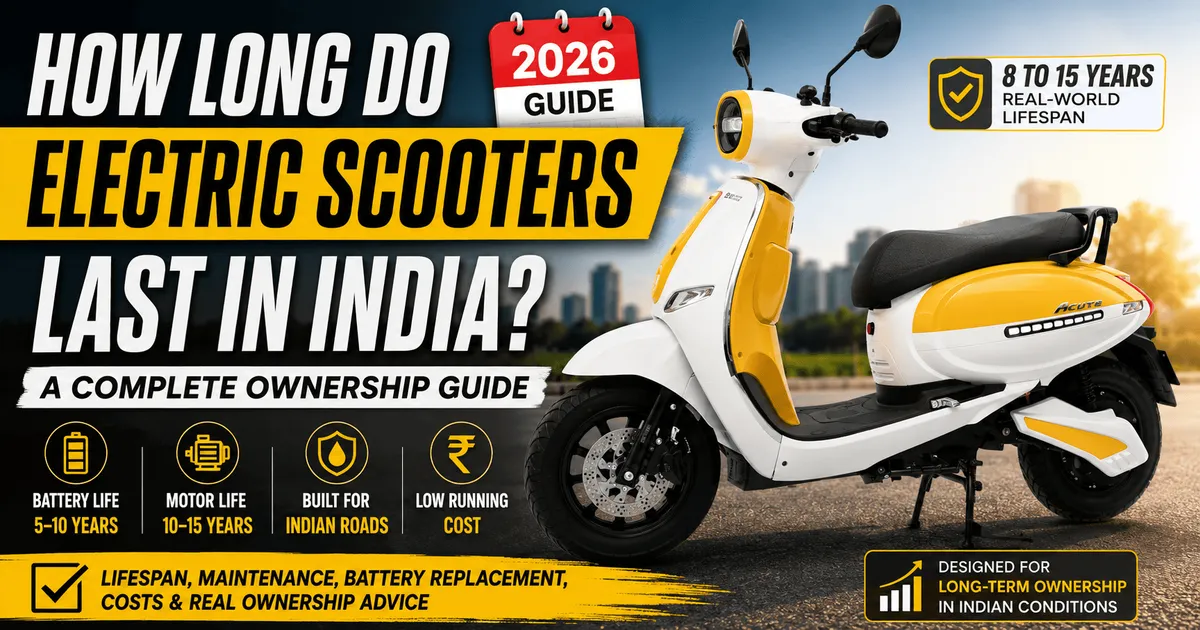
Quick answer: A quality electric scooter in India lasts 8 to 15 years. The battery lasts 5 to 10 years (or 50,000 to 1,20,000 km). The motor and frame almost always outlast the first battery pack entirely.
How Long Does an Electric Scooter Last in India?
Before buying any electric scooter, almost every Indian buyer asks the same question: how many years will this thing actually last?
That is a completely fair thing to wonder. An electric scooter is not a phone you swap out every two years. Whether you are riding 30 km to an office in Noida, dropping the kids to school in Pune, or doing deliveries in Patna, you need your scooter to be dependable for years, not just seasons.
Here is the honest answer: modern electric scooters are far more durable than most first-time buyers expect.
For the average Indian rider, a quality electric scooter lasts somewhere between 8 and 15 years. The battery is usually the first component that shows its age, typically between years 5 and 10. But here’s what matters more: the motor and the frame very often outlast the first battery pack entirely. That means a battery replacement around year 7 or 8 is a mid-life refresh, not a death sentence for the scooter.
This is the part that changes how you should think about EV ownership. You are not buying a scooter that becomes worthless when the battery fades. You are buying a long-term vehicle that may need one significant component swap during its life, in the same way a petrol scooter might eventually need an engine overhaul.
Every Component Has Its Own Lifespan
An electric scooter is not one thing with one lifespan. It is a collection of systems, each ageing at a different pace, each replaceable on its own. The table below gives you a realistic picture.
| Component | Average Lifespan | What You Should Know |
| LFP Battery Pack | 8 to 10 Years / 1,20,000 km | Best choice for India's heat |
| NMC Battery Pack | 5 to 7 Years / 60,000 to 80,000 km | Better range, shorter life in heat |
| Hub Motor | 10 to 15 Years / 1,00,000 to 1,50,000+ km | Rarely fails; minimal moving parts |
| Controller / BMS | 6 to 10 Years | Needs good IP rating to survive monsoons |
| Suspension | 5 to 8 Years | Wears faster on rough roads |
| Disc Brakes | Every 20,000 to 30,000 km | Cheap consumable; easy to replace |
| Tyres | 15,000 to 25,000 km | Varies with tyre quality and road surface |
| Chassis / Frame | 12 to 15+ Years | Often the last thing standing |
| Wiring Harness | 8 to 12 Years | Moisture is its biggest enemy |
| Entire Scooter | 8 to 15 Years | Assumes one battery replacement if needed |
The practical takeaway from this table: the battery is the one component you will most likely need to replace, but it is also the one that gives the scooter a second life when you do.
How Long Each Rider Type Can Expect
Daily mileage is the single biggest factor in how quickly a scooter ages. A scooter covering 20 km a day accumulates around 7,300 km a year. A delivery rider doing 120 km a day hits 43,800 km in the same period. Those are completely different ownership experiences.
| Rider Type | Daily Distance | Annual Kilometres | Expected Lifespan |
| Occasional Urban User | 10 to 15 km | 3,600 to 5,500 km | 13 to 15 Years |
| Daily Office Commuter | 20 to 40 km | 7,300 to 14,600 km | 10 to 12 Years |
| Family Usage | 15 to 30 km | 5,500 to 11,000 km | 10 to 12 Years |
| Long-Distance Commuter | 50 to 80 km | 18,000 to 29,000 km | 8 to 10 Years |
| Commercial Delivery Rider | 80 to 150 km | 29,000 to 54,000 km | 5 to 8 Years |
For the typical Indian office commuter riding around 30 km daily, a well-maintained scooter with a quality LFP battery will comfortably serve as a primary vehicle for over a decade. The battery refresh, if needed, usually happens somewhere between years 7 and 10.
Delivery riders face a harder reality. High daily mileage accelerates battery cycling, tyre wear, brake wear, and suspension fatigue all at once. Even so, many commercial riders still get several solid years of service before any major component needs attention.
What Actually Determines How Long a Scooter Lasts
Battery Chemistry
This is the single biggest differentiator, and it is worth understanding before you buy. LFP (Lithium Iron Phosphate) batteries tolerate India's summer heat far better than NMC (Nickel Manganese Cobalt) batteries. An LFP pack rated at 3,000 or more cycles can serve most Indian commuters for 8 to 10 years. An NMC pack rated at 800 to 1,200 cycles may reach 5 to 7 years under the same conditions.
To understand more about how these two chemistries compare, read LFP vs NMC vs Lithium
Build Quality and IP Rating
An IP67-rated battery compartment and motor housing is far more durable during monsoon riding than an unsealed unit. India's monsoon season puts electric vehicles through genuinely extreme conditions. Check the IP rating before buying, not after your first flooded road experience.
How You Charge
Charging habits are the most controllable factor in how long your battery lasts. Riders who keep their charge between 20% and 80% for daily use, avoid leaving the scooter plugged in outdoors in direct heat, and stick with the manufacturer's charger consistently see better long-term battery health. This one habit alone can add 1 to 3 years to your battery life. Read How to extend your battery life.
How You Ride
Aggressive acceleration from standstill, heavy braking, and overloading the scooter all accelerate wear on the motor, brakes, and battery. Smooth riding is not just about comfort. It genuinely extends the life of most mechanical components.
Road Conditions
Indian roads vary enormously by city and neighbourhood. Main roads in Bengaluru or Pune may be fine, but residential areas with potholes and broken surfaces put sustained stress on suspension, wheel bearings, and the wiring harness. Scooters built specifically for Indian road conditions hold up better than those designed for smoother surfaces elsewhere.
Where You Live
Temperatures above 40°C, which are common across Rajasthan, Telangana, and UP in summer, accelerate battery degradation meaningfully. Coastal riders in Mumbai, Kochi, or Chennai deal with additional corrosion from salt air on metal components. See the city-by-city section for specific guidance based on where you ride.
Maintenance
Electric scooters need significantly less maintenance than petrol vehicles, but they are not zero-maintenance. Annual servicing, including brake inspection, tyre pressure, connector checks, and suspension service, keeps small issues from becoming expensive ones over time.
How Long Does the Battery Last?
Battery life is the most searched ownership question for Indian EV buyers, and also one of the most misunderstood.
Most quality electric scooter batteries in India last between 5 and 10 years, depending on chemistry, usage, charging habits, and climate. For LFP chemistry, that often stretches toward the upper end of that range.
Cycle Life: The Right Way to Measure Battery Longevity
Battery life is measured in charge cycles, not calendar years. One full cycle means using 100% of the battery's capacity, regardless of whether you did that in one ride or across several partial charges.
| Battery Type | Rated Cycle Life | At 60 km Per Cycle | Total Kilometre Estimate |
| Entry-Level Lithium | 500 to 800 cycles | -- | 30,000 to 48,000 km |
| Standard NMC | 800 to 1,200 cycles | 60 km | 48,000 to 72,000 km |
| Premium NMC | 1,200 to 1,500 cycles | 60 km | 72,000 to 90,000 km |
| Quality LFP | 2,000 to 3,000+ cycles | 60 km | 1,20,000 to 1,80,000 km |
For an average Indian commuter riding 30 to 40 km daily, a 3,000-cycle LFP battery translates to well over a decade of use before capacity drops below 80%.
How to Tell Your Battery Is Ageing
Battery degradation happens slowly, not all at once. Here are the signs to watch for:
- Your range has dropped noticeably, say from 100 km to 75 to 80 km, without any obvious reason
- The battery percentage falls faster than it used to during the same journey
- Charging takes longer than it did in the first year
- The scooter feels weaker on uphill sections or when carrying a pillion
- App-based diagnostics show irregular cell voltage
A 15 to 20% range reduction is normal ageing over several years. A 40% or more reduction is when replacement starts to make financial sense.
When Should You Replace the Battery?
Most riders consider replacement when their usable real-world range falls below 60 to 70% of the original. If your scooter once delivered 100 km reliably and now consistently manages under 65 km, that is the right moment to evaluate replacement.
Importantly, reaching this point does not mean the scooter is done. The motor, frame, controller, and suspension may all have years of life remaining. A battery swap at this point is a mid-life investment, not the end.
Read: Top 5 reasons why you might need a battery replacement.
LFP vs NMC: Which Battery Lasts Longer in India?
Battery chemistry is the most important technical decision in an Indian EV purchase, and it is one that most buying guides explain.
| Feature | LFP (Lithium Iron Phosphate) | NMC (Nickel Manganese Cobalt) |
| Cycle Life | 2,000 to 4,000+ | 800 to 1,500 |
| Thermal Stability | Excellent (handles 40°C+ well) | Moderate (degrades faster above 35°C) |
| Safety Profile | Excellent, no thermal runaway risk | Good, some risk in extreme heat |
| Energy Density | Lower, heavier for the same range | Higher, lighter for the same range |
| Long-Term Cost | Lower, fewer replacements needed | Higher, earlier replacement likely |
| Best For | Daily commuters, hot climates, long ownership | Performance focus, lighter scooters |
| Estimated India Lifespan | 8 to 10 Years with daily use | 5 to 7 Years with daily use |
For most Indian riders, LFP is the better long-term choice. The weight difference is minor for urban commuting, and the heat tolerance advantage is significant for the conditions most Indian riders face across North India, the Deccan plateau, and coastal cities.
Read: Lead-Acid vs Lithium vs LFP
How Long Does the Motor Last?
The motor is arguably the most underrated component in an electric scooter's lifespan story. Unlike a petrol engine, which has hundreds of moving parts that generate friction and heat during every combustion cycle, a hub motor has almost no friction-based wear at all.
Most quality hub motors last 10 to 15 years or 1,00,000 to 1,50,000+ km with minimal maintenance.
That is not a typo or marketing language. It reflects a genuine mechanical reality: fewer moving parts means fewer wear points.
Why electric motors last so long:
- No combustion means no thermal stress cycles
- No engine oil, no spark plugs, no air filters
- Fewer than 10 moving parts, compared to 200+ in a petrol engine
- The only real wear point is the wheel bearing, a ₹500 to ₹2,500 replacement
What can shorten motor life:
- Water ingress, which is why IP rating matters so much
- Sustained overloading beyond the rated capacity
- Bearing wear from rough roads, preventable with an annual inspection
- Physical impact damage from accidents
Motor failure in a quality electric scooter is genuinely rare, and when it does occur, it is often a repair rather than a full replacement.
How Long Does the Frame Last?
The frame is the backbone of the scooter. If it is compromised, everything else becomes irrelevant. Unlike the battery and motor, the chassis is not something you replace. Its condition determines whether your ownership story ends at 8 years or runs past 15.
Quality steel or aluminium frames typically last 12 to 15+ years in Indian conditions, provided you do basic anti-corrosion maintenance.
Steel vs Aluminium Frames for Indian Conditions
Steel frames are heavier but highly impact-resistant. They handle potholes and daily load-carrying well. The weakness is rust: without a protective coating and periodic inspection, steel frames in monsoon-heavy or coastal regions can corrode at weld points and fasteners. Annual inspection is important from Year 4 onward.
Aluminium frames are lighter and naturally corrosion-resistant, making them a better fit for coastal cities like Mumbai and Kochi where salt air accelerates steel rust. They are slightly less forgiving of heavy impacts but fully adequate for all normal riding conditions.
Simple Habits That Keep the Frame Healthy
- Rinse the underside of the scooter after riding through flooded roads
- Reapply protective coating on fasteners once a year
- Check weld points for early rust from Year 4 or 5 onwards
- Address paint chips promptly before corrosion can spread
How Indian Weather Affects Your Scooter
India is one of the most demanding environments for electric vehicles anywhere in the world, and it is not uniform. What matters for your scooter in Jaipur is very different from what matters in Kochi. For a full breakdown by specific city, see the city-by-city guide below.
Summer heat: Temperatures above 40°C accelerate battery cell degradation, particularly in NMC chemistry packs. LFP batteries handle India's heat significantly better. This is one of the clearest reasons why LFP is recommended for North Indian riders.
Monsoon season: The biggest risk is water ingress through seals that have not been rated or tested for sustained exposure. An IP67-rated scooter handles typical urban flooding reasonably well. Lower-rated scooters may suffer damage to the BMS, controller, or wiring harness after regular monsoon riding.
Dust and pollution: Heavy dust in cities like Delhi, Kanpur, and Jodhpur gets into connectors and affects cooling. A quarterly connector clean makes a meaningful difference in the long run.
Coastal salt air: Riders in Mumbai, Chennai, Kochi, and Vizag face accelerated corrosion on metal components. Aluminium frames and more frequent inspections of exposed fasteners help considerably.
How Many Kilometres Can an Electric Scooter Last?
For riders who think in kilometres rather than years, these are realistic lifetime estimates across components.
| Component | Conservative Estimate | Optimistic Estimate (LFP, Good Maintenance) |
| Battery Pack | 50,000 to 80,000 km | 1,00,000 to 1,80,000 km |
| Motor | 80,000 to 1,00,000 km | 1,50,000+ km |
| Frame / Chassis | 1,00,000+ km | 1,50,000+ km |
| Full Scooter (one battery) | 70,000 to 1,00,000 km | 1,20,000 to 1,50,000 km |
| Full Scooter (one battery replacement) | 1,20,000 to 1,80,000 km | 2,00,000+ km |
A commuter riding 30 km a day covers roughly 10,950 km per year. Hitting 1,00,000 km total takes about 9 years. For a quality build with an LFP battery, that scooter should still be fully functional at that point.
Can an Electric Scooter Really Last 10 Years?
Yes. For most Indian buyers, 10 years is a realistic baseline expectation, not an aspirational one.
Picture a typical Delhi or Bengaluru commuter:
- Daily distance: 35 km
- Annual distance: approximately 12,775 km
- Total after 10 years: approximately 1,27,750 km
A quality LFP-battery scooter charged once daily will have completed roughly 3,500 cycles over that period, well within the 3,000 to 4,000 cycle rating of a good LFP pack. The motor and frame will have experienced no significant wear events under normal conditions.
What makes 10 years realistic:
- LFP battery chemistry
- IP67 or higher water resistance rating
- Annual servicing
- Charging to 80% daily rather than 100%
- Covered or shaded parking
- Avoiding consistent overloading
Can an Electric Scooter Last 15 Years?
Yes, particularly for riders with lower daily mileage.
An occasional commuter covering 15 km per day accumulates only 5,475 km per year, reaching 82,125 km over 15 years. That places minimal stress on an LFP battery, roughly 1,370 cycles over the full period, and almost no wear on the motor.
The maintenance needs over 15 years are manageable:
- Tyre replacement every 3 to 4 years approximately
- Brake pad replacement every 2 to 3 years
- Suspension service around Year 6 to 8
- Battery cell rebalancing or replacement around Year 10 to 12
The chassis, motor, and controller remain serviceable throughout. This is why EV ownership discussions in India are increasingly framing battery replacement as a mid-life cost, comparable to an engine overhaul on a petrol vehicle, rather than as something that marks the end of the scooter's life.
A Realistic Year-by-Year Ownership Timeline
Years 1 to 3: The Smooth Early Phase
Range performs at or close to the rated specification. Maintenance is minimal: tyre pressure checks, a connector inspection once in a while, nothing more. Battery degradation is not noticeable. The scooter rides exactly as it did on day one.
Years 4 to 6: The First Signs of Age
A 5 to 15% range reduction may start to become noticeable. First tyre replacement is likely around Year 3 or 4. First brake pad inspection or replacement typically falls in Year 4 to 5. The battery percentage drops a little faster during rides, but for most commuters this barely affects the day-to-day experience.
Years 7 to 9: Mid-Life Planning
Battery degradation becomes something worth tracking, though not an emergency. Suspension service is likely needed. A bearing replacement in the motor or wheels may be required (₹500 to ₹2,500). For NMC batteries, replacement becomes worth evaluating during this window. For LFP batteries, most average commuters still have 2 to 3 years of acceptable range remaining.
Years 10 to 12: The Battery Decision Point
LFP battery riders find themselves deciding whether to replace. Range is typically 65 to 80% of the original at this point. The motor and frame remain fully functional. A wiring harness inspection is worth doing. The scooter's resale value has dropped, but its running costs are still extremely low.
Years 12 to 15: Extended Life After a Battery Swap
With a fresh battery pack, the scooter's range experience is effectively reset. The motor, controller, and frame remain serviceable. This scooter now functions as a fully reliable daily commuter at a far lower total cost than buying new.
Battery Replacement Cost in India (2026)
Battery replacement is the largest single cost in EV ownership after the initial purchase. Understanding real 2026 pricing before you buy is part of honest ownership planning.
In 2026, electric scooter battery replacement in India typically costs between ₹45,000 and ₹1,20,000, depending on battery capacity, brand, and chemistry.
| Scooter Segment | Battery Capacity | Estimated Replacement Cost (2026) |
| Entry-Level Lead-Acid | 48V to 60V / SLA | ₹3,500 to ₹7,000 (every 12 to 18 months) |
| Entry Lithium | 1.5 to 2 kWh | ₹15,000 to ₹30,000 |
| Mid-Range | 2.5 to 3 kWh | ₹45,000 to ₹65,000 |
| Premium | 3 to 4 kWh | ₹65,000 to ₹1,20,000 |
A few things worth knowing about the current landscape:
PM E-DRIVE subsidies do not cover battery replacements. The PM E-DRIVE programme (India's successor to FAME II) applies to new vehicle purchases, not post-warranty battery replacements. A battery that lasts 10 years instead of 5 effectively saves you ₹50,000 to ₹80,000 in mid-life costs. This is one of the strongest arguments for prioritising LFP chemistry at the time of purchase.
Battery-as-a-Service (BaaS): Some brands, including Hero Vida, now offer scooters where you buy the vehicle without the battery and pay a monthly subscription instead. This removes the replacement cost concern entirely and lowers the upfront price. It is worth evaluating if long-term budget predictability matters more to you than outright ownership.
Trade-in value: Many authorised service centres will give you ₹5,000 to ₹15,000 back for an old battery pack, reducing the net replacement cost by around 10 to 15%.
Electric Scooter vs Petrol Scooter: Which Lasts Longer?
This is one of the most searched comparisons among Indian two-wheeler buyers who are thinking about making the switch.
| Factor | Electric Scooter | Petrol Scooter |
| Overall Mechanical Lifespan | 10 to 15 Years | 10 to 15 Years |
| Powertrain Complexity | Roughly 10 moving parts | 200+ moving parts |
| Annual Maintenance Cost | ₹2,000 to ₹5,000 | ₹8,000 to ₹15,000 |
| Fuel / Running Cost | ₹0.50 to ₹1.50 per km | ₹2.50 to ₹4 per km |
| Major Mid-Life Cost | Battery replacement (Year 7 to 10) | Engine overhaul (Year 8 to 12) |
| Monsoon Sensitivity | IP-rated models highly resistant | Carburettor and FI flooding risk |
| Resale Value | Currently weaker | Established second-hand market |
| 10-Year Running Cost | Lower for most urban commuters | Higher for most urban commuters |
The honest answer: both can last a decade or more when maintained properly. The electric scooter wins on running costs and mechanical simplicity. The petrol scooter has a stronger resale market today and a wider service network in rural areas.
For urban riders in cities with decent EV infrastructure, the 10-year total cost of electric ownership is typically ₹1,00,000 to ₹1,50,000 lower than an equivalent petrol scooter, even after factoring in a mid-life battery replacement.
Compare: Petrol Scooter vs Electric Scooter: Which one saves more?
How to Make Your Electric Scooter Last Longer
Charging Best Practices
These habits matter more than anything else for battery longevity.
- Charge to 80% for daily use; charge to 100% only before a long trip
- Do not regularly discharge below 15 to 20%
- Use only the OEM-supplied charger or a certified replacement
- Avoid charging outdoors in direct sunlight or when ambient temperature is above 40°C
- Do not leave the scooter fully charged and sitting unused for more than 48 to 72 hours
Riding Best Practices
- Prefer smooth, gradual acceleration over hard starts from standstill
- Respect the manufacturer's rated load limit, typically 150 to 160 kg for most Indian scooters
- Slow down on flooded roads; water ingress risk increases significantly at higher speeds
- Use regenerative braking where your scooter supports it; it reduces mechanical brake wear and extends range
Maintenance Schedule
| Interval | What to Do |
| Monthly | Tyre pressure check; visual check of brake pads and lights |
| Every 3 Months | Clean connectors; inspect wiring harness for chafing; clean under-seat battery area |
| Every 6 Months | Brake adjustment and pad inspection; lubricate suspension |
| Annually | Full service including suspension, bearings, corroded connector replacement, software update |
| Every 3 to 4 Years | Full tyre replacement; suspension bush inspection and replacement if worn |
Storage Habits
- Park in a covered, shaded space wherever possible
- After riding through flooded roads, rinse the underside and dry thoroughly before charging
- For extended non-use beyond two weeks, leave the battery at 40 to 60% charge, not at 100%
Resale Value and 10-Year Ownership Economics
Resale value is currently the electric scooter's weakest point compared to petrol. This is not because EVs are unreliable. It is because the second-hand EV market in India is still finding its footing and buyers are uncertain about remaining battery health without standardised State of Health (SoH) reporting.
What Affects Your Scooter's Resale Value
Battery SoH report: Scooters with app-based diagnostics showing SoH above 80% consistently attract better resale offers. Always request this data when buying or selling used.
Brand service network: Scooters from brands with wide service networks like Ola, Ather, TVS, Hero, and Bajaj have better resale prospects than those from smaller manufacturers.
Transferable warranty: Any remaining battery warranty that transfers to the new owner meaningfully improves the sale price.
Documented service history: Even an informal record of servicing builds buyer confidence and supports a higher asking price.
Battery age and cycle count: Disclosing actual battery age and cycle data removes the biggest uncertainty for buyers.
The 10-Year Numbers for a 30 km Per Day Commuter
| Cost Category | Electric Scooter (10 Years) | Petrol Scooter (10 Years) |
| Fuel / Electricity | ₹27,000 to ₹54,000 | ₹2,70,000 to ₹4,00,000 |
| Annual Maintenance | ₹20,000 to ₹50,000 | ₹80,000 to ₹1,50,000 |
| Battery Replacement | ₹45,000 to ₹80,000 | Not applicable |
| Engine Overhaul | Not applicable | ₹20,000 to ₹50,000 |
| Total Running Cost | ₹92,000 to ₹1,84,000 | ₹3,70,000 to ₹6,00,000 |
Even with a battery replacement included, electric ownership over 10 years costs roughly ₹2,00,000 to ₹4,00,000 less than petrol for the average Indian urban commuter.
What to Check in Your Warranty Before Buying
Warranty terms tell you how much confidence the manufacturer has in their own battery. Read them carefully before signing anything.
| Warranty Element | Minimum Acceptable | What Good Looks Like |
| Battery warranty | 3 Years / 30,000 km | 5 to 8 Years with SoH guarantee |
| SoH threshold | 70% at warranty end | 80% at warranty end |
| Motor warranty | 3 Years | 5+ Years |
| Vehicle warranty | 1 to 3 Years | 3 to 5 Years |
| Transferability | Confirm with dealer | Fully transferable to new owner |
| Extendability | Ask about paid extension | Available at reasonable cost |
The SoH threshold deserves particular attention. A warranty guaranteeing 70% battery health at 3 years is meaningfully weaker than one guaranteeing 80%. If your scooter originally delivered 100 km, a 70% floor means you are protected down to 70 km at the warranty boundary. An 80% floor protects you to 80 km. That is a real difference in what you can plan your daily commute around.
City-by-City Lifespan Guide
Delhi-NCR (Including Noida, Gurugram, Faridabad)
The main challenge is extreme summer heat from May to June, with temperatures regularly hitting 45°C or more. Dusty roads in outer areas and waterlogging in low-lying parts of Delhi during monsoon add to the stress.
What this means for your scooter: NMC batteries can degrade 10 to 15% faster than their rated cycle life in sustained summer heat. Dust ingress on connectors becomes a maintenance priority.
Recommendation: Choose a scooter with an LFP battery, IP67 or better, and prioritise indoor or covered parking from May to July. A quarterly connector clean is worth doing year-round.
Mumbai and Pune
The main challenge is one of India's most intense monsoon seasons. Mumbai adds coastal salt air on top of that. Pune has milder weather but similarly heavy monsoon rainfall.
What this means for your scooter: Steel frames corrode faster near the coast. Water ingress is the primary risk during monsoon riding.
Recommendation: An aluminium frame or very well-sealed steel frame, IP67 at minimum, and a post-monsoon connector inspection each October or November.
Bengaluru
The main challenge is not the climate; Bengaluru's mild temperatures, averaging 20 to 30°C through most of the year, make it one of India's best cities for battery longevity. The real issue is road quality, which varies sharply between main roads and residential areas.
What this means for your scooter: Pothole stress on suspension and wheel bearings is the primary wear factor. Battery thermal stress is lower than almost anywhere else in India.
Recommendation: Reinforced suspension, standard IP67 is sufficient. Bengaluru riders can genuinely expect above-average battery lifespan compared to most Indian cities.
Chennai and Coimbatore
The main challenge is high heat and humidity through most of the year, with coastal salt air in Chennai adding corrosion risk.
What this means for your scooter: Battery thermal stress in Chennai's summer is comparable to Delhi. Salt air accelerates corrosion on steel frame components and exposed fasteners.
Recommendation: LFP battery, aluminium frame where possible, monthly connector clean, and annual anti-corrosion inspection of fasteners.
Kolkata and Bhubaneswar
The main challenge is high monsoon flooding risk and persistent humidity year-round. Temperatures rarely exceed 40°C, which is actually gentler on batteries than North or South India.
What this means for your scooter: Water ingress is the primary concern. Humidity accelerates connector corrosion more than heat does here.
Recommendation: IP67 or better, post-monsoon wiring harness inspection, covered parking as a priority.
Are Sokudo Scooters Built for Long-Term Ownership?
Sokudo designs its scooters for the specific demands of Indian commuting, where reliability over years is not a bonus feature but a baseline expectation.
The use of LFP battery technology across the Sokudo range directly addresses India's primary battery lifespan challenge: heat. LFP handles 40°C+ ambient temperatures, daily charging cycles, and heavy commuting conditions substantially better than NMC alternatives found in many similarly priced scooters.
For different riders and daily distances:
- The Sokudo Plus suits light daily urban commuting and family use, with a starting price of around ₹59,890
- The Sokudo Acute 2.2 balances range and everyday practicality for mixed city riding
- The Sokudo Rapid 2.2 is suited to longer daily routes for commuters covering 60 to 80 km per day
- The Sokudo Acute offers the extended range for high-mileage riders, with a range of 150 km per charge
Combined with responsible charging habits, annual servicing, and basic monsoon care, Sokudo scooters are built to remain dependable primary vehicles for 10 or more years of Indian riding conditions.
Frequently Asked Questions
How many years does an electric scooter last in India?
A quality electric scooter in India typically lasts between 8 and 15 years. Light commuters covering 15 to 20 km per day often see 12 to 15 years of reliable service. Heavy users covering 50+ km daily can expect 8 to 10 years before any major component needs attention.
How long does an electric scooter battery last in India?
Battery lifespan depends heavily on chemistry. LFP batteries typically last 8 to 10 years or 1,00,000 to 1,80,000 km for average Indian commuters. NMC batteries typically last 5 to 7 years or 50,000 to 80,000 km. Charge cycle count matters more than calendar years.
How much does electric scooter battery replacement cost in India in 2026?
In 2026, battery replacement costs range from approximately ₹15,000 to ₹30,000 for small entry-level packs to ₹65,000 to ₹1,20,000 for premium 3 to 4 kWh packs. Mid-range 2.5 to 3 kWh replacements typically cost ₹45,000 to ₹65,000 at authorised service centres
Does heat damage electric scooter batteries in India?
Yes. Sustained exposure to temperatures above 40°C accelerates battery cell degradation, especially in NMC chemistry batteries. LFP batteries are significantly more heat-tolerant and are recommended for riders in North India, Rajasthan, Telangana, Tamil Nadu, and Gujarat.
Is an electric scooter worth buying for 10-year ownership in India?
Yes, for most Indian urban commuters. Over 10 years, even accounting for a mid-life battery replacement, total running costs for an electric scooter are typically ₹2 to ₹4 lakh lower than an equivalent petrol scooter at current fuel prices. The key is choosing LFP battery chemistry and maintaining basic charging and servicing habits.
Can an electric scooter last as long as a petrol scooter?
Yes. Both can last 10 to 15 years with proper maintenance. Electric scooters have a mechanical simplicity advantage (far fewer wear parts) but require battery management. Petrol scooters have a more established resale ecosystem and wider service network in rural areas.
What is the best way to extend electric scooter battery life in India?
The three most impactful habits are: charging to 80% for daily use rather than 100%, avoiding discharge below 15 to 20%, and parking in covered or shaded locations to reduce heat exposure. Together these can add 1 to 3 years to battery life.
How do I know when to replace my electric scooter battery?
Consider replacement when your real-world range drops below 60 to 70% of the original rated range. If your scooter once delivered 100 km and now consistently delivers under 65 km, replacement is worth evaluating. App-based State of Health (SoH) diagnostics on most modern scooters give you a more precise reading than guessing from range alone.
What IP rating should I look for in India's monsoon?
IP67 is the recommended minimum. IP67 means the battery and motor are protected against water immersion up to 1 metre for 30 minutes, adequate for typical urban flooding. Premium scooters often carry IP68 for additional protection. Avoid any scooter without a published IP rating if you ride in a monsoon-heavy region.
Does an electric scooter hold resale value in India?
Currently, resale value is weaker than petrol equivalents because buyers are uncertain about battery health in the used market. However, scooters with documented service history, SoH reports showing 80%+ battery health, and transferable warranty coverage sell for meaningfully more. The used EV market in India is maturing quickly.
What is Battery-as-a-Service (BaaS) and is it worth it?
BaaS is a model where you buy the scooter without the battery and pay a monthly subscription for battery use instead. This removes the largest single replacement cost from your ownership picture and lowers the upfront price. It is worth considering if long-term budget certainty matters to you more than outright ownership. The main thing to evaluate is whether the subscription pricing stays competitive over your full ownership period.
How do lead-acid and lithium batteries compare for electric scooter lifespan?
Lead-acid batteries, common in entry-level low-speed scooters, typically last only 12 to 18 months in Indian conditions and need replacing every 1 to 2 years at ₹3,500 to ₹7,000 per pack. Lithium batteries (LFP or NMC) last 5 to 10 years at a higher upfront cost. For any scooter you intend to use daily as a primary commuter, lithium is unambiguously the better long-term investment.
Summary
| Question | Answer |
| Typical scooter lifespan | 8 to 15 Years |
| LFP battery lifespan | 8 to 10 Years / 1,00,000 to 1,80,000 km |
| NMC battery lifespan | 5 to 7 Years / 50,000 to 80,000 km |
| Motor lifespan | 10 to 15+ Years |
| Frame lifespan | 12 to 15+ Years |
| Battery replacement cost (2026) | ₹45,000 to ₹1,20,000 |
| 10-year savings vs petrol | ₹2,00,000 to ₹4,00,000 |
| Best battery chemistry for India | LFP |
| Minimum IP rating for monsoon | IP67 |
Modern electric scooters built on quality platforms are long-term mobility investments. For Indian commuters looking to reduce fuel costs, lower their maintenance burden, and spend less on ownership over a decade, a scooter with LFP battery technology and basic maintenance habits will serve as a dependable daily vehicle for well over 10 years.
Last updated: June 2026. Battery replacement pricing reflects current 2026 market data. For model-specific pricing and availability, visit your nearest Sokudo authorised dealer.
Related Reading
- Best Electric Scooter For Daily Commute In India 2026
- PM E-DRIVE Subsidy Guide: How Much Can You Save in 2026?
- Electric Scooter vs Petrol Scooter: Total Cost of Ownership for Indian Commuters
- Electric Scooter In Rain: The Indian Rider’s Monsoon Guide
Comments
Share your thoughts about this article.
Loading comments...