15 July 2026•Sokudo Electric India
Published: July 15 2026 | Author: Sokudo Electric India Editorial Team
Electric Scooter for Delivery Riders in India (2026): Is Buying Better Than Renting?
Quick answer
Renting an electric scooter for delivery work in India usually costs between Rs 5,400 and Rs 9,000 a month. Buying a Sokudo electric scooter on EMI usually costs between Rs 1,800 and Rs 3,700 a month, depending on the model and city. Over one year, buying can save a full-time delivery rider more than Rs 50,000 compared to renting, and at the end of it, the rider owns the scooter.
A real story that started this comparison
Every food and grocery delivery rider in India runs into the same early decision: rent a scooter by the day, or take a loan and own one. Most buy-versus-rent content online skips straight to an EMI calculator without asking what that decision actually looks like for someone riding 80 to 100 km a day, five to seven days a week.
A few weeks back, I took a Rapido bike to the office. My rider showed up on an Ampere electric scooter. We got talking. He was not riding his own scooter. He was renting it, paying Rs 240 a day for it.
Ten days of that is Rs 2,400. A full month of full-time riding comes to Rs 7,200, just to use a scooter that still belongs to someone else. That number stuck. Rs 7,200 a month is close to what a bank would charge as EMI for an actual scooter, one that would be his, one he could sell, and one no rental company could take back for missing a payment.
This guide compares real rental numbers from platforms like Zypp and Ampere against real Sokudo EMI numbers across three models, and covers the ownership questions most other guides leave out, including how full-time delivery riding affects registration and insurance, why battery chemistry matters far more at 100 km a day than at 15 km a day, and when renting genuinely is the smarter short-term choice.
What is the best option for delivery riders in India in 2026: renting or buying?
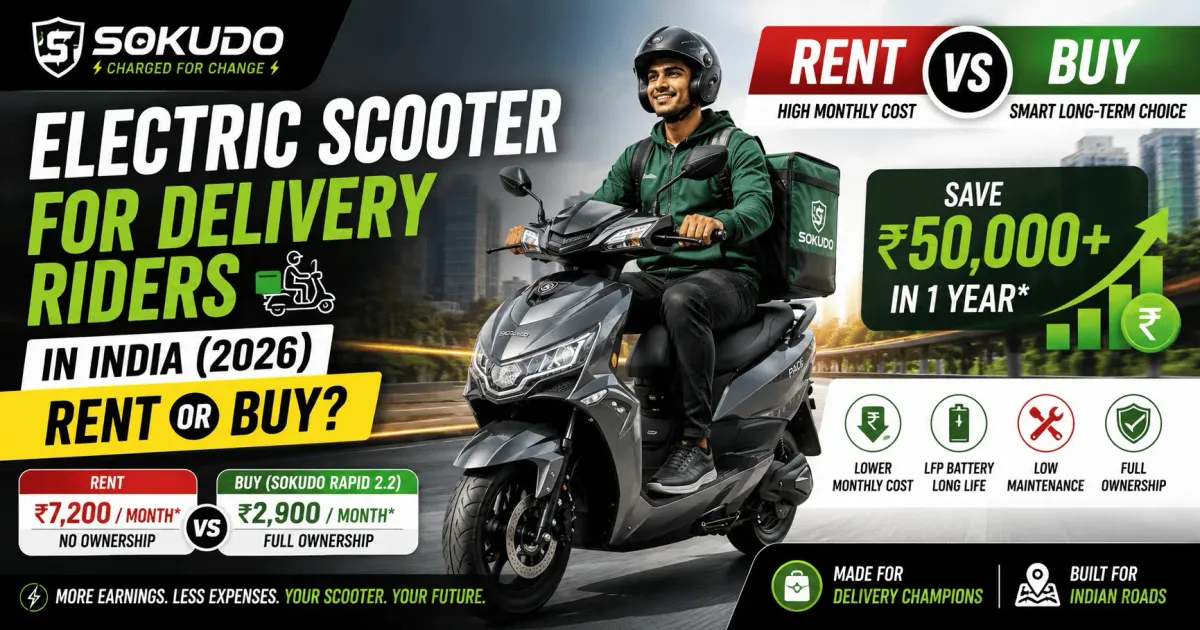
For most full-time delivery riders, buying is the financially stronger option. The Sokudo Rapid 2.2 on EMI costs roughly Rs 2,900 a month including charging, against Rs 7,200 a month for a common daily rental plan. That is a saving of over Rs 50,000 in the first year alone, with a fully owned scooter at the end of it.
For short-distance quick-commerce riders working a 5 to 10 km zone, the Sokudo Plus is the lower-cost entry point at around Rs 1,800 to Rs 1,900 EMI a month, and needs no driving licence. For riders covering longer routes that mix city roads with ring roads, the Sokudo Acute 2.2 is the stronger choice.
Renting still has a narrow, legitimate use case. That is covered later in this guide. The full comparison follows below.
What does renting an electric scooter for delivery work actually cost in India?
All the rental platforms built for delivery riders, like Zypp, promise a simple deal: no upfront cost, battery swapping, and a scooter the same day you sign up. Zypp's own website lists electric scooters on rent starting at Rs 180 a day. Other rental guides show most companies charging somewhere between Rs 180 and Rs 275 a day, sometimes going up to Rs 300, depending on the scooter model and your city.
Here is what that looks like across a full working month:
| Rental Plan | Daily Rent | Cost for 30 Days |
| Lowest | Rs 180 | Rs 5,400 a month |
| Common (Ampere or Zypp example) | Rs 240 | Rs 7,200 a month |
| Higher end | Rs 275 to Rs 300 | Rs 8,250 to Rs 9,000 a month |
That is before onboarding charges, helmet and kit fees, and a security deposit most rental companies ask for upfront. At the end of the month, the year, or three years, the rider still owns nothing.
There is another cost that is easy to miss. Rent stays fixed every day, but earnings do not. Zypp's own rider stories mention full-time delivery earnings anywhere between Rs
25,000 and Rs 48,000 a month, depending on the platform and hours worked. At Rs 7,200 in rent, that is between 15 and 29 percent of a rider's entire monthly income going straight to the scooter, before charging cost, food, phone recharge, or savings are even counted.
Renting vs buying: full comparison table for delivery riders (2026)
| Option | Monthly Cost | Range | Battery | Licence Needed | Ownership at End |
| Rental, lowest plan | Rs 5,400 | Depends on model | Varies | Usually yes | None, returned to company |
| Rental, common (Ampere or Zypp) | Rs 7,200 | Depends on model | Varies | Usually yes | None, returned to company |
| Rental, higher end | Rs 8,250 to Rs 9,000 | Depends on model | Varies | Usually yes | None, returned to company |
| Sokudo Plus (EMI) | Rs 1,800 to Rs 1,900 | Short zone, 5 to 10 km | LFP | No | Full ownership after loan term |
| Sokudo Rapid 2.2 (EMI plus charging) | About Rs 2,900 | Up to 120 km claimed | LFP | Yes | Full ownership after loan term |
| Sokudo Acute 2.2 (EMI) | Rs 2,600 to Rs 3,200 | Up to 100 km claimed | LFP | Yes | Full ownership after loan term |
EMI figures vary by city, down payment, and loan tenure. Confirm the exact number for your city on the Sokudo EMI calculator.
Renting and buying options compared
1. Renting via platforms like Zypp and Ampere: lowest barrier to entry, highest long-term cost
Typical daily cost: Rs 180 to Rs 300
Typical monthly cost: Rs 5,400 to Rs 9,000
Upfront cost: Usually low or none, but deposit and kit fees apply
Ownership at end of term: None, the scooter is always returned
Licence required: Usually yes, since most rental fleets are RTO-registered high-speed scooters
Rental platforms remove the biggest barrier for someone starting delivery work: no loan approval, no down payment, and a scooter on the same day. That makes renting genuinely useful in the first few weeks of delivery work, before a rider knows which platform, city zone, or shift pattern suits them.
Where renting stands out:
- No loan approval or credit history needed to start working
- Battery swapping on some platforms removes home-charging concerns
- Easy to return the vehicle if delivery work does not suit the rider
- No long-term commitment while a rider is still testing the work
Where renting trails:
- Costs 2 to 2.5 times more per year than EMI on a comparable Sokudo model
- Deposit and kit charges are often not fully refunded
- The rider owns nothing after any length of time
- Daily rent is fixed regardless of a slow-earning day, sick day, or rainy day
- Some rental plans tie the rider to one platform or one city hub
Best for: Riders in their first few weeks of delivery work who are still deciding on a platform, city zone, or whether full-time delivery riding suits them at all.
2. Sokudo Plus: best for short-distance, no-licence quick-commerce delivery
Official page: Sokudo Plus Price: Rs 67,951 ex-showroom
EMI: Around Rs 1,800 to Rs 1,900 a month over a 3-year loan
Battery: LFP
Running cost: Rs 0.09 per km, manufacturer confirmed
Top speed: 25 km/h, certified non-RTO category
Licence required: No
Registration required: No
The Sokudo Plus falls under India's non-RTO category with a certified 25 km/h top speed and motor output within the 250W threshold, which means no driving licence and no vehicle registration. For riders delivering within a tight 5 to 10 km zone, typically quick-commerce work for platforms like Zepto or Blinkit, that is a genuine practical advantage: lower entry cost, lower EMI, and no documentation delay before a rider can start working.
For a full legal breakdown of how the non-RTO classification works and what documents to carry, see our guide on whether you can ride an electric scooter without a licence in India.
Where it stands out:
- Lowest EMI among all Sokudo models relevant to delivery work
- No licence or registration paperwork before a rider can start earning
- LFP battery with confirmed Rs 0.09 per km running cost
- 100 kg kerb weight, easiest to manoeuvre through dense market lanes
- Zero fire complaints on the official product page
Where it trails:
- 25 km/h certified speed is not suitable for platforms or routes needing ring-road speeds
- Shorter effective daily coverage than the Rapid 2.2 or Acute 2.2
- Not the right choice for full-time riders covering more than 25 to 30 km a day
Best for: Riders working a small, dense delivery zone for quick-commerce grocery or food delivery within 5 to 10 km who want to start working immediately without licence paperwork.
3. Sokudo Rapid 2.2: best overall for full-time delivery riders
Official page: Sokudo Rapid 2.2
Price: Rs 97,951 ex-showroom
Claimed range: Up to 100 km
Battery: 2.2 kWh LFP
Running cost: Rs 0.09 per km, manufacturer confirmed
EMI: Rs 1,600 to Rs 3,700 a month depending on city, down payment, and loan period. Typically Rs 2,500 to Rs 2,700 in cities like Delhi on a standard 3-year loan
Charging cost: Roughly Rs 210 to Rs 270 a month at 80 to 100 km of daily riding
Licence required: Yes
The Rapid 2.2 is the main choice for full-time Swiggy, Zomato, Blinkit, Zepto, and Porter riders, most of whom cover 80 to 120 km a shift. Its LFP battery is built for the constant stop-and-go daily cycling that delivery work demands, rather than the occasional 15 to 20 km commute that most electric scooter reviews are written around. In real-world delivery conditions, with traffic, rider weight, and repeated full-charge cycles, expect closer to 70 to 90 km per charge rather than the claimed 120 km.
Use the Sokudo EMI calculator to confirm the exact monthly cost for your city.
Where it stands out:
- Highest claimed range in the delivery-relevant Sokudo lineup
- LFP battery chemistry, meaningfully more heat-tolerant than standard lithium-ion under daily heavy cycling
- Total monthly cost including EMI and charging comes in under Rs 3,000 to Rs 3,500, against Rs 7,200 or more in typical rent
- Works with any delivery platform, no rental-hub restriction
- Disc front brake for stopping confidence in heavy city traffic
Where it trails:
- Requires a driving licence and RTO registration, unlike the Plus
- Real-world range in heavy traffic and Indian summer heat runs below the claimed figure, as with any electric scooter
- EMI commitment requires loan approval and a down payment
Best for: Full-time delivery riders working 8 to 12 hour shifts across food or grocery delivery platforms, covering 80 to 120 km a day.
4. Sokudo Acute 2.2: best for longer routes and ring-road delivery work
Official page: Sokudo Acute 2.2
Price: Rs 1,04,951 ex-showroom
Claimed range: Up to 100 km
Top speed: 70 km/h
Battery: 2.2 kWh LFP
Kerb weight: Approximately 102 kg
Charging time: 4 to 5 hours
EMI: Rs 2,600 to Rs 3,200 a month
Licence required: Yes
Built for riders covering longer routes that mix city roads with ring roads, the Acute 2.2 offers more sustained power for riders regularly moving between delivery hubs spread further apart, rather than working one dense urban zone. The 70 km/h top speed and disc front brake make it noticeably more capable on faster stretches than the Rapid 2.2, though its claimed range of 100 km runs slightly lower.
Where it stands out:
- 70 km/h top speed, suited to ring-road and highway-adjacent delivery routes
- 2.2 kWh LFP battery for stable performance under repeated daily cycling
- Disc front brake for stopping confidence at higher speeds
Where it trails:
- Claimed range of 100 km is lower than the Rapid 2.2's 120 km
- Higher EMI than the Plus, comparable to or slightly above the Rapid 2.2 depending on city and down payment
Best for: Delivery riders whose routes regularly cross ring roads or connect hubs spread further apart, where sustained higher speed matters as much as maximum range.
Total cost of ownership: one-year comparison
For a rider on the common Rs 240-a-day rental plan, working about 30 days a month, against a Sokudo Rapid 2.2 owner on EMI:
| Renting (Ampere or Zypp style) | Buying a Sokudo Rapid 2.2 | |
| Monthly cost | Rs 7,200 | About Rs 2,900 (EMI plus charging) |
| Yearly cost | Rs 86,400 | About Rs 34,800 |
| What you have at year end | Nothing, scooter goes back to company | One year closer to fully owning it |
| Deposit or kit charges | Usually needed upfront, often not fully refunded | A one-time down payment that goes toward the scooter you keep |
At these numbers, a full-time rider on rent pays close to 2.5 times more every year than a rider paying EMI on a Rapid 2.2. After three years of rent, that rider has spent over Rs 2.5 lakh with nothing to show for it. After three years of EMI, the Sokudo owner has a fully paid-off scooter that still carries resale value.
Battery technology: why LFP matters more for delivery riders than casual commuters
Most electric scooter content is written for someone riding 15 to 20 km a day. A delivery rider working an 8 to 12 hour shift often covers 80 to 120 km a day, five to seven times more than a regular commuter, every single day. That difference is what makes battery chemistry genuinely important rather than just a specification to check off.
LFP, or Lithium Iron Phosphate, lasts through more charge and discharge cycles before losing power, and handles heat better. This matters during Indian summers when a heavily-used battery is being charged and drained daily. According to Battery University's analysis of lithium-ion chemistry and cell degradation, partial and full-cycle frequency, heat, and depth of discharge are the three primary drivers of battery aging, all of which affect delivery riders at a much higher rate than casual commuters.
| Usage Pattern | Casual Commuter (15 to 20 km/day) | Delivery Rider (80 to 120 km/day) |
| Charge and discharge frequency | Every 2 to 3 days | Daily, often deep-cycled |
| Where battery type shows up | Slowly, over several years | Within the first year or two |
| Risk if using standard lithium-ion | Minor range drop over time | Shorter range, more charging breaks, possible early replacement |
| Battery replacement cost if needed | Rs 15,000 to Rs 40,000 | Rs 15,000 to Rs 40,000 |
Sokudo's Rapid 2.2 and Acute 2.2 both use LFP batteries specifically because a large share of Sokudo buyers are riders doing heavy daily distances, not just weekend riders. For the full technical breakdown of LFP versus NMC chemistry and why it matters in Indian summer conditions, read our guide on are electric scooters safe in India.
What most buy vs rent blogs do not tell you
Most articles online stop at the rent-versus-EMI number. Two things that matter significantly to a working rider rarely get mentioned.
How delivery work affects your registration and insurance
If you plan to ride full-time for food or grocery delivery apps, some cities and some platforms expect the vehicle to carry a commercial registration instead of a private one. This is different from the non-RTO versus RTO distinction covered earlier in this guide. A commercial registration can change your insurance cost and how a claim is handled if something goes wrong while you are on a delivery.
Before taking a loan on a scooter meant mainly for delivery work, check with your local RTO office or your Sokudo dealer so your insurance stays valid. The Motor Vehicles Act, 1988 and its rules governing commercial vehicle use set out how commercial registration requirements apply. When in doubt, your nearest Sokudo showroom can guide you through what applies in your city.
Government subsidies may not apply to delivery use
Central and state subsidies that lower the price of electric scooters are usually meant for personal, non-commercial use. If you are buying a scooter mainly for full-time delivery work, do not assume the subsidy price you see online will apply to you. Ask your dealer to confirm this before signing anything. Our guide on how government subsidies made electric scooters affordable in India explains exactly how these schemes work and what the eligibility conditions are.
Why owning your own scooter gives you more freedom
No pressure from daily rent. With rent, every sick day, slow-order day, or rainy day still costs the same Rs 180 to Rs 275. With EMI, the monthly payment is fixed, and one low-earning day does not throw off the budget the way a missed daily rent payment can.
No sticking to one platform. Some rental plans are built around one delivery app or one rental hub in a city. A scooter you own works with Swiggy, Zomato, Blinkit, Zepto, Rapido, or any app you choose, along with personal trips, with no rental rules to follow.
Something to show for it at the end. After three years of rent, a rider has nothing. After three years of EMI, they have a scooter they fully own, one they can keep riding, pass on, or sell.
Which Sokudo is best for your delivery route?
Short distance, dense city delivery, 5 to 10 km zone Sokudo Plus. Non-RTO, no licence needed, lowest EMI among Sokudo models. Good for quick-commerce delivery within a small zone.
Full-time work, long shifts, heavy traffic Sokudo Rapid 2.2. Claimed range up to 120 km, LFP battery, built for the constant stop-and-go riding delivery work involves. This is the model most full-time Swiggy, Zomato, and Blinkit riders should compare directly against their current rent.
Longer routes with ring roads or hub-to-hub distances Sokudo Acute 2.2. More sustained power for riders covering longer distances between delivery hubs where higher speed matters as much as range.
New to delivery work, still deciding on a platform A short rental period, a few weeks at most, before switching to EMI once a route, platform, and shift pattern are settled. Renting indefinitely once the work pattern is clear is the costliest option on the table.
Compare all three models and the rest of the range on the Sokudo model comparison page, or browse all Sokudo electric scooters here.
Is buying always the right call for every delivery rider?
The answer depends on how settled a rider's delivery work actually is.
Renting is the right choice when:
- You are in the first few weeks of delivery work and still testing platforms or routes
- You are not sure delivery riding will be a long-term source of income
- You need a scooter immediately and cannot wait on loan approval or a down payment
- You expect to stop delivery work within a few months
Buying becomes the stronger option when:
- You have been doing delivery work for more than a month or two and plan to continue
- Your monthly rent is consistently above what an EMI on a comparable Sokudo model would cost
- You want the flexibility to work across multiple platforms without rental-hub restrictions
- You want a vehicle that carries resale value once the loan is paid off
Many riders assume renting is the safer choice because there is no commitment. In practice, once delivery work becomes a regular source of income, that same lack of commitment is what makes renting the more expensive path, every month, for as long as the rider keeps working.
How to switch from renting to owning: step by step
1. Write down what you actually pay in rent. Multiply your daily rent by the number of days you actually work in a month, not the rental company's lowest advertised rate.
2. Check your city's EMI on the Sokudo EMI calculator. Compare that number directly with what you wrote down in step 1.
3. Pick the right model for your route. Plus for short distances, Rapid 2.2 for full-time heavy delivery work, Acute 2.2 for longer routes.
4. Ask your dealer about registration. If the scooter is mainly for delivery work, ask about commercial use and insurance before taking the loan. Find your nearest Sokudo showroom here.
5. Book a test ride first. A scooter you will ride for 8 to 12 hours a day needs to feel right in person, not just on paper. Book a free test ride here.
For more detail on running costs and upkeep, read our guides on how much it costs to run an electric scooter in India and what electric scooter owners actually spend on maintenance. If your daily route is small enough that you do not need registration at all, see our guide to non-RTO electric scooters.
Frequently Asked Questions
Is it always cheaper to buy an electric scooter than to rent one for delivery work?
For anyone working full-time, buying is almost always cheaper. Rent usually costs between Rs 5,400 and Rs 8,250 a month. EMI on a Sokudo Rapid 2.2 usually costs under Rs 3,000 to Rs 3,700 a month depending on city and down payment. Renting still makes sense for the first few weeks while deciding which platform or route works best.
What EMI should I expect on a Sokudo for delivery work?
It depends on the model, your city, your down payment, and your loan period. As a general guide, the Sokudo Plus costs around Rs 1,800 to Rs 1,900 a month, and the Rapid 2.2 costs between Rs 1,600 and Rs 3,700 a month across different cities on a 3-year loan. Use the Sokudo EMI calculator to get the exact number for your city.
Do I need a commercial registration to use a Sokudo for delivery work?
This depends on your city and the platform you work with. It is best to check with your local RTO and your Sokudo dealer before taking a loan for a scooter you plan to use mainly for delivery work, since commercial registration can affect insurance cost and how a claim is handled.
Can a Sokudo handle 80 to 100 km of delivery riding every day?
The Rapid 2.2 and Acute 2.2 use LFP batteries built to handle heavy daily use, much more so than models made for casual riders covering 15 to 20 km a day. Claimed range is based on test conditions, so real-world range will run somewhat lower depending on rider weight, traffic, and weather. A typical delivery rider on the Rapid 2.2 should expect 70 to 90 km per charge in real conditions.
Can I switch between Swiggy, Zomato, Zepto, and Blinkit if I own my scooter?
Yes. A scooter you own is not tied to any single delivery app or rental company, unlike some rental plans built around one platform or one city hub.
Which Sokudo scooter has the longest range for delivery work?
The Sokudo Rapid 2.2 has the highest claimed range in the delivery-relevant lineup at up to 120 km. In real-world delivery conditions with mixed traffic and full-shift daily cycling, expect roughly 70 to 90 km per charge.
Is the non-RTO Sokudo Plus good enough for full-time delivery work?
It depends entirely on the route. The Plus is well suited to short, dense zones of 5 to 10 km, common in quick-commerce delivery. For full-time food delivery covering 80 km or more a day at higher speeds, the Rapid 2.2 or Acute 2.2 is the better fit. Both require a licence but offer higher speed and greater range.
How long does a Sokudo Rapid 2.2 take to charge overnight?
Around 3 to 4 hours for a full charge on the standard charger, which comfortably fits an overnight charging window between delivery shifts.
Are government subsidies available for scooters bought for delivery work?
Subsidies are usually structured for personal, non-commercial use. If a scooter is being bought mainly for full-time delivery work, do not assume the advertised subsidy price applies. Confirm eligibility with your dealer before signing anything.
What happens if I miss an EMI payment? Is buying riskier than renting?
A missed rental payment on a daily plan risks losing access to the scooter that day. A missed EMI payment affects your loan account and credit record and needs to be resolved with the lender, but does not mean instant loss of the vehicle. Either way, budgeting the fixed monthly cost against real, not best-case, monthly earnings is the safer approach before committing to either option.
Final verdict: should delivery riders in India rent or buy an electric scooter in 2026?
Every option in this comparison serves a genuinely different stage of a rider's delivery career.
Choose renting if you are in the first few weeks of delivery work, still deciding on a platform or route, and want zero commitment while you figure that out.
Choose the Sokudo Plus if you work a short, dense delivery zone under 10 km, want the lowest EMI, and want to skip licence and registration paperwork entirely.
Choose the Sokudo Rapid 2.2 if you are a full-time rider covering 80 to 120 km a day across food or grocery delivery platforms and want the strongest overall balance of range, LFP safety, and low running cost.
Choose the Sokudo Acute 2.2 if your routes regularly cross ring roads or connect hubs spread further apart, where sustained higher speed matters as much as range.
Across every model in this comparison, the pattern holds. Renting costs 2 to 2.5 times more per year than EMI once delivery work becomes a regular source of income. Buying is the only path that ends with the rider owning the scooter outright.
Browse the full Sokudo electric scooter range or check your city's exact EMI on the Sokudo EMI calculator to compare against what you are paying in rent today.
This article gives general cost estimates to help with planning. EMI, on-road price, and subsidy eligibility can vary by city, lender, down payment, and how the vehicle is registered. Please confirm exact numbers with your nearest Sokudo dealer or contact Sokudo before making a purchase.
Comments
Share your thoughts about this article.
Loading comments...