29 May 2026•Sokudo Electic India
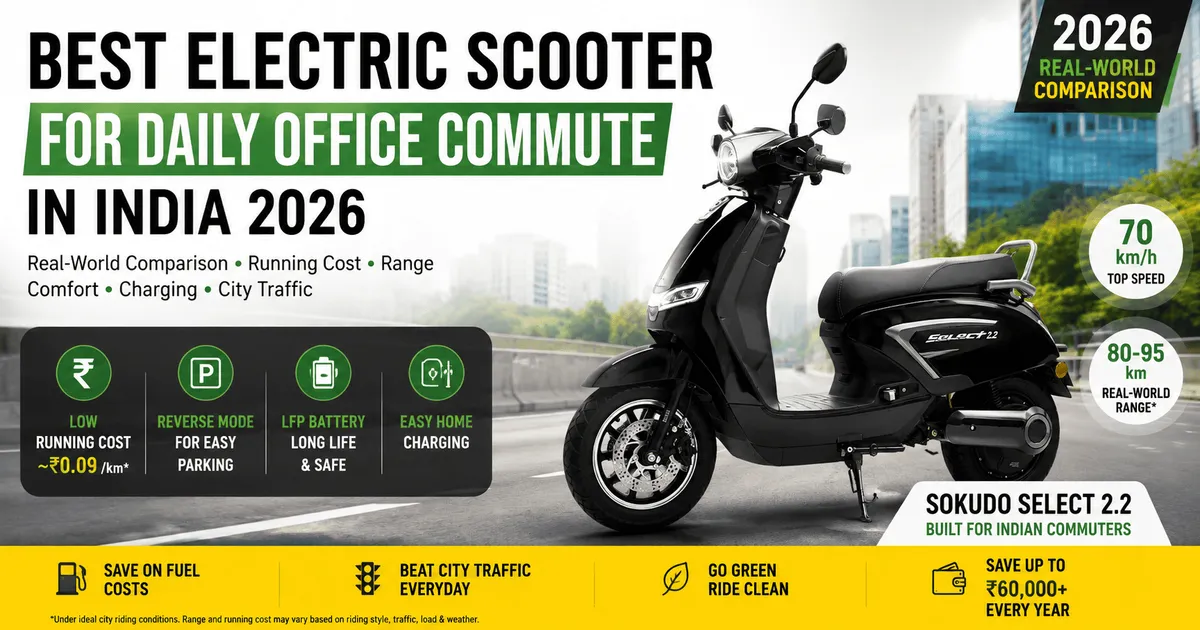
Best Electric Scooters for Daily Office Commute in India Across Every City and Budget
Published: May 2026 | Author: Sokudo Electric India Editorial Team | Reading Time: 12 min
Every weekday morning, millions of Indians make the same journey. Some travel 8 km through local city roads. Others spend over an hour navigating Bengaluru traffic, Delhi NCR congestion, Mumbai signals, or Chennai's heat-heavy commuting conditions.
And increasingly, all of them are asking the same question: which electric scooter is actually best for daily office commuting in India?
The answer is not the scooter with the highest top speed. It is not the scooter with the biggest touchscreen. The best office commuting scooter is the one that reduces daily stress - easy in traffic, affordable to run, simple to charge, and practical in apartment and office parking.
This guide compares India's leading commuter-focused electric scooters based on real-world office commuting conditions, not brochure specifications.
Best Electric Scooter for Daily Office Commute - Direct Answer
For most Indian office commuters in 2026, the strongest choices are:
| Rider Type | Recommended Scooter |
| Best overall office commuter | Sokudo Plus |
| Best for longer daily commute | Sokudo Select 2.2 |
| Best mainstream EV | TVS iQube |
| Best comfort-oriented commuter | Ather Rizta |
| Best premium office scooter | Bajaj Chetak |
For commuters prioritising affordability, traffic handling, parking convenience, and ownership cost, lightweight scooters under 105 kg consistently outperform heavier alternatives in everyday Indian urban conditions.
Why the Right Electric Scooter Makes a Real Difference for Office Commuters
Office commuting has changed significantly over the last five years. Fuel prices remain substantially higher than pre-pandemic levels. Urban congestion continues increasing. Parking space is shrinking. Daily commuting costs are rising every year.
According to the Ministry of Heavy Industries, electric two-wheelers remain one of the most economical forms of urban mobility available in India - but simply buying an EV is not enough. The wrong scooter creates daily frustration. The right one saves money, reduces stress, and improves commuting comfort for years.
Most scooter reviews happen during short media test rides. Real commuting involves 200+ days annually of Bengaluru traffic jams, Delhi NCR signal congestion, Mumbai stop-go conditions, Pune potholes, and Chennai summer temperatures. A scooter that feels exciting for 20 minutes may become genuinely tiring after six months of daily use.
Six Things That Actually Matter for Daily Office Commuting
Daily riding comfort A scooter used five to six days every week must stay comfortable across hundreds of hours annually. Seating position, suspension tuning, riding posture, and vibration levels matter far more than they appear on a spec sheet.
Traffic handling Indian office commuting means traffic signals, lane filtering, stop-start movement, and sudden braking. Scooters with smooth throttle response and predictable low-speed handling reduce rider fatigue significantly over time.
Parking convenience Office commuters park twice daily - once at home, once at the office. Apartment residents often deal with basement parking, narrow ramps, and crowded spaces. Reverse mode transforms this experience from frustrating to effortless.
Running cost This is where EVs deliver their strongest advantage. As our real cost of running an electric scooter in India guide shows, most electric scooters operate at ₹0.12–₹0.30 per kilometre - against ₹2.30/km for a petrol scooter. Our Sokudo models achieve approximately ₹0.09/km under ideal city conditions.
Charging practicality The best commuter scooter fits naturally into your existing daily schedule - overnight home charging, occasional office top-up, and no range anxiety for a standard 20–30 km commute.
Reliability Commuters cannot afford unexpected downtime. Battery warranty, service network coverage, and long-term ownership support become critical factors over 3–5 years of daily use.
How Much Range Does an Office Commuter Actually Need?
Most buyers overestimate their daily range requirement. Match your real commute distance to what you actually need:
| Daily Commute | Real-World Range Required | Typical Rider |
| 5–10 km | 40–60 km | Local office, metro feeder |
| 10–20 km | 70–90 km | Most urban office workers |
| 20–40 km | 100 km+ | Bengaluru, Delhi NCR, Hyderabad, Pune |
| 40+ km | 120 km+ with fast charging | Long-distance daily commuters |
Real-world range in Indian traffic is typically 60–80% of ARAI-certified figures. Use that adjusted number when comparing scooters, not the brochure claim.
Petrol Scooter vs Electric Scooter for Office Commuting - Real Numbers
Assumed commute: 25 km/day | 22 working days/month
| Cost Component | Petrol Scooter | Electric Scooter |
| Monthly fuel / charging | ₹2,000–₹4,000 | ₹250–₹700 |
| Annual servicing | ₹4,000–₹9,000 | ₹1,000–₹5,000 |
| Cost per kilometre | ~₹2.30 | ₹0.09–₹0.30 |
For most commuters, EV ownership becomes financially advantageous within 18–30 months. Heavy daily riders typically break even within 12–18 months.
According to NITI Aayog, electric two-wheelers now offer the fastest total cost of ownership recovery among all Indian EV vehicle categories.
Which Electric Scooter Handles Indian Office Traffic Best - City by City
Bengaluru Frequent congestion rewards smooth throttle response, excellent low-speed balance, and comfortable seating for slow-speed crawling. Best performers: Sokudo Plus, TVS iQube.
Delhi NCR Longer commute distances demand real-world range above 100 km, battery confidence in extreme summer heat, and reliable service support. Best performers: Sokudo Select 2.2, Ather Rizta.
Mumbai Parking convenience becomes the defining factor. Reverse mode and compact dimensions offer genuine daily advantages in basement and street parking. Best performers: Sokudo Plus, TVS iQube.
Pune Mixed road conditions - smooth stretches and rough patches - favour balanced suspension, lightweight construction, and manageable handling. Best performers: Sokudo Plus, Sokudo Select 2.2.
Chennai High ambient temperatures make battery chemistry a critical long-term consideration. LFP batteries handle Indian heat significantly better than NMC. Best performers: Sokudo Plus (LFP), TVS iQube.
Full Comparison - Best Electric Scooters for Office Commute in India 2026
| Model | Real-World Range | Weight | Reverse Mode | Running Cost/km | Best For |
| Sokudo Plus | 75–85 km | 100 kg | ✅ Yes | ~₹0.09 | Daily city commute, apartment parking |
| Sokudo Select 2.2 | 80–95 km | 101 kg | ✅ Yes | ~₹0.09 | Longer commutes, higher speed need |
| TVS iQube | Variant-dependent | ~118 kg | ✅ Yes | Low | Mainstream commuters, wide service network |
| Ather Rizta | 100 km+ potential | ~125 kg | ❌ No | Low | Comfort-focused, feature-heavy riders |
| Bajaj Chetak | Variant-dependent | ~135 kg | ❌ No | Low | Premium buyers, brand confidence |
*Under ideal city operating conditions.
Scooter-by-Scooter Breakdown for Office Commuters
Sokudo Plus - Best Overall Electric Scooter for Daily Office Commute
Best for: Apartment residents, city commuters, beginners, women professionals, elderly working commuters
The Sokudo Plus is engineered around practical Indian urban commuting rather than performance marketing - and it shows in every aspect of daily use.
At 100 kg with reverse mode standard, it eliminates the two biggest daily friction points for office commuters: traffic fatigue and parking effort. The LFP battery chemistry adds long-term ownership confidence in Indian heat conditions, where NMC batteries degrade noticeably faster. Charging overnight on a standard 15A socket means you leave for work every morning with a full battery and zero petrol-station stops.
Key advantages for office commuters:
- Lightest in class at 100 kg - significantly easier in stop-go traffic than 125–135 kg alternatives
- Reverse mode makes apartment basement and ramp parking genuinely effortless
- No-licence category eligibility for the widest possible rider base
- LFP battery designed for 2,000–4,000 charge cycles - 8–12 years for an average commuter
- Running cost of approximately ₹0.09/km under ideal conditions
Honest limitation: 50 km/h top speed suits city and neighbourhood commuting well. Not suited for expressway or inter-city riding.
Also read: Which Electric Scooter Is Easiest to Ride in India? - Sokudo India
Sokudo Select 2.2 - Best for Longer Daily Office Commutes
Best for: Commuters covering 25–40 km daily who need lightweight handling without sacrificing range or speed
The Sokudo Select 2.2 solves a specific problem: most lightweight scooters feel underpowered for longer city commutes, and most high-speed scooters are too heavy for comfortable daily urban use.
At 101 kg with a 70 km/h top speed and reverse mode, it handles Bengaluru traffic and Mumbai parking with the same ease as the Plus - while covering longer office routes without the range anxiety that affects smaller battery scooters. Throttle response is tuned for urban commuting, not aggressive performance. It is one of the very few scooters that genuinely avoids the lightweight-versus-performance trade-off.
Licence required - which is relevant for some riders but opens up the full city for those who hold one.
TVS iQube - Best Mainstream Electric Scooter for Office Commuters
Best for: Commuters wanting a polished, widely serviced mainstream EV with refined city handling
The TVS iQube is the most refined mainstream electric scooter for Indian office commuting. TVS has calibrated its throttle mapping, suspension tuning, and braking behaviour specifically for Indian road conditions - and the result is a scooter that feels more approachable than its 118 kg weight suggests.
Reverse mode is present. Multiple battery configurations are available, with IDC range extending beyond 170 km on higher variants. TVS's service network coverage across India is among the strongest available for any EV brand, which matters significantly for commuters in Tier 2 and Tier 3 cities.
For riders wanting something more premium than entry-level scooters without aggressive handling behaviour, the iQube remains the most sensible mainstream choice.
Ather Rizta - Best Comfort-Focused Electric Scooter for Office Commuting
Best for: Confident daily commuters who prioritise seating comfort, premium features, and connected technology
The Ather Rizta is built around family riding comfort and feature completeness. The seat is wide and well-padded. Battery options extend to 3.7 kWh. The technology package - connected features, navigation, ride analytics - is among the most complete in this segment.
At ~125 kg without reverse mode, parking in tight apartment spaces requires more physical effort than lighter alternatives. Riders under 5'4" will feel its weight during low-speed manoeuvring every day.
For confident, experienced riders whose primary concern is comfort and features over a long commute - the Rizta is a genuinely strong choice. For beginners or those commuting in tight city environments, the weight difference from the Sokudo models becomes a daily reality.
Bajaj Chetak - Best Premium Electric Scooter for Office Commuters
Best for: Experienced riders who prioritise build quality, brand heritage, and stable highway riding
The Bajaj Chetak delivers a premium, planted riding experience backed by Bajaj's extensive national service and dealership network - one of the most reliable ownership support systems available for any EV in India.
At ~135 kg without reverse mode, it is the most physically demanding scooter in this comparison for daily urban parking. The build quality confidence and highway stability are genuine strengths. The weight in tight parking and basement ramps is a genuine daily consideration.
For buyers where brand trust, long-term service assurance, and premium feel outweigh lightweight agility - the Chetak remains a compelling option.
Can You Charge an Electric Scooter at Home Before Going to the Office?
Yes - and for most commuters, home charging is simpler than a weekly petrol station visit.
Most electric scooters charge through a standard 15A household socket. The typical overnight routine:
- Return home from the office
- Plug in using the supplied charger
- Leave for work next morning on a full charge
No special installation is required for most low-speed and mid-range scooters. Apartment residents should verify parking socket access and their society's EV charging policy before purchase. Some societies bill through commercial meters at higher rates, which can add ₹100–₹300 monthly.
LFP vs NMC Battery - Which Is Better for Daily Office Commuters?
Battery chemistry significantly affects long-term ownership economics in Indian conditions:
| Factor | LFP Battery | NMC Battery |
| Charge cycles | 2,000–4,000 | 800–1,500 |
| Practical lifespan | 8–12 years | 4–6 years |
| Heat tolerance | Superior | More heat-sensitive |
| Thermal safety | Lower fire risk | Higher thermal runaway risk |
| Energy density | Slightly lower | Higher |
According to Battery University, LFP chemistry provides superior thermal stability and cycle longevity compared to NMC - a meaningful advantage in Indian ambient temperatures regularly exceeding 40°C.
For Indian office commuters charging daily over 5+ years, LFP batteries reduce the probability of early battery replacement - which at ₹45,000–₹70,000 for a mid-range pack, represents a significant ownership cost avoided.
Best Electric Scooter Based on Your Specific Office Commute
| Your Situation | Best Choice |
| 10 km daily commute | Sokudo Plus |
| 20–30 km daily commute | Sokudo Select 2.2 |
| Heavy traffic city commute | TVS iQube |
| Apartment resident with basement parking | Sokudo Plus |
| First-time EV buyer | Sokudo Plus |
| Woman office commuter | Sokudo Plus or TVS iQube |
| Elderly working professional | Sokudo Plus |
| Comfort and features priority | Ather Rizta |
| Premium build quality priority | Bajaj Chetak |
What to Check Before Buying an Electric Scooter for Office Use
These seven factors affect daily commuting life more than any performance figure:
- Daily commute distance - determines which battery size you actually need
- Home charging access - socket availability and apartment society policy
- Office parking conditions - tight spaces make reverse mode significantly valuable
- Battery warranty and chemistry - LFP vs NMC matters over 5+ years of daily charging
- Service network near your commute route - critical for Tier 2 city commuters
- Scooter weight - test parking effort specifically, not just riding feel
- Subsidy eligibility - check current PM E-DRIVE scheme benefits at the Ministry of Heavy Industries portal
People Also Ask
Which electric scooter is best for daily office commute in India in 2026?
The Sokudo Plus is the strongest overall choice for most Indian office commuters - lightweight, reverse mode equipped, LFP battery, and the lowest running cost in its category. For longer commutes, the Sokudo Select 2.2 or TVS iQube are the next strongest options.
How much does it cost to charge an electric scooter every month for office commuting?
Most commuters covering 20–25 km daily spend ₹300–₹700 per month on charging depending on battery size and local electricity tariff. This compares to ₹2,000–₹4,000 monthly for a petrol scooter covering the same distance.
Is an electric scooter cheaper than a petrol scooter for office commuting?
Yes - significantly. Electric scooters cost ₹0.12–₹0.30/km against approximately ₹2.30/km for a petrol scooter. Most office commuters recover the cost premium within 18–30 months through fuel savings alone.
Which electric scooter is easiest to park in apartment complexes?
Lightweight scooters with reverse mode are by far the easiest to park in Indian apartment settings. The Sokudo Plus at 100 kg with reverse mode standard is the strongest option in this category.
Can I charge my electric scooter at the office?
Many offices allow EV charging in designated parking areas, but policies vary by employer and building. Confirm with your office facilities team before purchase if this is part of your charging plan.
Which electric scooter has the best battery life for daily commuting?
Scooters with LFP batteries - including the Sokudo Plus and Sokudo Select 2.2 - provide the longest battery lifespan for daily commuters. LFP cells typically deliver 2,000–4,000 charge cycles versus 800–1,500 for NMC batteries under Indian conditions.
Final Verdict - Which Electric Scooter Should Office Commuters Buy in 2026?
For affordability, easy handling, apartment parking, and the lowest daily running cost - the Sokudo Plus is the strongest commuter-focused electric scooter available in India today. It is built specifically for the conditions Indian office commuters actually face, not for spec-sheet comparisons.
For riders needing additional speed and range flexibility - the Sokudo Select 2.2 is the natural step up without losing the lightweight handling advantage.
For mainstream support, wide service coverage, and refined ride quality - the TVS iQube remains an excellent choice for confident daily commuters.
For comfort-first riders who want premium features over everything else - the Ather Rizta deserves consideration.
For buyers where brand heritage and build quality are the priority - the Bajaj Chetak remains compelling.
The best office commuter scooter is ultimately the one that makes your daily journey simpler, cheaper, and less stressful - not the one with the most impressive spec sheet.
Explore the Sokudo Plus and Sokudo Select 2.2 or read our full guide on how much it costs to run an electric scooter in India before making your decision.
Specifications, pricing, range figures, and government subsidy details are subject to change. Always verify current information directly with the manufacturer or an authorised dealer before purchase.
Comments
Share your thoughts about this article.
Loading comments...