27 May 2026•Sokudo Electric India
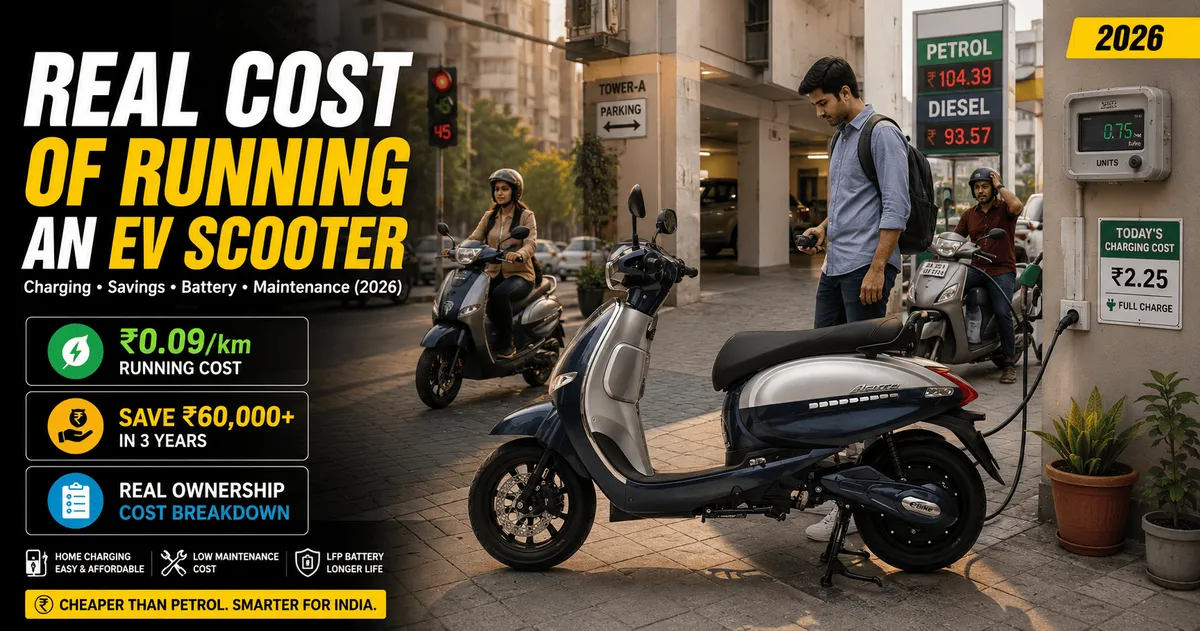
Real Cost of Running an Electric Scooter in India for Daily Commuters
Published: May 27, 2026 | Author: Sokudo Electric India Editorial Team | Reading Time: 11 min
Most electric scooter cost calculators online divide battery size by electricity tariff and call it done. That number is almost always wrong.
A scooter running in Bengaluru traffic, Delhi summer heat, or Mumbai stop-go conditions behaves nothing like a laboratory estimate. Electricity tariffs vary by state, riding habits affect real efficiency, and long-term ownership costs extend well beyond charging.
This guide calculates the actual cost of running an electric scooter in India in 2026 - using real commuting scenarios, realistic electricity pricing, servicing data, battery lifespan figures, and practical Indian urban riding patterns.
Real Monthly Cost of Running an Electric Scooter in India - Direct Answer
For most Indian commuters, the real monthly running cost of an electric scooter in 2026 is:
| Rider Type | Monthly Running Cost |
| Local short-distance rider | ₹180–₹350 |
| Office commuter (20–30 km/day) | ₹350–₹700 |
| Heavy daily rider | ₹800–₹1,500 |
Against a petrol scooter covering the same distances:
| Vehicle | Monthly Running Cost |
| Petrol scooter | ₹2,000–₹4,500 |
| Electric scooter | ₹300–₹1,500 |
The average electric scooter in India currently costs ₹0.12–₹0.30 per kilometre to run depending on electricity pricing, battery efficiency, and riding conditions. Sukodo EVs can bring this closer to ₹0.09/km under optimal city usage.
According to the Ministry of Heavy Industries EV Portal, electric two-wheelers remain one of the lowest-cost forms of urban transport currently available in India.
Why Most Online EV Cost Calculators Get It Wrong
Most calculators only divide battery size by electricity cost per unit. That ignores six things that materially affect your actual bill:
- Charging conversion losses (10–15% per cycle per Bureau of Energy Efficiency India)
- Battery capacity degradation over time
- Indian summer heat reducing efficiency
- Stop-go traffic increasing power draw
- Tyre and brake consumable costs
- Real-world range vs. ARAI-certified range
ARAI-certified range figures are achieved under controlled conditions. Real urban commuting in India typically delivers 60–80% of the claimed range. That gap changes ownership economics significantly - and no standard calculator accounts for it.
What Actually Makes Up the Running Cost of an Electric Scooter
EV ownership cost in India breaks into six components:
| Component | Real Impact |
| Electricity charging | Primary daily cost |
| Annual servicing | Recurring maintenance |
| Tyres and brake wear | Consumable replacement |
| Battery degradation | Dominant long-term cost |
| Insurance | Mandatory annual expense |
| Charging accessories | One-time setup cost |
Most buyers only think about charging. Battery longevity and maintenance determine the real economics over 3–5 years of ownership.
How Much Electricity Does an Electric Scooter Actually Use?
Electric scooters are rated by battery size in kilowatt-hours (kWh). Typical Indian market sizes:
| Battery Size | Scooter Category |
| 1.5–2.2 kWh | Low-speed city scooters |
| 2.2–3.5 kWh | Mid-range commuters |
| 3.5–4.5 kWh | Premium high-performance EVs |
Because charging systems lose 10–15% energy during conversion, a 2.2 kWh battery draws approximately 2.4–2.5 units from the wall per full charge - not 2.2. This is the correct number to use for cost calculations.
Real Charging Cost Per Full Charge Across Indian Cities
Average residential electricity tariffs in metro cities currently range between ₹7–₹11 per unit depending on state and consumption slab.
| Battery Size | Units Drawn | Cost at ₹7/unit | Cost at ₹11/unit |
| 2.2 kWh | ~2.5 units | ₹17–₹18 | ₹27–₹28 |
| 3 kWh | ~3.3 units | ₹23–₹24 | ₹36–₹37 |
| 4 kWh | ~4.5 units | ₹31–₹32 | ₹49–₹50 |
Even a premium electric scooter with a 4 kWh battery costs under ₹50 for a full charge - at the highest tariff rate.
For a commuter riding 20–25 km daily, that means charging every 2–4 days on a mid-range scooter.
Cost Per Kilometre: Electric Scooter vs Petrol Scooter in India
Petrol scooter:
- Petrol price: ₹104/litre
- Real-world mileage: 45 km/l
- Cost per km: ~₹2.30
Electric scooter:
- Electricity cost: ₹9/unit (average metro tariff)
- Real-world efficiency: 35–55 km/kWh
- Cost per km: ₹0.12–₹0.30
Electric scooters cost 85–95% less per kilometre than petrol scooters under typical Indian city riding conditions.
Annual Commute Cost Comparison - Real Numbers
Assumed commute: 25 km/day | 750 km/month | 9,000 km/year
| Vehicle | Annual Running Cost |
| Petrol scooter | ₹20,000–₹26,000 |
| Electric scooter | ₹2,500–₹6,500 |
Saving over one year: ₹14,000–₹23,000 - before factoring in lower servicing costs.
According to NITI Aayog, electric two-wheelers now offer the fastest total cost of ownership recovery among all Indian EV categories.
Monthly Running Cost for Every Type of Indian Rider
Office commuter (20–30 km/day)
- Charging: ₹300–₹600
- Maintenance reserve: ₹100–₹200
- Total: ₹400–₹800/month
Local and neighbourhood rider
- Charging: ₹120–₹250
- Maintenance reserve: ₹50–₹100
- Total: ₹180–₹350/month
Heavy daily or delivery rider
- Charging: ₹800–₹1,200
- Tyres and maintenance: ₹300–₹500
- Total: ₹1,100–₹1,700/month
Apartment commuter in metro city Some apartment charging setups bill through commercial meters at higher tariffs, adding ₹100–₹300 monthly over home socket rates. Verify your society's charging policy before purchase.
How Indian Traffic Conditions Affect EV Running Costs
Indian stop-go city traffic actually advantages electric motors over petrol engines. Unlike a petrol engine idling at a red light and burning fuel, an electric motor draws near-zero power at standstill.
| Condition | Cost Impact |
| Stop-go city traffic | Favours EV - near-zero idle consumption |
| Heavy acceleration | Reduces range, increases per-km cost |
| Summer heat above 40°C | Minor battery efficiency reduction |
| Low tyre pressure | Measurable range reduction |
| Regenerative braking | Recovers energy, improves city efficiency |
| Overloading | Higher power draw, faster tyre wear |
Urban riding at slow-to-medium speeds is where EVs are most efficient - which maps directly onto the conditions most Indian daily commuters actually experience.
Do Electric Scooters Actually Cost Less to Maintain?
Yes - substantially less. Electric scooters eliminate entire maintenance categories that petrol scooters require:
- Engine oil and filter changes
- Spark plug replacement
- Air filter servicing
- Clutch and gearbox maintenance
- Exhaust system repairs
- Carburettor or fuel injector cleaning
EVs still need tyre replacement, brake servicing, suspension checks, bearing inspection, and electrical diagnostics. Maintenance never reaches zero - it just drops to a fraction of petrol scooter costs.
Annual servicing cost comparison:
| Scooter Type | Annual Service Cost |
| Low-speed EV | ₹1,000–₹2,000 |
| Premium EV | ₹2,500–₹5,000 |
| Petrol scooter | ₹4,000–₹9,000 |
Hidden Costs Most Buyers Do Not Factor In
Battery degradation All lithium batteries lose capacity over time. Degradation accelerates under extreme heat, constant fast charging, and deep discharge cycles. In Indian climates regularly crossing 40°C, this is not a theoretical concern.
Tyre replacement Electric scooters produce instant torque from standstill, which creates slightly higher front tyre wear than petrol scooters. Expect replacement every 15,000–25,000 km depending on riding style.
Charger failure Chargers can fail after years of daily use. Replacement cost ranges from ₹2,000–₹8,000 depending on scooter brand and specification.
Higher insurance on premium EVs Premium EVs often carry higher insured declared value, which increases annual insurance premiums compared to entry-level models.
How Long Does an Electric Scooter Battery Last in India?
Battery lifespan depends primarily on chemistry type:
| Battery Chemistry | Expected Charge Cycles | Practical Lifespan (avg commuter) |
| NMC Lithium-ion | 800–1,500 cycles | 4–6 years |
| LFP (Lithium Iron Phosphate) | 2,000–4,000 cycles | 8–12 years |
Research from Battery University shows LFP chemistry provides superior thermal stability and cycle longevity compared to conventional NMC cells - a meaningful advantage in Indian ambient temperatures.
For an average commuter charging every 2–3 days, an LFP battery can outlast an NMC battery by 4–6 years under the same conditions. That difference directly affects whether you face a costly battery replacement within your ownership period.
Battery Replacement Cost in India (2026)
Battery replacement is the single largest potential long-term EV ownership expense:
| Scooter Category | Battery Replacement Cost |
| Low-speed EV | ₹25,000–₹45,000 |
| Mid-range EV | ₹45,000–₹70,000 |
| Premium EV | ₹70,000–₹1.2 lakh |
This is why battery warranty coverage and battery chemistry matter more than most spec-sheet comparisons suggest. An LFP battery that lasts 10 years changes total ownership economics entirely compared to an NMC battery needing replacement at year 5.
Brands like Sokudo Electric Scooters position LFP technology specifically for this reason - longer cycle life reduces the probability of mid-ownership battery replacement for Indian riders and the battery replacement cost is lower to almost 50% of what the market giants are charging right now.
Also Read- Top 5 reasons why you might need a battery replacement. Sokudo India
Real 3-Year Ownership Cost Comparison
Scenario: 25 km/day commute, 3-year ownership period
| Cost Component | Petrol Scooter | Electric Scooter |
| Fuel / Electricity | ₹72,000+ | ₹9,000–₹18,000 |
| Servicing | ₹15,000+ | ₹4,000–₹8,000 |
| Insurance | Similar | Similar |
| Total Running Cost | ₹87,000+ | ₹15,000–₹26,000 |
3-year saving: ₹60,000–₹72,000 for a moderate daily commuter - even before accounting for government subsidies.
When Does an Electric Scooter Break Even Against a Petrol Scooter?
Break-even depends on daily riding distance:
| Rider Type | Typical Break-Even Period |
| Heavy daily commuter (30+ km/day) | 12–18 months |
| Moderate office commuter (20–25 km/day) | 18–30 months |
| Light local rider (under 10 km/day) | 36–48 months |
EV ownership economics favour commuters with consistent daily mileage. Occasional riders take longer to recover the higher purchase price through fuel savings.
Home Charging - How Much Does It Actually Add to Your Electricity Bill?
Most Indian homes already support EV charging through standard 15A sockets. No special installation is needed for most low-speed and mid-range scooters.
Example monthly bill impact:
- Battery size: 2.2 kWh
- Charging frequency: 12 times/month
- Tariff: ₹9/unit
Monthly electricity bill increase: approximately ₹250–₹320
That is less than the cost of 3 litres of petrol.
Apartment residents should confirm parking socket access, society charging policy, and whether a metered or common socket applies before purchase.
Government Subsidies That Reduce Ownership Cost in 2026
The PM E-DRIVE scheme continues to reduce upfront EV purchase cost in India. Benefits currently available may include direct purchase subsidies, registration fee waivers, road tax exemptions, and state-level incentives that vary by region.
Current scheme details can be verified at the PM E-DRIVE Information Portal. Subsidy amounts and eligibility criteria vary by state and are subject to policy changes.
Also read: Which Electric Scooter Is Easiest to Ride in India? - Sokudo India
What to Calculate Before You Buy Any Electric Scooter
Before choosing a scooter, work through this checklist:
- Daily commute distance - determines charging frequency and annual electricity cost
- Home charging access - socket availability and society policy
- Local electricity tariff - check your state slab rate, not a national average
- Battery warranty period and chemistry - LFP vs NMC matters over 5+ years
- Service centre proximity - especially relevant in Tier 2 and Tier 3 cities
- Expected ownership years - longer ownership amplifies EV savings
- Battery replacement cost - ask the dealer before purchase, not after
These seven numbers tell you more about real ownership economics than any spec sheet comparison.
People Also Ask
What is the monthly cost of running an electric scooter in India?
Most Indian commuters spend ₹300–₹800 per month including electricity and basic maintenance. Heavy daily riders may spend ₹1,100–₹1,700.
How much does it cost per kilometre to run an electric scooter in India?
Between ₹0.12 and ₹0.30 per kilometre depending on electricity tariff, riding style, and battery efficiency. Sokudo scooter operate at ₹0.09/km in optimal conditions.
Are electric scooters cheaper than petrol scooters in India?
Yes - electric scooters typically cost 85–95% less per kilometre than petrol scooters. Over 3 years of daily commuting, most riders save ₹60,000–₹72,000 in running costs.
How much does electricity bill increase after buying an electric scooter?
Most users see a monthly increase of ₹250–₹700 depending on battery size and charging frequency. For moderate commuters, this is typically under ₹400/month.
How long does an electric scooter battery last in India?
NMC batteries typically last 4–6 years for an average commuter. LFP batteries last 8–12 years under the same conditions. Indian heat accelerates NMC degradation more than LFP.
What is the battery replacement cost for electric scooters in India?
₹25,000–₹45,000 for low-speed EVs, ₹45,000–₹70,000 for mid-range, and ₹70,000–₹1.2 lakh for premium scooters as of 2026.
Is it worth buying an electric scooter in India in 2026?
For regular commuters riding 20+ km daily, yes. Fuel savings, lower maintenance, and government subsidies make the economics compelling within 18–30 months for most riders.
Final Verdict - Are Electric Scooters Actually Cheaper to Run in India?
For most Indian city commuters in 2026, yes - electric scooters are meaningfully cheaper to operate than petrol scooters, and the gap widens every year as petrol prices increase.
The riders who benefit most are office commuters, urban daily riders, delivery users, and anyone covering 20 km or more per day consistently. Low-distance occasional riders still benefit from reduced maintenance and convenience, though fuel savings take longer to accumulate.
The key decision is not just which EV to buy - it is which battery chemistry, which warranty coverage, and which scooter is actually built for Indian operating temperatures and daily urban conditions.
Explore practical EV ownership guides and real commuter-focused scooters at Sokudo India.
Electricity tariffs, petrol prices, government incentives, and battery replacement costs vary by state and change over time. Verify current figures with your electricity provider, local dealer, and manufacturer before making a purchase decision.
Comments
Share your thoughts about this article.
Loading comments...