1 October 2026·30 min read
26 May 2026•Sokudo Electic India
Published: May 26, 2026 | Author: Sokudo Electric India Editorial Team | Reading Time: 9 min
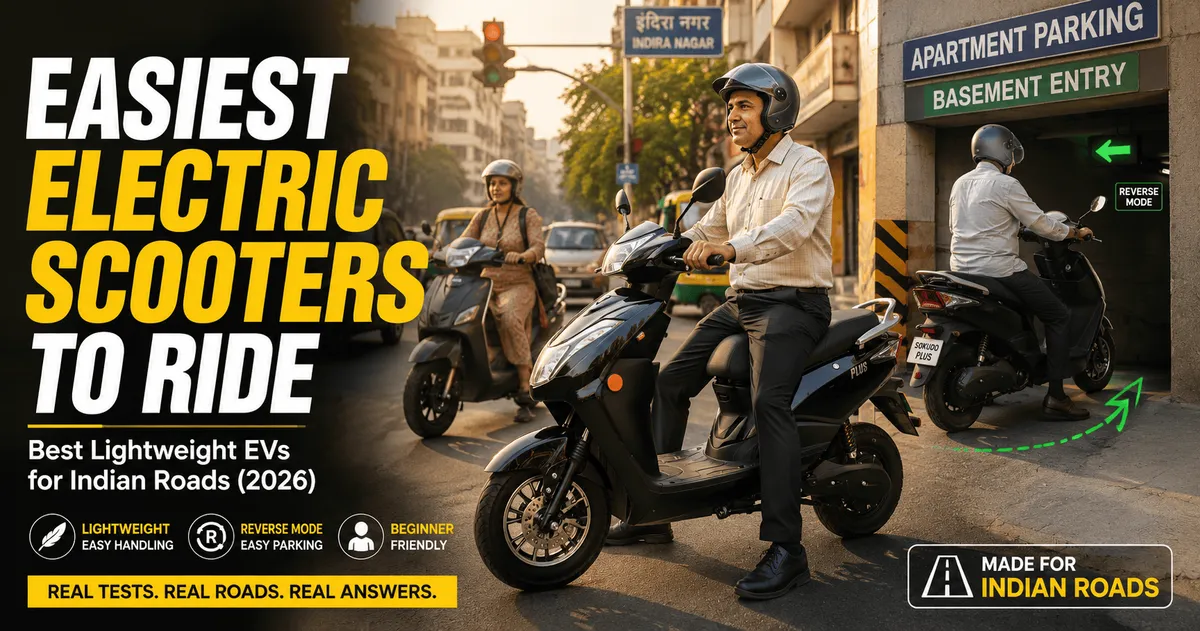
Electric scooter reviews in India consistently measure the wrong things. Range, top speed, touchscreen size - none of these tell you whether a scooter will feel manageable at a Bengaluru signal at 8 AM, or whether your mother can reverse it out of apartment parking.
This guide answers one specific question with precision: which electric scooter is genuinely easiest to ride in real Indian conditions in 2026?
We evaluated seven scooters across six practical comfort parameters used by actual Indian commuters - not spec sheets.
The easiest electric scooters to ride in India in 2026 are the Sokudo Plus, Ampere Reo, and TVS iQube - in that order for beginners, elderly riders, and short-height commuters.
The single biggest factor is kerb weight. Scooters under 105 kg feel dramatically easier to park, balance, and manoeuvre in Indian stop-go traffic compared to 125–135 kg premium models. Reverse mode is the second most impactful feature for daily urban use.
If you want one recommendation: the Sokudo Plus at 100 kg, with reverse mode, no-licence category eligibility, and an LFP battery, currently offers the most beginner-friendly riding experience for Indian city commuters.
International EV reviews are built around highway cruising and performance metrics. Indian commuting is something else entirely.
A typical Indian rider deals with:
In these conditions, weight, seat height, throttle smoothness, and reverse mode matter far more than 0–40 km/h acceleration or connected app features.
According to the Ministry of Road Transport and Highways, urban two-wheeler trips in India average under 15 km - which means most riders spend more time in stop-go traffic than at any kind of cruising speed. Riding ease in those conditions is what determines daily comfort, not peak performance.
This is the framework we used to evaluate every scooter below.
| Parameter | Why It Matters in India |
| Kerb weight | Directly affects balance at signals, parking effort, and U-turn confidence |
| Seat height / flat-foot reach | Determines psychological confidence at stops, especially for shorter riders |
| Throttle calibration | Smooth vs. jerky delivery changes how tiring the ride feels over 20 km |
| Reverse mode | Eliminates the most common daily frustration: reversing in tight parking |
| Low-speed stability | Wider wheelbases and predictable suspension feel safer in crawling traffic |
| Turning radius | Tight lanes, market areas, and apartment driveways demand compact manoeuvring |
Most buyers only check the first two during a test ride. The remaining four only reveal themselves after weeks of daily use - by which point returning the scooter is no longer an option.
| Scooter | Kerb Weight | Top Speed | Reverse Mode | Licence Required | Riding Ease |
| Sokudo Plus | 100 kg | 50 km/h | ✅ Yes | ❌ No | ⭐⭐⭐⭐⭐ |
| Sokudo Select 2.2 | 101 kg | 70 km/h | ✅ Yes | ✅ Yes | ⭐⭐⭐⭐½ |
| Ampere Reo | ~75 kg | 25 km/h | ❌ No | ❌ No | ⭐⭐⭐⭐½ |
| TVS iQube | ~118 kg | 78 km/h | ✅ Yes | ✅ Yes | ⭐⭐⭐⭐ |
| Hero Optima CX | ~82 kg | 45 km/h | ❌ No | ✅ Yes | ⭐⭐⭐½ |
| Ather Rizta | ~125 kg | 80 km/h | ❌ No | ✅ Yes | ⭐⭐⭐ |
| Bajaj Chetak | ~135 kg | 73 km/h | ❌ No | ✅ Yes | ⭐⭐½ |
Sokudo Plus - Easiest Overall for Indian City Riders
Best for: Beginners, elderly riders, women commuters, apartment dwellers, first-time EV buyers
The Sokudo Plus is purpose-built for Indian urban riding, not international spec comparisons. At 100 kg, it is light enough that most riders - including those under 5'2" - can hold it confidently at a signal with one foot down.
What separates it from everything else at this price point:
The Sokudo Plus does not try to impress in a drag race. It tries to make your Monday morning commute feel effortless. In that goal, it succeeds better than anything else in this comparison.
Honest limitation: 50 km/h top speed makes it best suited for city and neighbourhood use. Not the right choice for inter-city or highway riding.
Also read: Best Electric Scooter for Elderly Riders in India - Sokudo India
Best for: Riders who want lightweight handling but need more range and speed for longer city routes
Most lightweight scooters in India make you choose - easy handling or enough performance for a real commute. The Sokudo Select 2.2 is one of the few that genuinely avoids that trade-off.
At 101 kg with a 70 km/h top speed and reverse mode, it handles apartment parking, narrow lanes, and signal stops with the same ease as the Plus - while covering longer city distances without feeling strained. Throttle response is tuned for urban riding, not track-day aggression.
Licence required, which rules it out for some buyers but opens up more of the city for those who have one.
Best for: Senior riders, first-time two-wheeler riders, hyperlocal commuters, riders returning after a long break
At approximately 75 kg, the Ampere Reo is the physically lightest scooter in this comparison - and it shows. Almost anyone can manage it confidently, regardless of height, strength, or riding experience.
Its 25 km/h top speed limits it to colony roads and short neighbourhood commutes. The absence of reverse mode becomes a genuine inconvenience after a few weeks of apartment parking. But for the specific use case of a senior family member doing local errands, or someone riding a two-wheeler for the first time, nothing in this list removes physical intimidation as completely as the Reo.
Best for: Riders wanting a polished, feature-complete daily commuter with manageable ergonomics
The TVS iQube is the most refined scooter in the 115–120 kg range available in India right now. TVS has clearly calibrated its throttle, suspension, and braking for Indian road conditions specifically - and the result is a scooter that feels more approachable than its weight suggests.
Reverse mode is present. Braking is predictable. The seating position suits a wide height range. For riders who want something more premium than entry-level scooters without aggressive handling behaviour, the iQube is the most sensible mainstream choice.
At ~118 kg, it is noticeably heavier than the Sokudo models, but it is the best option in its weight class for riding ease.
Ather Rizta - Strong Comfort, But Weight Shows Up Every Day
Best for: Confident, experienced riders who prioritise seating comfort, features, and connected technology
The Ather Rizta is well-designed for family riding comfort. The seat is wide and supportive. Suspension handles rough roads well. The technology package is among the best in this segment.
But at ~125 kg without reverse mode, the weight becomes a daily reality in Indian apartment parking situations. Riders under 5'4" will feel it during parking and low-speed manoeuvring - not just occasionally, but every single day.
For confident, experienced riders this is an excellent scooter. For the specific question of easiest to ride, it falls below the lighter alternatives in practical urban conditions.
Best for: Experienced riders prioritising build quality, premium feel, and stability at speed
The Bajaj Chetak has genuine road presence. Its metal-heavy construction delivers planted, stable highway behaviour and strong long-term build confidence. Bajaj's service network across India is also a meaningful ownership advantage.
At ~135 kg without reverse mode, it is the most physically demanding scooter in this comparison for daily urban use. Reversing manually in a basement parking ramp after a long day is genuinely tiring. In crawling traffic, its weight requires more active rider management than lighter alternatives.
The Chetak is not hard to ride - but it asks the most from you, every day.
First-time EV buyer: Sokudo Plus or Ampere Reo. Start with something that removes anxiety from parking, not adds to it.
Buying for an elderly parent: Sokudo Plus. Reverse mode plus light weight plus LFP safety is the right combination for senior daily use.
Women commuter in a metro city: Sokudo Plus or TVS iQube. Both are built for low-speed confidence in real urban conditions.
Confident daily commuter wanting mainstream performance: TVS iQube. The most refined scooter in the 115–120 kg range.
Hyperlocal colony commuter: Ampere Reo. Nothing beats it for pure physical manageability at low speeds.
Experienced rider wanting premium feel and don't mind the weight: Ather Rizta or Bajaj Chetak - go in knowing parking requires more physical effort.
Also read: Best Electric Scooter for Women Commuters in India- Sokudo India
Most test rides happen on smooth, open roads that look nothing like your actual commute. Test these six things specifically:
1. Flat-foot reach at a standstill Can both feet rest flat on the ground? If not, ask yourself how you will feel doing this 40 times a day at signals.
2. Manual reverse without motor Reverse it manually with the motor off. If it feels heavy in the showroom, it will feel heavier in your basement parking bay after a
long day.
3. Tight U-turn Make a full U-turn in a tight space - not a wide arc. This replicates what market lanes and apartment driveways actually demand.
4. Throttle from a complete stop Apply throttle gently from standstill. Does it ease forward smoothly, or does it lurch? Lurching compounds over 20 km of city traffic.
5. Reverse mode usability If the scooter has reverse mode, use it in the showroom. Check how intuitive the activation is. A mode buried in menus does not help in a tight parking situation.
6. Loaded stability Ask the salesperson if you can sit with weight on the footboard - simulate grocery bags. Can you hold it stable at a standstill? This is closer to real riding than any empty test ride.
If anything during this checklist makes you hesitant, that hesitation compounds daily. It does not go away after you get used to the scooter.
Which electric scooter is easiest for beginners in India in 2026?
The Sokudo Plus and Ampere Reo are the most beginner-friendly electric scooters in India in 2026. Both are lightweight, have smooth throttle response, and require minimal physical effort during parking and low-speed manoeuvring. The Sokudo Plus additionally offers reverse mode, which the Ampere Reo does not.
Does scooter weight really matter that much for daily riding?
Yes - significantly. The difference between a 100 kg scooter and a 135 kg scooter is felt every time you park, reverse, or hold balance at a signal. Over months of daily commuting in Indian city traffic, this difference accumulates into a meaningfully different riding experience.
Which electric scooter is best for elderly riders in India?
Scooters under 105 kg with reverse mode are consistently best for elderly riders. The Sokudo Plus meets both criteria. The Ampere Reo is lighter but lacks reverse mode, which becomes a practical limitation in apartment parking.
Is a no-licence electric scooter safe to ride in India?
Sub-250W continuous, sub-50 km/h scooters are legally operable without a driving licence in India under current CMVR regulations. They are safe for urban commuting at the speeds Indian city traffic typically permits. Always verify current regulations with your regional transport office before purchase.
Does battery type affect how an electric scooter rides?
Not directly - but LFP batteries tend to have more stable weight distribution and generate less heat, contributing to a more consistent long-term riding experience. LFP also carries lower thermal runaway risk, which is particularly relevant in Indian summer conditions where ambient temperatures regularly exceed 40°C.
Is reverse mode worth it on an electric scooter in India?
In Indian apartment and basement parking scenarios, reverse mode is one of the most practically valuable features available. Most riders who use it daily say they would not consider a scooter without it again. It is especially impactful for elderly riders, shorter riders, and anyone parking on a slope or ramp.
The easiest electric scooter to ride in India in 2026 is the Sokudo Plus - for most riders, in most Indian city conditions.
The Ampere Reo is easier to physically manage but limited in speed and everyday practicality. The TVS iQube is the most refined option in the mainstream segment.
The Ather Rizta and Bajaj Chetak are genuinely good scooters - but they are not the easiest to ride, and that difference shows up every single day.
The best scooter for you is not the one with the most impressive spec sheet. It is the one that feels calm on your Monday commute, parks without frustration in your apartment, and builds your confidence over months of daily use.
Explore the Sokudo Plus and Sokudo Select 2.2 - or visit a Sokudo dealership near you for a test ride built around real Indian commuting conditions, not a showroom loop.
Specifications, pricing, and regulations are subject to change. Always verify current details directly with the official manufacturer or an authorised dealer before purchase.
Share your thoughts about this article.
Loading comments...