12 September 2026·20 min read
26 June 2026•Sokudo Electic India
Published: June 26 2026 | Author: Sokudo Electric India Editorial Team
There is a strange gap sitting right at the heart of India's electric vehicle story.
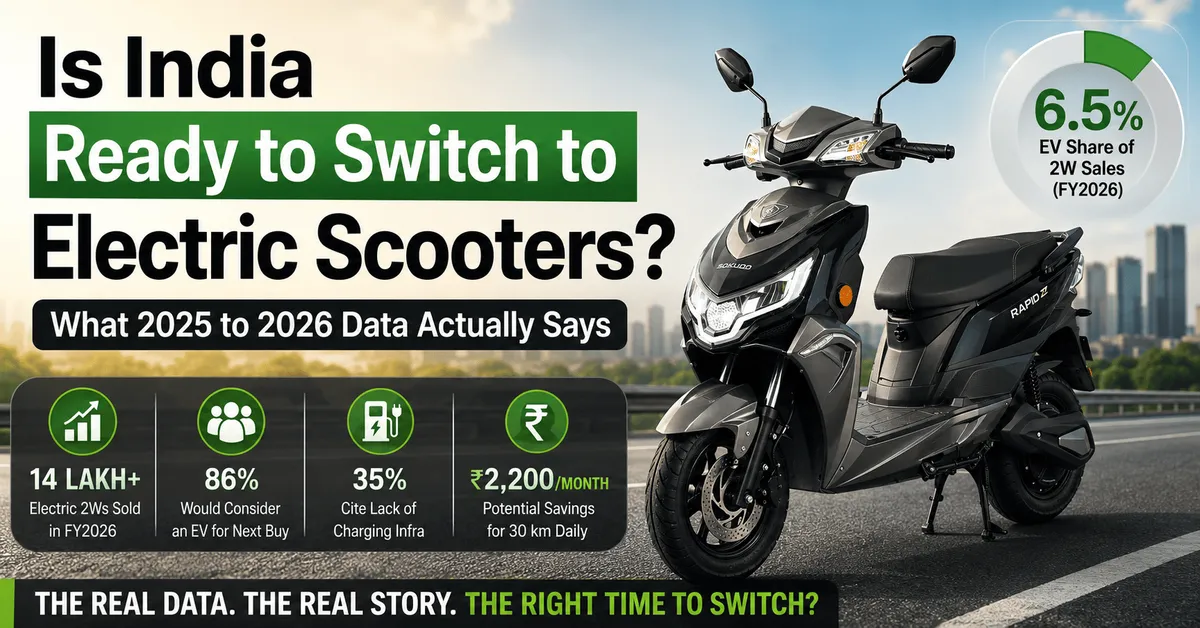
Ask a hundred people if they would consider buying an electric scooter for their next vehicle purchase. According to McKinsey's India Mobility Consumer Survey, 86 of those 100 say yes. Only 69 would even consider a petrol vehicle.
Now look at actual sales. As of FY2026, only about 6.5 out of every 100 new two-wheelers sold in India are electric.
That gap between what people say they want and what they actually buy is the most interesting thing happening in Indian mobility right now. And if you are somewhere in the middle of deciding whether to make the switch, understanding that gap matters a lot more than reading another spec comparison.
Let us start with actual numbers rather than projections.
India sold 14,01,818 electric two-wheelers in FY2026, up from 11,50,790 in FY2025. That is 21.8 percent growth year-on-year, according to FADA's official retail registration data. Electric scooters and motorcycles now make up 6.54 percent of all two-wheeler retail sales in the country, up from 6.09 percent the previous year.
Six percent sounds modest. But look at what the trajectory has actually looked like:
| Financial Year | EV Share of Total 2W Sales |
| FY2020 | Under 1% |
| FY2021 | Approximately 0.4% |
| FY2025 | 6.09% |
| FY2026 | 6.54% |
That is close to a ten-times jump in six years. The direction is not ambiguous.
And monthly figures make the acceleration even clearer. In May 2026, electric two-wheeler penetration hit a record 9.3 percent of total two-wheeler retail, up from 6.1 percent in May 2025. That single month saw 1,70,733 units sold, a 62.8 percent year-on-year surge, driven in part by petrol price increases during the same period. In March 2026, India's electric two-wheeler segment moved 1,89,322 units, the highest monthly figure ever recorded.
So when people ask whether India is switching to electric scooters, the most accurate answer is this: yes, and the pace is picking up considerably.
This is where the picture gets genuinely interesting.
A 2025 national survey by Zoho on EV adoption in India found that 30 percent of respondents already use some form of electric vehicle. The remaining 70 percent still rely on petrol or diesel.
Among those who have already switched, the breakdown tells its own story:
In practical terms, roughly one in every four or five Indians who have gone electric did so through an electric scooter or bike. Two-wheelers are not just the most affordable entry point into EV ownership. They are the dominant format by a very wide margin, and they are likely to remain so for years given how deeply embedded two-wheelers are in Indian daily life.
If 86 percent of people say they would consider an electric scooter, and only 6.5 percent have actually bought one, something specific is creating the gap. The data is honest about what that is.
Charging infrastructure is the single biggest friction point. McKinsey's consumer survey found that 35 percent of respondents feel their area lacks sufficient charging infrastructure. More than half, specifically 58 percent, said they need access to public charging for an electric vehicle to work for them in their daily life.
This concern is legitimate. Home charging works straightforwardly if you have a fixed parking spot and a standard 15-amp power point nearby. The calculation changes for someone living in a multi-storey apartment without dedicated parking, or commuting regularly between towns where roadside charging points are sparse.
Cost anxiety is real, even though the running cost story strongly favours electric. Many buyers walk into a showroom, compare the sticker price of an electric scooter with a petrol model at the same life stage, and see a gap. The total cost of ownership story, specifically that lower running costs over time more than offset the higher upfront price, requires a longer-term mental model than most showroom visits naturally produce.
To give a concrete example: Sokudo scooters run at approximately Rs 0.09 per kilometre. A comparable petrol scooter at current fuel prices runs at approximately Rs 2.50 per kilometre. For a rider covering 30 km daily, that difference adds up to roughly Rs 2,200 saved every single month. The payback on a price difference typically happens within two to three years of regular use. But that calculation needs to be explained, walked through, and trusted rather than just stated.
Past fire incidents created lasting hesitation among some buyers. The high-profile battery fire incidents involving certain EV brands in 2022 left a visible mark on public perception. A LocalCircles poll conducted at the time found that 32 percent of consumers were not convinced about EV safety and performance. That number has improved since, as manufacturers have adopted stricter battery standards, regulators have tightened requirements under AIS-156, and newer models have accumulated years of safe daily operation in Indian conditions.
But trust moves slowly. Buyers who are on the fence about safety need more than a manufacturer's reassurance. They need visible track records, clear warranty terms, and evidence of quality standards from independent certifying bodies.
For Sokudo, ICAT certification and the Zero Fire Complaints designation on models like the Sokudo Plus are part of how that trust is built practically rather than just claimed.
The Zoho survey provides some of the most grounded data on this question.
Electric two-wheeler owners in India gave their experience an average satisfaction score of 4.36 out of 5. The Net Promoter Score, which measures how likely owners are to recommend the product to a friend, came in at 55.6. For context, an NPS above 50 is generally considered excellent in consumer products. Above 70 is world-class.
What do satisfied owners specifically point to? Lower running costs come up consistently. So does the smooth, quiet ride, which turns out to matter a great deal to people who spend 45 to 60 minutes per day commuting through city traffic. Features like reverse mode, USB charging points, and regenerative braking are mentioned regularly as practical daily benefits that petrol scooters simply do not offer.
What frustrates existing owners? Charging takes longer than a fuel fill-up. Public chargers are still unevenly distributed. A small proportion of riders experience range anxiety on trips beyond their usual daily commute.
This is an honest picture, and it is worth holding onto. Electric scooters are not perfect. They do things differently from petrol scooters, and some of those differences require adjustment. But the people who own them and use them every day are largely happy with the decision they made. That is not a small thing.
One significant driver of electric scooter adoption between 2021 and 2024 was government subsidy support.
Under FAME-II, buyers received up to Rs 15,000 per kWh in central government subsidies, which in some cases covered as much as 40 percent of the vehicle's purchase price. This made several premium electric scooters genuinely price-competitive with mid-range petrol models and accelerated adoption considerably.
That structure changed with PM E-DRIVE, the scheme that replaced FAME-II in October 2024. Subsidies dropped to Rs 5,000 per kWh, capped at Rs 10,000 per vehicle, for the initial phase, and then reduced further to Rs 2,500 per kWh capped at Rs 5,000 per vehicle for the FY2026 revised structure. The scheme for electric two-wheelers extended to July 31, 2026 before closing.
The impact of this reduction was visible. Annual growth in electric two-wheeler registrations, which had been running above 30 percent, slowed to around 11.9 percent in calendar year 2025 as subsidies tapered and price adjustments worked through the market.
But here is what matters most for anyone evaluating the purchase today: even after subsidies fell sharply, sales continued growing and FY2026 still produced a record 14 lakh units. That tells you something important. The category has moved past pure subsidy dependence and into genuine demand driven by actual fuel cost savings, product quality, and growing owner confidence. The buyers buying now are doing so because the economics make sense, not because of government incentives that may or may not still be available.
For a detailed breakdown of exactly which subsidies are still available, what state-level incentives stack on top, and how the combined savings affect the real on-road price of different Sokudo models, see our complete guide on how government subsidies made electric scooters affordable in India.
McKinsey projects that electric two-wheelers could account for 60 to 70 percent of all new two-wheeler sales in India by 2030. That would mean roughly 12 to 14 million electric scooters sold annually, up from about 1.4 million today.
That is a significant projection and it deserves some scrutiny. But consider the actual trajectory: under 1 percent six years ago, 6.5 percent today, and already touching 9.3 percent in peak months. A jump from 6.5 percent to 60 to 70 percent in four years is not automatic. But the direction of travel is not in question. The pace is the only variable.
What is likely to drive the next major wave of adoption?
The data points to a few specific things. Total cost of ownership needs to become more visible and more trusted among buyers who have not yet made the switch. Many people still do not know that an electric scooter running at Rs 0.09 per km saves them more in a single year than the price difference between a petrol and electric scooter at comparable specifications. When that calculation becomes common knowledge rather than something that has to be actively discovered, buying behaviour shifts faster.
Charging infrastructure needs to reach Tier-2 and Tier-3 cities at a density that removes the daily range anxiety for riders who park on the street or live in older housing without dedicated power points. This is improving, but it is the single biggest structural barrier remaining.
Product reliability and service accessibility need to become consistent enough that a buyer in Coimbatore or Kanpur has the same confidence about after-sales support as a buyer in Delhi or Bengaluru.
And word of mouth is probably the most underestimated driver. The Zoho data shows that existing EV two-wheeler owners are highly satisfied. Every satisfied owner talking to friends and family about their experience is doing more to accelerate adoption than any advertising campaign.
The honest answer, backed by the data, is that India is mid-switch.
The intent is already there in a large majority. Actual adoption has crossed 6.5 percent and rising, with monthly figures already touching 9.3 percent. The people who have already made the switch are overwhelmingly satisfied, with satisfaction scores and NPS numbers that most consumer product categories would find impressive.
The remaining hesitation lives in three places: infrastructure access, upfront cost perception, and trust in brands and battery quality. All three are addressable and are being addressed, but not uniformly or at the same pace across geographies.
For buyers evaluating the decision right now, the question is not really whether electric scooters are ready for India. The category, the technology, and the economics have all matured. The question is a more personal one: is the right model, at the right price point, with the right service support available in your specific city or town, for your specific daily commute?
That is the problem Sokudo was built to address, with ICAT-certified scooters starting at Rs 67,951, a 3-year battery and motor warranty, LFP battery technology across the entire range, and a confirmed Rs 0.09 per km running cost that makes the financial case from the very first month of ownership.
If you are somewhere in that 86 percent who are still thinking about it, the data from the people who have already made the switch has a clear message: most of them do not regret it.
India sold approximately 14 lakh (1.4 million) electric two-wheelers in FY2026, up 21.8 percent from FY2025, according to FADA's official retail registration data. Peak months in FY2026 crossed 1.8 lakh units sold in a single month.
As of FY2026, electric two-wheelers account for 6.54 percent of total two-wheeler retail sales in India. In peak months like May 2026, that figure crossed 9.3 percent. For comparison, the electric share was under 1 percent just six years ago.
A 2025 national Zoho survey on EV adoption found that 30 percent of respondents already use some form of electric vehicle. Among these early adopters, 74 percent use electric two-wheelers, making the scooter and bike category the dominant format for EV adoption in India.
The same Zoho survey found that electric two-wheeler owners gave their experience an average satisfaction score of 4.36 out of 5, with a Net Promoter Score of 55.6. An NPS above 50 is generally considered excellent for consumer products, which puts India's electric scooter owners in a strongly positive category.
The three main barriers from the data are concerns about charging infrastructure (35 percent of consumers say their area lacks sufficient chargers), upfront purchase price compared to petrol models, and lingering trust concerns about battery safety following incidents in 2022. All three are improving but at different rates in different parts of the country.
McKinsey projects electric two-wheelers could make up 60 to 70 percent of new two-wheeler sales in India by 2030, driven by lower total ownership costs, improving charging infrastructure, and growing word-of-mouth from satisfied existing owners.
Sokudo scooters have a manufacturer-confirmed running cost of Rs 0.09 per kilometre. At 30 km daily, that works out to approximately Rs 2.70 per day or Rs 81 per month on electricity. A comparable petrol scooter at current fuel prices costs approximately Rs 2.50 per km, or Rs 75 per day and Rs 2,250 per month for the same distance. The monthly saving from switching to a Sokudo scooter at this usage level is approximately Rs 2,169.
It depends on your daily distance and road type. The Sokudo Plus at Rs 67,951 is best for local commutes under 25 km with no licence or registration required. The Sokudo Rapid 2.2 at Rs 97,951 suits office commuters covering 25 to 40 km on arterial roads. The Sokudo Acute at Rs 1,25,951 covers long-range commuters covering 40 to 60 km daily with 150 km claimed range and LFP battery technology. All models carry a 3-year battery and motor warranty and run at Rs 0.09 per km. See the full Sokudo range to compare all models side by side.