11 June 2026•Sokudo Electric India
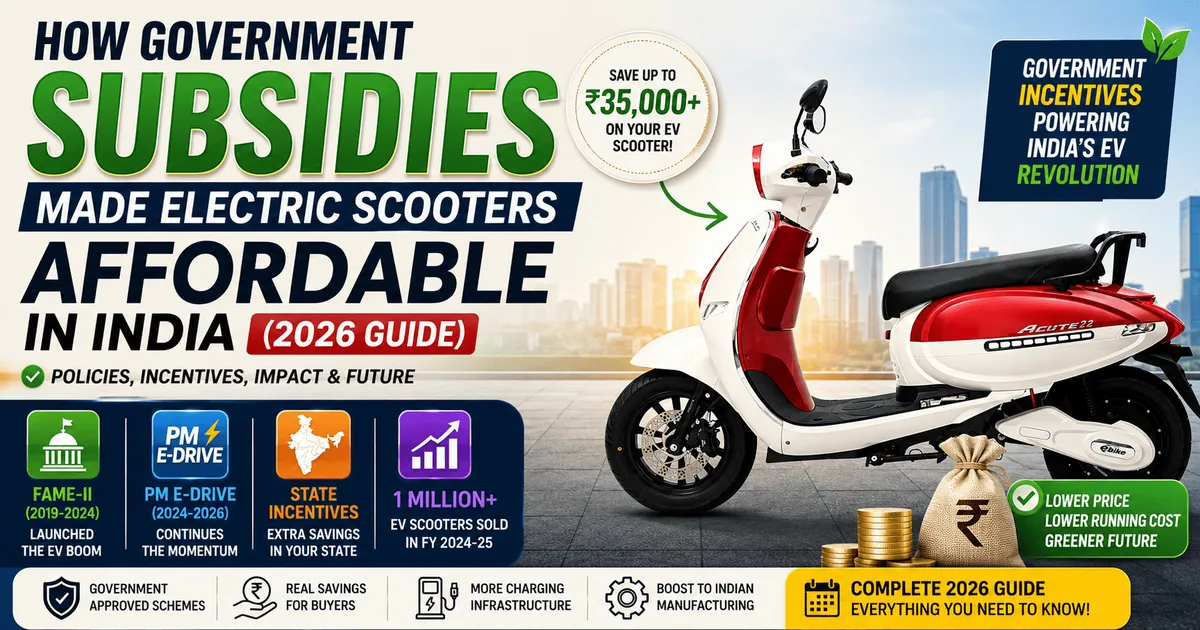
How Government Subsidies Made Electric Scooters Affordable in India (2026 Guide)
Published: June 11 2026 | Author: Sokudo Electric India Editorial Team
India's electric scooter revolution did not happen by chance.
In 2015, electric two-wheelers were expensive, rare, and largely ignored by mainstream buyers. Most people considered them underpowered, unreliable, and impractical for daily commuting. Petrol scooters dominated the market because they were affordable upfront, widely serviced, and easy to refuel anywhere.
Today, India sells over one million electric scooters every year. In FY2024-25 alone, approximately 1.15 million electric two-wheelers were sold, accounting for roughly 6 percent of all two-wheeler sales in the country. That shift did not happen through market forces alone. It happened because the Indian government made a deliberate, sustained financial commitment to making electric scooters cheaper to buy.
This guide explains exactly how that happened, what it means for buyers in 2026, and whether the window to benefit from government support is still open.
Did Government Subsidies Actually Make Electric Scooters Cheaper?
Yes, significantly. Government subsidies through the FAME-II programme and the current PM E-DRIVE scheme have directly reduced the purchase price of electric scooters by thousands of rupees per vehicle. When combined with state-level incentives, total savings for individual buyers have ranged from Rs 5,000 to Rs 35,000 or more depending on the state of purchase and the model chosen. Over 90 percent of electric two-wheelers sold in India in recent years were purchased using some form of central or state subsidy.
Why Electric Scooters Were Once Out of Reach for Most Indian Buyers
Before government incentives entered the picture, electric scooters faced a straightforward problem: they cost significantly more upfront than petrol scooters while offering less performance, shorter range, and minimal service support.
Battery technology was expensive. Lithium-ion packs were imported. Local manufacturing was limited. And without scale, prices stayed high. A buyer comparing a Rs 70,000 petrol scooter with a Rs 1,10,000 electric scooter of similar performance made a simple financial calculation. Petrol won.
Charging infrastructure barely existed. Public awareness was low. And without a proven resale market, buyers had little confidence that the higher upfront investment would pay off over time.
The government recognised that the market would not correct itself fast enough. Private buyers needed a financial reason to switch before the industry could build the scale required to bring prices down naturally.
The Evolution of EV Subsidies in India: From FAME-I to PM E-DRIVE
FAME-I (2015 to 2019): The Pilot
India's formal EV incentive programme began in April 2015 under the FAME India (Faster Adoption and Manufacturing of Electric Vehicles) policy.
FAME-I was a pilot phase with a budget of Rs 795 crore, of which approximately Rs 529 crore was actually utilised. The scheme supported around 2.8 lakh EVs across all vehicle categories. More importantly, it gave the government, manufacturers, and buyers the data needed to design a more effective follow-up programme.
The lessons from FAME-I were clear. Consumer incentives needed to be larger. Local manufacturing requirements needed to be stricter. And the two-wheeler segment needed to be the primary focus because it represented the largest slice of Indian vehicle ownership.
FAME-II (2019 to 2024): The Programme That Moved the Market
FAME-II launched in April 2019 with a budget of Rs 11,500 crore, making it one of the largest EV incentive commitments in India's history. The scheme ran until March 2024 and its targets included 10 lakh electric two-wheelers, 5 lakh electric three-wheelers, 55,000 electric four-wheelers, and 7,000 electric buses.
How the subsidy worked for electric scooter buyers:
FAME-II linked incentives to battery capacity. Electric two-wheelers initially received up to Rs 15,000 per kWh, later revised to Rs 10,000 per kWh. Only scooters using advanced lithium-based batteries with at least 50 percent locally manufactured content were eligible. This requirement served two purposes simultaneously: it reduced the purchase price for end buyers and pushed manufacturers to localise their supply chains.
What FAME-II achieved:
By the time the programme concluded, FAME-II had supported approximately 1.67 million EVs across all categories. Electric two-wheelers made up the bulk of this figure, with over 90 percent of e-2W sales during the scheme's peak years benefiting from subsidised pricing. The programme also helped deploy 5,195 electric buses and more than 9,159 public charging stations across India.
Those numbers represent a structural transformation. When FAME-II began, electric scooters were a curiosity. When it ended, they were a mainstream buying category.
| FAME-II Key Figure | Value |
| Total budget | Rs 11,500 crore |
| EVs supported (all categories) | 1,671,606 units |
| e-2W subsidy rate (peak) | Rs 10,000 to Rs 15,000 per kWh |
| Public chargers deployed | 9,159+ |
| Electric buses deployed | 5,195 |
Source: Press Information Bureau, Ministry of Heavy Industries, March 2026
PM E-DRIVE (October 2024 to July 2026): The Current Scheme
When FAME-II concluded, the government replaced it with the PM E-DRIVE scheme (Electric Drive Revolution in Innovative Vehicle Enhancement), approved by the
Union Cabinet in September 2024 and launched on October 1, 2024.
The total fund allocated to PM E-DRIVE is Rs 10,900 crore. The scheme targets approximately 24.79 lakh electric two-wheelers with a dedicated budget of Rs 1,772 crore for the e-2W segment.
How the current PM E-DRIVE subsidy works for electric scooter buyers:
The scheme operates through an e-voucher mechanism. Buyers receive Rs 2,500 per kWh of battery capacity, capped at Rs 5,000 per vehicle. This deduction happens automatically at the dealership at the time of purchase. No separate application or form is required.
Key eligibility conditions:
- The electric scooter must be priced at Rs 1.5 lakh or less ex-showroom
- The battery must be lithium-based (advanced battery category)
- Buyers need an Aadhaar card and PAN card at the dealership
- Government employees are not eligible for the central subsidy
- The scheme for electric two-wheelers runs until July 31, 2026
In March 2026, the government revised the per-kWh incentive downward from earlier levels to Rs 2,500 per kWh with a Rs 5,000 cap, and simultaneously extended the e-2W deadline by four months to July 31, 2026. This revision signals a gradual move toward market self-sustainability as EV adoption matures, but the support window is still open.
| PM E-DRIVE Key Figure | Value |
| Total scheme budget | Rs 10,900 crore |
| e-2W vehicles targeted | 24,79,120 units |
| e-2W budget allocation | Rs 1,772 crore |
| Subsidy per vehicle | Rs 2,500 per kWh, capped at Rs 5,000 |
| Maximum scooter price eligible | Rs 1.5 lakh ex-showroom |
| Scheme deadline for e-2Ws | July 31, 2026 |
Source: PM E-DRIVE official portal, Ministry of Heavy Industries; BikeDekho, March 2026
For the most current scheme details, buyers can refer to the PM E-DRIVE official portal maintained by the Ministry of Heavy Industries.
State EV Subsidies: Where the Real Savings Stack Up
Central government subsidies are only part of the picture. Many state governments layer additional purchase incentives and tax exemptions on top of the central scheme. This is where combined savings can become genuinely significant for buyers.
Maharashtra (2025 to 2030 EV Policy)
Maharashtra's current EV policy, running from 2025 to 2030, is one of the most comprehensive state-level programmes in the country. The policy targets 30 percent of all new vehicle registrations being electric by 2030.
For electric scooter buyers:
- Flat rebate of Rs 10,000 per electric two-wheeler at the time of purchase
- 100 percent exemption from road tax and registration fees on all EVs
- Combined with PM E-DRIVE, a Maharashtra buyer can receive up to Rs 15,000 in total incentives on a qualifying scooter
Maharashtra led India in EV adoption in FY2024-25, selling approximately 2,46,221 EVs in total, representing 12.52 percent of all India's EV sales. Within that, approximately 2,11,880 were electric two-wheelers, accounting for 18 percent of India's total e-2W sales.
Delhi EV Policy
Delhi provides zero road tax and zero registration fees for all registered electric vehicles. Buyers in Delhi also receive additional purchase support of Rs 5,000 to Rs 25,000 per electric two-wheeler on top of central incentives, depending on the specific scheme active at time of purchase.
Gujarat EV Policy
Gujarat has offered purchase support of Rs 10,000 to Rs 20,000 per electric two-wheeler alongside tax waivers. Policies have been updated periodically, so buyers should verify the current figures at the state transport office before finalising a purchase.
Karnataka, Tamil Nadu, and Kerala
Karnataka offers a 50 percent registration fee waiver and Rs 10,000 per electric two-wheeler under its EV policy. Tamil Nadu waives registration tax and offers Rs 5,000 to Rs 10,000 per e-2W. Kerala has introduced similar incentive structures to encourage EV adoption in the state.
What state incentives mean in practice:
State incentives typically add Rs 5,000 to Rs 25,000 per electric scooter on top of central support, making the effective purchase price 10 to 20 percent lower than the listed ex-showroom price when all available incentives are combined.
| State | Purchase Incentive per e-2W | Tax/Fee Benefit |
| Maharashtra | Rs 10,000 | 100% road tax and registration waiver |
| Delhi | Rs 5,000 to Rs 25,000 | Zero road tax, zero registration |
| Gujarat | Rs 10,000 to Rs 20,000 | Tax waivers |
| Karnataka | Rs 10,000 | 50% registration fee waiver |
| Tamil Nadu | Rs 5,000 to Rs 10,000 | Registration tax waiver |
Source: Bolt.Earth Maharashtra EV Policy report, January 2026; state government portals
Buyers should confirm the exact current figures with their state transport department or dealer before purchasing, as state policies are updated periodically. The NITI Aayog e-AMRIT portal provides a regularly updated reference for national and state EV incentive information.
How Much Did Subsidies Actually Reduce Electric Scooter Prices?
A practical example helps illustrate the real impact.
Consider a buyer in Maharashtra purchasing a qualifying electric scooter priced at Rs 89,000 ex-showroom in June 2026:
| Incentive | Amount |
| PM E-DRIVE (central subsidy) | Rs 5,000 |
| Maharashtra state rebate | Rs 10,000 |
| Road tax saving | Rs 3,000 to Rs 5,000 (est.) |
| Registration fee saving | Rs 1,500 to Rs 2,500 (est.) |
| Total effective saving | Rs 19,500 to Rs 22,500 |
On a scooter listed at Rs 89,000, that represents a real-world price reduction of approximately 22 to 25 percent before a single kilometre is ridden.
For a buyer in Delhi purchasing at the higher end of the state incentive band, the combined saving from central and state support could reach Rs 30,000 or more on eligible models.
How Subsidies Changed the Market: The Numbers
The impact of these programmes on actual buyer behaviour is visible in sales data.
India's total two-wheeler market in FY2024-25 was approximately 19.6 million units. Within that, electric two-wheelers accounted for approximately 1,149,641 units, representing roughly 6 percent of total two-wheeler sales. This compares with under 0.5 million electric two-wheelers sold just a few years earlier.
That growth trajectory reflects what happens when upfront price barriers are systematically reduced. More buyers enter the market. More buyers drive down manufacturing costs. Lower manufacturing costs further reduce prices. The cycle reinforces itself until the market can sustain itself without heavy subsidy support, which is precisely where India's EV two-wheeler segment is now heading.
According to analysis by the Council on Energy, Environment and Water (CEEW), over 90 percent of electric two-wheelers sold in recent years used FAME or PM E-DRIVE subsidies, confirming that the central incentive structure was a primary driver of purchase decisions rather than a marginal benefit.
Why Running Costs Matter More Than Subsidies Over the Long Term
Subsidies reduce the upfront cost. But for most daily commuters, the more important number is what the scooter costs to run every day for five to ten years.
This is where the financial case for electric scooters becomes strongest, independent of whether any subsidy is available.
| Expense | Electric Scooter | Petrol Scooter |
| Cost per km | Rs 0.20 to Rs 0.80 | Rs 2.50 to Rs 4.00 |
| Monthly cost (1,000 km) | Rs 300 to Rs 800 | Rs 3,000 to Rs 4,000 |
| Engine oil changes | None | Yes, every 3 months |
| Spark plugs, filters | None | Yes, annually |
| 5-year fuel and maintenance | ~Rs 33,000 | ~Rs 2,05,000 |
For a rider covering 11,000 km per year over five years, the total ownership cost difference between an electric scooter and a petrol scooter typically exceeds Rs 1.5 lakh in the electric scooter's favour, even after accounting for the higher upfront purchase price.
Subsidies narrow the purchase price gap at the start. Running cost economics sustain the advantage across the entire ownership period. For buyers who commute daily in Indian cities, both factors compound in the same direction.
To understand the full five-year ownership cost breakdown, our guide on the most affordable electric scooters in India for 2026 includes model-specific cost calculations.
How Subsidies Drove Local Manufacturing and Better Battery Technology
One of the less-discussed effects of the FAME and PM E-DRIVE programmes is how they pushed the industry toward better products.
By linking subsidies to local content requirements (a minimum of 50 percent local manufacturing), the government created a financial incentive for manufacturers to build supply chains within India rather than simply importing assembled products.
This localisation drive had a direct effect on battery manufacturing, component quality, and ultimately product reliability. Manufacturers who invested in local LFP battery production, for example, were able to meet subsidy eligibility criteria while also building products better suited to Indian operating conditions.
The result is that buyers in 2026 are not just getting cheaper scooters than they would have in 2019. They are getting technically better scooters, with longer-lasting batteries, stronger safety systems, and more reliable performance in Indian heat and road conditions.
The Future of EV Subsidies in India: What Happens After July 2026?
The March 2026 revision of PM E-DRIVE, which halved the per-kWh incentive from earlier levels to Rs 2,500 while extending the deadline for e-2Ws to July 31, 2026, is a deliberate signal from the government. Incentives are gradually reducing as the market matures.
This does not mean electric scooters will become unaffordable after subsidies end. Battery costs have fallen significantly over the past decade and continue to decline. Manufacturing scale has increased. Competition has intensified. These forces are working to bring prices down independently of government support.
However, buyers who purchase before July 31, 2026 are still able to benefit from the current PM E-DRIVE central subsidy of up to Rs 5,000, plus whatever their state currently offers. Waiting beyond that date means those savings disappear from the equation.
The government's long-term strategy is clearly toward market self-sustainability rather than permanent subsidy dependence. The industry is moving in that direction. But the transition period, which buyers are currently in, still offers meaningful purchase price advantages that will not be available indefinitely.
Is Now a Good Time to Buy an Electric Scooter in India?
Looking at the full picture, the answer for most daily commuters is yes, and the timing is specifically relevant.
PM E-DRIVE subsidies are still active but running down toward a July 31, 2026 deadline. State incentives in Maharashtra, Delhi, Gujarat, Karnataka, and Tamil Nadu are still available but subject to periodic revision. Battery technology is mature. Service networks have expanded. Product reliability has improved significantly compared to early-generation scooters.
All Sokudo electric scooters including the Sokudo Acute, Sokudo Rapid 2.2, Sokudo Select 2.2, and Sokudo Plus use LFP battery technology, are priced well within the Rs 1.5 lakh PM E-DRIVE eligibility ceiling, and carry a 3-year battery warranty alongside a 1-year vehicle warranty.
For model-by-model comparisons and current pricing, visit the full Sokudo electric scooter range.
Frequently Asked Questions
What is the current electric scooter subsidy in India in 2026?
The PM E-DRIVE scheme provides Rs 2,500 per kWh of battery capacity, capped at Rs 5,000 per electric two-wheeler. The deduction is applied automatically at the dealership. The scheme is valid for electric two-wheelers until July 31, 2026. Buyers need an Aadhaar card and PAN card. The scooter must be priced at Rs 1.5 lakh or below ex-showroom.
Is FAME-II still available?
No. FAME-II concluded in March 2024. It has been replaced by the PM E-DRIVE scheme which launched in October 2024.
What is PM E-DRIVE?
PM E-DRIVE stands for Electric Drive Revolution in Innovative Vehicle Enhancement. It is the central government scheme that replaced FAME-II. Its total budget is Rs 10,900 crore, targeting approximately 24.79 lakh electric two-wheelers with a subsidy of Rs 2,500 per kWh capped at Rs 5,000 per vehicle.
Which states offer additional EV subsidies?
Maharashtra, Delhi, Gujarat, Karnataka, Tamil Nadu, and Kerala all offer state-level incentives on top of the central PM E-DRIVE subsidy. These range from Rs 5,000 to Rs 25,000 per electric two-wheeler plus road tax and registration fee exemptions. Figures change periodically and should be verified with your dealer or state transport office.
Can I combine central and state subsidies?
Yes. The central PM E-DRIVE subsidy and state-level incentives can be combined. Maharashtra buyers, for example, can receive Rs 5,000 from PM E-DRIVE plus Rs 10,000 from the state scheme, plus road tax and registration savings on top.
Which electric scooters qualify for PM E-DRIVE?
Electric two-wheelers priced at Rs 1.5 lakh or below ex-showroom, using lithium-based batteries, are eligible. Models from ICAT-certified manufacturers that meet local content requirements qualify. Ask your dealer to confirm eligibility for the specific model before purchase.
Are EV subsidies ending?
Not immediately, but they are reducing. PM E-DRIVE cut the per-kWh incentive in March 2026 and set the e-2W deadline at July 31, 2026. Future schemes may exist but their size and structure are not yet confirmed. The current window is still open.
Are electric scooters still worth buying without subsidies?
Yes, for most daily commuters. The running cost advantage of Rs 0.20 to Rs 0.80 per km versus Rs 2.50 to Rs 4.00 per km for petrol creates substantial savings over five years regardless of whether a purchase subsidy was available. Subsidies accelerate the break-even point but do not create it.
How much money can a buyer save overall by switching to electric in 2026?
For a rider covering 11,000 km per year, five-year savings on fuel and maintenance alone typically exceed Rs 1.5 lakh compared to an equivalent petrol scooter. Add available subsidies of Rs 15,000 to Rs 25,000 at the time of purchase and the total financial advantage of switching to electric is substantial.
What documents do I need to claim PM E-DRIVE at the dealership?
An Aadhaar card and PAN card. The deduction is processed through the e-voucher mechanism at the dealership. No separate government portal registration is required by the buyer.
Final Verdict: Did Government Subsidies Transform India's Electric Scooter Market?
The evidence is unambiguous. India's EV two-wheeler market was niche in 2015 and mainstream in 2026. The journey from one to the other was shaped significantly by government financial commitment at both the central and state level.
FAME-I created proof of concept. FAME-II moved the market, supporting 1.67 million EVs and pushing manufacturers to localise production and improve product quality. PM E-DRIVE is completing the transition, with a narrowing subsidy structure that signals growing market maturity rather than declining government support.
The practical conclusions for buyers in 2026 are clear:
The PM E-DRIVE subsidy of up to Rs 5,000 is still available until July 31, 2026 and applies automatically at the dealership. State incentives in several major states add Rs 10,000 to Rs 25,000 on top. Combined savings of Rs 15,000 to Rs 30,000 are realistically achievable for buyers in Maharashtra, Delhi, and Gujarat. Beyond
the purchase price, the running cost advantage of electric over petrol remains substantial and permanent regardless of what happens to future subsidy structures.
For buyers who have been considering a switch, the combination of remaining subsidy support, mature battery technology, lower running costs, and expanded service networks makes 2026 one of the strongest years on record to make that decision.
To understand what to look for beyond price, read our guide on how to choose the right electric scooter in India in 2026. For safety and battery technology comparisons, see our guide on whether electric scooters are safe in India. And for long-term ownership expectations, our guide on how long electric scooters last in India covers what to expect across different usage profiles.
Comments
Share your thoughts about this article.
Loading comments...