10 June 2026•Sokudo Electric India
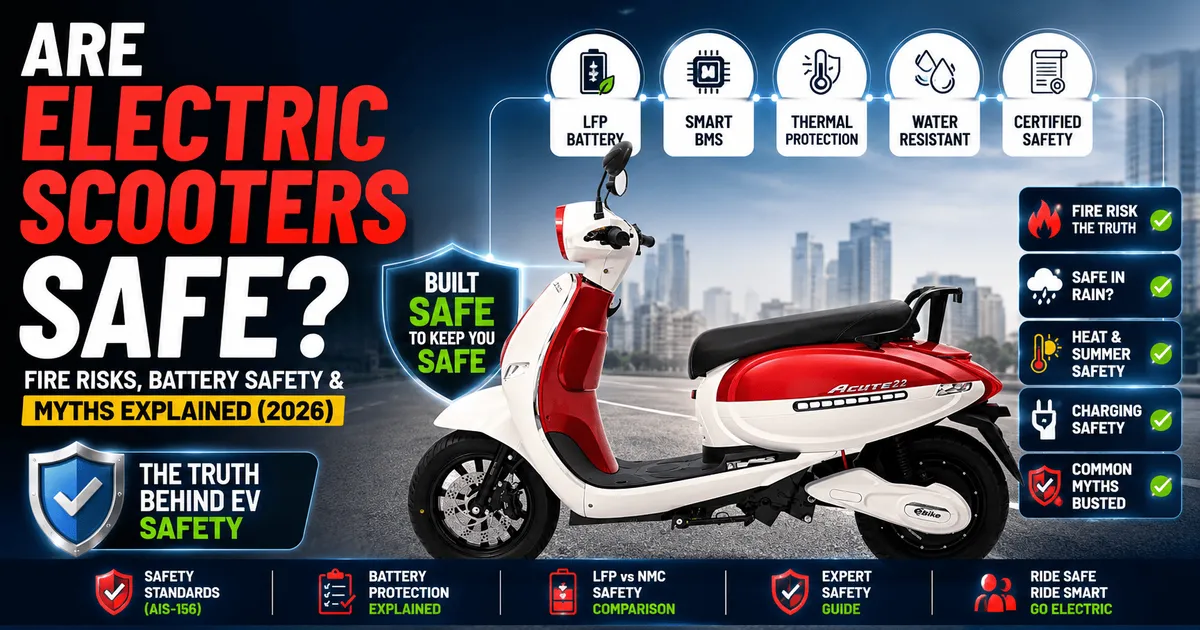
Are Electric Scooters Safe? Fire Risks, Battery Safety and Common Myths Explained (2026)
Published: June 10 2026 | Author: Sokudo Electric India Editorial Team
Electric scooters have become one of the fastest-growing vehicle categories in India. But alongside that growth, one question comes up in almost every buying conversation:
Are electric scooters actually safe?
The concern is understandable. A handful of widely reported fire incidents between 2021 and 2023 created lasting doubt among buyers who were seriously considering switching from petrol. Even in 2026, many people still carry worries about battery explosions, charging risks, and summer temperatures.
The reality today is very different from that perception.
Battery technology has improved significantly. Government regulations are now considerably stricter. Battery management systems have become smarter.
Manufacturers are widely adopting safer battery chemistries. Testing requirements are far more thorough than they were even three years ago.
Modern electric scooters are genuinely safer than the early-generation products that made headlines. This guide covers everything you need to know before buying, so you can make your decision based on facts rather than fear.
Are Electric Scooters Safe in India?
Yes. Modern electric scooters are generally safe when they use quality battery technology, certified components, and properly designed battery management systems.
Most fire incidents reported in India involved early-generation batteries, inadequate thermal management, manufacturing defects, or improper charging practices.
Scooters using LFP battery technology offer significantly improved safety compared to older battery chemistries. Buyers who choose reputable manufacturers with proper certifications and strong warranties face very low ownership risk.
What Actually Makes an Electric Scooter Safe?
Electric scooter safety is not determined by one component. It depends on how several systems work together to protect the rider, the battery, and the vehicle throughout its working life.
Battery technology is the foundation. Battery chemistry directly influences thermal stability, heat resistance, fire risk, lifespan, and charging safety. It is one of the most important differences between scooters.
Battery Management System (BMS) acts as the brain of the battery pack. A quality BMS continuously monitors cell voltage, temperature, charging rate, current flow, and cell balance. If abnormal conditions appear, the system can automatically limit charging, reduce power output, or disconnect circuits to prevent damage.
Charger quality matters more than most buyers realise. The charger controls charging voltage, current flow, temperature monitoring, and overcharge protection. Using uncertified or poor-quality chargers bypasses these safeguards.
Motor controller protection regulates power delivery between the battery and motor. Modern controllers include protection against short circuits, overheating, power surges, and electrical faults.
Thermal management prevents battery packs from overheating during charging and riding. Effective thermal management protects performance, extends lifespan, and reduces fire risk.
Vehicle certification means the scooter has been tested against established safety standards before it reached the market. This includes testing for heat resistance, water resistance, crash protection, battery abuse scenarios, and charger compatibility.
Why Electric Scooter Fires Happen: The Real Causes
To understand EV safety accurately, it helps to understand what actually causes battery fires. Batteries do not spontaneously ignite without a trigger. Most battery-related incidents occur when multiple failures happen at the same time.
Thermal runaway is the mechanism behind most serious battery incidents. It occurs when heat generated inside a battery exceeds the battery's ability to dissipate that heat. The temperature rises rapidly, triggering a chain reaction inside battery cells. Without proper protection systems, this reaction can spread from one cell to neighbouring cells, a process called thermal propagation.
The most common triggers for thermal runaway include:
- Manufacturing defects in battery cells, even microscopic ones that create internal short circuits
- Poor-quality cells that lack consistent construction and reduced thermal tolerance
- Physical battery damage from severe crashes, crushing impacts, or punctures
- Water ingress from prolonged exposure to deep water rather than normal rain
- Faulty or uncertified chargers that deliver incorrect voltage or cause overcharging
- Unauthorized modifications that bypass factory safety systems
Most of the incidents India saw between 2021 and 2023 were traceable to combinations of these factors: inadequate thermal management, poor cell quality, and
manufacturing defects in early-stage products from brands that were scaling too fast without adequate quality control.
How Common Are Electric Scooter Fires in India? Looking Past the Headlines
Media coverage can significantly distort perception of risk. When an EV fire occurs, it often receives national coverage. Millions of safe daily rides receive no coverage at all.
India now has millions of electric two-wheelers operating on its roads every day. When evaluating safety, the number of incidents needs to be seen against this total, not just counted in isolation.
The Bureau of Energy Efficiency under India's Ministry of Power tracks the growth of EV adoption across India and consistently reports year-on-year increases in the registered EV fleet. As that fleet has grown, regulatory requirements have simultaneously tightened, with the result that safety performance has improved while adoption has expanded.
A useful analogy is aviation. Plane incidents receive extensive media coverage despite air travel being statistically very safe. The coverage reflects the newsworthiness of the event, not the frequency of the risk.
For buyers, the relevant question is not whether fires have ever happened. It is how frequently they occur relative to the total number of vehicles in operation, and whether the scooter you are considering has been built to modern safety standards.
How does fire risk compare with petrol scooters?
Petrol scooters carry combustible liquid fuel, hot engine components operating at high temperatures, fuel lines, and exhaust systems. Electric scooters eliminate all of these risks entirely while introducing battery-related considerations.
| Risk Factor | Electric Scooter | Petrol Scooter |
| Fuel leakage | No | Yes |
| Battery fire risk | Possible | No |
| Engine fire risk | No | Possible |
| Explosion risk | Very low | Moderate |
| Fire spread | Usually localised | Fuel-assisted |
| Flammable liquid on board | No | Yes |
| Hot exhaust components | No | Yes |
Neither technology is completely risk-free. The goal is managing risk through quality engineering, proper usage, and choosing products that meet modern safety standards.
LFP vs NMC Batteries: Which Is Safer for Indian Riders?
Battery chemistry is one of the most important safety considerations in any electric scooter, and one of the least discussed in most buying conversations.
Two chemistries dominate the Indian electric scooter market:
NMC (Nickel Manganese Cobalt) batteries offer higher energy density and lighter pack weight. They perform well in terms of range, but require more sophisticated thermal management systems and are generally more susceptible to heat-related degradation.
LFP (Lithium Iron Phosphate) batteries offer better thermal stability, longer cycle life, improved safety characteristics, and more consistent performance in high-temperature environments. The trade-off is slightly lower energy density.
| Feature | LFP | NMC |
| Thermal stability | Higher | Lower |
| Fire resistance | Better | Moderate |
| Cycle life | Higher (2,000 to 4,000+ cycles) | Lower |
| Heat tolerance | Excellent | Good |
| Safety margin | Excellent | Good |
| Indian climate suitability | Excellent | Good |
If you're building or riding an EV in India, LFP battery chemistry holds a massive real-world edge. As highlighted by Auto Punditz's deep dive into Indian EV conditions, mass-market two-wheelers and cars are heavily pivoting toward LFP. The reasons are simple: it offers exceptional thermal stability that can handle intense tropical summers, costs less to manufacture, and boasts a much longer lifespan under the daily stress of stop-and-go traffic and frequent top-up charging.
Summer temperatures in cities like Delhi, Jaipur, Nagpur, and Hyderabad regularly exceed 42 to 47 degrees Celsius. Scooters parked outdoors under direct sunlight can experience significantly higher surface temperatures. In these conditions, the thermal stability advantage of LFP is not theoretical. It is a practical daily reality.
All Sokudo electric scooters including the Sokudo Acute, Sokudo Acute 2.2, Sokudo Rapid 2.2, and Sokudo Plus use LFP battery technology, making them suitable for the range of temperatures and riding conditions Indian commuters encounter daily.
Can Electric Scooters Be Used Safely in Indian Summers?
This is one of the most common concerns among buyers, and it deserves a clear answer.
Modern electric scooters are designed and tested specifically for hot climates. Manufacturers in India conduct extensive heat testing because India represents one of the most demanding battery environments in the world.
What actually happens above 40 degrees Celsius?
A modern electric scooter does not become unsafe once temperatures exceed 40 degrees. The battery management system actively manages performance in response to heat. Riders may occasionally notice slightly reduced range, a brief pause before charging starts, or a temporary power limitation in extreme conditions.
These are safety features responding as designed, not defects.
The BMS continuously monitors cell temperatures, voltage levels, and current flow. If it detects conditions that could stress the battery, it can reduce output, delay charging initiation, or disconnect affected circuits. This proactive monitoring reduces the likelihood of heat-related issues significantly.
Simple habits that protect battery health in summer:
- Park in shaded or covered areas whenever possible
- Avoid leaving the scooter under direct sunlight for extended periods
- Allow the scooter to cool briefly after long rides before beginning to charge
- Avoid charging immediately after aggressive riding in extreme heat
These are small adjustments that meaningfully extend battery life over years of ownership. For a detailed breakdown of best practices, our guide on how to extend the battery life of your electric scooter covers this with specific recommendations.
Are Electric Scooters Safe During the Monsoon?
Yes. Modern electric scooters are designed to handle rain and wet-weather commuting safely.
Battery packs are housed in sealed enclosures designed to resist water intrusion, dust, road debris, and mud contamination. Controllers and wiring harnesses carry similar protection. Normal monsoon commuting in cities like Mumbai, Kochi, and Chennai is not a problem for well-designed electric scooters.
Understanding IP ratings
IP stands for Ingress Protection. The rating describes how effectively a component resists dust and water. Most battery packs and controllers on modern scooters carry ratings like IP65, IP67, or IP68. Higher numbers indicate stronger protection.
| IP Rating | Protection Level |
| IP65 | Dust-tight, protected against water jets |
| IP67 | Dust-tight, protected against temporary immersion |
| IP68 | Dust-tight, protected against extended immersion |
Always check your specific model's documentation for the exact ratings.
What to avoid during monsoon season:
- Deep water crossings and flooded roads regardless of the IP rating
- Pressure washing electrical components directly
- Parking in standing water for extended periods
Flooded roads are a risk for all vehicles, not just electric scooters. The electrical hazards, hidden potholes, and debris in floodwater make them dangerous independent of what is powering the vehicle.
Charging during monsoon season remains safe when basic precautions are followed: keep charging ports dry before plugging in, use covered charging areas, inspect charging cables for damage regularly, and make sure plugs are fully seated before leaving the scooter to charge.
AIS-156: The Safety Standard That Changed the Industry
One of the biggest improvements in electric scooter safety came from a regulatory response to the fire incidents of 2021 to 2022. Following those incidents, India's automotive regulators worked with manufacturers, testing agencies, and industry bodies to strengthen EV safety requirements.
The result was a significant strengthening of the AIS-156 standard, which governs electric two-wheelers in India.
AIS-156 introduced enhanced requirements covering battery pack design, thermal safety, cell protection, fault management systems, charger safety, water resistance, and critically, thermal propagation testing.
Thermal propagation testing is one of the most important additions. This test evaluates what happens if a single battery cell fails. The standard requires that a single cell failure must not cause uncontrolled heat spread to the entire battery pack. Modern battery designs must demonstrate that they can contain a thermal event
rather than allow it to cascade.
This represents a genuine and meaningful advance in safety. Early-generation scooters were not required to demonstrate this. Most modern compliant scooters are.
Other key testing requirements under AIS-156 include:
- Electrical safety validation and mechanical durability testing
- Environmental and weather exposure testing
- Battery abuse condition testing simulating damage and misuse scenarios
- Charging system compatibility and safety validation
- Impact resistance testing for real-world road conditions
Buyers choosing scooters that comply with current AIS-156 requirements are choosing products that have been validated against a significantly more rigorous standard than anything that existed during the early incident-heavy period.
The Ministry of Road Transport and Highways maintains updated information on type approval requirements and safety standards applicable to electric vehicles sold in India.
Safe Charging Practices Every EV Owner Should Follow
Most battery problems are preventable. Charging is the most routine aspect of EV ownership, and following a few straightforward habits makes a meaningful difference to both safety and battery lifespan.
Use only approved chargers. The charger supplied with your scooter is designed to communicate correctly with your specific battery management system. It operates within the correct voltage and current parameters for your battery chemistry. Uncertified third-party chargers often lack voltage regulation, temperature monitoring, and current protection.
Check your power socket. Avoid loose sockets, burnt outlets, damaged wiring, or improvised extension cords. Electrical faults in the socket or wiring feeding the charger can create unnecessary hazards even with a good quality charger.
Charge in a ventilated area. Heat generated during charging needs somewhere to go. Covered parking, a garage with airflow, or an open-air charging area all work well. Avoid enclosed spaces with poor air circulation.
Do not cover the charger while it is operating. Some riders place chargers under cloth or inside bags to protect them from dust. This traps heat and creates unnecessary stress on the charger.
Let the scooter cool before charging after long summer rides. Charging a battery that is already hot from extended riding in peak heat conditions places additional stress on the cells. A 15 to 20 minute rest period before connecting the charger is a simple and effective habit.
Avoid draining below 20%. LFP batteries in particular benefit from being kept between 20% and 80% for everyday use. Deep discharges repeated over time shorten cycle life faster than normal charging does.
Inspect charging cables periodically. Check for fraying, kinks, or damage to the cable and the connector. A damaged cable should be replaced before continued use.
Warning Signs of Battery Problems: What to Watch For
Battery issues rarely appear without warning. Learning to recognise early signs can prevent much larger problems later.
Battery swelling is one of the clearest indicators of damage. A swollen battery pack should be inspected by an authorised service centre immediately. Do not continue riding.
Unusual heat during or after charging. Batteries become warm normally. Excessive or unexpected heat, particularly when the scooter is not in use, warrants investigation.
Burning smell of any kind. Any smell resembling burning plastic, electrical insulation, or chemical odours means stopping immediately and contacting the manufacturer or service centre.
Sudden range drops. Gradual reduction in range over months is normal battery aging. A rapid, unexpected drop in range over days or a single charging cycle can indicate a cell-level problem.
Charging interruptions or error messages. If the charger stops and restarts repeatedly, throws error codes, or runs unusually hot, it needs to be checked.
Unexpected power cut-offs while riding. A scooter that cuts power suddenly mid-ride may have a BMS intervention, cell imbalance, or a controller fault that requires diagnosis.
Physical damage after an accident. After any significant impact, battery inspection is strongly recommended even when there is no visible external damage. Internal cell damage may not be immediately apparent from the outside.
What to Do If the Battery Overheats
This is uncommon, but every rider should know how to respond calmly.
- Stop riding. If you notice unusual heat, smell, visible smoke, or warning indicators, pull over safely and turn the scooter off.
- Move away from flammable material if you can do so safely. Keep distance from dry vegetation, other vehicles, and buildings.
- Disconnect charging if safe. If overheating occurs while charging, unplug only if you can do so without touching visibly damaged components.
- Do not use water to cool a battery. Water and lithium batteries interact dangerously. Keep bystanders at a safe distance.
- Call the manufacturer's service line. Authorised centres have proper diagnostic equipment. Do not attempt to open the battery pack or make repairs yourself. Battery packs operate at high voltage and require professional handling.
7 Common Myths About Electric Scooter Safety, Debunked
Myth 1: Electric scooters catch fire frequently
This is the most widespread misconception. Millions of electric scooters operate safely across India every day. Fire incidents receive extensive media coverage precisely because they are unusual. Modern EVs benefit from improved battery chemistry, better BMS systems, stricter regulations, and more thorough testing. The vast majority of owners never experience any battery-related safety issue throughout their ownership period.
Myth 2: All lithium batteries are equally dangerous
Lithium batteries vary significantly by chemistry and engineering quality. LFP batteries offer better thermal stability and a larger safety margin than NMC batteries. Cell quality, thermal management design, and BMS sophistication matter as much as chemistry. Two scooters can both use lithium batteries and have very different safety profiles.
Myth 3: Electric scooters are unsafe in Indian summers
Modern scooters are specifically designed and tested for hot climates. Battery systems include temperature monitoring, thermal protection, and performance management. High-quality LFP batteries handle elevated temperatures particularly well. Heat can accelerate battery degradation over time if ignored, but it does not make a properly engineered scooter unsafe to ride.
Myth 4: Charging overnight is dangerous
Overnight charging is exactly how most electric scooters are intended to be used. Modern chargers and BMS systems monitor voltage, current, temperature, and charging completion continuously. Once the battery reaches full charge, the system manages the process automatically. The key is using the approved charger and a good-condition household socket, not limiting how long the scooter is connected.
Myth 5: EV batteries explode easily
True explosions from EV batteries are extremely rare. Most battery failures involve thermal runaway and overheating rather than explosive events. Modern battery packs include multiple protection layers designed to detect abnormalities early, limit damage, and isolate affected cells. Well-designed batteries are engineered specifically to prevent catastrophic failure from escalating.
Myth 6: Electric scooters cannot be used in rain
Modern electric scooters are built for wet-weather operation with IP-rated battery packs, sealed electrical components, and water-resistant connectors. Normal monsoon commuting is safe. Flooded roads remain a hazard for all vehicles regardless of propulsion type.
Myth 7: Battery degradation makes a scooter unsafe
Battery degradation means reduced range and more frequent charging. It does not automatically create a safety issue. A battery holding 75 to 80 percent of its original capacity can still function safely for years. Degradation and damage are different conditions with different implications.
Safety Checklist: What to Verify Before Buying Any Electric Scooter
Before finalising any purchase, check these points carefully.
- Battery chemistry: LFP batteries offer the strongest safety profile for Indian conditions
- AIS-156 compliance: Verify the vehicle meets current regulatory requirements
- Battery warranty: A 3-year or longer battery warranty reflects manufacturer confidence in the product
- Vehicle warranty: 1-year vehicle warranty is the benchmark in this segment
- BMS quality: Ask about overcharge protection, temperature monitoring, and cell balancing
- IP rating: Check battery pack and controller protection against water and dust
- Service network: Confirm an authorised service centre is accessible near your location
- Manufacturer reputation: Established manufacturers with a track record invest more heavily in testing and engineering quality
Sokudo scooters carry a 3-year battery warranty and 1-year vehicle warranty and use LFP battery technology across the range. For model-by-model comparisons, visit the full Sokudo electric scooter range.
Frequently Asked Questions
Are electric scooters safe in India in 2026?
Yes. Modern electric scooters using quality components, certified battery systems, and advanced BMS technology are generally safe. Safety standards and manufacturing quality have improved significantly compared to the early-generation products involved in the incidents of 2021 to 2023.
What causes electric scooter fires?
The most common causes are manufacturing defects, poor-quality battery cells, thermal runaway triggered by overheating or physical damage, faulty or uncertified chargers, and unauthorized modifications that bypass safety systems.
Is LFP safer than NMC?
Yes, generally. LFP batteries offer better thermal stability, greater heat resistance, and a larger safety margin than most NMC battery systems. They also last longer under Indian temperature and usage conditions.
Can an electric scooter catch fire while charging?
It is possible but uncommon when using an approved charger and a properly functioning power socket. Most charging incidents are linked to uncertified chargers, damaged cables, or pre-existing battery damage.
Are electric scooters safe to ride in rain?
Yes. Modern electric scooters are designed for wet-weather operation with IP-rated components. Avoid flooded roads and deep water crossings regardless of the IP rating.
Is overnight charging safe?
Yes. Modern scooters are designed specifically for overnight charging when used with the approved charger and a good-quality household socket.
Which battery type is safest for Indian conditions?
LFP batteries are widely considered the safest and most durable battery technology available for electric scooters in Indian operating conditions, particularly given the high ambient temperatures across much of the country.
How do I know if my battery is damaged?
Watch for swelling, excessive heat during or after charging, burning smells, sudden range loss, repeated charging interruptions, and unexpected power cut-offs while riding. Any of these symptoms warrants professional inspection before continued use.
Final Verdict: Should Battery Safety Stop You From Buying an Electric Scooter?
Battery safety is a legitimate consideration. It should not be a reason to avoid electric scooters altogether.
The technology has matured significantly. Modern EVs are genuinely safer than early-generation products, backed by stricter regulations, improved battery chemistry, better BMS engineering, and more thorough testing requirements under AIS-156.
The important conclusions from the evidence are straightforward:
Modern electric scooters built with quality components and certified battery systems are generally safe. Battery chemistry matters far more than marketing language. AIS-156 compliance has raised the safety floor for the entire industry. LFP batteries represent one of the safest battery technologies available for Indian riders in 2026. Purchasing from a manufacturer that provides proper warranties and a service network reduces long-term ownership risk substantially.
For most buyers, the question is no longer whether electric scooters are safe. The question is whether the specific scooter you are considering has been engineered, tested, and supported properly.
When those boxes are checked, an electric scooter can offer safe, reliable, and low-cost transportation for years.
If you are still weighing your options, our guide on how to choose the right electric scooter in India covers every buying factor in detail. For comfort and handling comparisons, see which electric scooter is easiest to ride in India. And for long-term ownership expectations, our guide on how long electric scooters last in India gives a realistic picture based on daily usage patterns.
Comments
Share your thoughts about this article.
Loading comments...