9 June 2026•Sokudo Electric India
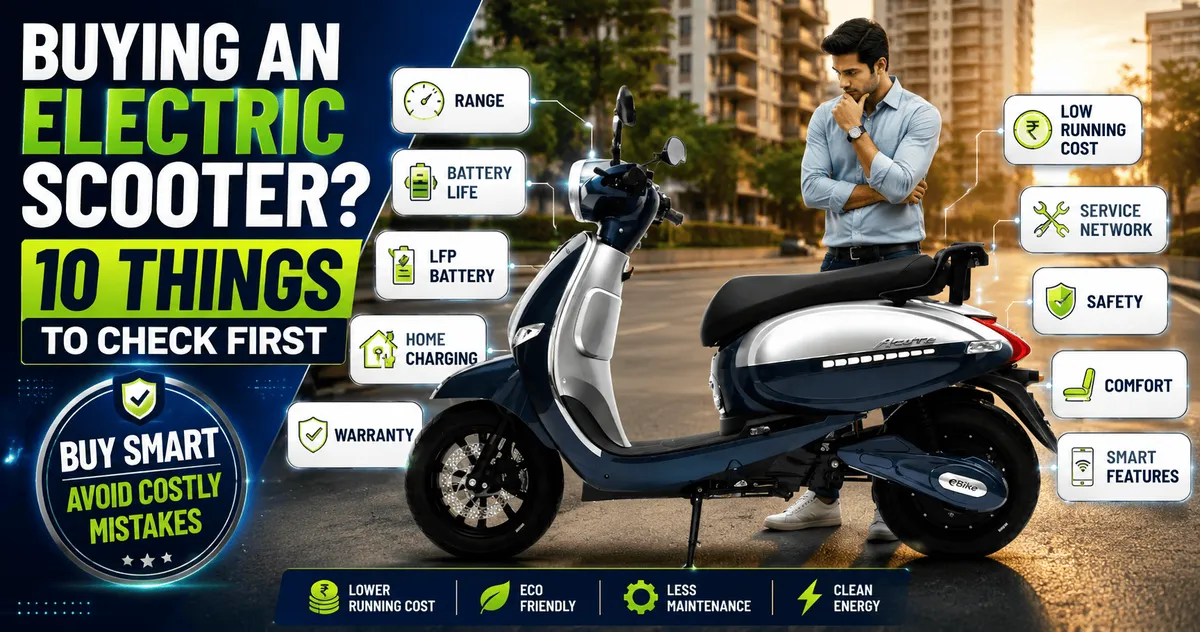
How to Choose the Right Electric Scooter in India (2026): The Complete Buyer's Guide
Published: June 9 2026 | Author: Sokudo Electric India Editorial Team
Buying an electric scooter in 2026 should feel straightforward.
For many buyers, it does not.
A quick search for the best electric scooter in India brings up dozens of options. Most promise ranges between 80 km and 150 km. Most advertise smart features. Most claim to offer the lowest running costs. On paper, they start to look very similar.
But ownership experiences can vary significantly.
A scooter that suits a college student riding 15 km daily may be completely wrong for a delivery rider covering 90 km. A scooter that looks impressive in a brochure can become frustrating if the battery degrades early, charging access is difficult, or the nearest service centre is 40 km away.
The truth is this: choosing the right electric scooter has very little to do with finding the one with the highest claimed range or the biggest battery. The right scooter is the one that fits your daily routine, your charging situation, your budget, and your realistic expectations about ownership.
This guide walks through every factor that actually matters, in the order they matter, so you can make a decision you will be comfortable with years from now.
What Should You Focus on When Choosing an Electric Scooter?
If you want a short answer before the full breakdown, focus on these six things:
- Your actual daily commute distance
- Real-world range, not claimed range
- Battery technology (LFP vs NMC)
- Where and how you will charge
- Battery warranty coverage
- Service centre proximity
Most ownership problems can be traced to one of these six areas. The rest of this guide explains each one in enough detail to help you evaluate any scooter properly.
Why Most Buyers End Up With the Wrong Scooter
The most common mistake is simple: buyers compare specifications instead of matching the scooter to their lifestyle.
When people browse options, they typically ask which scooter has the highest top speed, the largest battery, the longest range, or the most features. These are reasonable questions. They are just not the most important ones.
The questions that actually predict ownership satisfaction are different:
- How far do I actually ride every day?
- Can I charge at home reliably?
- How long do I plan to keep this scooter?
- What happens if something needs to be repaired?
- Does the battery technology suit Indian weather conditions?
Many buyers end up purchasing far more scooter than they need. Others buy the cheapest option available and later discover the range, charging experience, or support network does not fit their life.
A better approach is to start with your own requirements and then find the scooter that meets them, rather than starting with a spec sheet and working backwards.
Step 1: Calculate Your Daily Commute Before Looking at Any Scooter
Before comparing brands, prices, or features, figure out your average daily riding distance. This one number shapes almost every other buying decision.
Manufacturers advertise maximum range, but range only matters relative to your actual usage. Someone riding 20 km daily has completely different requirements from someone riding 70 km daily.
Riders covering less than 20 km per day
This group includes college students, local commuters, senior citizens, and families running daily errands. For these riders, nearly every modern electric scooter offers more than enough range. Paying extra for a larger battery makes little sense here. Focus instead on comfort, weight, ease of charging, and reliability.
The Sokudo Plus at 100 kg with a real-world range of 65-75 km is a strong fit for this group. It also falls in the low-speed category, meaning no driving licence is required, which makes it one of the most accessible options for new riders and senior users.
Riders covering 20 to 50 km per day
This is the largest segment of electric scooter buyers in India. Office commuters, professionals, and daily city riders sit here. For this group, a real-world range above 70 km, a reliable battery warranty, decent suspension for city roads, and accessible service support are the priorities.
This category generally benefits the most from switching to electric because fuel savings accumulate fast and overnight charging at home is usually convenient.
Riders covering 50 to 100 km per day
As daily distance increases, battery size and charging strategy become more important. Buyers in this range should evaluate actual battery capacity, fast charging availability, and long-term degradation closely. The scooter should handle the full daily distance without any need for mid-day charging under normal circumstances.
For a closer look at how daily mileage affects long-term ownership, our guide on how long electric scooters last in India breaks down what to expect across different usage profiles.
Step 2: Ignore Claimed Range. Focus on Real-World Range
This is where many first-time EV buyers get their expectations wrong.
Manufacturers publish range figures under controlled test conditions. These figures are useful for comparing scooters against each other, but they do not reflect actual riding in Indian conditions. Real-world range is affected by rider weight, speed, traffic patterns, road gradient, ambient temperature, tyre pressure, and battery age.
In typical Indian urban riding, actual range tends to run 20 to 30 percent below the advertised figure.
| Claimed Range | Realistic Range in India |
| 80 km | 55 to 65 km |
| 100 km | 70 to 80 km |
| 120 km | 85 to 100 km |
| 150 km | 110 to 130 km |
Use the realistic column when making your decision, not the brochure number.
A practical rule to follow: choose a scooter with a real-world range of at least twice your average daily riding distance. If you commute 25 km daily, you want a minimum of 60 km in realistic conditions. If you ride 40 km daily, aim for at least 80 km. This gives you a buffer for traffic, gradual battery ageing, and occasional longer trips.
Step 3: Battery Technology Matters More Than Most Buyers Realise
Many buyers compare range. Very few compare battery chemistry. This is one of the more costly oversights in the EV buying process.
Battery chemistry affects lifespan, heat tolerance, safety, charging behaviour, and long-term degradation. Two scooters with identical claimed ranges can deliver completely different ownership experiences depending on which battery technology they use.
NMC (Nickel Manganese Cobalt) batteries offer higher energy density and lighter pack weight. They perform well in terms of range-per-kg but generally require more sophisticated thermal management systems and tend to degrade faster in heat.
LFP (Lithium Iron Phosphate) batteries offer better thermal stability, longer cycle life, improved safety characteristics, and more consistent performance in hot weather conditions. The trade-off is slightly lower energy density, which means marginally heavier packs for the same range.
Building or riding an EV in India, LFP battery chemistry holds a massive real-world edge. As highlighted by Auto Punditz's deep dive into Indian EV conditions, mass-market two-wheelers and cars are heavily pivoting toward LFP. The reasons are simple: it offers exceptional thermal stability that can handle intense tropical summers, costs less to manufacture, and boasts a much longer lifespan under the daily stress of stop-and-go traffic and frequent top-up charging.
For buyers prioritising long-term ownership, daily commuting, and durability in Indian weather, LFP is generally the stronger choice.
All Sokudo scooters including the Sokudo Acute, Sokudo Acute 2.2, Sokudo Rapid 2.2, and Sokudo Plus use LFP battery technology. At Indian summer temperatures, this is a meaningful specification difference and not just a marketing point.
Step 4: Sort Out Your Charging Situation Before You Buy
Range gets most of the attention in EV comparisons. Charging convenience often has a bigger impact on how satisfied you actually feel owning the scooter every day.
A scooter with a slightly shorter range but easy home charging can be far more pleasant to own than a high-range scooter that is inconvenient to charge regularly.
Before buying, answer one question honestly: where will I charge this scooter every day?
Home charging is the ideal scenario for most riders
For most Indian commuters, home charging is the biggest practical advantage of electric scooter ownership. Instead of stopping at a petrol station every few days, you plug in overnight using a standard 15-amp household socket and start each morning with a full battery. No queues. No fuel shortages. No detours.
India's Ministry of Power guidelines on EV charging infrastructure encourage residential and workplace slow charging as the primary charging method for personal electric vehicles, and this remains the most practical and cost-effective approach for daily commuters.
Apartment residents need to check before buying
Living in an apartment does not rule out EV ownership. It does mean you need to confirm charging access before committing to a purchase.
Ask whether your housing society allows charging in the parking area, whether there is a standard power outlet nearby, and whether a dedicated charging point can be installed if needed. Many residential communities across Bengaluru, Pune, Hyderabad, Gurugram, and Noida have already set up EV charging infrastructure. If yours has not, check what the plans are before finalising your decision.
Public charging is a backup, not a daily solution
India's public charging network has expanded considerably in recent years. However, it still cannot match the convenience of home charging for daily personal use.
Public charging is best treated as emergency top-up support, a resource for longer trips, or an occasional supplement rather than a primary charging method. For riders relying entirely on public chargers, ownership satisfaction tends to be lower.
Charging speed: what is actually fast enough?
Many buyers assume faster is always better when it comes to charging. The reality is more nuanced. Most riders charge overnight, which means a scooter that completes a full charge within 5 to 8 hours is perfectly adequate for typical daily use.
| Battery Size | Typical Charge Time |
| 1.5 kWh | 4 to 5 hours |
| 2.2 kWh | 5 to 7 hours |
| 3 kWh | 6 to 8 hours |
| 4 kWh and above | 7 to 10 hours |
For most commuters, overnight charging completely eliminates charging time as a practical concern.
Step 5: Read the Battery Warranty Carefully
The battery is the single most expensive component in any electric scooter. It typically accounts for a large share of the vehicle's total value.
Yet most buyers spend far more time comparing top speed and range than reading warranty details. This is worth correcting.
Battery replacement can cost anywhere between Rs 45,000 and Rs 1,20,000 or more depending on battery size, chemistry, and brand. A strong warranty directly reduces this long-term financial risk.
What battery warranties typically cover
Most manufacturers cover manufacturing defects, internal cell failures, abnormal battery degradation, and battery management system issues. Coverage periods vary significantly across brands. Several manufacturers now offer warranties extending to three years or beyond on battery packs specifically.
What battery warranties typically exclude
Read the exclusions carefully. Most warranties do not cover physical damage, water damage resulting from misuse, unauthorized repairs, improper charging, or accidental damage.
Battery health guarantees are increasingly important
Some manufacturers now offer capacity guarantees alongside standard defect coverage. These typically promise that battery capacity will remain above a stated percentage during the warranty period, giving buyers greater long-term confidence about performance.
Sokudo scooters carry a 3-year battery warranty and a 1-year vehicle warranty across the range, which is among the stronger warranty packages available at their price points.
Step 6: Calculate Total Cost of Ownership, Not Just Purchase Price
One of the most persistent mistakes in scooter buying is focusing solely on the sticker price.
This made sense for petrol scooters where running costs were fairly uniform across brands. Electric scooter ownership works differently. The real comparison should be based on total cost of ownership across the period you plan to keep the vehicle.
Running cost comparison
| Vehicle Type | Cost Per KM |
| Electric Scooter | Rs 0.09 to Rs 0.80 |
| Petrol Scooter | Rs 2.50 to Rs 4.00 |
For a rider covering 1,000 km per month, that difference amounts to Rs 2,200 to Rs 3,700 saved every single month. Over five years, it becomes a significant sum.
5-year ownership comparison (approximately 11,000 km per year)
| Expense | Electric Scooter | Petrol Scooter |
| Purchase Price | Rs 90,000 | Rs 80,000 |
| Energy or Fuel | Rs 25,000 | Rs 1,80,000 |
| Maintenance | Rs 8,000 | Rs 25,000 |
| Total Cost | Rs 1,23,000 | Rs 2,85,000 |
The electric scooter saves approximately Rs 1.62 lakh over five years in this example. Actual results vary depending on mileage, local electricity tariffs, and riding habits, but the economic direction is consistent.
For a detailed model-by-model comparison, read our guide on the most affordable electric scooters in India for 2026, which includes total ownership cost calculations across budget categories.
Step 7: Check the Service Network Before You Buy
A good scooter with poor service support can quickly become a source of frustration.
Electric scooters still require periodic maintenance. Brakes, tyres, suspension, and electrical systems all need attention over time. Access to trained technicians who carry the right spare parts makes a real difference to ownership confidence.
Before finalising any purchase, find out how far the nearest authorised service centre is. Ask about average turnaround times for common jobs. Check whether spare parts are held locally or need to be ordered from a central warehouse. Speak to existing owners if possible.
A service network that is difficult to access often matters more than an extra 10 km of claimed range. The Central Motor Vehicles Rules under India's Ministry of Road Transport also require that registered electric vehicles be serviced by authorised centres for warranty claims, so proximity to an authorised workshop is a practical ownership necessity, not just a convenience.
Modern electric scooters are increasingly software-driven as well. Battery optimisation, ride modes, connectivity, and diagnostics all depend on software.
Manufacturers who provide regular over-the-air updates and remote diagnostic support extend the useful life of the vehicle and improve the ownership experience well beyond the purchase date.
Step 8: Ride Comfort Should Rank Higher on Your List
A lot of buyers become so focused on specifications that they overlook how the scooter actually feels to ride every day.
A scooter can look impressive on paper and still feel uncomfortable after a month of daily commuting. Seat width, cushion quality, riding posture, and pillion comfort all affect whether you enjoy the scooter or merely tolerate it.
Indian roads present specific challenges. Potholes, speed breakers, and uneven surfaces are a daily reality in most cities. A well-tuned suspension absorbs these imperfections and reduces rider fatigue over long commutes. For daily use, suspension quality should rank among your top priorities, not as an afterthought.
Scooter weight also matters more than most buyers account for. Larger batteries increase kerb weight, and this affects parking, low-speed control, and how the scooter handles in tight spaces. For senior riders, new riders, and smaller riders in particular, a lighter scooter makes daily use meaningfully easier. Our guide on the easiest electric scooters to ride in India in 2026 covers this in detail, including how even a 25 to 30 kg weight difference between models changes the practical riding experience.
Always take a test ride on a road that resembles your actual commute, not a smooth showroom forecourt.
Step 9: Safety Features Worth Checking
When comparing scooters, safety often gets less attention than range and price. That is worth correcting.
Battery safety is the most important safety consideration
The battery is the most technically complex component in the scooter. Look for models that include an advanced Battery Management System (BMS) with overcharge protection, short-circuit protection, temperature monitoring, and cell balancing. The IEA's research on EV battery safety consistently highlights BMS quality as one of the most important factors in reducing battery-related incidents. A well-designed BMS monitors battery health continuously and prevents the conditions that cause rapid degradation or safety failures.
Braking performance matters more than top speed
In real urban riding, stopping safely is far more consequential than reaching high speeds. Look for disc brakes, a Combined Braking System (CBS), and regenerative braking. These features improve stopping distances and rider confidence in traffic.
Lighting quality affects visibility
Early morning rides, evening commutes, and monsoon conditions all demand reliable lighting. LED headlights, LED tail lamps, and Daytime Running Lights (DRLs) improve how clearly you see and how visible you are to other road users.
Water resistance for monsoon conditions
India's monsoon season runs from June through September across most of the country. Scooters should carry published IP ratings, sealed electrical components, and protected wiring harnesses to handle heavy rain without issues. Avoid riding through flooded roads or deep water crossings regardless of the IP rating.
Step 10: Smart Features That Are Worth Paying For (and Those That Are Not)
Most premium electric scooters now function partly as connected devices. Not every smart feature adds meaningful value to daily riding.
Features that genuinely improve ownership:
- Battery monitoring and charging status via smartphone app
- GPS tracking and anti-theft movement alerts
- Over-the-air software updates that improve battery efficiency and ride modes after purchase
- Ride analytics showing energy consumption and efficiency
Features that often add cost without meaningful benefit:
- Excessive screen customization
- Novelty animations and digital effects
- Premium interface upgrades that do not affect core vehicle performance
Prioritise reliability, battery quality, warranty, and service access before paying extra for cosmetic technology.
Step 11: Warning Signs to Watch Before Buying
The Indian EV market has grown rapidly. Most of this growth reflects genuine product improvement. Some of it reflects brands making claims they cannot consistently deliver on.
Unrealistic range figures are a warning sign. If a scooter advertises very high range without any explanation of testing conditions, ask what the real-world figure is. Look for independent owner reviews, not just manufacturer claims.
Vague or very short warranty terms often reflect lower engineering confidence. Read the battery warranty document before finalising any purchase. If the warranty is short, coverage details are unclear, or exclusions are broad, treat that as relevant information about the product.
Limited or distant service centres create real ownership problems. A scooter that performs well for three years and then needs a software diagnostic or a brake bleed should not require a half-day trip to get sorted.
Buying on price alone is perhaps the most common and most avoidable mistake. A scooter that costs Rs 8,000 less but carries a shorter battery warranty, uses lower-grade cells, or lacks a reliable service network will likely cost more over three years of ownership.
Step 12: Matching the Right Scooter to Your Rider Profile
The best electric scooter is not the same for everyone. Here is a straightforward breakdown by use case.
College students need affordable running costs, easy charging, and low maintenance above everything else. A moderate real-world range of 60 to 80 km and simple home charging are usually enough. Lightweight design helps with daily parking and manoeuvring.
Office commuters represent the strongest EV ownership case. Predictable daily distances, overnight home charging, and consistent urban riding conditions mean the fuel savings compound quickly and the ownership experience is smooth. Focus on a reliable battery, comfortable suspension, and solid warranty coverage.
Families typically use scooters for school runs, local errands, and daily household trips. Comfort, reliability, storage capacity, and pillion suitability matter most.
Senior citizens benefit most from lightweight scooters with smooth throttle response, comfortable seating, and simple controls. A scooter under 105 kg with reverse mode makes parking and low-speed manoeuvring significantly easier. Our dedicated guide on the best electric scooters for elderly riders in India covers this in practical detail, including seat height, weight, and specific model recommendations.
Delivery riders have different requirements from personal commuters. Range, durability, battery lifespan, and long-term running costs are all more critical when the scooter is covering 60 to 100 km daily on a commercial schedule. Total cost of ownership becomes the dominant consideration.
Frequently Asked Questions
What should I check before buying an electric scooter in India?
Start with your daily commute distance, then evaluate real-world range, battery technology, charging access, battery warranty, service centre proximity, and total ownership cost. These six factors predict ownership satisfaction better than any specification sheet.
How much range do I actually need?
A useful guideline is to choose a scooter with a real-world range of at least twice your average daily riding distance. This accounts for battery ageing, traffic variation, and occasional longer trips.
Is LFP better than NMC for Indian conditions?
For most Indian riders, yes. LFP batteries offer better heat tolerance, longer cycle life, and improved safety characteristics. NMC batteries offer higher energy density but generally degrade faster in high-temperature environments.
Can I charge an electric scooter at home using a normal socket?
Yes. Most electric scooters including all Sokudo models charge using a standard 15-amp household socket. No special installation is required for overnight slow charging.
How long does an LFP battery last?
LFP batteries are typically rated for 2,000 to 4,000 charge cycles. For a rider charging once every two days, that translates to approximately 10 to 20 years before significant degradation. Standard lithium-ion batteries are rated for 800 to 2,000 cycles.
What is the most important factor when buying an electric scooter?
For most riders, the combination of battery chemistry, warranty coverage, charging convenience, and service network availability matters more than top speed or maximum claimed range.
Does the PM E-DRIVE subsidy apply to Sokudo scooters?
Eligible Sokudo models qualify for the PM E-DRIVE subsidy of up to Rs 5,000 applied directly at the dealership. The scheme is valid until July 31, 2026 and requires an Aadhaar card and PAN card at purchase. Many states also offer additional road tax waivers and registration fee exemptions on top of the central subsidy.
Final Thoughts: The Right Scooter Is the One That Fits Your Life
The Indian electric scooter market in 2026 is genuinely mature. Buyers have access to better battery technology, longer warranties, stronger service networks, and more reliable products than at any point before.
But choosing well still requires looking past the marketing.
Start with your daily distance. Evaluate real-world range rather than brochure figures. Pay attention to battery chemistry, warranty terms, charging access, and service support. Think about total ownership cost rather than purchase price alone. And take a test ride on a road that actually resembles the roads you ride every day.
For most Indian commuters, an electric scooter delivers lower running costs, less maintenance, and a more convenient daily experience than continuing with petrol.
The question is not whether electric is practical. The question is which electric scooter suits your specific situation.
Browse the full Sokudo electric scooter range to compare models, specifications, and pricing across the lineup.
Comments
Share your thoughts about this article.
Loading comments...