1 October 2026·30 min read
25 May 2026•Sokudo Electic India
Published: May 23, 2026 | Last updated: May 23, 2026 | By: Sokudo Electric India Editorial Team
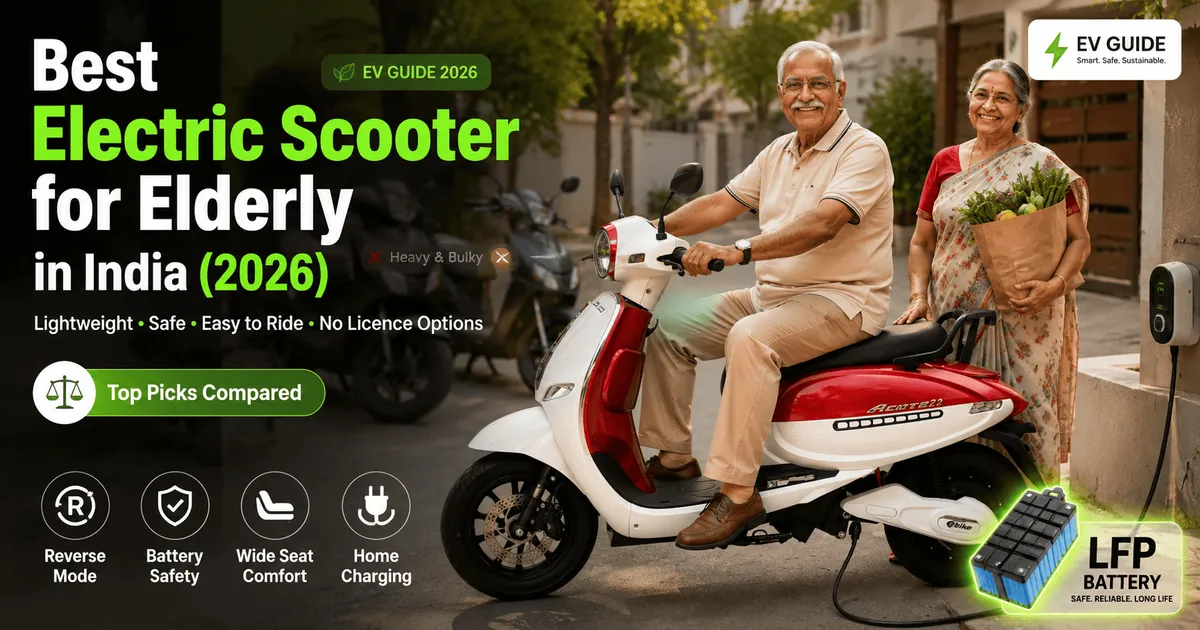
Let me be straight with you - most "best electric scooter for elderly" articles online are just copied spec sheets with no real context. They'll list the Ather Rizta or Bajaj Chetak and call it a day, without stopping to ask whether a 68-year-old with slightly weak knees can actually hold a 135 kg scooter steady at a traffic signal in Bangalore.
This guide is written differently. We've looked at what elderly riders actually deal with daily - not what sounds good on a product page.
There's a reason your neighbour uncle switched to an electric scooter last year and hasn't looked back. It's not because he's an EV enthusiast. It's because the thing just makes daily life easier.
No gear shifting. No warm-up wait. No petrol pump visits in the heat. You turn it on and it moves - smoothly, quietly, without fuss. For someone managing a 20-minute morning trip to the market or a weekly temple visit, that simplicity genuinely matters.
Running costs are another big factor. A petrol scooter typically costs ₹1,800–₹2,500 per month just in fuel and basic servicing. An electric scooter? Closer to ₹300–₹500 total. Over three years, that difference adds up to somewhere between ₹50,000 and ₹75,000 saved - money that stays in the household rather than going to the pump.
The shift is real. More elderly riders in India's cities and towns are making this move, and the reasons make complete sense once you look at them properly.
This is where most guides go wrong. They obsess over top speed and 0-to-60 times - things that are completely irrelevant to a 70-year-old going to the sabzi mandi.
Here's what actually matters:
Weight of the scooter. This is the single most important factor and almost nobody talks about it enough. When a rider stops at a signal, they need to hold the scooter steady with both feet. If the scooter weighs 130+ kg, that's genuinely hard for an older person - especially on uneven ground or a slight slope. Look for scooters under 110 kg. The difference between a 100 kg scooter and a 135 kg one is something you feel immediately.
Seat height. Both feet should rest flat on the ground, not on tiptoe. A seat height around 760–790 mm works well for most Indian adults. Anything higher and you're adding unnecessary strain on the knees at every stop.
Reverse mode. This sounds minor until you've tried reversing a heavy scooter out of a tight parking spot manually. Reverse mode lets the scooter crawl backwards on its own. For elderly riders dealing with apartment parking or narrow lanes, this feature alone is worth paying attention to.
Battery safety. After India saw multiple EV fire incidents in recent years, this stopped being a techie concern and became a real one. We'll explain what to look for in the next section.
Service centre proximity. This matters more for elderly buyers than any other demographic. If the nearest authorised service centre is 40 km away, the ownership experience becomes stressful fast.
Here's something a lot of families searching for a scooter for their father or mother genuinely don't know: not all electric scooters require a driving licence in India.
Under current Central Motor Vehicles Rules (CMVR):
This means if your elderly parent hasn't renewed their licence in years, or simply doesn't have one anymore, they can still legally ride a certified low-speed electric scooter. The Sokudo Plus and Ampere Reo both fall into the no-licence category. Just make sure to verify this on the official spec sheet before buying - not just from what the salesperson tells you at the showroom.
One note: even though third-party insurance isn't legally mandatory for sub-250W scooters, it's still a sensible thing to have. Check with your local RTO for state-specific rules.
If someone you know has been following EV news in India over the past couple of years, the words "battery fire" have probably come up. Several incidents were reported nationally, including scooters catching fire while being ridden or during charging.
The root cause in most cases was battery chemistry. Conventional lithium-ion (NMC) batteries can overheat under stress - and India's summer heat, plus the habit of overnight charging indoors, creates exactly those conditions.
LFP batteries (Lithium Iron Phosphate) are chemically more stable. They handle heat better, are far less likely to enter what's called "thermal runaway," and typically last through 2,000–4,000 charge cycles compared to 500–1,500 for standard li-ion cells.
For an elderly rider charging their scooter in a covered garage or near their home overnight, this is not a small difference. Sokudo's models run on LFP batteries with a built-in Battery Management System that monitors the battery in real time. The company reports zero fire complaints on its LFP-equipped scooters to date.
When you're at the showroom, simply ask: "Is this an LFP battery?" If the answer is yes and the battery warranty is at least 3 years, you're in a good position.
Here's a straight comparison of the scooters worth considering for elderly riders, including competitors. No fluff.
| Model | Price | Claimed Range | Real-world Range | Weight | Top Speed | Battery | Licence Needed | Reverse Mode | Warranty |
| Sokudo Plus | ₹67,951 | 105 km | ~65–75 km | 100 kg | 50 km/h | LFP | No ✅ | Yes | 3yr battery |
| Sokudo Rapid 2.2 | ₹97,951 | 100 km | ~60–72 km | 101 kg | 70 km/h | LFP | Yes | Yes | 3yr battery |
| Sokudo Select 2.2 | ₹1,03,951 | 100 km | ~60–72 km | 101 kg | 70 km/h | LFP | Yes | Yes | 3yr battery |
| Ampere Reo | ₹59,900 | 80 km | ~50–60 km | ~75 kg | 25 km/h | LFP | No ✅ | No | Varies |
| Hero Optima CX | ₹83,300 | 82 km | ~50–60 km | ~82 kg | 45 km/h | Li-ion | Yes | No | 3yr battery |
| Ather Rizta S | ₹1.24 lakh | 123 km | ~80–95 km | 125 kg | 80 km/h | NMC | Yes | No | Up to 8 years |
| Bajaj Chetak 3001 | ₹1.07 lakh | ~113 km | ~70–85 km | ~135 kg | 73 km/h | Li-ion | Yes | No | 3yr battery |
A quick note on range: the "real-world range" column is what actually matters. ARAI-certified figures are tested in lab conditions. In actual Indian city traffic - with stops, inclines, and heat - expect around 60–75% of the claimed number. A scooter rated at 100 km will realistically give you 60–72 km. For most elderly riders covering 15–25 km a day, that still means charging every 2–3 days, not daily.
The Chetak and Rizta are good scooters, but at 135 kg and 125 kg respectively, they're noticeably harder to handle at low speeds. If weight and ease of manoeuvring are priorities - and for elderly riders they should be - both models ask more from the rider than the Sokudo lineup does.
Sokudo Plus (₹67,951) The no-licence option. 100 kg, LFP battery, 8–9 hours charging time, 3-year battery warranty. If your parent doesn't have an active driving licence and mainly rides within the neighbourhood, this is the most practical starting point. Range of around 65–75 km in real-world conditions covers several days of typical local commuting on one charge.
Sokudo Rapid 2.2 (₹97,951) Steps up to a 2.2 kWh LFP battery with 4–5 hour charging, disc brakes at the front, and 70 km/h top speed. Requires a licence. Good for elderly riders who are still comfortable with slightly longer city routes and want a quicker charge turnaround.
Sokudo Select 2.2 (₹1,03,951) The most fully featured of the three. Same 2.2 kWh LFP battery (73.6V 30Ah), same charging time and speed as the Rapid, but with additional features that make the ownership experience more complete. Best suited for daily city commuting with a full warranty package.
All three models weigh 100–101 kg - lighter than most alternatives in the same price range - and all carry the 3-year battery vehicle warranty.
It's worth raising this honestly. For some elderly riders - particularly those who haven't been on a two-wheeler in several years, or who have knee or hip concerns - a three-wheel electric scooter is genuinely worth considering.
Models like the AMO Jaunty 3W or Komaki FAM 2.1 don't require any balancing. The scooter stands on its own at all times, which removes a significant physical demand at traffic stops and during parking. For someone recovering from surgery or managing reduced lower-body strength, that's meaningful.
The honest tradeoffs: three-wheelers are slower, have shorter range, and the service network is far thinner than mainstream brands. They're also harder to navigate in narrow lanes because of the wider body.
If the elderly rider has been riding two-wheelers within the last few years without issues, a well-chosen lightweight two-wheeler is likely the better practical choice. If there's genuine doubt about balance or physical stability, a three-wheeler deserves a serious look - and a supervised test ride of both types is the best way to find out.
The PM E-DRIVE scheme is active right now and most buyers either don't know about it or assume they don't qualify. Here's how it actually works:
The scheme provides ₹2,500 per kWh of battery capacity, capped at ₹5,000 per vehicle. For a scooter with a 2.2 kWh battery, that works out to ₹5,500 calculated - but it's capped at ₹5,000. The deduction happens automatically at the dealership. You don't fill out a separate form or apply anywhere.
The vehicle needs to be priced under ₹1.5 lakh ex-factory to qualify. The scheme runs until July 31, 2026 for two-wheelers.
You need: an Aadhaar card and PAN card. That's it.
Many states also layer additional benefits on top - road tax waivers, registration fee exemptions. Ask the dealer specifically about what your state currently offers before finalising the purchase. This is often where an extra ₹3,000–₹8,000 in savings is sitting unclaimed.
Government employees are not eligible for the central subsidy.
This is one of the most common concerns families raise, especially for apartment dwellers. The practical answer is simpler than most people expect.
Sokudo scooters charge through a standard 15-amp home socket - the kind most Indian homes already have. No special charger installation, no electrician visit, no separate EV charging unit needed. The charger comes with the scooter.
The Select 2.2 and Rapid 2.2 take 4–5 hours for a full charge, which means plugging in after dinner and having a full battery by midnight. The Plus takes 6-7 hours - perfect for overnight charging.
For apartment residents, the main question is whether your building's parking allows charging through an outlet. Most societies now permit this, and many have already installed EV points. Worth confirming before purchase if you're in a building with managed parking.
Monthly electricity cost for typical usage: roughly ₹180–₹220. At ₹8–₹10 per unit of electricity, a full 2.2 kWh charge costs about ₹18–₹22. Most elderly riders won't charge more than 10–12 times a month given their daily distances.
Please don't skip the test ride. A 15-minute ride at the dealership tells you things that no specification sheet can - whether the seat is the right height, whether the acceleration feels predictable, whether the elderly rider feels calm or nervous on it.
Specific things to check:
Both feet rest flat on the ground at a standstill. Not on tiptoe - flat. This is non-negotiable for elderly riders. Check that the handlebar reach doesn't cause shoulder strain. Ask the rider to do a slow U-turn - if it feels uncomfortable or requires too much effort, that's a signal. Test the brakes at low speed. Test the reverse mode in the parking area. Check whether the under-seat storage is accessible without an awkward bend. And simply ask the rider how they feel - confident, or uneasy?
If the rider feels anxious on the test ride, that feeling doesn't go away after purchase. Try a different model.
Which electric scooter is best for elderly riders without a licence?
The Sokudo Plus (₹59,889) is the strongest option - LFP battery, 100 kg, and legally exempt from licence and RTO requirements. The Ampere Reo (₹59,900) is the other no-licence alternative, though it doesn't offer reverse mode.
Is there a subsidy on electric scooters in 2026?
Yes. PM E-DRIVE gives up to ₹5,000 off automatically at the dealership on eligible models. Valid until July 31, 2026. Bring your Aadhaar and PAN.
What is the real monthly cost of running an electric scooter?
For most elderly riders covering 20–25 km a day, total monthly cost - electricity plus occasional servicing - works out to ₹300–₹500. Compared to ₹1,800–₹2,500 for a petrol scooter.
Can I charge it at home in an apartment?
Yes, through a standard 15-amp socket. No special installation needed. Confirm with your housing society if parking is managed.
What if my parent has weak knees - will they manage?
On a scooter with the right seat height (760–790 mm) and weight under 105 kg, both feet sit flat on the ground, which significantly reduces knee strain at stops. If knee weakness is more serious, evaluate a three-wheel scooter.
How long does the battery last?
LFP batteries typically last 2,000–4,000 charge cycles. At one charge every 2–3 days for typical elderly usage, that's 10–20 years of battery life before significant degradation - well beyond the warranty period.
Final Recommendation
For elderly riders without a valid licence or on a tighter budget: Sokudo Plus at ₹67,951 is the clearest choice. Lightweight, LFP battery, no-licence legal, longest warranty in the segment.
For elderly riders with a valid licence who want more range and faster charging: Sokudo Select 2.2 at ₹97,951 offers the most complete package - same lightweight build, full LFP safety, and 4–5 hour charging.
For riders with genuine balance or mobility concerns: look at three-wheel options like the AMO Jaunty 3W before deciding.
For families with a higher budget who want a premium brand name: the Ather Rizta S has the longest range and strong after-sales, but at 125 kg it's significantly heavier - factor that into the decision honestly.
The best electric scooter for elderly riders isn't necessarily the most advanced or the most talked-about one. It's the one the rider feels safe and confident on, weighs less than 110 kg, charges safely at home, and comes with a warranty that actually covers something meaningful if things go wrong.
Take the test ride. That's where the decision really gets made.
Explore Sokudo's full range here Sokudo Electric Scooters
Disclaimer: Prices are approximate ex-showroom as of May 2026 and may vary. Real-world range estimates are based on 60–75% of ARAI-certified figures. Subsidy details are subject to government policy changes - verify with your dealer before purchase.