1 October 2026·30 min read
6 July 2026•Sokudo Electic India
Published: July 06, 2026 | Author: Sokudo Electric India Editorial Team
If your electric scooter is not delivering the range you expected, you are not alone. The gap between a manufacturer's claimed range and what you actually get in daily riding is one of the most commonly reported frustrations among electric scooter owners in India.
The good news is that this gap almost never comes from a defect. It comes from a combination of riding style, tyre pressure, carried load, road conditions, battery habits, and seasonal factors working against efficiency. Most of these are directly within your control.
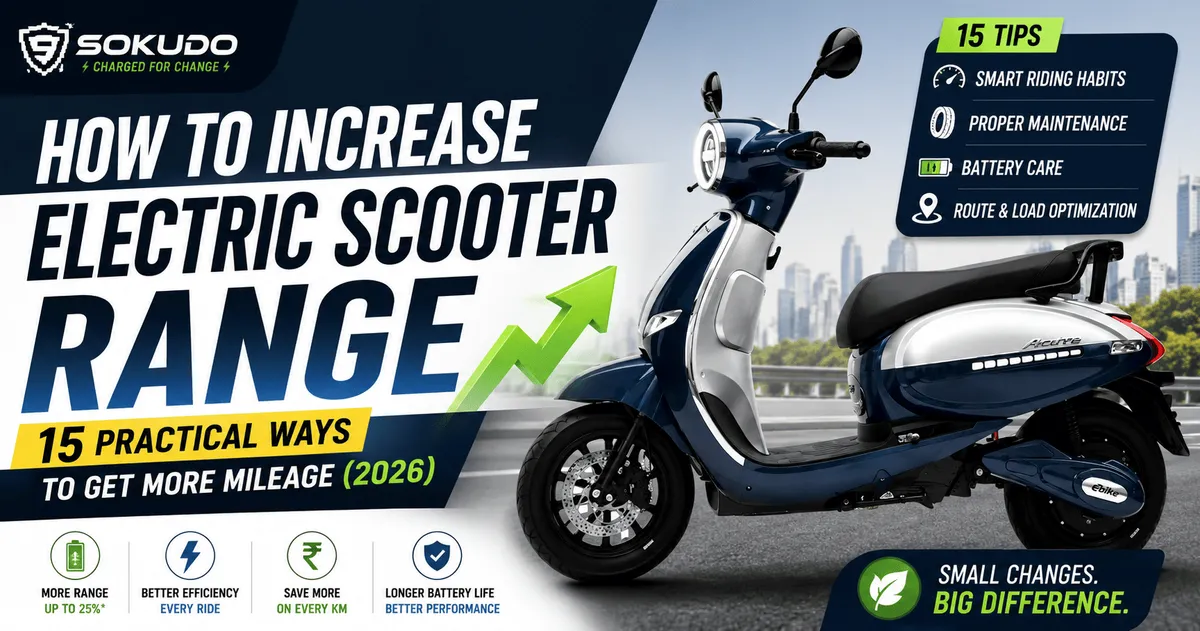
This guide covers 15 specific, practical ways to improve range without changing the scooter itself. Every tip here applies to Indian riding conditions, including city stop-start traffic, Indian summer heat, monsoon roads, and the kind of daily commuting patterns most Sokudo owners actually face.
The biggest range gains come from five areas: smoother riding, using eco mode, maintaining correct tyre pressure, reducing unnecessary load, and protecting long-term battery health through proper charging habits. Addressing all five consistently can improve real-world range by 15 to 25 percent compared to careless riding on the same scooter.
Range improvement quick reference:
| What You Change | Approximate Range Impact |
| Switch from sport to eco mode | Up to 20 to 25% improvement |
| Correct tyre pressure | 5 to 10% improvement |
| Smooth acceleration and braking | 10 to 15% improvement |
| Remove 10 kg of unnecessary load | 3 to 7% improvement |
| Consistent battery charging habits | Long-term capacity protection |
| Shade parking in Indian summers | Reduces thermal degradation over time |
Before going through the 15 tips, it helps to understand what is actually causing the gap. A scooter's claimed range is measured under controlled IDC (Indian Driving Cycle) conditions: consistent speed, ideal temperature, standard rider weight, and no traffic stops. Your daily commute in Delhi, Ghaziabad, Lucknow, or Pune looks nothing like that.
Real-world range in Indian conditions is affected by:
Battery condition and age. A healthy battery holds charge better and delivers more usable range. As batteries age, capacity naturally declines. This is why battery care is not just about safety. It directly affects how far your scooter can go every day. For Sokudo's LFP (Lithium Iron Phosphate) batteries, the 2,500-plus cycle life and better thermal stability under Indian summer heat mean this decline happens more slowly than in NMC lithium-ion alternatives, but the principle holds for any chemistry.
Rider weight and load. Every extra kilogram makes the motor work harder. Carrying a pillion, a heavy backpack, or unnecessary items in the underseat space reduces the total distance from one charge. In stop-start city traffic, this effect is amplified because the scooter repeatedly accelerates under load.
Speed and throttle use. Fast acceleration and sustained high-speed riding are the two biggest range killers. Smooth throttle control uses less current per kilometre, while sudden power spikes drain the battery quickly and repeatedly.
Road and weather conditions. Stop-go traffic, steep flyovers, rough Indian roads, and extreme temperatures all reduce efficiency. Wet monsoon roads increase rolling resistance, while summer heat puts additional stress on battery performance. The same scooter on the same charge can deliver different results in different cities, seasons, and on different routes.
This is the single biggest riding change most people can make immediately. A full-throttle launch uses a sharp spike of current from the battery that a smooth launch simply does not require. Think of it the way you would think about fuel economy in a petrol vehicle: gentle acceleration consistently gets more distance per unit of energy than aggressive takeoffs.
At every traffic signal, ease the throttle up rather than twisting it hard. The difference in journey time is almost nothing. The difference in range over a month of daily commuting adds up considerably.
Frequent speed changes waste energy that the battery had already spent building momentum. Every time you accelerate again after slowing unnecessarily, the motor draws a fresh burst of current.
On open roads, ring roads, or lighter traffic stretches, hold a consistent pace rather than repeatedly speeding up and slowing down. This is especially relevant for Sokudo Rapid 2.2 and Select 2.2 owners covering 30 to 40 km arterial road commutes, where sustained steady speed is often achievable for several minutes at a time.
Every hard brake discards momentum that the battery already spent building. Riders who watch traffic ahead, anticipate signal changes, and begin braking early convert more of that momentum into a gradual, controlled deceleration rather than a sharp stop.
If your Sokudo model supports regenerative braking, use it thoughtfully as part of your deceleration pattern rather than relying on it as a substitute for poor forward planning.
Most electric scooters including Sokudo models include multiple riding modes. The mode you choose has a direct and measurable effect on range.
Eco mode limits power output and smooths throttle response, which reduces energy consumption per kilometre during normal city riding. For most commutes within 25 to 40 km, eco mode is the most practical daily setting because the speed ceiling is rarely a constraint on typical city roads.
Switch to normal mode when you need a little more responsiveness for traffic conditions, and reserve sport mode for specific situations like overtaking, steep inclines, or short merging stretches, rather than using it as your default.
Air resistance rises sharply with speed. A scooter riding at 65 km/h uses considerably more energy than the same scooter at 45 km/h, even though the speed difference might not feel dramatic. On longer commutes, the additional energy cost of riding near the top of the speed band compounds across the full distance.
For city commuting on roads where traffic is naturally between 30 and 55 km/h, staying in the moderate speed zone gives the best balance between time and efficiency.
Tyre pressure plays a significant role in the real-world range of an electric scooter. When tyres are underinflated, they deform more as they roll, increasing rolling resistance and causing the motor to consume additional battery power. Maintaining the recommended tyre pressure helps reduce energy loss, improves efficiency, and extends both battery range and tyre life, according to Apollo Tyres explanation of tyre rolling resistance,
Even a pressure drop of 5 to 7 PSI below the recommended figure can meaningfully reduce range, especially in stop-start city traffic where the scooter is constantly accelerating against that extra resistance.
Check tyre pressure when the tyres are cold (before riding or at least 30 minutes after stopping) and use the figure printed on the tyre sidewall, not a generic internet figure. A small digital pressure gauge costs under Rs 300 and pays for itself in range improvement within weeks. For the full tyre inspection routine, see our 7 electric scooter maintenance checks guide.
Carry only what you need. Tools, boxes, bags, and items left in the underseat boot from a previous trip add weight that the motor carries all day without benefit. Every extra 10 kg reduces efficiency noticeably, particularly during acceleration and on inclines.
If you carry a pillion regularly, remember that two adults versus one can reduce effective range by 10 to 20 percent depending on the rider weights, the scooter's rated capacity, and road conditions.
Route choice has a larger effect on range than most riders realise. A slightly longer route with fewer traffic stops and gentler gradients can be more efficient than a shorter route through heavy congestion or over multiple flyovers.
If you have a fixed daily commute, spending five minutes identifying whether there is a smoother alternative route can pay off in range every single day. Navigation apps can also help avoid real-time congestion pockets that would otherwise force multiple hard stops and restarts.
Try not to run the battery down to zero or near-zero regularly, Battery University's widely referenced guide to lithium battery longevity confirms shallow, frequent charging cycles extend usable capacity far more than infrequent deep discharges.
For most daily commuters, a practical habit is to plug in when the battery falls to around 20 to 30 percent rather than riding it to the bottom. This is particularly important for LFP batteries, which are rated for 2,500-plus cycles at normal charging ranges but can see accelerated degradation if repeatedly deeply discharged.
For everyday commuting, many EV guides recommend keeping the battery roughly between 20 and 80 percent charge rather than cycling it from 0 to 100 every day. This reduces electrochemical stress on the cells and helps preserve usable capacity over the long term.
Use a 100 percent charge when you genuinely need maximum range for a longer trip, not as your daily default.
Charging a battery that is already hot from a ride, particularly after the scooter has been parked under direct sun in Indian summer temperatures, adds thermal stress on top of charge stress simultaneously. This accelerates cell degradation over time, which means the battery delivers less range in year two or three than it did in year one.
Let the scooter rest in shade for 15 to 20 minutes after a hot ride before connecting the charger. Park in covered or shaded spots whenever available, especially during the March to June heat peak in cities like Delhi NCR, Jaipur, Nagpur, and Hyderabad.
For the full seasonal battery protection guide, read our article on how to extend the battery life of your electric scooter.
The charger supplied with your Sokudo scooter is matched to the specific voltage, current, and communication protocol of your battery system. Third-party chargers that deliver incorrect voltage or lack proper temperature monitoring can cause charging inefficiencies or cell damage that gradually reduces the battery's effective range.
If the original charger is damaged, replace it through an authorised Sokudo dealer rather than purchasing an uncertified alternative.
A poorly maintained scooter loses efficiency in ways that are easy to miss but consistent in their impact. Brake drag, misaligned wheels, worn tyres, and loose mechanical components all force the motor to work harder for the same distance.
For Sokudo owners, the recommended service interval is every six months or every 1,500 to 3,000 km, whichever comes first. Between visits, the weekly and monthly checks in our electric scooter maintenance checklist cover everything you can handle at home, including tyre pressure, brake feel, and wheel spin tests.
Understanding what service visits cost and what they cover is also useful for planning your ownership budget. Our guide on electric scooter maintenance cost in India covers this in detail including Sokudo's Rs 530 per visit paid service pricing and three free initial services.
Your scooter does not behave identically in every season, and adjusting your habits accordingly protects both range and battery health across the year.
Summer (March to June): Avoid parking in direct sun for extended periods. Charge in shade or indoors. Expect slightly reduced range in peak heat and do not interpret it as a fault. Use shade parking, avoid aggressive acceleration in the heat, and let the scooter cool briefly before charging.
Monsoon (June to September): Wet roads increase rolling resistance and reduce efficiency. Smooth riding becomes even more important on slippery surfaces. Keep the charging port dry and inspect it after every rain ride. For detailed monsoon care, our electric scooter monsoon guide covers everything from IP ratings to safe post-rain charging.
Winter (November to February): LFP batteries can see a 5 to 15 percent range reduction in temperatures below 10 degrees Celsius. This is normal chemistry behaviour and not a sign of battery damage. Charge at room temperature where possible and store the scooter indoors overnight in colder regions.
For summer-specific battery safety, read our dedicated guide on whether electric scooters are safe in Indian summers.
The most reliable early indicator of genuine battery degradation is a measurable range drop under constant conditions: same route, same load, same temperature. Keep a simple monthly record: note the remaining battery percentage when you arrive home after a full commute from a full charge.
If that number drops more than 15 to 20 percent compared to when the scooter was new, book a free battery health check at a Sokudo showroom. The BMS (Battery
Management System) log review at a service centre often identifies early degradation months before it becomes noticeable in daily riding, which means catching and addressing it earlier and at lower cost.
Most range problems come from habits that seem harmless in isolation but compound over time.
Riding in sport mode by default. Sport mode is useful for specific situations but power-hungry across a full commute. If you use it as your default setting, you will consistently get less range than the same scooter would deliver in eco or normal mode.
Ignoring tyre pressure. Underinflated tyres are among the most common and most fixable causes of poor range. A weekly pressure check costs nothing and pays off every ride.
Carrying unnecessary weight. Heavy bags, tools left in the boot from previous trips, and overloading with passengers all add resistance the motor carries all day.
Poor charging discipline. Deep discharging repeatedly, charging a hot battery immediately after a summer ride, and using uncertified chargers all gradually reduce the battery's effective capacity, which means progressively less range over months of ownership.
Skipping service intervals. Brake drag, worn tyres, and misaligned components reduce efficiency quietly. By the time the problem is obvious, the cumulative range loss has already been significant.
Range Improvement Checklist
Why is my electric scooter range lower than the claimed figure?
Claimed range is measured under ideal IDC test conditions: consistent speed, standard temperature, standard rider weight, and no traffic stops. Real-world range in Indian city conditions, with stop-start traffic, variable speeds, Indian summer heat, and typical rider load, will always be lower. The realistic expectation is approximately 70 to 80 percent of claimed range in mixed city riding. This is normal and not a defect.
Does eco mode always give the best range?
Eco mode generally gives the best range because it limits power draw and smooths throttle response, reducing energy consumption per kilometre. For most Indian city commutes where speeds stay between 25 and 50 km/h, eco mode is entirely practical. On routes with fast-moving traffic or steep inclines, normal mode is a better balance between safety and efficiency.
Does tyre pressure really make a noticeable difference to range?
Yes, significantly. Underinflated tyres increase rolling resistance, meaning the motor uses more energy to cover the same distance. A consistent 5 to 7 PSI below the recommended pressure can reduce range by 5 to 10 percent across a full charge. Checking and correcting tyre pressure is one of the fastest and cheapest ways to recover lost range.
Can regular maintenance improve range?
Yes. Brake drag, misaligned wheels, worn tyres, and poor bearing condition all force the motor to work harder for the same distance. Addressing these through regular service visits and the at-home checks in our maintenance guide directly supports range rather than just safety.
How do I know if my battery is actually degrading and losing range?
Track your remaining battery percentage after a consistent commute from a full charge once a month. If the number drops more than 15 to 20 percent compared to when the scooter was new under similar conditions, book a free battery health check at a Sokudo showroom. Degradation caught early through BMS monitoring is almost always cheaper to address than degradation discovered after it becomes severe.
Does heat in Indian summers reduce range?
Yes. High ambient temperatures and direct sun exposure increase the thermal stress on the battery during both riding and charging. This can slightly reduce range in the short term during hot days, and over many months of poor heat management it can accelerate battery degradation that permanently reduces capacity. Shade parking, delayed charging after hot rides, and LFP battery chemistry all help manage this.
How much range can I realistically recover by changing my habits?
Riders who switch from aggressive to smooth riding, correct their tyre pressure, move from sport mode to eco mode, and remove unnecessary load typically see real-world improvements of 15 to 25 percent compared to their previous riding pattern on the same scooter. The gains are cumulative: each small change adds to the others.
Which Sokudo model gives the best real-world range?
The Sokudo Acute with its 3.1 kWh LFP battery and 150 km claimed range delivers approximately 110 to 125 km in real Indian riding conditions, making it the highest real-world range model in the Sokudo range. The Sokudo Pace delivers approximately 85 to 100 km from 125 km claimed range. For the full model comparison with real-world range estimates for each, see our guide on how to choose the right electric scooter in India.
Getting more range from your electric scooter is not about buying an upgrade. It is about using what you already own more intelligently.
The biggest gains are almost always the simplest: ride smoothly, use eco mode for daily commuting, keep the tyres at the correct pressure, avoid unnecessary load, charge properly, and park in shade during Indian summers. Do all five consistently and you will almost certainly close a significant part of the gap between your claimed range and your real-world experience.
Beyond riding habits, battery health is the long-term factor that matters most. The tips in this guide protect both immediate range and the battery capacity that determines range in year three and year four of ownership. For everything related to battery longevity, our guide on how long electric scooters last in India is the most detailed resource in our cluster.
Browse the full Sokudo electric scooter range to see real-world range estimates, confirmed Rs 0.09 per km running cost, and LFP battery specifications across every model.