12 September 2026·20 min read
1 July 2026•Sokudo Electic India
Published: July 1, 2026 | Author: Sokudo Electric India Editorial Team
One of the biggest reasons people consider switching to an electric scooter is lower ownership cost. That assumption is usually correct. Electric scooters have fewer moving parts, no engine oil changes, and lower routine servicing requirements than petrol scooters.
But lower maintenance does not mean zero maintenance. Owners still need to budget for service visits, tyre wear, brake adjustments, charging-related checks, battery health monitoring, and occasional repairs depending on mileage, road conditions, and riding habits.
This guide breaks down what electric scooter owners in India actually spend, where the money goes, which costs are predictable, and how Sokudo reduces ownership stress through lower service pricing and support-led after-sales coverage.
Key ownership numbers at a glance:
| Ownership Point | Value |
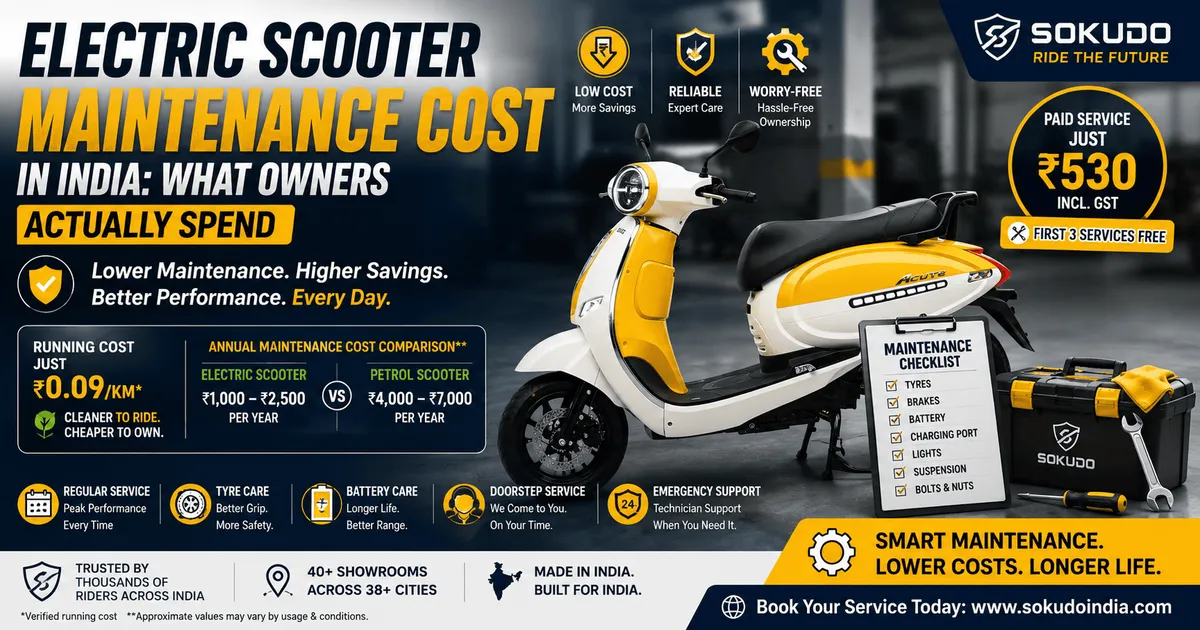
| Sokudo paid service charge | Rs 530 including GST |
| Free services | First three services |
| Running cost | Rs 0.09 per km |
| Doorstep service | Available |
| Emergency technician support | Yes, dispatched to rider location |
Electric scooter maintenance cost is the money spent to keep the scooter safe, road-ready, and reliable after purchase. It is important to separate this from running cost, which is a different figure entirely.
Running cost refers to electricity consumed per kilometre to move the scooter. For Sokudo, this is a confirmed Rs 0.09 per km.
Maintenance cost refers to service visits, wear-item replacement, diagnostics, and repair-related spending over time.
Ownership cost is the full picture: purchase price plus running cost plus maintenance cost plus any long-term replacement planning.
Many buying guides mix these three together, which creates confusion when buyers are comparing electric scooters to petrol alternatives. The cleaner way to think about it is that running cost is what you spend every day to ride, while maintenance cost is what you spend periodically to keep the scooter in good working condition.
For the full breakdown of how running cost and ownership cost combine over five years with actual Sokudo figures, see our guide on how much it costs to run an electric scooter in India.
Routine electric scooter servicing in India typically runs in the range of Rs 1,000 to Rs 2,500 per year for basic upkeep. Broader annual maintenance can rise depending on tyre wear, brake replacement, battery condition, and riding intensity.
The real number depends on how much the scooter is ridden, whether it faces rough roads or water exposure, and how well the owner maintains tyres, brakes, and charging habits. A low-usage family scooter and a high-use daily commuter will not have the same annual maintenance profile.
| Cost Head | Typical Yearly Spend |
| Routine servicing | Rs 1,000 to Rs 2,500 |
| Brake adjustments and pads | Usage-based |
| Tyres | Usage-based |
| Electrical fixes | Occasional and variable |
| Battery diagnostics | Low routine cost, higher only if degradation appears |
For most owners, yearly maintenance is not one large expense. It is a mix of small predictable service costs and occasional wear-related spending that shows up as and when it is needed.
Routine service usually covers inspection, tightening, brake check, electrical review, and general condition assessment. This is the base layer of ownership cost and the easiest to predict. For most owners on a standard urban commuting pattern, this is the line item they see most regularly.
Tyres are one of the most common wear items because Indian roads, potholes, underinflation, and load patterns affect lifespan quickly. Owners who ride daily or on rough roads will see faster tyre wear than light urban users. The 7 electric scooter maintenance checks guide covers how to spot tyre wear early before it becomes a replacement cost.
Brake pads, brake adjustment, and braking response checks are part of normal upkeep. Frequent stop-go city riding in places like Delhi, Ghaziabad, and Lucknow can increase brake wear and service frequency. Disc front brakes, which Sokudo's Rapid 2.2, Select 2.2, Acute 2.2, and Acute models carry, generally offer more consistent performance over time than drum setups.
Battery maintenance does not usually mean battery replacement. In most cases it means regular charging discipline, periodic health checks, and attention to sudden range drop or charging inconsistency. Getting a battery health check every six months at a Sokudo showroom is one of the most cost-effective things an owner can do because problems identified in BMS logs often appear months before they affect real-world range.
Minor issues like connectors, cables, indicator bulbs, or charging port wear can add small but real costs over time, especially in dusty or wet riding conditions. These are individually modest but worth factoring into a realistic annual budget rather than treating maintenance as only routine service costs.
This is the most misunderstood part of electric scooter ownership. Routine service costs are predictable. Battery-related cost risk is the variable that shapes long-term financial planning more than anything else.
Battery condition depends on four things: charging habits, heat exposure, storage behaviour, and total usage over time. Owners who avoid deep discharge, use only the manufacturer-supplied charger, charge in shade during Indian summers, and get periodic health checks generally reduce the risk of early degradation significantly.
Sokudo scooters use LFP (Lithium Iron Phosphate) battery technology across the entire range. LFP batteries carry a thermal runaway threshold
of approximately 270 degrees Celsius compared to roughly 210 degrees Celsius for standard NMC lithium-ion alternatives. According to independent battery chemistry analysis for the Indian electric scooter market, this 60-degree safety margin means LFP cells remain chemically stable in conditions where NMC cells are already under significant heat stress, which directly affects long-term battery lifespan and replacement planning.
For practical tips on charging habits that protect LFP battery life over years of Indian riding, read our guide on how to extend the battery life of your electric scooter.
Electric scooters generally require less routine maintenance than petrol scooters because they do not need engine oil changes, clutch work, air filter servicing, spark plug replacement, or many of the engine-related upkeep tasks found in internal combustion two-wheelers.
| Category | Electric Scooter | Petrol Scooter |
| Engine oil | Not required | Required every 3 months |
| Spark plugs | Not required | Annual replacement |
| Air filter | Not required | Regular cleaning and replacement |
| Moving parts | Significantly fewer | More complex drivetrain |
| Routine service complexity | Lower | Higher |
| Long-term cost concern | Battery condition | Engine-related wear |
That said, electric scooters are not maintenance-free. Buyers who assume zero upkeep often ignore tyre care, brake response, charging hygiene, and periodic inspections until a small issue grows into a larger repair bill.
The clearest comparison for Indian riders looking at real numbers is in our guide on petrol scooter vs electric scooter in India, which shows the five-year cost difference across fuel, maintenance, and running costs.
A realistic maintenance budget should account for smaller costs that quietly shape ownership over time. Many buying guides skip these entirely, which is why some owners are surprised when they encounter them.
None of these are large individually. Together they form the realistic ownership cost that differs from what a headline service price alone would suggest.
For monsoon-specific care that prevents several of these hidden costs, read our guide on electric scooters in the rain and monsoon season. For summer-specific battery protection, see our guide on whether electric scooters are safe in Indian summers.
Not every rider spends the same on maintenance. Usage intensity is one of the clearest predictors of what an owner will actually spend over a year.
| Rider Profile | Typical Usage | Main Maintenance Pattern |
| Family or occasional rider | Low monthly km | Mostly scheduled service, slow tyre wear |
| Daily city commuter | 25 to 40 km daily | Tyres, brakes, routine checks more frequent |
| Heavy-use or delivery rider | 80 to 120 km daily | More frequent preventive upkeep, closer battery monitoring |
Low-use family rider: A family scooter doing school runs and local errands within 10 to 15 km daily will see slow tyre wear, minimal brake stress, and predictable service intervals. For this rider, annual maintenance stays close to the base Rs 1,000 to Rs 2,500 routine service estimate with little additional spend.
Daily city commuter: A rider covering 30 to 40 km daily in urban traffic will see routine service become important but will also encounter more frequent brake and tyre checks. Stop-go traffic in Indian cities accelerates wear compared to steady highway riding.
High-use or delivery rider: At 80 to 120 km daily, wear cycles speed up considerably. Tyres may need replacement more than once a year. Battery cycling is intensive, making charging discipline and periodic health checks more financially important at this usage level.
For a detailed breakdown of what the right Sokudo model looks like at each of these distance profiles, see our guide on the best electric scooter for daily commuting in India.
Most buyers focus on year-one service costs. The five-year picture is more useful for making an informed purchase decision.
| Cost Head | 5-Year Outlook |
| Routine service | Recurring, predictable, and relatively low |
| Tyres and brakes | Wear-based and usage-linked, increases with higher daily mileage |
| Electrical fixes | Small but possible, especially in dusty or wet conditions |
| Battery care and reserve planning | Critical long-term factor, directly tied to charging habits and heat exposure |
Electric scooter maintenance is typically lighter year to year than petrol scooter maintenance. But the realistic five-year picture includes tyre replacement, brake upkeep, periodic diagnostics, and battery reserve planning rather than just service charges.
According to EV ownership analysis published by Greaves Electric Mobility for the Indian market, LFP battery chemistry specifically reduces long-term degradation risk under Indian heat conditions, which has a direct financial effect on five-year battery health and replacement planning compared to NMC alternatives.
This is where Sokudo ownership differs from the general market picture. The paid service pricing, after-sales structure, and on-ground support that Sokudo provides give owners a more predictable and lower-cost maintenance experience than the industry average.
Sokudo ownership and after-sales advantages:
| Ownership Factor | Sokudo Support |
| Paid service charge | Rs 530 including GST |
| Free services | First three services are free |
| Running cost | Rs 0.09 per km (manufacturer confirmed) |
| Service convenience | Doorstep service available |
| Breakdown support | Technician dispatched to rider location during travel malfunctions |
A paid service charge of Rs 530 including GST is among the most accessible service pricing in the Indian electric scooter segment. Combined with three free initial services, most Sokudo owners will complete a substantial portion of their first-year maintenance at no service charge.
The doorstep service option removes the inconvenience of transporting a scooter to a workshop for routine checks. And for riders who experience a malfunction during travel, the on-location technician dispatch means the breakdown does not automatically become an expensive towing or logistics problem.
These are not general market standards. They are Sokudo-specific ownership benefits that make the maintenance cost picture more predictable from day one of ownership.
To book a doorstep service or speak with a Sokudo technician, visit the Sokudo service and showroom locator or call +91-8920649555.
For EMI planning alongside ownership costs, the Sokudo EMI calculator gives a clear monthly outlay for any model in the range.
A homemaker in Ghaziabad using the Sokudo Plus for school runs and errands covers approximately 450 km per month. Electricity cost at Rs 0.09 per km is Rs 40.50 per month. Routine service at Rs 530 per visit with three free initial services means first-year paid service cost is effectively zero for the first three visits. Annual maintenance sits at the lower end of the Rs 1,000 to Rs 2,500 range with typical tyre and brake wear at low usage.
A professional in Delhi using the Sokudo Rapid 2.2 for a daily 35 km commute covers approximately 1,050 km per month. Electricity cost at Rs 0.09 per km is approximately Rs 94.50 per month. Tyre and brake wear is moderate given daily arterial road riding. Annual maintenance including routine service, periodic brake checks, and occasional electrical inspection sits in the mid-range of ownership cost.
A long-distance commuter using the Sokudo Acute covers approximately 1,650 km per month. Electricity cost at Rs 0.09 per km is approximately Rs 148.50 per month. At this usage level, battery health monitoring every six months and more frequent tyre checks become financially important. The LFP battery's 2,500-plus cycle life and thermal stability reduce the risk of early replacement even at high mileage.
How much does electric scooter maintenance cost in India?
Routine electric scooter servicing in India typically costs between Rs 1,000 and Rs 2,500 per year for basic upkeep. Real spend can go higher depending on tyre wear, brake replacement, battery condition, and riding intensity. For Sokudo scooters specifically, paid service visits cost Rs 530 including GST, and the first three services are free.
Is electric scooter maintenance cheaper than petrol scooter maintenance?
Yes, in most cases. Electric scooters do not need engine oil changes, spark plug replacement, air filter servicing, clutch maintenance, or exhaust repairs. These are recurring costs for petrol scooters that electric owners simply do not have. The main long-term maintenance consideration for electric scooters is battery health rather than engine wear.
What is the biggest long-term maintenance cost in an electric scooter?
Battery condition is the most important long-term cost variable. Owners who follow correct charging habits, avoid deep discharge, charge in shade during Indian summers, and get periodic battery health checks significantly reduce the risk of early capacity degradation. Sokudo's LFP battery technology also helps because LFP chemistry is more resistant to heat-related degradation than standard NMC alternatives.
Does running cost mean the same as maintenance cost?
No. Running cost refers to the electricity consumed per kilometre to power the scooter. For Sokudo, this is Rs 0.09 per km. Maintenance cost refers to service visits, wear-item replacement, diagnostics, and repair-related spend over time. Both together, combined with the purchase price, form the total ownership cost.
What is the service cost of Sokudo electric scooters?
Sokudo's paid service charge is Rs 530 including GST. The first three services are free. This makes Sokudo one of the more accessible after-sales ownership propositions in the Indian electric scooter segment.
Does Sokudo provide doorstep service?
Yes. Sokudo offers doorstep service and also dispatches a technician to the rider's location if a malfunction occurs during travel. This removes the logistical burden of transporting a scooter to a workshop for both routine and emergency situations.
How often should I service my Sokudo electric scooter?
For typical daily urban use, visit a Sokudo service centre every six months or every 1,500 to 3,000 km, whichever comes first. Delivery riders and fleet operators covering significantly higher daily mileage should shorten the interval to every 1,000 km. Between dealer visits, the weekly and monthly checks in our electric scooter maintenance checklist cover everything you can handle at home.
How does maintenance cost change in Indian summers and monsoons?
Summer heat increases battery thermal stress, making shade parking and delayed post-ride charging more important. Monsoon season increases the risk of charging port corrosion and connector degradation, making weekly port inspections and proper drying before charging important habits. Both seasonal factors can add small unplanned costs if ignored. For detailed seasonal guidance, read our monsoon riding guide and our summer safety guide.
Electric scooter maintenance cost in India is genuinely lower than petrol scooter upkeep for most riders. But the real ownership picture becomes clearer only when service pricing, wear items, battery care, and support quality are explained separately rather than rolled into a single headline figure.
For Sokudo owners, the maintenance story is more predictable than the industry average. Rs 530 per paid service visit, three free initial services, Rs 0.09 per km running cost, doorstep service, and on-location technician support for travel malfunctions give Sokudo ownership a practical after-sales edge that extends well beyond the purchase price.
Browse the full Sokudo electric scooter range to compare all six models with confirmed pricing, and use the Sokudo EMI calculator to plan your monthly outlay including both purchase and running costs.