6 June 2026•Sokudo Electric India
Published: June 6, 2026 | Last updated: June 6, 2026 | By: Sokudo Electric India Editorial Team
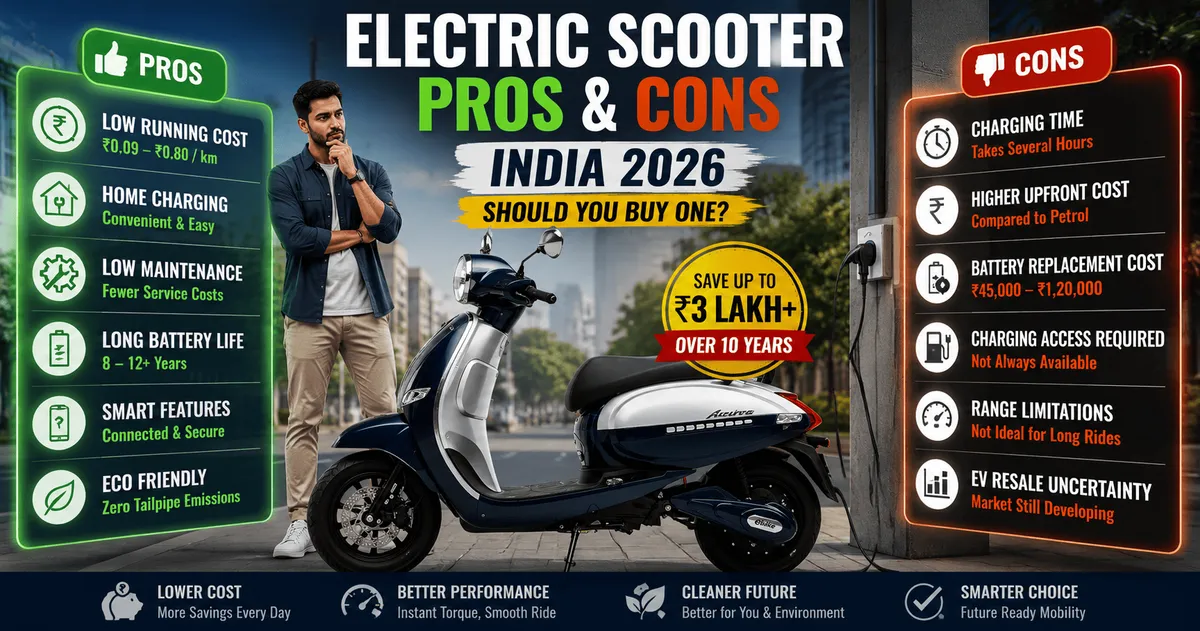
Electric Scooter Advantages and Disadvantages in India: Everything You Need to Know Before Buying
Electric scooters have moved from a niche experiment to one of the fastest-growing vehicle categories in India. What changed?
A few years ago, range anxiety, fire incidents, and high prices gave buyers pause. Today, modern electric scooters offer longer battery life, lower running costs, improved safety, and smarter technology than most early models even promised. The FAME-II subsidy scheme has also made EVs more accessible across income brackets.
But one question still matters: Are electric scooters actually worth buying in India in 2026?
The answer depends on your daily commute, charging access, riding habits, and how long you plan to keep the vehicle.
This guide covers every major advantage and disadvantage of electric scooters, honestly, with real Indian context — so you can make the right decision for your situation.
Is an Electric Scooter Worth Buying?
For most Indian city riders covering between 15 km and 60 km daily, an electric scooter now offers one of the lowest total costs of ownership of any personal vehicle.
Electric scooters work best for:
- Daily office commuters
- College students
- Families running errands
- Senior citizens who value smooth, low-effort riding
- Urban delivery riders with predictable routes
A petrol scooter may make more sense if:
- You ride 150+ km daily or travel between cities frequently
- You have no reliable access to home charging
- You live in a rural area with unreliable electricity supply
Why More Indians Are Switching to Electric
The primary driver is economics — and the numbers make it hard to argue otherwise.
Petrol prices across most Indian states hover above ₹100–₹120 per litre. A rider doing 30–40 km daily can easily spend ₹2,500–₹4,000 every month on fuel alone. Over five years, that often exceeds the original purchase price of the scooter itself.
Electric scooters change this calculation completely.
Most electric scooters cost approximately ₹0.20–₹0.80 per kilometre to run on home electricity. A comparable petrol scooter costs ₹2.50–₹4.00 per kilometre depending on mileage and local fuel prices. That is not a small difference.
Some electric scooter brands like Sokudo offer per km run cost at just ₹0.09
But cost is only part of the story. Modern electric scooters also offer:
- Home charging — no more fuel station detours
- Smooth, vibration-free riding from instant torque delivery
- Fewer mechanical components and lower maintenance bills
- Smart connectivity features including GPS, anti-theft alerts, and ride analytics
- Significantly lower tailpipe emissions, which matters increasingly in cities like Delhi, Bengaluru, and Mumbai
How Electric Scooter Ownership Differs From Petrol
Understanding what you are actually buying helps set the right expectations.
A petrol scooter relies on an engine, fuel system, spark plugs, air filters, clutch assembly, and exhaust. These components create friction, wear, and recurring service costs.
An electric scooter replaces most of this with a battery pack, electric motor, controller, and battery management system (BMS). Fewer moving parts generally means fewer breakdowns and lower annual maintenance spend.
The daily ownership rhythm also changes. Instead of stopping at a petrol pump every few days, you plug the scooter into a standard household socket overnight and begin each morning with a full charge. Many long-term EV owners cite this as one of the features they appreciate most.
For a deeper look at long-term ownership, read our guide on how long electric scooters last in India.
Advantages of Electric Scooters in India
1. Extremely Low Running Costs
This is the headline benefit and the numbers speak for themselves.
| Vehicle Type | Cost Per KM | Monthly Cost (1,000 km) |
| Electric Scooter | ₹0.20–₹0.80 | ₹300–₹800 |
| Petrol Scooter | ₹2.50–₹4.00 | ₹3,000–₹4,000 |
A single full charge typically costs between ₹15 and ₹50 depending on battery size and your local electricity tariff. For context, that is roughly equivalent to less than half a litre of petrol in most states.
Over a five-year ownership period, these savings compound significantly. Most riders who switch to electric recover the price premium within 2–3 years purely through fuel savings.
2. Lower Maintenance Costs
There is no engine oil to change, no spark plugs to replace, no air filter servicing, and no exhaust maintenance. Routine upkeep for an electric scooter focuses on:
- Tyres and brake pads
- Suspension checks
- Bearings
- Periodic electrical system inspection
Annual maintenance costs are typically a fraction of what equivalent petrol scooters require. This is a meaningful saving over the life of the vehicle.
3. Home Charging Convenience
Imagine never visiting a petrol station again.
Instead of refuelling every few days, you simply plug in overnight using a standard 15-amp household socket. No queues. No fuel shortages. No route detours. For families and working professionals in particular, this convenience compounds into significant time savings over months of use.
Most electric scooters are designed for standard home charging without any special installation. Apartment residents should confirm that their housing society permits charging in the parking area, many larger societies have now installed dedicated EV charging points.
4. Better Performance in City Traffic
Indian city conditions signals, tight gaps, stop-and-go congestion — actually favour electric drivetrains.
Electric motors deliver instant torque from zero speed. This makes pulling away from signals faster and more controlled, overtaking smoother, and low-speed manoeuvring easier than on comparably priced petrol scooters. For daily commuters in cities like Delhi, Pune, Hyderabad, and Chennai, this translates into noticeably less rider fatigue by the end of the day.
5. Quiet and Comfortable Riding
Electric scooters produce minimal mechanical noise and virtually no vibration at the handlebar or footboard. The reduction in engine noise and vibration during a 45-minute daily commute is something most riders notice immediately and don't want to give up after switching.
6. Smart Technology Features
Modern electric scooters increasingly function like connected devices. Standard or available features on many 2026 models include:
- GPS tracking and anti-theft alerts
- Ride analytics via mobile app
- Real-time battery and range monitoring
- OTA (over-the-air) software updates
- Remote diagnostics
These features improve both security and the day-to-day ownership experience.
7. Environmental Benefits
Electric scooters produce zero tailpipe emissions — no carbon monoxide, nitrogen oxides, or particulate matter. For riders in cities with high pollution levels, this is a genuine benefit beyond just the financial case. India's Central Pollution Control Board consistently lists two-wheeler combustion emissions as a significant contributor to urban air quality problems.
Real-World Range vs Claimed Range: What to Expect
Most buyers are surprised when their scooter's real-world range falls short of the manufacturer's claimed figure. This is normal, expected, and not a defect — it is the difference between ideal test-condition range and actual road performance.
Real-world range is affected by:
- Rider weight
- Riding speed (higher speed drains battery faster)
- Road gradient and terrain
- Ambient temperature (batteries lose efficiency in extreme heat or cold)
- Tyre pressure
- Battery age and condition
| Claimed Range | Realistic Range in Indian Conditions |
| 80 km | 55–65 km |
| 100 km | 65–80 km |
| 120 km | 95–105 km |
| 150 km | 125–135 km |
Planning your daily commute around the realistic figure, not the claimed one, will give you a much more accurate picture of what to expect.
How Long Does an Electric Scooter Battery Last?
Battery lifespan is the most common concern among first-time EV buyers, and it is one that deserves a clear, honest answer.
Battery life is measured in charge cycles — one complete 0–100% charge counts as one cycle. Most modern lithium-ion batteries are rated for 800–2,000 cycles.
LFP (Lithium Iron Phosphate) batteries, which several scooters now use, are rated for 2,000–4,000+ cycles.
For a rider covering 30 km daily, this translates to roughly 8–12 years before significant battery degradation becomes noticeable. LFP batteries also handle India's heat conditions better than standard NMC (nickel-manganese-cobalt) cells — an important advantage for riders in North India, the Deccan plateau, and coastal cities where ambient temperatures regularly exceed 40°C in summer.
Good charging habits extend battery life considerably. Avoid draining the battery below 20%, keep it out of direct sunlight when parked, and prefer overnight slow charging over repeated fast charging where possible. For a full breakdown of best practices, read our guide on how to extend your electric scooter battery life.
Disadvantages of Electric Scooters in India
1. Higher Purchase Price
Most electric scooters still carry a higher upfront price than comparably specified petrol scooters. The Sokudo Plus starts at ₹59,889 competitive for the segment but entry-level petrol scooters are available for less.
The gap has narrowed considerably in 2026, and long-term savings typically more than compensate. But the upfront investment is a real consideration for budget-focused buyers.
2. Battery Replacement Cost
If the battery reaches the end of its usable life during your ownership period, replacement is the single largest potential expense typically ₹45,000–₹1,20,000 depending on battery size and chemistry.
However, with LFP batteries rated for 2,000–4,000+ cycles, most riders covering normal daily distances will not need a replacement within 8–10 years of purchase. This is a long-term consideration, not an immediate concern for most buyers.
3. Charging Takes Longer Than Refuelling
A petrol scooter is refuelled in three minutes. An electric scooter requires several hours to charge fully.
| Battery Size | Typical Charging Time |
| 1.5 kWh | 4–5 hours |
| 2.2 kWh | 5–7 hours |
| 3 kWh | 6–8 hours |
| 4 kWh+ | 7–10 hours |
For most riders, overnight charging eliminates this as a practical problem. However, if you forget to plug in and wake up to a low battery, you cannot "top up" as quickly as with petrol. Planning your charging habit is part of EV ownership.
4. Charging Infrastructure Limitations
India's public charging network has grown significantly but still cannot match the density of petrol stations, particularly outside major cities. For riders who rely entirely on public charging — or those living in apartments without access to a charging point in the parking area — this remains a genuine constraint.
Home charging resolves this for most buyers. If home charging is not possible in your current living situation, evaluate this carefully before purchasing.
5. Range Anxiety for Long-Distance Riders
For riders whose commute stays within 40–80 km daily, range anxiety is largely a non-issue with 2026 models. For highway riders, intercity travellers, or commercial users covering 120+ km daily, planning around charge availability adds a layer of complexity that petrol scooters simply do not require.
6. Developing Resale Market
The used EV market in India is younger and less mature than the used petrol market. Resale values depend heavily on battery health a metric that is not yet standardized across the industry. As battery health reporting tools and standardized diagnostics become more common, EV resale confidence is expected to
improve. For now, buying new often offers clearer value than buying used for EVs.
Can Electric Scooters Handle Indian Monsoons?
Yes, modern electric scooters are built with IP-rated (Ingress Protection) components designed to handle wet conditions and monsoon commuting.
However, riders should avoid:
- Flooded roads or deep water crossings (the depth limit varies by model)
- Pressure washing the underbody or electrical components
- Parking for extended periods in standing water
Normal rain, Mumbai monsoon commutes, and Chennai's wet season are all conditions that quality electric scooters handle without issue. When in doubt, check the IP rating specified in your scooter's documentation.
Apartment Living and Electric Scooter Ownership
Charging access is one of the most important practical considerations for apartment residents.
Ideal conditions for EV ownership:
- Dedicated or assigned parking with a nearby electrical outlet
- Housing society permission to use or install a charging point
- Access to a standard 15-amp socket in or near the parking area
Conditions that require planning:
- Street parking without access to electricity
- Shared parking areas with restricted electrical use
- Buildings where the housing society has not yet adopted an EV policy
Many larger residential societies and gated communities across Delhi-NCR, Pune, and Bengaluru have already installed EV charging infrastructure. If yours has not, it is worth raising at the next RWA meeting — demand is increasing and the setup cost is modest.
5-Year Total Ownership Cost Comparison
Based on a rider covering approximately 11,000 km per year.
| Expense | Electric Scooter | Petrol Scooter |
| Purchase Price | ₹90,000 | ₹80,000 |
| Energy / Fuel (5 years) | ₹25,000 | ₹1,80,000 |
| Maintenance (5 years) | ₹8,000 | ₹25,000 |
| Total Ownership Cost | ₹1,23,000 | ₹2,85,000 |
The electric scooter saves approximately ₹1.62 lakh over five years in this scenario — enough to cover the original purchase price of another scooter. Actual results will vary based on your mileage, local electricity rates, and riding conditions.
For a model-by-model breakdown of the most affordable electric scooters in India for 2026, including total ownership cost comparisons, read our dedicated guide.
Which Rider Profile Benefits Most?
College Students: Low running costs make this one of the strongest economic cases for EV ownership. Overnight charging at home eliminates the recurring fuel expense that adds up quickly on a student budget.
Office Commuters: Perhaps the clearest use case. A predictable daily distance, overnight charging at home, and no fuel station stops make electric the practical choice for most urban commuters.
Families: Excellent for daily errands, school runs, and local trips. The smooth ride and quiet operation make family outings more comfortable.
Senior Citizens: Lightweight models with smooth throttle response and no clutch or gear changes reduce physical effort considerably. Read our detailed guide on the best electric scooters for elderly riders in India for model-specific recommendations.
Delivery Riders: Depends heavily on daily distance and whether charging can be done between shifts. For delivery riders covering 60–80 km daily with access to midday charging, EVs are viable. For those covering 150+ km continuously, evaluate carefully.
Why Battery Chemistry Matters More Than Marketing
Most buyers focus on top speed, claimed range, and price. Battery chemistry is the factor that most directly determines long-term ownership quality — and most buying guides underexplain it.
Standard NMC (Nickel-Manganese-Cobalt) batteries:
- Higher energy density
- Lower thermal stability
- More susceptible to heat degradation
LFP (Lithium Iron Phosphate) batteries:
- Better thermal stability — important for Indian summers
- Longer cycle life (2,000–4,000+ cycles)
- Improved safety characteristics
- Slightly lower energy density, meaning marginally larger/heavier packs for the same range
For Indian riding conditions high ambient temperatures, extended summers, and urban stop-start usage LFP is the more durable long-term choice.
The Sokudo Acute, Sokudo Acute 2.2, Sokudo Select 2.2, and Sokudo Rapid 2.2 all use LFP battery technology, making them particularly well-suited for riders prioritising durability and long-term value over the full ownership period.
Frequently Asked Questions
Do electric scooters actually save money in India?
Yes, for most urban commuters, the savings are substantial. Running costs of ₹0.09–₹0.80 per km versus ₹2.50–₹4.00 per km for petrol add up to lakhs in savings over five years.
How much does it cost to charge an electric scooter at home?
Between ₹15 and ₹50 per full charge, depending on battery size and your state's electricity tariff. Most riders spend ₹300–₹800 per month on electricity, compared to ₹3,000–₹4,000 on petrol.
Can electric scooters be ridden in rain and monsoon?
Yes. Modern EVs are built with IP-rated components for wet conditions. Avoid flooded roads and deep water crossings.
How long does an electric scooter battery last?
Most standard lithium-ion batteries last 3–5 years with typical use. LFP batteries, found in Sokudo models, are rated for 2,000–4,000+ charge cycles — translating to 8–12+ years for most Indian commuters.
Is insurance mandatory for electric scooters?
Yes. Registration-eligible electric scooters require third-party insurance at minimum, as per Indian motor vehicle regulations. Comprehensive insurance is recommended.
Can I charge using a normal home socket?
Yes. Most electric scooters charge via a standard 15-amp household socket. No special installation is needed for overnight slow charging.
Are electric scooters good for intercity travel?
They can handle inter-city trips with planning, but they are optimised for daily urban commuting. Petrol scooters still offer more flexibility for unplanned long-distance travel.
Which battery type is best for Indian conditions?
LFP (Lithium Iron Phosphate) batteries are widely regarded as the most suitable for India's climate due to better heat tolerance, longer cycle life, and improved safety.
Is buying an electric scooter worth it in 2026?
For most urban commuters travelling predictable daily distances with access to home charging, yes. The combination of lower running costs, lower maintenance, and home charging convenience makes the switch financially compelling for the majority of Indian riders.
Advantages and Disadvantages of Electric Scooters: Summary
| Advantages | Disadvantages |
| Extremely low running cost (₹0.20–₹0.80/km) | Higher purchase price than petrol |
| Lower maintenance bills | Battery replacement cost (₹45k–₹1.2L) |
| Home charging — no fuel station visits | Charging takes hours, not minutes |
| Instant torque — better city performance | Public charging infrastructure still developing |
| Quiet, smooth, vibration-free riding | Range limitations for 150+ km/day riders |
| Smart connectivity features | Younger, less mature resale market |
| Zero tailpipe emissions |
Final Verdict: Should You Buy an Electric Scooter in 2026?
Electric scooters are no longer a future technology.
For daily commuters, students, families, and city riders covering predictable distances, the advantages outweigh the disadvantages by a considerable margin. Lower running costs, reduced maintenance requirements, home charging convenience, and increasingly reliable LFP battery technology have made electric scooters one of
the most practical daily transport choices available in India today.
The disadvantages are real. Charging infrastructure has room to grow. Battery replacement is a long-term cost to plan for. And petrol scooters continue to offer greater flexibility for unplanned intercity travel.
But for the majority of Indian commuters the office worker in Noida, the student in Pune, the family in Coimbatore an electric scooter now delivers exceptional value over the life of the vehicle.
The question is no longer whether electric scooters are practical.
The question is whether continuing to pay ₹100-per-litre petrol prices makes sense when a well-engineered alternative is available starting at ₹67,951 on the Sokudo Plus.
Want to compare Sokudo models side by side? Visit the full Sokudo electric scooter range and find the model that fits your commute, budget, and riding style.
Comments
Share your thoughts about this article.
Loading comments...