8 June 2026•Sokudo Electric India
Published: June 8, 2026 | Last updated: June 8, 2026 | By: Sokudo Electric India Editorial Team
How Long Do Electric Scooter Batteries Last in India?
Electric scooters have become one of the fastest-growing segments of Indian mobility. According to data from the VAHAN Portal tracked by EVReporter, electric two-wheelers crossed 12.79 lakh units in 2025 alone - an 11.4% growth over the previous year. Rising fuel prices, lower operating costs, and rapidly improving battery technology have convinced millions of Indian riders to make the switch.
But before most buyers finalise their decision, one question dominates every conversation:
How long will the battery actually last?
This concern is understandable and financially important. Unlike tyres, brake pads, or other consumable components, the battery is the single most expensive part of an electric scooter. Many first-time buyers worry it will degrade quickly, lose range within a year or two, or require a costly replacement before the vehicle has paid for itself.
The reality is significantly more encouraging than most people expect.
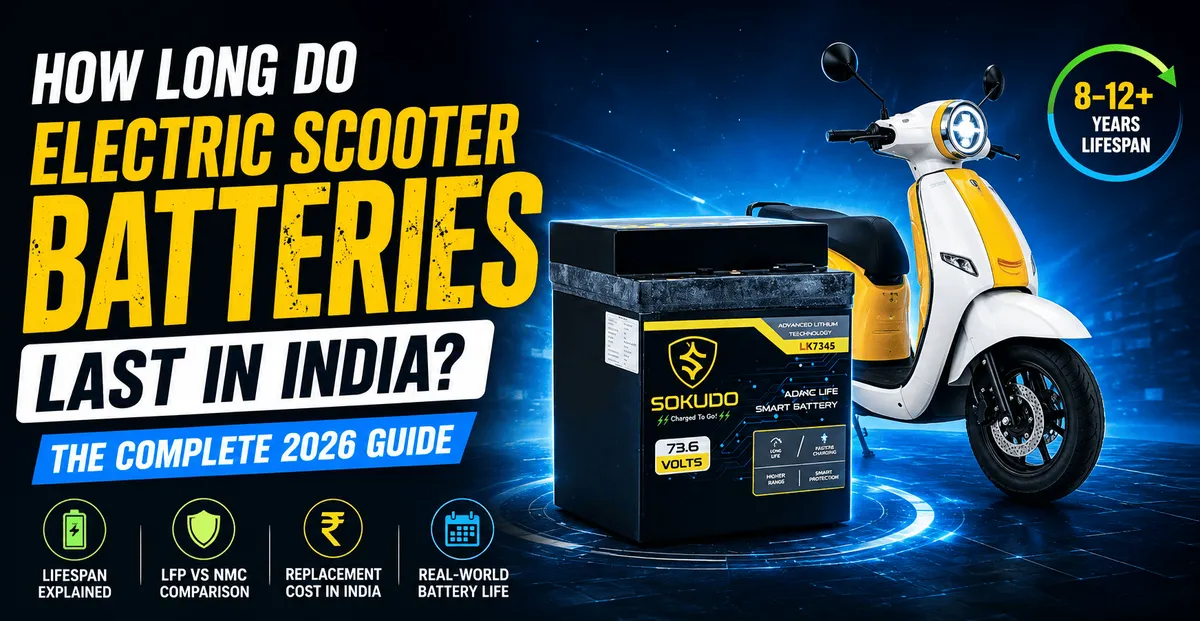
Modern electric scooter batteries - particularly LFP (Lithium Iron Phosphate) technology - have been engineered for long-term Indian use. For most Indian commuters, a quality electric scooter battery will easily last between 8 and 12 years without needing replacement. This guide explains exactly how that is possible, what affects battery lifespan, how to read degradation correctly, and what you can do to protect your battery investment from day one.
How Long Does an Electric Scooter Battery Last?
For a daily commuter riding 30–40 km per day in India:
- LFP battery: 8–12 years, or approximately 100,000–200,000 km before significant degradation
- Standard lithium-ion battery: 5–8 years, or approximately 80,000–150,000 km
- Lead acid battery: 2–4 years, or approximately 25,000–40,000 km
| Battery Type | Expected Lifespan | Charge Cycles | Best For |
| Lead Acid | 2–4 Years | 300–500 | Budget entry-level scooters |
| Lithium-Ion (NMC) | 5–8 Years | 800–2,000 | Mid-range scooters |
| LFP (Lithium Iron Phosphate) | 8–12+ Years | 2,000–4,000+ | Long-term ownership in Indian conditions |
A student covering 15 km daily may never need a battery replacement in their primary ownership period. A gig delivery rider covering 100 km daily may consume cycles faster but can still expect 6–10 years from a quality LFP battery.
The key insight: battery lifespan is far longer than most first-time buyers assume.
Why Indian Buyers Worry About EV Batteries - And Why Most Fears Are Outdated
For decades, Indian buyers have owned petrol scooters. They understand how a petrol engine ages, what maintenance costs to expect, and roughly how long the vehicle will last. Electric scooters feel unfamiliar by comparison - and the battery, being invisible and expensive, becomes the focal point of every concern.
Common questions include:
- Will the battery die after 2–3 years?
- How much does battery replacement cost?
- Does daily charging damage the battery faster?
- Can a battery survive Indian summers reaching 45°C?
- Will the scooter become unusable once capacity drops?
Most of these fears originate from early-generation electric vehicles from 2015–2019, which used inferior battery chemistry, lacked proper Battery Management Systems (BMS), and had minimal thermal protection. Those concerns no longer apply to a modern AIS 156-certified scooter with an LFP battery.
Understanding how modern batteries actually work dissolves most of these fears immediately. For a deeper look at how different battery chemistries compare for Indian conditions, read our guide on Lead-Acid vs Lithium vs LFP: Which EV Battery is Best?
AIS 156 Certification: The Battery Safety Standard Every Indian EV Buyer Should Know
Before diving into lifespan, there is a regulatory baseline that matters enormously for safety and long-term reliability - and most buyers have never heard of it.
AIS 156 is India's mandatory battery safety standard for electric two-wheelers and three-wheelers (L-category vehicles), enforced by the Ministry of Road Transport and Highways (MoRTH). MoRTH amended AIS-156 for L-category electric vehicles to prescribe technical requirements for traction batteries, applicable since December 2022. EV batteries are tested for over-charge and discharge protection, over-current and short-circuit protection, over-temperature protection, voltage cut-off, and Battery Management System compliance.
From a consumer perspective, AIS 156 certification provides assurance that the electric vehicle has undergone rigorous testing and meets the necessary safety standards set by the government. The certification is issued by the Automotive Research Association of India (ARAI).
In practical terms, AIS 156 certification means the battery in your scooter has been verified to:
- Withstand overcharging without fire risk
- Handle short-circuit events safely
- Manage thermal events with warning systems
- Operate with a microprocessor-based BMS
All Sokudo electric scooters are AIS 156 certified. This is not a marketing claim - it is a regulatory requirement that every scooter sold in India must meet, and it provides the baseline safety and durability that makes modern battery lifespans possible.
Understanding Battery Lifespan: Years vs Kilometres vs Charge Cycles
Battery lifespan is often misunderstood because people measure it differently. There are three valid ways to think about it - and understanding all three creates realistic expectations.
Measurement 1: Years
How long the battery lasts in calendar time. This depends heavily on how frequently the scooter is used.
Measurement 2: Kilometres
Total distance the battery can cover across its lifetime. A battery with 3,000 charge cycles and 100 km of range has a theoretical lifespan of 300,000 km. Real-world conditions reduce this somewhat, but modern LFP batteries frequently exceed 150,000 km in practice.
Measurement 3: Charge Cycles
The most accurate measurement. A charge cycle represents 100% battery usage - not the number of charging sessions. Using 50% today and 50% tomorrow equals one cycle. Four separate 25% discharges also equal one cycle.
| Battery Type | Cycle Life | Approximate km (at 100 km range) |
| Lead Acid | 300–500 | 30,000–50,000 km |
| Lithium-Ion (NMC) | 800–2,000 | 80,000–200,000 km |
| LFP | 2,000–4,000+ | 200,000–400,000 km |
For a commuter riding 30 km daily, reaching even 150,000 km takes approximately 13–14 years. This is why battery replacement is rarely needed during primary ownership for most Indian riders.
Battery Chemistry: The Foundation of Lifespan
Battery chemistry is the single biggest determinant of how long a battery will last. Three chemistries dominate the Indian market.
Lead Acid Batteries
The earliest EV batteries. Affordable but limited.
- Lifespan: 2–4 years
- Cycle life: 300–500 cycles
- Weight: Heavy (adds 15–20 kg vs lithium)
- Charging: Slow
- Indian suitability: Poor - heat accelerates degradation significantly
Lead acid batteries are disappearing from modern electric scooters. If you are comparing models, any scooter still offering lead acid as the primary option should be evaluated very carefully for long-term ownership costs. The Sokudo Plus offers both lead acid and lithium options, allowing buyers to choose based on their daily distance and budget.
Lithium-Ion (NMC) Batteries
A major advancement over lead acid. The current mainstream choice across the EV industry.
- Lifespan: 5–8 years
- Cycle life: 800–2,000 cycles
- Weight: Light
- Charging: Fast
- Indian suitability: Good, but heat degrades them faster than LFP
NMC batteries prioritise energy density - which is why they deliver higher range and lighter weight. The trade-off is lower cycle life and greater sensitivity to heat. For Indian summers regularly exceeding 40°C, NMC batteries require careful thermal management.
LFP (Lithium Iron Phosphate) Batteries
The benchmark for long-term ownership in Indian conditions.
- Lifespan: 8–12+ years
- Cycle life: 2,000–4,000+
- Weight: Slightly heavier than NMC but significantly lighter than lead acid
- Charging: Fast with 3–4 hour full charge
- Indian suitability: Excellent - engineered for heat resistance and cycle durability
LFP batteries sacrifice some energy density compared to NMC, but deliver substantially better thermal stability, safety, and lifespan. Requirements for AIS 156 Phase 2 implementation include thermal propagation testing and audio-visual warning systems in case of thermal events - standards that LFP batteries meet with considerable margin due to their inherent chemistry.
This is why Sokudo's range - the Acute, Acute 2.2, Rapid 2.2, Select 2.2, and Pace - is built on LFP technology. For a detailed technical comparison of all three chemistries, see Sokudo's complete battery technology guide.
LFP vs NMC: The Comparison That Actually Matters for Indian Buyers
| Specification | LFP Battery | NMC Battery |
| Cycle life | 2,000–4,000+ | 800–2,000 |
| Thermal stability | Excellent | Moderate |
| Heat resistance | Handles 40–50°C well | Degrades faster in heat |
| Fire risk | Very low | Moderate |
| Energy density | Moderate | High |
| Weight | Slightly heavier | Lighter |
| Lifespan (India) | 8–12+ years | 5–8 years |
| Best for | Long-term ownership | Range-maximised performance |
For Indian buyers prioritising long-term ownership, lower replacement risk, and performance in extreme summer temperatures - LFP is the superior choice by a significant margin.
How Indian Climate Affects Battery Life
India presents battery challenges that most EV markets simply do not face. Understanding them helps you protect your investment.
The Heat Problem
Heat is the primary enemy of battery health in India. During peak summer months, temperatures across much of India regularly exceed 40°C, and in states like Rajasthan, Gujarat, and parts of UP and MP, they frequently touch 45–48°C.
Sustained heat exposure causes:
- Accelerated chemical aging inside battery cells
- Reduced long-term capacity
- Increased internal resistance over time
- Greater thermal stress on cell connections
LFP batteries handle these conditions significantly better than NMC alternatives because of their higher thermal stability threshold. This is one of the primary reasons they have become the preferred chemistry for Indian EV manufacturers focused on long-term ownership rather than headline range figures.
Practical steps to protect your battery in Indian summers:
- Park in shade or covered parking whenever possible
- Avoid leaving the scooter in direct sun for extended periods after charging
- Charge in the evening or at night when ambient temperatures are lower
- Do not charge immediately after a long ride - let the battery cool for 15–20 minutes first
Cold Weather in India
Most Indian riders do not face severe cold, but riders in northern states during December–February may notice:
- Temporarily reduced range (10–20% in very cold conditions)
- Slightly slower charging
- Lower initial performance on cold mornings
These effects are temporary. Performance returns to normal once temperatures rise. Cold weather does not permanently damage modern lithium batteries in the way that sustained heat does.
Real-World Battery Lifespan by Rider Profile
Technical specifications become more meaningful when applied to actual Indian riding situations.
Student or College Rider (10–25 km daily)
Usage pattern: College commute, tuition, local errands. Low daily mileage, predictable charging.
- Lithium-ion battery: 7–10 years
- LFP battery: 10–15+ years
For most students, the scooter - and the battery - will likely be replaced before the battery shows significant degradation.
Recommended model: Sokudo Select 2.2 for its urban styling and LFP durability, or the Sokudo Plus for budget flexibility.
Daily Office Commuter (20–50 km daily)
Usage pattern: Predictable daily commute, overnight charging at home, moderate speeds.
- Lithium-ion battery: 6–9 years
- LFP battery: 8–12+ years
Office commuters represent the ideal use case for electric scooters. Consistent, moderate usage allows the battery to reach its full lifespan potential.
Recommended model: Sokudo Rapid 2.2 for its 120 km range and three riding modes, or the Sokudo Acute for pure city performance.
Family Rider (20–40 km daily, mixed use)
Usage pattern: School pickups, grocery runs, local errands, occasional longer trips.
- Lithium-ion battery: 8–12 years
- LFP battery: 10–15+ years
Moderate usage and lower average speeds mean batteries age slowly. The 250 kg load capacity of the Rapid 2.2 makes it particularly suitable for pillion riding.
Recommended model: Sokudo Pace for its 100 km range, ride comfort, and 3-year battery warranty.
Gig or Delivery Rider (70–120 km daily)
Usage pattern: Multiple charges per day, stop-and-go city traffic, long operating hours, high annual mileage.
- Lithium-ion battery: 4–7 years
- LFP battery: 7–10+ years
Delivery riders consume charge cycles significantly faster than other profiles. Even so, the economics are overwhelmingly favourable - a delivery rider covering 3,000 km monthly can save ₹40,000–₹60,000 per year compared to a petrol scooter.
For commercial riders, LFP chemistry is not optional - it is the only battery type that makes long-term economic sense at this usage intensity.
Recommended model: Sokudo Rapid 2.2 for its 120 km range, fast 3–4 hour charging, 250 kg load capacity, and LFP durability.
Battery Degradation: What Actually Happens Over Time
Battery degradation is the most misunderstood aspect of EV ownership. Most people imagine a battery that works perfectly for years and then suddenly stops. The reality is a slow, gradual, predictable decline.
Typical Degradation Curve (LFP Battery, Average Indian Commuter)
| Battery Age | Approximate Remaining Capacity | Real-World Range (100 km original) |
| New | 100% | 100 km |
| 1 Year | 97–99% | 97–99 km |
| 3 Years | 92–96% | 92–96 km |
| 5 Years | 87–92% | 87–92 km |
| 8 Years | 78–87% | 78–87 km |
| 10 Years | 70–82% | 70–82 km |
Note: These figures are based on manufacturer specifications for LFP chemistry under typical Indian commuting conditions (30–50 km daily, overnight charging, ambient temperatures of 25–40°C). Individual results will vary based on charging habits, storage conditions, and riding patterns.
The practical meaning: a scooter with 100 km original range will likely still deliver 85–90 km after five years of daily commuting. This remains usable for the vast majority of Indian riders whose daily distances fall between 20 and 50 km.
Why Degradation Is Gradual, Not Sudden
LFP chemistry degrades more linearly than NMC. Where NMC batteries can show more abrupt capacity drops, LFP batteries tend to decline slowly and predictably, giving riders plenty of warning before performance becomes a practical concern.
Signs Your Electric Scooter Battery Is Ageing
Even the best batteries eventually show signs of ageing. Recognising these early helps you plan - not panic.
1. Reduced Real-World Range
The most common and most obvious sign. A scooter that previously covered 100 km now consistently delivers 82–85 km on a full charge. Mild reduction is completely normal. It only becomes a practical concern when the daily range no longer meets your commuting needs.
2. More Frequent Charging
A direct consequence of reduced capacity. If you previously charged twice a week and now charge three times for the same commute, your battery capacity has reduced. This is often the first sign riders notice in everyday use.
3. Battery Percentage Drops Unevenly
An ageing battery may drop from 80% to 60% faster than expected, then slow down through the middle range. Irregular discharge curves indicate reduced cell uniformity as the battery ages.
4. Longer Charging Times
Charging behaviour can change as batteries age. If a battery that previously charged in 3–4 hours now takes 5–6 hours, internal resistance has increased. This warrants a service centre check.
5. Unexpected Power Reduction
If the scooter cuts power unexpectedly, reduces acceleration noticeably, or shows warning lights, the battery should be professionally evaluated. These are late-stage signs and are uncommon in well-maintained LFP batteries within 8 years.
For a complete list of warning signs with diagnostic steps, read: Top 5 Reasons Why You Might Need a Battery Replacement
How to Check Your Battery Health
Modern electric scooters provide multiple ways to assess battery condition.
Method 1: Manufacturer App or Dashboard Most current scooters display battery health as a percentage. A reading above 90% indicates excellent condition. Below 75% warrants evaluation.
Method 2: Service Centre Diagnostic Authorised service centres can run BMS data reports that show cell-level health, balance, and degradation history. This is the most accurate assessment available.
Method 3: Range Monitoring Track your daily range consistently over months. A gradual decline of 1–2% per year is normal. Rapid drops of 10–15% in a short period indicate a problem worth investigating.
General health benchmarks:
| Battery Health Reading | Condition | Action |
| 95–100% | Excellent | No action needed |
| 85–94% | Good | Normal monitoring |
| 75–84% | Moderate | Monitor more closely |
| Below 70% | Reduced | Consider replacement evaluation |
When to Replace Your Electric Scooter Battery
The most important principle: replace based on performance, not age.
A ten-year-old battery that still meets your daily range needs does not need replacing. A six-year-old battery that no longer covers your commute reliably does.
Replace your battery when:
- The available range no longer covers your daily distance reliably
- Charging behaviour has become erratic or significantly slower
- Battery health readings fall consistently below 70%
- The scooter shows repeated power cuts or thermal warnings
- Repair costs approach or exceed replacement value
For most Sokudo owners using LFP models in typical commuting conditions, battery replacement is unlikely to be necessary for the first 8–10 years of ownership.
Electric Scooter Battery Replacement Cost in India (2026)
Battery replacement is often cited as a major EV ownership risk. Understanding realistic costs puts this in perspective.
| Battery Size | Approximate Replacement Cost (2026) |
| 1.5 kWh | ₹20,000–₹35,000 |
| 2.2 kWh | ₹35,000–₹55,000 |
| 3.0 kWh | ₹55,000–₹80,000 |
| 3.1 kWh (LFP) | ₹60,000–₹85,000 |
Important context: Battery costs have been falling steadily. India's EV battery market is projected to grow from USD 2.71 billion in 2025 to USD 15.90 billion by 2034 - this scale of production typically drives significant cost reductions. A replacement needed in 2033 will very likely cost less in real terms than the same replacement today.
Battery warranty covers you for the critical early period. After warranty expiry, a healthy battery should need no replacement for several more years.
Charging Habits That Maximise Battery Life
Battery chemistry sets the ceiling. How you charge determines whether you reach it.
Best practices for Indian riders:
Charge before it hits 20% Deep discharge (0–5%) creates unnecessary stress on battery cells. Recharging at 20–30% extends cycle life.
Avoid leaving at 100% for long periods If the scooter is not being used for several days, keeping the battery between 40–80% is gentler on cells than leaving it fully charged.
Charge in the evening or overnight Ambient temperatures are lower, which reduces thermal stress during the charging process.
Always use the original manufacturer charger Third-party chargers may not match the voltage profile designed for your specific battery pack. This can accelerate degradation over time.
Let the battery cool before charging after a long ride After a 40–50 km run in hot weather, wait 15–20 minutes before plugging in. This prevents charging into a heat-stressed battery.
Keep tyres inflated properly Underinflated tyres increase rolling resistance, forcing the motor and battery to work harder on every journey. This consumes charge cycles faster than necessary.
For a complete step-by-step guide: How to Extend the Battery Life of Your Electric Scooter
Habits that reduce battery life faster:
- Frequently draining to 0% before recharging
- Leaving the scooter discharged for days or weeks
- Charging immediately after high-speed riding in summer heat
- Parking in direct sun for hours after charging
- Using fast charging exclusively when standard charging is available
- Using unapproved chargers from unbranded sources
Battery Warranty: What It Covers and What It Does Not
What battery warranties typically cover:
- Manufacturing defects in cells or pack
- Premature capacity failure beyond specified degradation thresholds
- BMS failures under normal use
- Internal short circuits or cell-level failures
What battery warranties typically do not cover:
- Normal gradual capacity degradation within specified limits
- Damage from third-party chargers
- Physical damage from accidents
- Water damage beyond rated protection standards
- Damage from incorrect storage over long periods
Battery warranty vs vehicle warranty
These are separate coverages. A scooter may carry a 3-year battery warranty and a separate 1-year vehicle warranty, or different combinations. Understanding which components fall under which warranty period is important before purchase.
Sokudo's Warranty & Coverage page details exactly what is covered across battery and vehicle warranties for each model.
Important principle: The end of warranty does not mean the battery is near failure. Warranty periods are conservative manufacturer commitments - not lifespan limits. Many LFP batteries continue performing reliably for years beyond their warranty coverage.
Common Battery Myths - Debunked for Indian Riders
Myth: Electric scooter batteries only last 2–3 years. False. This applies to early lead-acid EV batteries from 2015–2018. Modern LFP batteries last 8–12+ years under typical Indian commuting conditions.
Myth: Charging every day destroys the battery. False. Modern batteries are designed for daily charging. Consistent moderate charging is healthier than irregular deep discharge cycles.
Myth: Fast charging ruins the battery quickly. Partially true, but overstated. Occasional fast charging is safe. Using fast charging exclusively over many years may slightly accelerate degradation - but modern BMS systems manage this protection automatically.
Myth: The battery dies suddenly. False. Degradation is gradual and predictable. Riders have months or years of advance notice through reduced range before the battery reaches a point where replacement is needed.
Myth: Once capacity drops, the scooter becomes unusable. False. A battery at 75% capacity still delivers 75 km on a 100 km-range scooter. This remains fully usable for most Indian daily commutes of 20–40 km.
Myth: Indian summers will destroy an EV battery within a few years. False for LFP batteries. LFP chemistry was specifically developed with thermal stability as a priority. It handles Indian temperature ranges significantly better than early EV chemistries.
Why LFP Batteries Are the Right Choice for India in 2026
The shift toward LFP technology across the Indian EV industry is not coincidental. It is a direct response to the specific demands of Indian ownership - long distances, high temperatures, frequent charging, and buyers who keep vehicles for many years.
Key advantages for the Indian context:
Cycle life advantage: 2,000–4,000+ cycles vs 800–2,000 for NMC - translating to years of additional useful life at the same daily usage level.
Thermal advantage: LFP handles repeated exposure to 40–45°C far better than NMC, making it the logical choice for 8–9 months of Indian summer conditions across most states.
Safety advantage: Lower risk of thermal runaway makes LFP batteries inherently safer in the dense, uncontrolled parking conditions common in Indian cities and towns.
Cost-of-ownership advantage: A battery that lasts 10+ years instead of 6 years means the replacement cost is either avoided entirely or significantly delayed - improving total ownership economics.
AIS 156 compliance advantage: LFP chemistry clears AIS 156 thermal propagation requirements with considerably more margin than alternative chemistries, contributing to more robust long-term certification compliance.
This is why all Sokudo electric scooters - the Acute, Acute 2.2, Rapid 2.2, Select 2.2, and Pace - are equipped with LFP battery technology. For a deeper look at Sokudo's specific battery technology and specifications, visit the Sokudo Battery Technology page.
Petrol vs Electric: The Running Cost Reality in 2026
Battery lifespan becomes even more meaningful when viewed in the context of what you save over that period.
For a petrol scooter covering 30 km daily:
- Fuel consumption: approximately 35 km/litre
- Monthly fuel cost at ₹105/litre: approximately ₹2,700/month
- Annual fuel cost: approximately ₹32,400
For an electric scooter covering 30 km daily:
- Electricity consumption: approximately 1.5 units per 30 km
- Monthly electricity cost at ₹7/unit: approximately ₹315/month
- Annual electricity cost: approximately ₹3,780
Annual savings: approximately ₹28,000–₹30,000
Over 10 years, the cumulative savings on fuel alone approach ₹2,80,000–₹3,00,000 - significantly more than most battery replacement costs. For a full side-by-side breakdown, read: Petrol Scooter vs Electric Scooter in India 2026: Which Saves More Money?
Frequently Asked Questions
How long does an electric scooter battery last in India?
For most Indian commuters, a quality LFP electric scooter battery lasts 8–12 years or between 100,000 and 200,000 km before significant degradation. Standard lithium-ion batteries typically last 5–8 years. The actual lifespan depends on daily distance, charging habits, climate exposure, and battery chemistry. A student covering 15 km daily may see 12–15 years from an LFP battery. A delivery rider covering 100 km daily may see 7–9 years from the same technology.
How many charge cycles does an electric scooter battery have?
LFP batteries are typically rated for 2,000 to 4,000 or more charge cycles. Standard lithium-ion (NMC) batteries offer 800 to 2,000 cycles. Lead acid batteries are limited to 300–500 cycles. One cycle equals 100% of battery capacity used - not one charging session. A commuter charging 50% per session uses one cycle every two charges.
Does daily charging damage an electric scooter battery?
No. Modern electric scooter batteries are specifically engineered for daily charging. The Battery Management System (BMS) controls voltage, current, and temperature during every charge to protect battery cells. Consistent moderate daily charging is healthier for battery longevity than infrequent deep discharge cycles.
Can electric scooter batteries survive Indian summers?
Yes - especially LFP batteries. LFP chemistry was developed with thermal stability as a core priority. It handles sustained exposure to temperatures of 40–48°C significantly better than NMC alternatives. Parking in shade and avoiding charging in direct midday sun provides additional protection in extreme summer conditions.
How much does electric scooter battery replacement cost in India?
Battery replacement costs vary by pack size. Approximate 2026 figures range from ₹20,000–₹35,000 for a 1.5 kWh battery to ₹55,000–₹85,000 for a 3+ kWh LFP pack. These costs are expected to decline as India's battery manufacturing industry scales. Battery costs have already dropped significantly over the past five years and this trend is projected to continue.
What is the difference between LFP and lithium-ion batteries for electric scooters?
LFP (Lithium Iron Phosphate) is a specific type of lithium-ion battery. Compared to the more common NMC (Nickel Manganese Cobalt) lithium-ion chemistry, LFP offers longer cycle life (2,000–4,000+ vs 800–2,000 cycles), better heat resistance, improved thermal stability, and lower fire risk. NMC batteries offer higher energy density and lighter weight. For Indian riding conditions where heat and long-term durability are priorities, LFP is generally the superior choice for most buyers.
Is AIS 156 certification important when buying an electric scooter?
Yes. AIS 156 is the mandatory Indian government battery safety standard for electric two-wheelers, enforced since December 2022. It requires batteries to pass rigorous testing for overcharge protection, thermal propagation, short-circuit protection, and BMS compliance. Buying an AIS 156-certified scooter ensures the battery meets government safety standards - it is not optional for legally sold vehicles in India.
When should I replace my electric scooter battery?
Replace based on performance, not age. Consider replacement when available range no longer meets your daily commuting needs reliably, when battery health readings fall consistently below 70%, or when charging behaviour becomes significantly erratic. For most riders using quality LFP batteries, this point does not arise for 8–10 years under typical Indian commuting conditions.
Can I check my battery health at home?
Yes, partially. Most modern electric scooters display a battery health percentage on the dashboard or companion app. Tracking your real-world range over time is the simplest home check - consistent gradual decline is normal, while sudden drops indicate a potential issue. For precise cell-level diagnostics, visit an authorised service centre which can access BMS data directly.
What happens when battery capacity falls below 70%?
The scooter remains fully operational. A battery at 70% capacity delivers 70 km on a scooter originally rated for 100 km. For riders whose daily distance is 30–40 km, this remains completely usable. Replacement becomes worth considering when reduced capacity begins to affect your ability to complete your regular journeys comfortably.
Final Verdict: How Long Can You Realistically Expect an Electric Scooter Battery to Last?
The fear that electric scooter batteries will fail within a few years is a myth rooted in outdated technology from 2015–2019. The reality of 2026 is significantly different.
India's electric vehicle market reached 2.3 million units in 2025 and accounts for 8% of all new vehicle registrations - a milestone driven in part by growing buyer confidence in battery reliability. That confidence is not unfounded.
For Indian commuters choosing a modern LFP-equipped electric scooter:
- Battery lifespan: 8–12+ years under typical commuting conditions
- Total km potential: 100,000–200,000 km before significant degradation
- Degradation pattern: Gradual and predictable - not sudden failure
- Fuel savings over battery lifespan: ₹2,50,000–₹3,00,000+ compared to a petrol scooter
Choosing an AIS 156-certified scooter with LFP battery technology, following sensible charging habits, and protecting the battery from sustained heat exposure is the complete formula for maximising battery lifespan in India.
The economics are clear. The technology is proven. And the battery lifespan is far longer than most first-time buyers expect.
Ready to explore Sokudo's LFP battery electric scooters? Compare all models at sokudoindia.com or book a free test ride at your nearest showroom.
Related Reading:
Comments
Share your thoughts about this article.
Loading comments...