30 May 2026•Sokudo Electric India
Petrol Scooter vs Electric Scooter in India 2026 - Real Cost, Maintenance and Ownership Compared
Published: May 2026 | Author: Sokudo Electric India Editorial Team | Reading Time: 13 min
For over two decades, petrol scooters dominated Indian roads. The Honda Activa, TVS Jupiter, Suzuki Access, and Hero Pleasure became household names because they were affordable, practical, and easy to maintain anywhere in the country.
But 2026 is different.
Petrol prices continue hovering between ₹95–₹110 per litre across most Indian cities. Electric scooters have become more affordable, more reliable, and significantly cheaper to operate. And Indian buyers are now asking one straightforward question: should I buy a petrol scooter or an electric scooter?
The answer depends on how much you ride, where you ride, and how long you plan to keep the vehicle. This guide compares both options using real-world Indian commuting conditions - not marketing claims.
Petrol Scooter vs Electric Scooter - Direct Answer
For most Indian commuters riding more than 20 km daily, an electric scooter is now the cheaper option over a 3–5 year ownership period.
| Category | Winner |
| Daily running cost | Electric scooter |
| Maintenance cost | Electric scooter |
| Long-term ownership cost | Electric scooter |
| Refuelling convenience | Petrol scooter |
| Service network coverage | Petrol scooter |
| Environmental impact | Electric scooter |
| Daily urban commuting | Electric scooter |
| Highway and long-distance riding | Petrol scooter |
For city commuters, the economics increasingly and decisively favour EVs.
Why More Indian Riders Are Switching to Electric Scooters
According to EV adoption figures tracked by the Ministry of Heavy Industries, electric two-wheelers continue to be one of India's fastest-growing vehicle categories - driven by lower operating costs, government incentives, and improving product quality.
For urban commuters, the appeal is straightforward: no petrol expenses, lower maintenance, home charging convenience, and a significantly reduced daily commuting cost. But the biggest factor remains ownership cost over time. Most Indian riders don't buy scooters for weekend leisure. They buy them for daily commuting - and that changes the financial equation entirely.
Real Running Cost Comparison
Petrol Scooter Running Cost in India
Assumptions: Petrol price ₹102/litre | Real-world mileage 45 km/litre | Monthly distance 750 km
Current petrol prices across Indian states can be tracked at NDTV Fuel Prices.
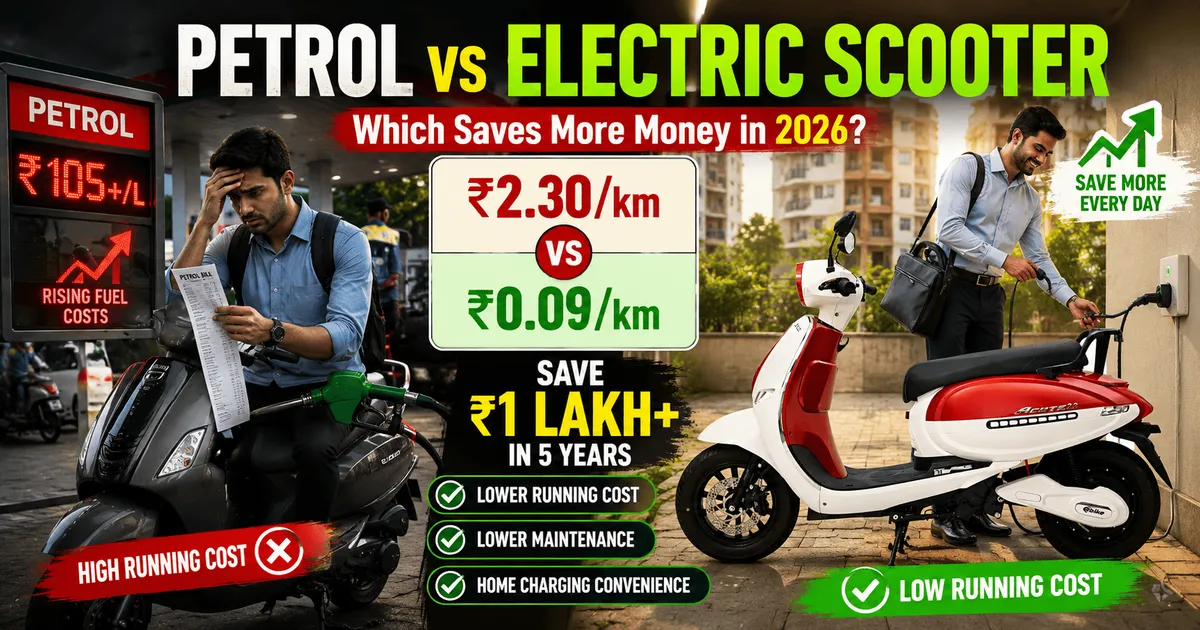
Cost per kilometre: ₹102 ÷ 45 = ₹2.27/km
| Period | Petrol Scooter Fuel Cost |
| Monthly | ₹1,700–₹2,000 |
| Annual | ₹20,000–₹25,000 |
| 5 Years | ₹1,00,000–₹1,25,000 |
Electric Scooter Running Cost in India
Electric scooter operating cost depends on battery size, electricity tariff, riding style, and charging efficiency. Most commuter EVs consume approximately 35–55 km per kWh. Based on average Indian residential electricity tariffs - which vary by state and consumption slab and can be checked at your state electricity board portal - electric scooters typically cost:
₹0.12–₹0.30 per kilometre
Certain efficient scooters like the Sokudo Plus can bring this closer to ₹0.09/km under ideal city conditions.
Cost Per Kilometre: Electric vs Petrol
| Vehicle | Cost Per km | Annual Cost (10,000 km) |
| Petrol scooter | ₹2.20–₹2.50 | ₹22,000–₹25,000 |
| Electric scooter | ₹0.09–₹0.30 | ₹900–₹3,000 |
Annual saving by switching: ₹18,000–₹24,000 for a commuter riding 10,000 km per year.
Monthly Ownership Cost Comparison - Office Commuter (25 km/day)
| Expense | Petrol Scooter | Electric Scooter |
| Fuel / Charging | ₹2,000–₹4,000 | ₹300–₹700 |
| Maintenance reserve | ₹300–₹700 | ₹100–₹250 |
| Total monthly | ₹2,300–₹4,700 | ₹400–₹950 |
For a complete breakdown of what drives these numbers, read our guide on how much it costs to run an electric scooter in India.
Maintenance Comparison - What You Actually Pay Each Year
A petrol scooter contains engine oil, air filters, fuel injectors, spark plugs, clutch systems, and transmission components - all of which require periodic servicing or replacement. Electric scooters eliminate most of these parts entirely.
EVs still need tyre replacement, brake servicing, suspension inspection, and electrical diagnostics - but at a fraction of petrol scooter maintenance frequency and cost.
| Vehicle | Annual Maintenance Cost |
| Petrol scooter | ₹4,000–₹9,000 |
| Electric scooter | ₹1,000–₹5,000 |
Over five years, that difference compounds into ₹15,000–₹40,000 in avoided maintenance costs - before fuel savings are even counted.
Range Comparison - Do Electric Scooters Have Enough for Indian Commuters?
Most Indian commuters travel 10–30 km daily. Modern commuter EVs comfortably deliver 75–120 km of real-world range per charge, which means charging every 2–4 days for the majority of office commuters.
For longer daily commutes of 40 km or more, the Sokudo Acute is worth serious attention - it delivers up to 150 km on a single charge, making it one of the strongest range-per-charge options available for Indian long-distance daily commuters without requiring mid-day charging.
One important note on range figures: always apply a 70–80% real-world adjustment to any claimed or certified range figure. Indian traffic, heat, rider weight, and
road conditions all reduce efficiency from laboratory numbers. A scooter claiming 120 km ARAI range typically delivers 85–100 km in actual city use.
Charging vs Refuelling - Which Is Actually More Convenient?
Where petrol still wins: refuelling speed. A petrol tank is full in under two minutes with no planning required.
Where EVs have an underrated advantage: home charging eliminates petrol station visits entirely. The typical EV commuter routine:
- Return home from office
- Plug into a standard 15A household socket
- Leave next morning with a full charge
Most Indian homes already support EV charging without any special installation. For apartment residents, verifying your society's parking socket policy before purchase is worth doing - some societies bill through commercial meters at higher rates.
For most commuters who currently stop at a petrol station once or twice weekly, home charging is actually less disruptive to their schedule - not more.
Battery Life - NMC vs LFP for Indian Conditions
Battery chemistry is one of the most consequential decisions in EV ownership, yet most buyers never check it before purchase.
| Battery Type | Charge Cycles | Practical Lifespan | Heat Tolerance |
| NMC Lithium-ion | 800–1,500 | 4–6 years | More heat-sensitive |
| LFP (Lithium Iron Phosphate) | 2,000–4,000 | 8–12 years | Superior thermal stability |
Research published by Battery University confirms that LFP chemistry provides significantly better thermal stability and cycle longevity than NMC - a meaningful advantage in India where ambient temperatures regularly exceed 40°C and accelerate NMC degradation.
For a daily commuter charging every 2–3 days, an LFP battery can outlast an NMC pack by 4–6 years under identical conditions. That difference directly determines whether you face a battery replacement cost mid-ownership.
Battery Replacement Cost in India (2026)
| Scooter Category | Replacement Cost |
| Low-speed EV | ₹25,000–₹45,000 |
| Mid-range EV | ₹45,000–₹70,000 |
| Premium EV | ₹70,000–₹1.2 lakh |
This is why battery warranty coverage and chemistry matter more than most specification comparisons acknowledge. An LFP battery lasting 10 years changes total ownership economics far more than a ₹5,000 difference in purchase price.
Also Read: Before comparing battery replacement costs, it's worth understanding the early signs of battery failure. Reduced range, slow charging, frequent shutdowns, visible battery damage, and age-related degradation are among the most common indicators that a replacement may be required. Read our detailed guide: Top 5 Reasons Why You Might Need a Battery Replacement.
5-Year Ownership Cost Comparison - Real Numbers
Assumptions: 10,000 km annually | Moderate commuter | Standard maintenance
| Cost Category | Petrol Scooter | Electric Scooter |
| Fuel / Charging | ₹1,10,000+ | ₹15,000–₹25,000 |
| Maintenance | ₹20,000–₹45,000 | ₹5,000–₹15,000 |
| Insurance | Similar | Similar |
| Total 5-year cost | ₹1.3–₹1.6 lakh | ₹20,000–₹40,000 |
5-year saving: ₹90,000–₹1.2 lakh for a moderate daily commuter - even before accounting for available government subsidies.
Current subsidy details under the PM E-DRIVE scheme can be verified at the Ministry of Heavy Industries EV portal.
Who Benefits Most from an Electric Scooter?
Strong EV candidates:
Daily office commuters covering 20–40 km consistently benefit most from fuel savings. Delivery riders with high daily mileage recover purchase cost fastest. Students gain from low operating costs and home charging convenience. Women commuters benefit from eliminating petrol station stops. Elderly riders gain from reduced maintenance and simpler ownership.
Riders who may still prefer petrol:
Rural and semi-urban riders with limited charging infrastructure face genuine practical constraints. Highway-focused riders doing frequent long-distance trips still benefit from petrol's refuelling speed and range flexibility. Very low usage riders - under 5 km daily - take significantly longer to recover any EV purchase premium through fuel savings.
Best Electric Scooter Alternatives to Petrol Scooters in 2026
| Use Case | Recommended Scooter |
| Daily city commuting | Sokudo Plus |
| Long daily commutes (40 km+) | Sokudo Acute - 150 km single charge |
| Mainstream family commuting | TVS iQube |
| Comfort-focused premium commuting | Ather Rizta |
| Premium build quality | Bajaj Chetak |
People Also Ask
Is an electric scooter cheaper than a petrol scooter in India?
Yes - significantly. Electric scooters cost ₹0.09–₹0.30 per kilometre compared to ₹2.20–₹2.50 per kilometre for petrol scooters. Over five years of daily commuting, most riders save ₹90,000–₹1.2 lakh in combined fuel and maintenance costs.
How much can I save annually by switching from petrol to electric?
Most office commuters covering 10,000 km annually save ₹18,000–₹24,000 per year in fuel costs alone. Adding maintenance savings brings the annual total saving to ₹22,000–₹30,000 for moderate commuters.
Which electric scooter has the longest range in India?
The Sokudo Acute delivers up to 150 km on a single charge, making it the strongest option for long-distance daily commuters who cannot charge mid-day.
How long does an EV battery last in Indian conditions?
NMC batteries typically last 4–6 years for an average daily commuter. LFP batteries last 8–12 years under the same conditions. Indian summer heat above 40°C accelerates NMC degradation more than LFP.
Are electric scooters good for Indian city traffic?
Yes - electric motors perform exceptionally well in stop-go city traffic because they draw near-zero power at standstill, unlike petrol engines that idle and consume fuel continuously. Indian urban traffic actually maximises EV efficiency.
What is the battery replacement cost for electric scooters?
₹25,000–₹45,000 for low-speed EVs, ₹45,000–₹70,000 for mid-range, and ₹70,000–₹1.2 lakh for premium scooters in 2026. Choosing LFP chemistry significantly reduces the probability of replacement within a typical 5-year ownership period.
Final Verdict - Petrol or Electric Scooter in 2026?
For most Indian urban commuters, the numbers in 2026 decisively favour electric scooters.
If your daily riding exceeds 15–20 km, an EV delivers lower monthly expenses, lower maintenance costs, home charging convenience, and substantially better long-term economics. The break-even point for most moderate commuters falls within 18–30 months - after which every kilometre ridden is significantly cheaper than petrol.
Petrol scooters retain genuine advantages for highway travel, remote areas with limited charging infrastructure, and riders whose usage is too low and irregular to recover the EV purchase premium through fuel savings.
But for city commuting, office travel, college runs, and daily errands - electric scooters have become the more economical, more practical, and more sustainable choice.
Before making your final decision, also read:
- Which electric scooter is easiest to ride in India?
- How much does it cost to run an electric scooter in India?
- Best electric scooter for daily office commute in India
Explore the full Sokudo electric scooter range including the Sokudo Plus for city commuting and the Sokudo Acute for longer daily routes.
Fuel prices, electricity tariffs, government policies, and vehicle specifications change over time. Always verify current information from manufacturers, dealers, electricity providers, and government sources before making a purchase decision.
Comments
Share your thoughts about this article.
Loading comments...