12 September 2026·20 min read
13 June 2026•Sokudo Electic India
Published: June 13 2026 | Author: Sokudo Electric India Editorial Team | Reading Time: 11 min
Electric scooters have become one of the smartest ways to cut daily commuting costs in India. But not every rider needs a high-speed scooter registered with the RTO, requiring a full driving licence and insurance.
For millions of Indian riders, daily travel is school runs, grocery shopping, local errands, short office commutes, and trips through residential areas. For this kind of riding, a non-RTO electric scooter is not a compromise. It is often the smarter, lower-cost choice.
Non-RTO scooters offer:
The challenge is that the Indian market now has dozens of no-licence electric scooters, all claiming impressive range and affordability. Not all of them deliver equally on those claims.
This guide compares five of the most popular non-RTO scooters available in India in 2026 across range, battery technology, warranty, running cost, weight, and real-world ownership value so you can make a clear, informed decision.
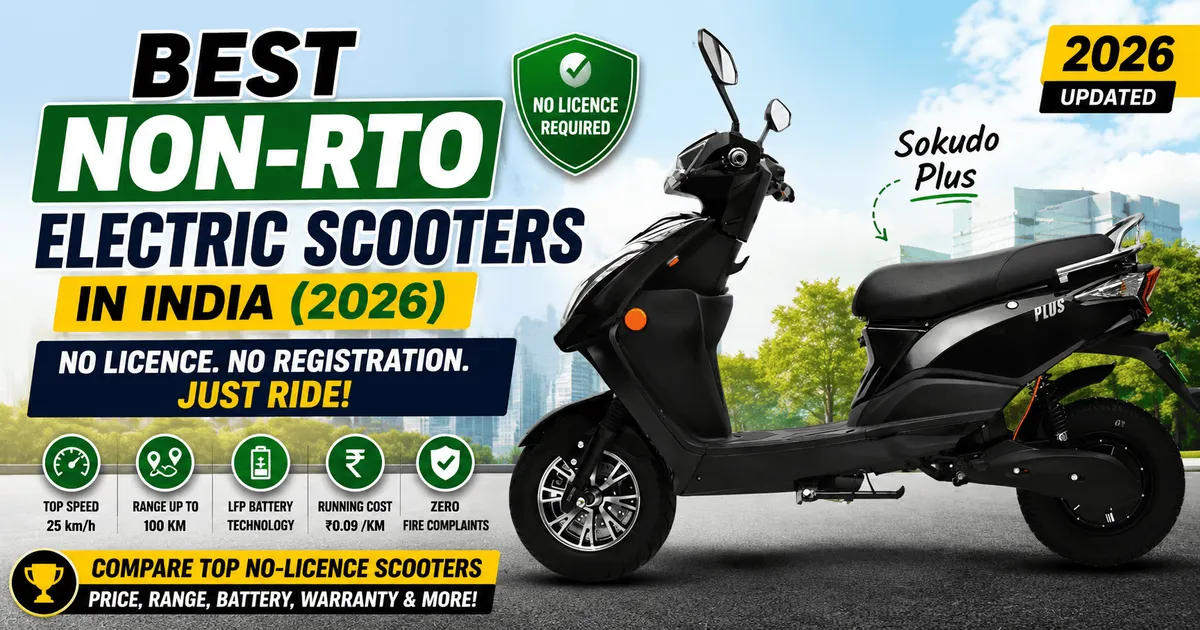
For most riders who want the strongest combination of range, LFP battery technology, warranty coverage, and long-term ownership confidence, the Sokudo Plus stands out with its 100 km claimed range, confirmed Rs 0.09 per km running cost, 3-year battery warranty, and 1-year vehicle warranty.
For budget-first buyers, the Ampere Reo 80 at Rs 59,900 offers an LFP battery and 80 km range at the lowest price in this comparison. For riders who prioritise a lightweight portable-battery scooter from an established brand, the Hero Electric Flash LX at Rs 59,640 remains a strong option. For maximum features, the Zelio Eeva ZX+ brings reverse gear and anti-theft at a competitive entry price. For ultra-compact city handling, the Okinawa Lite at 48 kg is the lightest option available.
The full comparison follows below.
What Is a Non-RTO Electric Scooter in India?
Under Central Motor Vehicles Rules notified by India's Ministry of Road Transport and Highways, an electric scooter qualifies as a non-RTO vehicle when:
Because these vehicles fall below the prescribed thresholds, they do not require a driving licence, vehicle registration, a number plate, or road tax.
This exemption makes non-RTO scooters particularly attractive for students, senior citizens, homemakers, first-time riders, apartment dwellers, and small-town commuters whose daily journeys stay within 15 to 25 km. The savings on registration alone range from Rs 3,000 to Rs 8,000 depending on state, and the absence of a mandatory insurance requirement reduces first-year ownership costs further.
Top Non-RTO Electric Scooters in India (2026): Full Comparison Table
| Model | Top Speed | Claimed Range | Battery Type | Charging Time | Kerb Weight | Warranty | Starting Price |
| Sokudo Plus | 25 km/h | Up to 100 km | LFP | 4 to 5 hrs | 100 kg | 3yr battery, 5yr vehicle | Rs 67,951 |
| Hero Electric Flash LX | 25 km/h | Up to 85 km | Lithium-ion | 4 to 5 hrs | 69 kg | Confirm with dealer | Rs 59,640 |
| Okinawa Lite | 25 km/h | Up to 60 km | Lithium-ion | 4 to 5 hrs | 48 kg | Confirm with dealer | Rs 69,093 |
| Ampere Reo 80 | 25 km/h | Up to 80 km | LFP | 5 to 5.5 hrs | 71 kg | 3yr or 30,000 km battery | Rs 59,900 |
| Zelio Eeva ZX+ | 25 km/h | Up to 80 km (Li-ion) | Lithium-ion variants | 4 hrs (Li-ion) | 90 kg | 1yr or 10,000 km | Rs 67,500 |
All prices are ex-showroom and may vary by city and dealer. Claimed ranges are under test conditions. Real-world range in Indian urban riding is typically 20 to 25 percent lower. Confirm warranty terms directly with your authorised dealer before purchase.
Official page: Sokudo Plus
Price: Rs 67,951 ex-showroom
Claimed range: Up to 100 km
Top speed: 25 km/h (certified, confirmed on official product page)
Battery: LFP (Lithium Iron Phosphate)
Charging time: 4 to 5 hours
Kerb weight: 100 kg
Running cost: Rs 0.09 per km (manufacturer confirmed)
Battery warranty: 3 years
Vehicle warranty: 1 years
Fire complaints: Zero (stated on official product page)
Licence required: No
Registration required: No
Among all non-RTO scooters currently available in India, the Sokudo Plus is the only model in this comparison that combines an LFP battery with a 3-year battery warranty, a 1-year vehicle warranty, and a manufacturer-confirmed Rs 0.09 per km running cost. That combination makes it the most quantifiably strong long-term ownership proposition in the non-RTO category.
It matters because building or riding an EV in India, LFP battery chemistry holds a massive real-world edge. As highlighted by Auto Punditz's deep dive into Indian EV conditions, mass-market two-wheelers and cars are heavily pivoting toward LFP. It offers exceptional thermal stability that can handle intense tropical summers, costs less to manufacture, and boasts a much longer lifespan under the daily stress of stop-and-go traffic and frequent top-up charging.
A student covering 15 km daily spends approximately Rs 40 per month on electricity. A homemaker covering 12 km daily spends under Rs 35 per month. Over a year, that is Rs 400 to Rs 500 in total electricity cost for local commuting, compared to Rs 18,000 to Rs 25,000 on petrol for an equivalent petrol scooter.
At 100 kg it is heavier than the Hero Flash LX (69 kg) and Okinawa Lite (48 kg), which matters for riders who frequently lift or manoeuvre the scooter manually. It is also Rs 8,000 to Rs 10,000 more expensive than the Ampere Reo 80 and Hero Flash LX at entry level.
Best for: Riders who want the strongest long-term ownership package in the non-RTO category. Students, homemakers, senior citizens, and small-town riders covering 10 to 25 km daily who plan to keep the scooter for five or more years.
Official page: Hero Electric Flash LX
Price: Rs 59,640 ex-showroom
Claimed range: Up to 85 km
Top speed: 25 km/h
Battery: Lithium-ion (51.2V, 30Ah, portable)
Charging time: 4 to 5 hours
Kerb weight: 69 kg Motor: 250W BLDC
Licence required: No
Registration required: No
Hero Electric has over a decade of presence in India's electric two-wheeler market, with one of the largest authorised dealer and service networks among EV brands in this segment. For riders in Tier-2 and Tier-3 cities where newer EV brands may have limited reach, that network availability is a practical ownership advantage.
The Flash LX is the lightest lithium-powered scooter in this comparison at 69 kg. The portable detachable battery is arguably its most distinctive practical feature. Riders living in apartments without dedicated parking charge points can carry the battery indoors and charge it from any standard household socket. This solves the apartment charging problem entirely without requiring any infrastructure change.
Standard lithium-ion chemistry does not offer the thermal stability or extended cycle life of LFP batteries. Warranty terms should be confirmed directly with the dealer before purchase. The 85 km claimed range is below the Sokudo Plus and the lead-acid variants of the Zelio Eeva ZX+.
Best for: Senior citizens and lighter riders who need the easiest possible scooter to handle. Apartment residents who cannot install a fixed charging point and need a portable battery solution. Budget buyers who want an established brand name and national service presence.
Official page: Okinawa Lite
Price: Rs 69,093 ex-showroom
Claimed range: Up to 60 km
Top speed: 25 km/h
Battery: Lithium-ion (detachable)
Charging time: 4 to 5 hours
Kerb weight: 48 kg
Licence required: No
Registration required: No
Okinawa is one of the few EV brands in India that has pursued dedicated IATF 16949 quality certification for its manufacturing processes, which provides an independent quality assurance signal beyond marketing claims. The Okinawa Lite is their entry-level urban commuter, built around one defining characteristic: at 48 kg, it is the lightest scooter in this entire comparison by a significant margin.
The 60 km claimed range is the lowest in this comparison. In real-world Indian riding conditions, expect approximately 45 to 50 km, which limits suitability for riders travelling more than 10 to 12 km daily. At Rs 69,093 it is priced higher than the Hero Flash LX and Ampere Reo 80 despite offering the shortest range in the group. Standard lithium-ion chemistry does not provide the long-term thermal stability of LFP.
Best for: Riders whose daily travel stays under 10 to 12 km and who prioritise the absolute lightest scooter for ease of handling. Suitable for congested market areas, narrow residential lanes, and apartment buildings where the scooter needs to be lifted or carried occasionally.
Official page: Ampere Reo 80
Price: Rs 59,900 ex-showroom
Claimed range: Up to 80 km
Top speed: 25 km/h
Battery: LFP (1.44 kWh)
Charging time: 5 to 5.5 hours
Kerb weight: 71 kg
Battery warranty: 3 years or 30,000 km
Licence required: No
Registration required: No
The Ampere Reo 80 is backed by Greaves Electric Mobility, one of India's more established EV manufacturing and engineering groups. At Rs 59,900 it is the most affordable non-RTO scooter in this comparison with an LFP battery, which makes it a noteworthy option for buyers who want thermal stability and cycle life advantages without paying a premium for them.
The 80 km claimed range falls below the Sokudo Plus's 100 km. Charging time at 5 to 5.5 hours is the longest in this comparison. At 71 kg it is heavier than the Hero Flash LX and Okinawa Lite. Vehicle warranty terms beyond the battery should be confirmed directly with the dealer. There is no confirmed running cost per km from the manufacturer equivalent to Sokudo's Rs 0.09 per km.
Best for: Budget-conscious buyers who want an LFP battery and a credible engineering-backed manufacturer at the lowest possible price. Suitable for daily travel under 15 to 18 km. A strong second option to the Sokudo Plus for buyers where upfront cost is the primary constraint.
Official page: Zelio Eeva ZX+
Price: From Rs 67,500 (lead acid) to Rs 90,500 (lithium-ion variant)
Claimed range: Up to 80 km (lithium-ion variant)
Top speed: 25 km/h
Battery: Multiple variants including lead acid and lithium-ion
Charging time: 4 hours (lithium-ion variant)
Kerb weight: 90 kg
Loading capacity: 180 kg
Warranty: 1 year or 10,000 km
Licence required: No
Registration required: No
Zelio has built a focused presence within India's low-speed EV segment. The Eeva ZX+ is their most feature-complete offering, with anti-theft alarm, reverse gear, front disc brake, rear drum brake, digital display, hydraulic front and rear shock absorbers, and a parking switch all included as standard across variants.
At 90 kg for the lithium-ion variant it is heavier than the Hero Flash LX, Okinawa Lite, and Ampere Reo 80, which affects daily handling ease. The 1-year or 10,000 km warranty is significantly shorter than the Sokudo Plus's 3-year battery and 1-year vehicle warranty and the Ampere Reo's 3-year battery warranty. Lead acid variants have substantially longer charging times of 7 to 10 hours. Zelio's service network is more limited in reach compared to Hero Electric and Ampere. Standard lithium-ion chemistry does not provide LFP's thermal stability benefits.
Best for: Riders who want the most features at an entry-level non-RTO price and are comfortable with a shorter warranty period. Well-suited for buyers who value anti-theft alarm and reverse gear and can manage the heavier weight.
For a rider covering 20 km daily (approximately 7,200 km per year):
| Cost Item | Sokudo Plus | Hero Flash LX | Okinawa Lite | Ampere Reo 80 | Zelio Eeva ZX+ |
| Ex-showroom price | Rs 67,951 | Rs 59,640 | Rs 69,093 | Rs 59,900 | Rs 67,500 |
| On-road additions (reg, tax) | None | None | None | None | None |
| Confirmed running cost per km | Rs 0.09 | Not confirmed | Not confirmed | Not confirmed | Not confirmed |
| Daily running cost (20 km) | Rs 1.80 | Est. Rs 2 to Rs 3 | Est. Rs 2 to Rs 3 | Est. Rs 2 to Rs 3 | Est. Rs 2 to Rs 3 |
| Monthly running cost | Rs 54 | Est. Rs 60 to Rs 90 | Est. Rs 60 to Rs 90 | Est. Rs 60 to Rs 90 | Est. Rs 60 to Rs 90 |
| Annual maintenance | Rs 1,500 to Rs 2,500 | Est. Rs 2,000 to Rs 3,000 | Est. Rs 2,000 to Rs 3,000 | Est. Rs 2,000 to Rs 3,000 | Est. Rs 2,000 to Rs 3,000 |
| Battery warranty | 3 years | Confirm with dealer | Confirm with dealer | 3yr or 30,000 km | 1yr or 10,000 km |
| Vehicle warranty | 1 years | Confirm with dealer | Confirm with dealer | Confirm with dealer | 1yr or 10,000 km |
Petrol scooter running costs for comparison: Rs 2.50 to Rs 4.00 per km or Rs 1,500 to Rs 2,400 per month at 20 km daily. All non-RTO electric scooters in this comparison save the rider Rs 1,400 to Rs 2,300 every month versus a petrol scooter at the same daily distance.
Over three years at 20 km daily, the fuel saving alone versus a petrol scooter exceeds Rs 50,000 for any non-RTO scooter in this comparison.
That saving exceeds the purchase price of the Ampere Reo 80 and Hero Flash LX within three years purely on electricity versus petrol.
For a deeper understanding of long-term EV ownership economics including battery lifecycle and degradation expectations, read our guide on how long electric scooters last in India.
Range figures tell you how far a scooter might travel on day one. Battery chemistry tells you how reliably it will do that after two, three, or five years of Indian summer conditions.
LFP vs standard lithium-ion in Indian conditions:
| Battery factor | LFP | Standard Lithium-ion |
| Thermal stability | High | Moderate |
| Cycle life | 2,000 to 4,000 cycles | 800 to 1,500 cycles |
| Heat degradation risk | Low | Higher |
| Indian summer suitability | Excellent | Good |
| Fire safety profile | Excellent | Good |
In the non-RTO category, only the Sokudo Plus and Ampere Reo 80 use LFP chemistry. All other models in this comparison use standard lithium-ion batteries.
For buyers planning to keep their scooter for five or more years, this distinction has a direct financial impact. A battery that degrades faster in heat means shorter range by year two or three, more frequent charging sessions, and potentially earlier replacement cost. Battery replacement
in the electric scooter segment typically costs Rs 15,000 to Rs 40,000 depending on chemistry and capacity. A longer-lasting LFP battery delays or eliminates this cost within a typical ownership period.
Students need four things from a non-RTO scooter: no licence requirement, low running costs, enough range for their daily commute, and manageable weight.
For students covering 10 to 20 km daily, the Sokudo Plus is the strongest option because its 100 km claimed range means fewer charging cycles per week and greater convenience. At Rs 0.09 per km, a student covering 15 km daily spends approximately Rs 40 per month on electricity, which is meaningfully lower than buying petrol or even the Rs 60 to Rs 90 running costs of other models in this comparison where per-km rates are not confirmed.
For students on a strict budget, the Ampere Reo 80 at Rs 59,900 with an LFP battery and 80 km claimed range offers credible value without exceeding Rs 60,000.
Senior riders typically prioritise easy handling, predictable acceleration, low maintenance, comfortable seating, and confidence-inspiring riding characteristics.
The Hero Electric Flash LX at 69 kg wins on weight for riders who frequently manoeuvre or lift the scooter. The portable detachable battery also eliminates any charging infrastructure concern for senior citizens living in older buildings without accessible power outlets near parking.
For senior citizens who prioritise range and warranty confidence over weight, the Sokudo Plus offers a stronger long-term package. Its 25 km/h certified ceiling, smooth riding characteristics, and 1-year vehicle warranty make it a reliable daily companion for riders who plan to keep the scooter for several years.
Our dedicated guide on the best electric scooters for elderly riders in India covers this use case in full detail with model-specific recommendations, seat height comparisons, and weight considerations.
Homemakers running school drops, grocery trips, medical visits, and local errands typically cover 10 to 20 km daily across colony roads, local markets, and residential streets.
The Sokudo Plus suits this profile well. Its 100 km range means charging every two to three days rather than daily. The reverse gear makes parking in tight spaces significantly easier. The disc front brake improves stopping confidence in unpredictable market traffic. At Rs 0.09 per km, a homemaker covering 15 km daily spends approximately Rs 40 per month on electricity.
For homemakers in apartments who cannot install a dedicated charge point, the Hero Electric Flash LX with its portable detachable battery offers the most practical charging solution.
The answer depends entirely on your route and daily distance.
Many buyers assume they need a high-speed scooter because it sounds more capable. In practice, a large proportion of Indian daily riders never exceed 20 to 25 km/h during their actual commute. For these riders, a non-RTO scooter delivers everything they need at lower total ownership cost.
For buyers who are on the borderline, our detailed guide on low-speed vs high-speed electric scooters in India walks through every scenario including real daily commute examples, cost comparisons, and a decision tree.
What is a non-RTO electric scooter in India?
A non-RTO electric scooter is an electric two-wheeler with a certified top speed of 25 km/h or below and motor output of 250W or below. Under Central Motor Vehicles Rules notified by India's Ministry of Road Transport and Highways, these scooters are exempt from the requirements to obtain a driving licence, vehicle registration, number plate, or road tax.
Do I need a driving licence to ride a non-RTO scooter in India?
No. As long as the scooter's certified top speed does not exceed 25 km/h and motor output does not exceed 250W, no driving licence is required under current Indian regulations. Always confirm the specific certified specifications of the variant you are purchasing with your dealer, not just the marketing description.
Which non-RTO electric scooter has the longest range in India in 2026?
The Sokudo Plus claims up to 100 km on a single charge, making it the highest-range non-RTO scooter in this comparison. In real-world Indian riding conditions with mixed traffic, standard rider weight, and city speeds, expect approximately 65 to 80 km.
Which non-RTO scooter has the best battery technology for Indian conditions?
The Sokudo Plus and Ampere Reo 80 both use LFP battery technology, which offers better thermal stability, longer cycle life, and a stronger safety profile than standard lithium-ion alternatives. LFP is particularly well-suited to Indian summer conditions where temperatures regularly exceed 40 degrees Celsius.
What is the cheapest non-RTO electric scooter with a good range in India?
The Ampere Reo 80 at Rs 59,900 offers 80 km claimed range with an LFP battery and is the most affordable option in this comparison with that combination. The Hero Electric Flash LX at Rs 59,640 offers 85 km range at the same price point with a standard lithium-ion battery and portable charging.
What is the running cost of the Sokudo Plus per kilometre?
The Sokudo Plus has a manufacturer-confirmed running cost of Rs 0.09 per km. At a daily commute of 15 km, that is approximately Rs 1.35 per day or Rs 40 per month on electricity.
Which non-RTO scooter has the best warranty in India?
The Sokudo Plus offers a 3-year battery warranty and 1-year vehicle warranty, the strongest warranty package in this comparison. The Ampere Reo 80 offers a 3-year or 30,000 km battery warranty. The Zelio Eeva ZX+ offers 1 year or 10,000 km.
Can I get a subsidy on a non-RTO electric scooter in India?
Central government subsidies under PM E-DRIVE and state-level incentives in Maharashtra, Delhi, Gujarat, Karnataka, and Tamil Nadu may apply depending on the model, its certification status, and current scheme eligibility. Confirm subsidy eligibility with your dealer at the time of purchase. Our guide on how government subsidies made electric scooters affordable in India covers the full subsidy landscape including current PM E-DRIVE details.
Is insurance mandatory for a non-RTO electric scooter?
Third-party insurance is not legally mandated for non-RTO vehicles in the same way it is for registered motor vehicles. However, basic accidental damage and third-party liability coverage is strongly recommended for any daily-use vehicle regardless of regulatory classification.
Which non-RTO scooter is best for apartments in India?
The Hero Electric Flash LX with its portable detachable battery is the most practical choice for apartment residents who cannot install a dedicated charging point. The battery can be carried indoors and charged from any standard household socket. The Okinawa Lite also offers detachable battery charging. The Sokudo Plus charges via a standard 15-amp household socket and with a 4 to 5 hour charge time can also be managed overnight from a nearby socket.
Do non-RTO scooters work in the rain and monsoon?
Yes. Modern non-RTO electric scooters are designed with sealed electrical components and water-resistant housings suitable for normal monsoon commuting. Avoid flooded roads and deep water crossings regardless of the model. For a full breakdown of EV safety in Indian weather conditions.
Every scooter in this comparison serves a genuinely different type of rider.
Choose Hero Electric Flash LX if you want the lightest scooter with a portable detachable battery, the most established brand service network, and the lowest entry price. Best for senior citizens, apartment residents, and Tier-2 and Tier-3 city buyers.
Choose Ampere Reo 80 if you want an LFP battery at the most affordable price with a credible manufacturer behind it. Best for budget-first buyers who still want thermal stability and a solid battery warranty.
Choose Okinawa Lite if your daily travel stays under 10 to 12 km and you need the most compact, lightest scooter for tight city handling. Best for ultra-local commutes in dense urban environments.
Choose Zelio Eeva ZX+ if you want the most features at entry pricing including anti-theft alarm, reverse gear, and hydraulic suspension at both ends. Best for feature-focused buyers who can manage a heavier weight and a shorter warranty.
Choose Sokudo Plus if you want the strongest overall combination of:
For riders who want a non-RTO scooter they can depend on every day for five or more years of Indian commuting, the Sokudo Plus makes the most complete case across every ownership dimension that actually matters after the purchase date.
Browse the full Sokudo electric scooter range to compare the Plus alongside Sokudo's high-speed models with current pricing and specifications.