12 June 2026•Sokudo Electric India
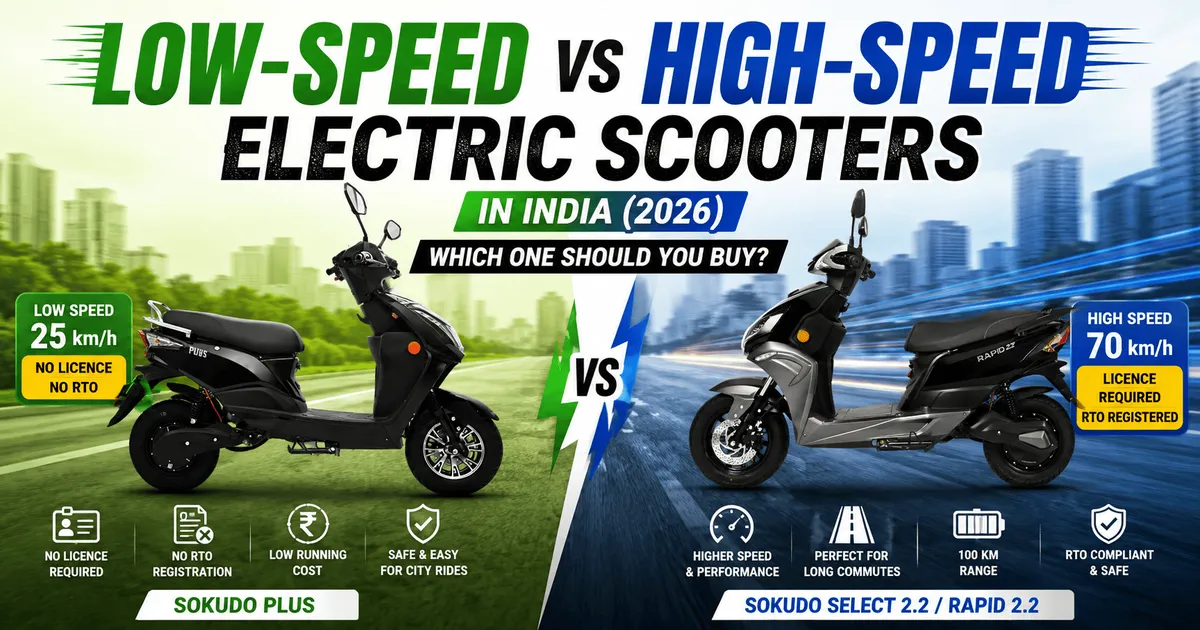
Low-Speed vs High-Speed Electric Scooters in India: Which One Should You Buy in 2026?
Published: June 12 2026 | Author: Sokudo Electric India Editorial Team
Buying an electric scooter in India should feel straightforward. For most people, it does not.
Most buyers are not struggling to choose between brands. They are struggling to answer one much simpler question:
Should I buy a low-speed electric scooter that does not require a licence, or should I invest in a high-speed scooter with registration and a number plate?
The answer is not the same for everyone. The right choice depends on how far you ride daily, which roads you use, and what you actually need the scooter to do.
A scooter that works perfectly for a college student travelling 8 km to campus is not the right choice for a professional commuting 40 km on a ring road. Likewise, a high-speed registered scooter makes no practical sense for a homemaker doing school runs inside a residential colony.
This guide covers the legal difference between both categories, confirmed real-world specs, a concrete cost comparison, and a clear decision framework so you can stop second-guessing and choose the right scooter for your life.
Low-Speed or High-Speed Electric Scooter?
| If You... | Best Choice |
| Do not have a driving licence | Sokudo Plus |
| Travel under 25 km daily on local roads | Sokudo Plus |
| Ride mainly inside colonies and city roads | Sokudo Plus |
| Want no RTO registration or number plate hassle | Sokudo Plus |
| Need speeds above 50 km/h for arterial roads | Sokudo Select 2.2 or Rapid 2.2 |
| Commute 30 km or more daily | Sokudo Select 2.2 or Rapid 2.2 |
| Use flyovers, ring roads, or highways | Sokudo Select 2.2 or Rapid 2.2 |
| Want a complete petrol scooter replacement | Sokudo Select 2.2 or Rapid 2.2 |
The Legal Difference: Do You Need a Licence for an Electric Scooter in India?
This is the question most buyers search for first, and understanding it clearly protects you from making an expensive mistake.
Under the Central Motor Vehicles Rules notified by India's Ministry of Road Transport and Highways, electric two-wheelers with a top speed not exceeding 25 km/h and a motor output not exceeding 250W are exempt from the following requirements:
- Driving licence
- Vehicle registration
- Number plate
- Road tax
These vehicles are commonly called non-RTO scooters or no-licence electric scooters.
Once an electric scooter exceeds either of these thresholds, it is treated as a motor vehicle under Indian law. That means you need a valid driving licence, vehicle registration, a number plate, mandatory third-party insurance, and full compliance with all traffic regulations.
| Requirement | Low-Speed (up to 25 km/h, up to 250W) | High-Speed (above 25 km/h) |
| Driving licence | Not required | Required |
| RTO registration | Not required | Required |
| Number plate | Not required | Required |
| Insurance | Recommended but not mandated | Mandatory |
| Road tax | Not applicable | Applicable |
The Sokudo Plus has an official certified top speed of 25 km/h as confirmed on the Sokudo India product page. This places it squarely within the non-RTO, no-licence category under Indian motor vehicle regulations. No registration, no number plate, no road tax, and no driving licence are required to ride it.
The Sokudo Select 2.2 and Rapid 2.2 both have a top speed of 70 km/h and require full registration, a driving licence, insurance, and a number plate.
Sokudo Plus vs Select 2.2 vs Rapid 2.2: Full Specification Comparison
Here are the confirmed specifications directly sourced from Sokudo India's official product pages so you can make a judgment based on real numbers rather than marketing claims.
| Specification | Sokudo Plus | Sokudo Select 2.2 | Sokudo Rapid 2.2 |
| Top speed | 25 km/h | 70 km/h | 70 km/h |
| Claimed range | Up to 100 km | Up to 100 km | Up to 100 km |
| Real-world range (est. mixed city riding) | 65 to 80 km | 70 to 80 km | 70 to 80 km |
| Battery chemistry | LFP | 2.2 kWh LFP | 2.2 kWh LFP |
| Charging time | 4 to 5 hours | 4 to 5 hours | 4 to 5 hours |
| Kerb weight | 100 kg | 100 kg | 101 kg |
| Brakes | Disc front, Drum rear | Disc front, Drum rear | Disc front, Drum rear |
| Running cost | Rs 0.09 per km | Rs 0.09 per km | Rs 0.09 per km |
| Driving licence required | No | Yes | Yes |
| RTO registration required | No | Yes | Yes |
| Ex-showroom price | Rs 67,951 | Rs 1,03,951 | Rs 97,951 |
| Battery warranty | 3 years | 3 years | 3 years |
| Vehicle warranty | 1 years | 5 years | 5 years |
| Fire complaints | Zero | Zero | Zero |
Real-world range estimates are based on typical Indian urban riding conditions including mixed traffic, city speeds, and standard rider weight. Actual range varies with rider weight, road gradient, ambient temperature, and speed.
All three models use LFP (Lithium Iron Phosphate) battery technology. All three carry the same 3-year battery and 1-year vehicle warranty. The difference between them is not quality. It is use case.
Non-RTO, No-Licence Electric Scooters: When Sokudo Plus Is All You Need
A large number of Indian riders do not actually need a high-speed scooter. They have assumed that more speed equals better value. That assumption costs money.
Consider a typical day for a large percentage of two-wheeler users in Indian cities:
- Morning school drop: 3 km
- Grocery and market run: 4 km
- Local errands and appointments: 5 km
- Evening pickup: 3 km
Total: 15 km, almost entirely on colony roads, school zones, and local streets where traffic naturally flows below 25 km/h.
For this rider, buying a high-speed scooter means paying for registration, insurance, a driving licence if they do not already have one, and a Rs 32,000 to Rs 36,000 higher purchase price, for performance they will never use.
The Sokudo Plus is built for exactly this situation. At Rs 67,951, a certified 25 km/h top speed, up to 100 km claimed range, 4 to 5 hour charging time, 100 kg kerb weight, Rs 0.09 per km running cost, and zero fire complaints, it covers every daily local commute with none of the ownership complexity of a registered vehicle.
Who benefits most from the Sokudo Plus:
Students whose daily travel stays within 10 to 20 km on city roads get everything they need at the lowest ownership cost available. No registration hassle. No licence requirement. No mandatory insurance premium. Easier throttle control for less experienced riders. For parents buying a scooter for a teenager, the 25 km/h speed ceiling also provides meaningful built-in safety.
Homemakers managing school runs, grocery shopping, medical visits, and local errands rarely exceed 15 to 20 km daily. The Plus handles all of this while keeping monthly running costs at just Rs 0.09 per km on home electricity, which works out to roughly Rs 40 to Rs 60 for a typical daily routine.
Senior citizens often find lower maximum speeds more confidence-inspiring than scooters capable of 70 km/h. At 100 kg with a smooth 25 km/h ceiling, the Plus is manageable, stable, and low-stress for daily local use. Our dedicated guide on the best electric scooters for elderly riders in India covers this in full detail.
Small town and Tier-2 city riders where daily distances are shorter, roads are narrower, and average traffic speeds are lower, typically find a non-RTO scooter delivers better practical value than a high-speed alternative.
First-time riders gain genuine confidence on a scooter with a 25 km/h ceiling before considering faster vehicles. Lower maximum speed significantly reduces the consequences of throttle-control and braking errors that beginner riders commonly make.
When Lower Speed Is Actually the Safer Choice
Many buyers assume a faster scooter is automatically a safer scooter. In several real-world Indian environments, the opposite is true.
School zones and tuition routes involve children crossing roads, school buses making unexpected stops, and heavy pedestrian activity. A 25 km/h scooter is genuinely more appropriate here than one capable of 70 km/h. Stopping distances at 25 km/h are a fraction of those at 70 km/h, which is a practical safety advantage when an unexpected obstacle appears.
Residential colonies have tight corners, parked vehicles, walking residents, and children playing. Even if you own a 70 km/h scooter, you will rarely use that speed here. A low-speed scooter feels more manageable and predictable in these environments every single day.
Market areas are unpredictable. Pedestrians step into traffic suddenly. Delivery vehicles block lanes. Parking spaces open and close without warning. Easier low-speed manoeuvrability is an advantage, not a limitation.
First-time and older riders benefit from a lower speed ceiling precisely because it reduces the physical and cognitive demands of riding. Confidence is a genuine safety asset on Indian roads.
High-Speed Electric Scooters: When Select 2.2 or Rapid 2.2 Is the Right Choice
There is a clear point at which a low-speed scooter starts creating problems rather than solving them.
If your daily commute involves fast-moving arterial roads, flyovers, or ring roads where surrounding traffic flows between 50 and 70 km/h, riding
at 25 km/h creates its own safety risk. Large speed differentials between your vehicle and surrounding traffic increase the probability of
dangerous forced overtaking and sudden lane changes by other vehicles.
Office commuters travelling 25 to 40 km daily on a combination of city roads and main roads need cruising speeds that keep pace with traffic safely. At 70 km/h top speed, 2.2 kWh LFP battery, 100 km claimed range, and 4 to 5 hour charging, the Sokudo Select 2.2 and Rapid 2.2 are built precisely for this use case. Running cost remains the same Rs 0.09 per km regardless of which model you choose.
Petrol scooter replacement buyers who currently ride an Activa, Jupiter, Access, or Ntorq expect their electric replacement to match that performance. The high-speed Sokudo models deliver this while running at Rs 0.09 per km versus Rs 2.50 to Rs 4.00 per km for petrol, a saving of over 95 percent on fuel costs alone.
Professionals covering 40 to 60 km daily as their primary vehicle need range, speed, and route flexibility that a 25 km/h scooter cannot provide. For these riders, the additional ownership requirements of registration and insurance are easily justified by the performance they actually use every day.
Riders who regularly carry a pillion should also favour a high-speed scooter. Two-up riding changes vehicle dynamics significantly, and high-speed scooters are built with more robust components designed to handle the additional weight reliably.
Real-World Scenarios: Which Sokudo Scooter Is Right for You?
Scenario 1: Student, 16 to 22 years, 15 to 20 km daily, city roads
Daily trips: college 5 km, coaching 3 km, friends and errands 5 km. Routes are residential roads, local markets, colony lanes.
Best choice: Sokudo Plus
The Plus at Rs 67,951 covers 65 to 80 km real-world range on a single charge, requires no licence or registration, and runs at just Rs 0.09 per km. Monthly running cost for a student covering 15 km daily works out to approximately Rs 40. For parents, the 25 km/h certified speed provides built-in protection for a new rider without restricting any journey the student actually makes.
Scenario 2: Homemaker, daily errands, 10 to 15 km, school zones and colony roads
Morning school drop, grocery shopping, afternoon appointments, evening pickup. Average 12 km per day entirely on local roads.
Best choice: Sokudo Plus
No licence needed. No registration paperwork. No mandatory insurance. At Rs 0.09 per km, a typical daily routine of 12 km costs just over Rs 1 in electricity. A full charge takes 4 to 5 hours overnight and costs Rs 15 to Rs 25 depending on local electricity tariffs.
Scenario 3: Senior citizen, under 10 km daily, local commuting
Medical appointments, local shopping, community visits. Rider values easy handling and predictable response over performance.
Best choice: Sokudo Plus
At 100 kg with a 25 km/h ceiling, the Plus is among the lightest and most manageable scooters at its price point. Lower speed directly improves rider confidence. At Rs 0.09 per km, the monthly running cost for a senior covering 8 km daily is under Rs 25. See our full guide on the best electric scooters for elderly riders in India for detailed recommendations.
Scenario 4: Office commuter, metro city, 25 to 40 km daily, flyovers and main roads
Route includes residential streets, arterial roads, a flyover, and a business district. Traffic flows between 40 and 70 km/h on main road sections.
Best choice: Sokudo Select 2.2
At 70 km/h top speed, Rs 1,03,951 ex-showroom, and 4 to 5 hour overnight charging, the Select 2.2 keeps pace with traffic safely and covers the full commute on a single charge. Running cost at Rs 0.09 per km means a 35 km daily commute costs just Rs 3.15 in electricity. The natural step up for riders who need arterial road performance.
Scenario 5: Professional, 40 to 60 km daily, primary vehicle
One scooter for work, personal travel, and weekend use. Currently riding a 125cc petrol scooter and wants a complete EV replacement.
Best choice: Sokudo Rapid 2.2
At Rs 97,951, 70 km/h top speed, 100 km claimed range, and Rs 0.09 per km running cost, the Rapid 2.2 replaces a petrol scooter entirely. A rider covering 50 km daily saves over Rs 1,900 every month compared to a petrol scooter running at Rs 3.00 per km. The 4 to 5 hour charge time means a full battery every morning from an overnight plug-in.
Scenario 6: Family buying their first electric scooter
Three questions settle it immediately:
- Does the primary rider have a driving licence? If no, the Plus is the answer.
- Does daily riding regularly exceed 25 km? If no, the Plus covers it.
- Does the route regularly include flyovers, highways, or fast-moving main roads? If yes, Select 2.2 or Rapid 2.2.
For many families, questions one and two alone point clearly to the Plus.
Quick Decision Tree
Choose Sokudo Plus if:
- Daily travel is under 25 km
- Most rides are on colony roads, school zones, or local streets
- You do not have a driving licence or prefer to avoid RTO registration
- You are buying for a student, senior citizen, or first-time rider
- Simplicity and lower total ownership cost matter more than top speed
Choose Sokudo Select 2.2 if:
- Daily travel is 25 to 40 km
- You already have a driving licence
- Your route includes flyovers or fast-moving main roads
- You want a practical daily replacement for a 100cc to 125cc petrol scooter
Choose Sokudo Rapid 2.2 if:
- Daily travel exceeds 40 km
- The scooter will be your primary vehicle
- You regularly use ring roads or higher-speed city corridors
- You want maximum commuting flexibility across the city
Total Cost of Ownership: Where the Real Difference Shows
Most buyers compare sticker prices. The more useful comparison is what each scooter costs to own over three years.
Purchase and on-road costs
The Sokudo Plus at Rs 67,951 requires no registration fees, no road tax, and no mandatory insurance as a non-RTO vehicle. The Select 2.2 at Rs 1,03,951 and Rapid 2.2 at Rs 97,951 require registration, insurance, and number plate costs, adding approximately Rs 5,000 to Rs 12,000 on top of the ex-showroom price depending on state and coverage chosen.
Running cost comparison at 20 km per day
| Cost Item | Sokudo Plus | Select 2.2 or Rapid 2.2 | Petrol Scooter (125cc) |
| Running cost per km | Rs 0.09 | Rs 0.09 | Rs 2.50 to Rs 4.00 |
| Daily cost (20 km) | Rs 1.80 | Rs 1.80 | Rs 50 to Rs 80 |
| Monthly running cost | Rs 54 | Rs 54 | Rs 1,500 to Rs 2,400 |
| Engine oil changes | None | None | Rs 600 to Rs 800 every 3 months |
| Annual maintenance estimate | Rs 1,500 to Rs 2,500 | Rs 2,000 to Rs 3,500 | Rs 7,000 to Rs 14,000 |
At 20 km per day, both Sokudo models save approximately Rs 18,000 to Rs 28,000 annually on fuel alone compared to a petrol scooter, before accounting for maintenance savings.
3-year total ownership comparison (20 km per day, approximately 7,200 km per year)
| Expense | Sokudo Plus | Sokudo Rapid 2.2 | Petrol Scooter (125cc) |
| Purchase and on-road cost | Rs 67,951 | Rs 1,05,000 to Rs 1,12,000 | Rs 85,000 to Rs 90,000 |
| Electricity or fuel (3 years) | Rs 1,944 | Rs 1,944 | Rs 54,000 to Rs 86,400 |
| Maintenance (3 years) | Rs 4,500 to Rs 7,500 | Rs 6,000 to Rs 10,500 | Rs 21,000 to Rs 42,000 |
| 3-year total | Rs 74,395 to Rs 77,395 | Rs 1,12,944 to Rs 1,24,444 | Rs 1,60,000 to Rs 2,18,400 |
Electricity cost calculated at Rs 0.09 per km across 21,600 km over 3 years.
The petrol scooter costs double or more over three years even at a modest 20 km per day. Both Sokudo options deliver substantial long-term savings. The choice between Plus and the high-speed models then comes down purely to whether your commute actually requires 70 km/h capability.
For a deeper breakdown of long-term EV ownership economics, read our guide on how long electric scooters last in India.
Safety: Which Category Is Actually Safer?
The safest scooter is not the fastest one. It is the one that matches the environment you ride in every day.
When the Plus is the safer choice
In school zones, residential colonies, market areas, and narrow lanes, 25 km/h is genuinely more appropriate than 70 km/h. Stopping distances at 25 km/h are dramatically shorter. The consequences of a throttle error or braking misjudgement at 25 km/h are significantly lower than at 70 km/h. For first-time riders, students, and senior citizens, this is a practical safety advantage every single day.
When high-speed is the safer choice
On fast-moving arterial roads and flyovers where traffic flows at 50 to 70 km/h, a scooter limited to 25 km/h creates its own risk. Surrounding vehicles are forced to brake or swerve around a slow-moving vehicle unexpectedly. In these environments, the Select 2.2 and Rapid 2.2 allow the rider to maintain natural traffic flow rather than creating a speed obstacle.
Battery safety is consistent across the entire range
All Sokudo models use LFP battery technology, which offers better thermal stability than NMC alternatives and is widely regarded as among the safest battery chemistries for Indian ambient temperatures. The Sokudo Plus carries a specific Zero Fire Complaints designation on its official product page, which is a meaningful long-term ownership confidence signal. The International Energy Agency's analysis of EV battery technology consistently highlights LFP chemistry's thermal stability advantage as a practical differentiator in high-temperature markets like India.
All three models carry AIS-156 certified components and the same 3-year battery plus 1-year vehicle warranty. For a full breakdown of EV battery safety in Indian conditions, read our guide on are electric scooters safe in India.
Does Low Speed Mean Lower Build Quality?
No. This is one of the most persistent misconceptions in the EV market.
The Sokudo Plus uses the same LFP battery chemistry, the same disc front and drum rear brake configuration, the same 100 kg build quality, and the same 3-year battery plus 1-year vehicle warranty as the high-speed models in the Sokudo range. The engineering priorities behind battery safety, build durability, and long-term reliability are consistent across all three models.
What changes is the motor output, certified top speed, and resulting regulatory classification. Not the quality standard.
LFP Batteries: Why Chemistry Matters Regardless of Speed Category
All three Sokudo models use LFP (Lithium Iron Phosphate) battery technology. For Indian buyers, this matters more than most buying guides explain.
LFP batteries offer better thermal stability, longer cycle life (typically 2,000 to 4,000 charge cycles), improved heat tolerance, and a stronger safety profile compared to standard NMC lithium-ion alternatives. In a market where summer temperatures in Delhi NCR, Rajasthan, Gujarat, and Telangana routinely exceed 42 degrees Celsius and where scooters park outdoors for hours under direct sun, this is not a marginal benefit.
A battery that degrades faster in heat means shorter range after 18 to 24 months, more frequent replacements, and higher lifetime ownership cost. LFP chemistry specifically reduces this risk for all three Sokudo models, whether you choose the Rs 67,951 Plus or the Rs 1,03,951 Select 2.2.
For the practical habits that protect LFP batteries over years of daily use, read our guide on how to extend electric scooter battery life.
Frequently Asked Questions
Do I need a driving licence for a low-speed electric scooter in India?
No. Under Central Motor Vehicles Rules notified by the Ministry of Road Transport and Highways, electric two-wheelers with a top speed not exceeding 25 km/h and motor output not exceeding 250W do not require a driving licence, RTO registration, number plate, or road tax. The Sokudo Plus has a certified top speed of 25 km/h as confirmed on the official Sokudo India product page, which places it in this exempt category.
What is a non-RTO electric scooter?
A non-RTO electric scooter is an electric two-wheeler officially certified at a top speed of 25 km/h or below and motor output of 250W or below, which exempts it from RTO registration requirements under Indian law. It does not require a registration certificate, number plate, road tax, or driving licence.
Is the Sokudo Plus a non-RTO, no-licence scooter?
Yes. The official Sokudo India product page confirms a certified top speed of 25 km/h for the Plus, which places it in the non-RTO, no-licence category under current Indian motor vehicle regulations. No driving licence, registration, number plate, or road tax is required.
How much does it cost to run the Sokudo Plus per kilometre?
The Sokudo Plus runs at Rs 0.09 per km. At a typical daily commute of 15 km, that works out to Rs 1.35 per day or approximately Rs 40 per month. This compares with Rs 2.50 to Rs 4.00 per km for a petrol scooter, making the Plus over 95 percent cheaper to run than petrol on a per-kilometre basis.
How much does it cost to run the Sokudo Select 2.2 or Rapid 2.2?
Both high-speed Sokudo models also run at Rs 0.09 per km. At a typical office commute of 35 km daily, that works out to Rs 3.15 per day or approximately Rs 95 per month on electricity, compared to Rs 87 to Rs 140 per day on petrol for the same distance.
Can a 16-year-old ride the Sokudo Plus?
The Plus does not require a driving licence under Indian law given its 25 km/h certified top speed. However, general traffic rules regarding helmets, road conduct, and state-specific minor riding regulations still apply. Always verify the current rules applicable in your state before allowing a minor to ride any vehicle on public roads.
Is insurance mandatory for the Sokudo Plus?
Third-party insurance is not legally mandated for non-RTO vehicles in the same way it is for registered motor vehicles. However, basic accidental damage and third-party liability insurance is available at a modest cost and is strongly recommended. Financial protection against an accident or theft is worth having independent of legal requirements.
What documents should I carry while riding the Sokudo Plus?
Even though registration is not required, carry the purchase invoice, manufacturer warranty documents, and any vehicle documentation provided at the time of purchase. These help verify the vehicle's specifications and legal status if ever required by traffic authorities.
Which is better for daily office commuting, Plus or high-speed?
It depends on your route. If your office is within 15 to 20 km and you ride mainly on city roads and colony lanes, the Sokudo Plus at Rs 67,951 covers the commute at the lowest total ownership cost with no registration or licence requirement. If your commute exceeds 25 to 30 km and involves flyovers or fast-moving arterial roads where traffic flows above 40 km/h, the Select 2.2 at Rs 1,03,951 or Rapid 2.2 at Rs 97,951 is the appropriate choice.
Which Sokudo scooter is best for senior citizens?
The Sokudo Plus is generally the strongest fit for senior riders because of its 100 kg kerb weight, 25 km/h top speed, smooth low-stress riding characteristics, simple controls, and the lowest running cost in the range at Rs 0.09 per km. See our full guide on the best electric scooters for elderly riders in India for detailed model comparisons.
Does a low-speed scooter compromise on battery technology?
No. The Sokudo Plus uses the same LFP battery chemistry as the high-speed Sokudo models. Battery quality is a manufacturer choice, not a function of vehicle speed category. The Plus carries the same 3-year battery and 1-year vehicle warranty as the Select 2.2 and Rapid 2.2.
Are high-speed electric scooters more expensive to run than the Plus?
No. All three Sokudo models run at Rs 0.09 per km, making running costs identical across the range. The cost difference between the models comes from the higher purchase price and the additional registration, insurance, and number plate costs required for high-speed registered vehicles.
When does a high-speed scooter pay for itself over the Plus?
When your daily distance reliably exceeds 25 to 30 km, your route includes fast-moving roads or flyovers, and the scooter replaces a petrol vehicle entirely. In those situations, the higher purchase price and additional registration and insurance costs are justified by the performance and route flexibility you actually use every day.
Final Verdict
There is no universal right answer.
The best electric scooter is the one that fits your actual daily riding life rather than an aspirational spec sheet.
For the large segment of Indian riders whose daily travel is local, predictable, and under 25 km on city roads, the Sokudo Plus at Rs 67,951 is a genuinely compelling choice. Certified 25 km/h top speed. No licence. No registration. No road tax. No number plate. LFP battery. Up to 100 km claimed range. 4 to 5 hour charging. Rs 0.09 per km running cost. 3-year battery warranty. 1-year vehicle warranty. Zero fire complaints. That is a complete ownership package for local Indian commuting at the lowest total cost in the Sokudo range.
For commuters covering 30 to 60 km daily on arterial roads, flyovers, and ring roads who need a genuine petrol scooter replacement, the Sokudo Select 2.2 at Rs 1,03,951 or Sokudo Rapid 2.2 at Rs 97,951 provide 70 km/h capability, 100 km range, and the same Rs 0.09 per km running cost and LFP reliability at savings of over 95 percent compared to petrol.
The choice between them comes down to one honest question: how do you actually ride every day?
Answer that, and the right scooter becomes obvious.
Browse the full Sokudo electric scooter range to compare all models side by side with current pricing and specifications.
If you want to understand all the factors that matter beyond speed before buying, our complete guide on how to choose the right electric scooter in India in 2026 covers the full decision process in detail.
Comments
Share your thoughts about this article.
Loading comments...