7 September 2026•Sokudo Electric India
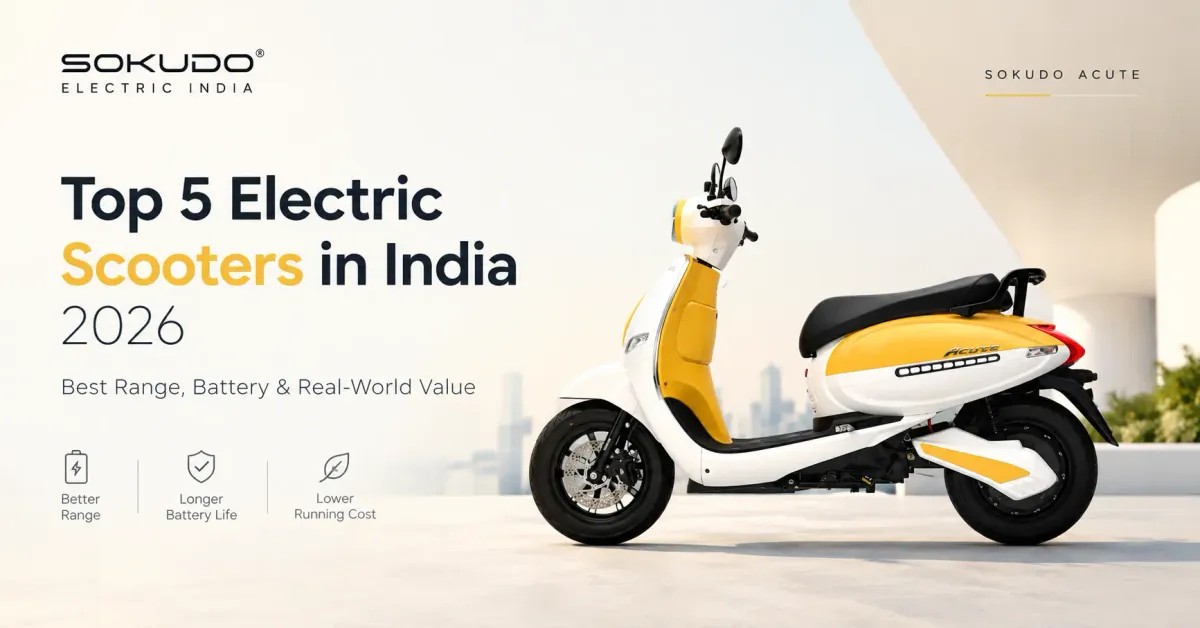
Top 5 Electric Scooters in India (2026): Real Range, Best Battery, and Honest Comparison
Published: September 07 2026 | Updated: October 09 2026 | Author: Sokudo Electric India Editorial Team
If you are comparing electric scooters in India purely on price or claimed range, you are likely to end up with the wrong one.
The Indian electric scooter market in 2026 is genuinely competitive. Models like the TVS iQube, Ather Rizta, and Bajaj Chetak compete with newer brands including Sokudo. Every single one of them has a compelling brochure. The challenge is figuring out which one actually suits your daily riding life.
This guide ranks the top five electric scooters in India right now based on the factors that matter most during actual ownership: real-world range, battery chemistry, performance, charging convenience, warranty, running cost, and service access. Not just the number that appears biggest in the advertisement.
Quick Answer: Top 5 Electric Scooters in India in 2026
| Rank | Electric Scooter | Best For | Battery | Claimed Range | Top Speed | Price |
| 1 | Sokudo Acute | Long-range riding | 3.1 kWh LFP | Up to 150 km | 70 km/h | Rs 1,25,951 |
| 2 | TVS iQube | Family and everyday commuting | 2.3 to 5.3 kWh | Up to 212 km IDC | Up to 82 km/h | From Rs 95,124 |
| 3 | Ather Rizta | Family-focused riding | Up to 3.5 kWh | Up to 161 km IDC | 80 km/h | From Rs 1,21,999 |
| 4 | Bajaj Chetak C Series | Build quality and city use | Up to 3.5 kWh | Up to 153 km | Up to 80 km/h | Varies by variant |
| 5 | Sokudo Pace | Range-focused value | 2.2 kWh LFP | Up to 125 km | 55 to 60 km/h | Rs 83,951 |
Specifications and prices vary by variant and location. Figures use current manufacturer information. Sokudo prices confirmed from official backend as of August 2026.
How We Selected These Five
There is no single specification that makes an electric scooter the best. A scooter with the highest claimed range may be completely wrong for a short daily commute.
A lightweight scooter may be easier to handle but may underperform on faster roads. A premium scooter may have more technology but cost significantly more than a simpler alternative that covers the same daily distance just as well.
We evaluated seven factors:
Real-world range: How far the scooter actually goes in Indian city traffic, not in a lab. Riding speed, rider weight, traffic patterns, road conditions, temperature, and riding mode all affect the number you actually see.
Battery technology: Chemistry affects longevity, thermal stability under Indian summer heat, charging behaviour, and what the battery can deliver in year three or four of daily ownership.
Performance: Top speed and acceleration matter on busy urban arterials and faster city stretches, not just for the brochure.
Charging convenience: How long the scooter takes to charge determines how easily it fits into a daily routine.
Practicality: Weight, storage, seating comfort, ground clearance, and how the scooter handles in real Indian traffic and parking conditions.
Ownership: Warranty terms, maintenance requirements, service network access, and total cost of ownership over three to five years.
Overall value: The best electric scooter delivers a sensible balance between what you pay and what you actually get across all of the above.
Claimed Range vs Real-World Range: Read This Before Comparing Any Scooter
Every scooter in this comparison comes with a claimed range figure. That number comes from a laboratory test on a flat road at perfect temperature, with a standard rider weight, no wind, and a controlled speed. That is not your commute.
The image below shows confirmed real-world range figures for every Sokudo model based on actual Indian city and highway riding:
| Scooter | Claimed Range | Real City Range | Real Highway Range |
| Sokudo Plus (Non-RTO) | 100 km | Around 90 km | Around 95 km |
| Sokudo Pace | 125 km | Around 115 km | Around 120 km |
| Sokudo Rapid 2.2 | 100 km | Around 90 km | Around 95 km |
| Sokudo Select 2.2 | 100 km | Around 90 km | Around 95 km |
| Sokudo Acute 2.2 | 100 km | Around 90 km | Around 95 km |
| Sokudo Acute | 150 km | Around 140 km | Around 145 km |
Figures based on real Indian riding conditions. Actual results vary with rider weight, traffic, temperature, tyre pressure, and riding mode.
For competitor IDC range figures, always apply a 15 to 20 percent real-world reduction from the published number as a practical planning estimate. A scooter claiming 212 km IDC likely delivers 170 to 180 km in real Indian conditions. One claiming 150 km as Sokudo Acute does may deliver 130 to 145 km depending on route type. The Sokudo figures above are confirmed real-world estimates, not IDC lab numbers.
1. Sokudo Acute: Best Electric Scooter in India for Long-Range Riding
The Sokudo Acute is built for riders who want a high-speed electric scooter with a large battery, genuinely long range, and battery chemistry that holds up through years of daily Indian summer riding.
Sokudo Acute Specifications
| Specification | Detail |
| Price | Rs 1,25,951 ex-showroom |
| Battery | 3.1 kWh LFP |
| Claimed range | Up to 150 km |
| Real city range | Around 140 km |
| Real highway range | Around 145 km |
| Top speed | 70 km/h |
| Motor | 2300W BLDC hub motor |
| Charging time | 3 to 4 hours |
| Ground clearance | 165 mm |
| Kerb weight | 109 kg |
| Brakes | Front disc, rear drum |
| Battery warranty | 3 years |
Why the Sokudo Acute Ranks First
The most important thing about the Sokudo Acute is not any single specification. It is the combination of battery capacity, battery chemistry, and real-world range that no other scooter in this comparison delivers at this price.
The 3.1 kWh LFP battery is the foundation. LFP (Lithium Iron Phosphate) batteries offer better thermal stability than standard NMC lithium-ion alternatives, meaning the pack degrades more slowly under the kind of heat that Indian summers impose on a scooter parked under direct sun for six hours in Delhi, Jaipur, or Nagpur. They also offer significantly longer cycle life, typically 2,000 to 4,000 charge cycles, versus 800 to 1,500 for NMC. In plain terms: your Sokudo Acute should still deliver range close to what it did when new after two, three, even four years of daily city riding.
The 70 km/h top speed makes it genuinely usable on arterial roads, ring roads, and faster city stretches where 60 km/h scooters start feeling like they are in everyone's way.
At Rs 1,25,951, the Ather Rizta Z at approximately Rs 1,21,000 is the closest competitor on price. The Rizta offers up to 161 km IDC range and more family-focused features including 56 litres of storage and a touchscreen dashboard. The Acute counters with LFP battery chemistry (the Rizta uses NMC) and a confirmed 3 to 4 hour charging time. If long-term battery durability under Indian conditions matters more to you than storage space and connected features, the Acute is the stronger long-term investment.
Running cost: Rs 0.09 per km confirmed. At 40 km daily, that is Rs 108 per month in electricity versus approximately Rs 2,448 per month on petrol for the same distance. The monthly saving alone is Rs 2,340.
Who should buy it: Long-distance city commuters covering 40 km or more daily. Field executives and professionals on the scooter most of the working day. Anyone who has experienced range anxiety on a previous electric scooter and wants it gone permanently. Buyers who plan to keep the scooter for four to five years and want LFP chemistry protecting long-term range.
Who should not: If your daily travel is 10 to 15 km, you genuinely do not need this much battery. A Sokudo Pace or Sokudo Rapid 2.2 covers shorter commutes at lower cost.
2. TVS iQube: Best Mainstream Electric Scooter for Everyday Family Commuting
The TVS iQube is one of the strongest choices for buyers who want a mainstream electric scooter from a brand with deep roots in Indian two-wheelers, multiple battery configurations, and connected features across the range.
TVS iQube Specifications
| Specification | Detail |
| Starting effective price | Rs 95,124 (variant dependent) |
| Battery options | 2.3 to 5.3 kWh |
| IDC range | 114 to 212 km depending on variant |
| Top speed | 68 to 82 km/h |
| Connected features | Over 118 via SmartXonnect |
| Best for | Daily commuting and family use |
Why the TVS iQube Ranks Second
The iQube's biggest strength is genuine versatility across its variant range. A buyer primarily riding within the city can select a smaller battery variant and keep costs lower. Someone who needs more range for a longer daily commute can step to a larger battery option without changing brands.
Over 118 connected features across the iQube ecosystem, navigation, ride analytics, and OTA software updates are available depending on the variant. TVS Motor Company has one of the widest authorised service networks of any two-wheeler brand in India, which matters significantly for buyers in Tier-2 and smaller cities.
The iQube does not try to do one thing extraordinarily. It delivers a familiar, reliable scooter ownership experience with electric power, good technology integration, and the confidence that comes from an established manufacturer with decades of Indian market presence.
Where it falls short relative to Sokudo: TVS iQube variants use NMC lithium-ion chemistry rather than LFP. For buyers in high-temperature regions planning five-plus years of daily ownership, this is worth factoring into the comparison. TVS's service network is wider than Sokudo's current reach, which works in its favour for riders outside major metros.
Who should buy it: Family commuters. Daily office riders who value connected features and navigation. Buyers who want multiple battery options under one model name. Riders in cities where TVS's service network is the most accessible option.
3. Ather Rizta: Best Electric Scooter for Families in India
The Ather Rizta is designed specifically around what makes an electric scooter genuinely useful for families, not just for solo riders on a predictable commute.
Ather Rizta Specifications
| Specification | Detail |
| Starting price | Rs 1,21,999 |
| Battery | Up to 3.5 kWh |
| IDC range | Up to 161 km |
| Top speed | 80 km/h |
| Battery warranty | 3 years or 30,000 km |
| Storage | Up to 56 litres |
| Ather Grid points | 6,100 plus across 370 plus cities |
| Best for | Families and practical city riding |
Why the Ather Rizta Ranks Third
The Rizta crossed 2 lakh units sold within 18 months of launch, which is one of the fastest adoption rates any electric scooter in India has achieved. That pace of uptake reflects genuine owner satisfaction rather than just aggressive marketing.
The 56-litre total storage is the highest of any scooter in this comparison. A large, long seat accommodates two adults comfortably. The 80 km/h top speed and Ather's 6,100-point fast-charge network mean the Rizta does not sacrifice performance or charging convenience for practicality.
The 7-inch TFT touchscreen and AtherStack AI features including pothole alerts and crash detection are the most comprehensive connected package in this comparison. Ather's public charging infrastructure specifically benefits urban riders who use fast charging occasionally rather than relying entirely on home overnight charging.
Where it falls short relative to Sokudo Acute: The Rizta uses NMC battery chemistry rather than LFP. It is also priced similarly to the Sokudo Acute at approximately Rs 1,21,000 for the base Z variant but without LFP's thermal stability advantage. Ather's service network, while strong in major metros, is more limited than TVS and Bajaj in smaller cities.
Who should buy it: Families where the scooter is used for school drops, grocery runs, and office commutes. Buyers in major metros with access to Ather Grid fast charging. Riders who prioritise technology, storage, and owner community support. Buyers who commute 25 to 40 km daily and value a comprehensive smart feature set.
4. Bajaj Chetak C Series: Best for Build Quality and Urban City Riding
The Bajaj Chetak has one major advantage that newer EV brands cannot immediately replicate: the Chetak name carries decades of trust in Indian households, and Bajaj Auto has one of the deepest dealer and service networks in the country.
Bajaj Chetak C Series Specifications
| Specification | Detail |
| Battery options | 2.5 to 3.5 kWh |
| Range | Up to 153 km (C35 variants) |
| Top speed | Up to 80 km/h |
| Charging | Variant dependent, C25 in approximately 3 hours 45 minutes |
| Best for | City riding and build quality |
| Flagship features | Hill-hold, ride modes, Google Maps integration on C35 01 |
Why the Bajaj Chetak Ranks Fourth
The all-metal body construction is unique in this comparison. Every other scooter here uses polymer panels. The Chetak's metal body delivers a tactile sense of build quality that is difficult to replicate, and it genuinely differentiates the ownership experience from the moment you touch it.
Bajaj's nationwide dealer network covering metros, Tier-2, and smaller towns means riders across India can access authorised servicing and parts without the uncertainty that can come with newer brands. The 2026 C Series introduced hill-hold assist and multiple ride modes as standard on C35 and C30 variants, and the C35 01 received integrated Google Maps navigation.
IP67 water resistance across the battery and electrical components means monsoon commuting in Mumbai, Kochi, and Chennai is genuinely well supported.
Where it falls short: Chetak scooters use NMC lithium-ion rather than LFP chemistry. For the head-to-head comparison of Sokudo versus Bajaj Chetak across every variant and price point, read our Sokudo vs Bajaj Chetak complete comparison guide.
Who should buy it: Urban commuters who value metal body build quality. Buyers in smaller cities where Bajaj's dealer network is the strongest option available. Families who value brand familiarity and trust built over decades. Riders who prioritise service availability and resale confidence.
5. Sokudo Pace: Best Value Electric Scooter Under Rs 85,000
The Sokudo Pace is for buyers who want substantial range, LFP battery chemistry, and high-speed performance without stepping into the Rs 1 lakh bracket.
Sokudo Pace Specifications
| Specification | Detail |
| Price | Rs 83,951 ex-showroom |
| Battery | 1.8 kWh LFP |
| Claimed range | Up to 125 km |
| Real city range | Around 115 km |
| Real highway range | Around 120 km |
| Top speed | 55 to 60 km/h |
| Charging time | 4 to 5 hours |
| Best for | Daily commuting and range-focused buyers |
| Battery warranty | 3 years |
| Running cost | Rs 0.09 per km confirmed |
Why the Sokudo Pace Ranks Fifth
At Rs 83,951, the Pace is the most affordable high-speed LFP scooter in this top five. For a daily commute of 20 to 40 km, having around 115 km of confirmed real-world city range means charging every two to three days rather than every night. That is a meaningful convenience difference in daily ownership.
It is a high-speed registered scooter, which makes it fundamentally different from a non-RTO scooter. You need a driving licence and registration, but you get full city and arterial road performance in return.
The LFP battery advantage applies here exactly as it does on the Acute. Long-term range retention in Indian summer conditions is meaningfully better with LFP chemistry than with NMC alternatives at a similar price point. The running cost of Rs 0.09 per km is confirmed by Sokudo, which puts it ahead of most competitors in this segment where per-km figures are estimated rather than published.
At this price the main competitor is the Hero Vida VX2 Go at approximately Rs 73,850. The Vida Go offers a removable battery (useful for apartment charging) but 92 km claimed range versus the Pace's 125 km. On range per rupee, nothing at under Rs 85,000 matches the Pace.
Who should buy it: Young working professionals commuting up to 50 km daily. First-time electric scooter buyers who want enough range to feel relaxed. Riders upgrading from a petrol scooter who are nervous about charging access. Anyone who wants maximum daily range at the lowest price in the high-speed LFP category.
For a comparison of the Pace against every scooter under Rs 1 lakh including Ola S1X, Bajaj Chetak C2501, Ampere Magnus, and Hero Vida, read our best electric scooter under Rs 1 lakh guide.
Top 5 Electric Scooters Compared: Full Specification Table
| Scooter | Battery | Claimed Range | Real City Range | Top Speed | Running Cost | Warranty | Price |
| Sokudo Acute | 3.1 kWh LFP | 150 km | ~140 km | 70 km/h | Rs 0.09/km | 3yr battery | Rs 1,25,951 |
| TVS iQube | 2.3 to 5.3 kWh NMC | Up to 212 km IDC | 170 to 175 km (est.) | Up to 82 km/h | Not confirmed/km | Varies by variant | From Rs 95,124 |
| Ather Rizta | Up to 3.5 kWh NMC | Up to 161 km IDC | 125 to 135 km (est.) | 80 km/h | Not confirmed/km | 3yr/30,000 km | From Rs 1,21,999 |
| Bajaj Chetak C Series | Up to 3.5 kWh NMC | Up to 153 km | 120 to 130 km (est.) | Up to 80 km/h | Not confirmed/km | 3yr/30,000 km | Varies by variant |
| Sokudo Pace | 2.2 kWh LFP | 125 km | ~115 km | 55 to 60 km/h | Rs 0.09/km | 3yr battery | Rs 83,951 |
IDC range figures for TVS, Ather, and Bajaj are certified test-cycle numbers. Sokudo real-world range figures are confirmed estimates from actual Indian riding. Competitor real-world estimates apply a standard 15 to 20 percent reduction from IDC figures.
Which Electric Scooter Has the Best Battery in India?
Battery chemistry is becoming one of the most important factors when buying an electric scooter in India, and most buyers do not ask about it before purchasing.
LFP vs NMC: What the Difference Actually Means
| Factor | LFP (Sokudo) | NMC (TVS, Ather, Bajaj, most others) |
| Thermal stability | High | Moderate |
| Cycle life | 2,000 to 4,000 cycles | 800 to 1,500 cycles |
| Heat degradation risk | Low | Higher |
| Indian summer suitability | Excellent | Good |
| Energy density | Lower (slightly heavier pack) | Higher (lighter for same range) |
| Long-term range retention | Stronger | Weaker under heat stress |
| Safety profile | Excellent | Good |
In Indian cities where ambient summer temperatures in Delhi NCR, Rajasthan, Gujarat, and Telangana regularly exceed 42 degrees Celsius, and where scooters park under direct sun for hours every day, LFP chemistry's thermal stability is a real ownership advantage rather than a theoretical one.
Sokudo uses LFP battery technology across its entire range: Plus, Pace, Rapid 2.2, Select 2.2, Acute 2.2, and Acute. The TVS iQube, Ather Rizta, and Bajaj Chetak all use NMC lithium-ion variants. For a rider planning five years of daily ownership in a hot city, the battery chemistry question deserves as much attention as the advertised range figure.
Which Electric Scooter Is Best for Your Daily Commute?
If You Ride 10 to 20 km Per Day
Prioritise: Easy handling, comfortable seating, low running cost, and simple overnight charging. You do not need the largest battery. The Sokudo Rapid 2.2 at Rs 97,951 or Sokudo Select 2.2 at Rs 1,03,951 cover this distance with days of buffer between charges.
If You Ride 20 to 40 km Per Day
Look for 80 to 120 km confirmed real-world range, a solid battery warranty, comfortable riding position, and reliable charging. The Sokudo Pace at Rs 83,951 with its confirmed 115 km real city range is the strongest value option in this bracket. The TVS iQube and Bajaj Chetak also serve this profile well for buyers who prioritise brand familiarity and wider service networks.
If You Ride 40 to 60 km Per Day
Larger battery and higher usable range become critical. Battery durability under daily cycling matters. The Sokudo Acute at Rs 1,25,951 with its confirmed 140 km real city range is the standout choice. The Ather Rizta Z is worth comparing if connected features and 56-litre storage matter more than battery chemistry.
If You Ride 60 km or More Per Day
Battery capacity is the most important specification. The Sokudo Acute was built specifically for this profile. Confirmed 140 km real city range means a rider covering 60 km daily can charge every two days without any range stress. Running cost at Rs 0.09 per km makes heavy daily use more affordable than any competitor in this bracket.
For a complete framework covering daily distance, road type, and the right Sokudo model for each commute profile, read our best electric scooter for daily commute in India guide.
Which Electric Scooter Is Best for Families?
Family buyers need a different combination from solo performance-focused riders. The key requirements are a comfortable long seat, good pillion space, generous storage, practical range, stable ride quality, and reliable service access.
The Ather Rizta leads this specific category with 56-litre total storage, a long dual-adult seat, pillion backrest, and Magic Twist regenerative braking for easier city riding. The TVS iQube is strong here too, with multiple battery options and TVS's trusted service network that gives families confidence about after-sales support anywhere in India.
For Sokudo buyers with family needs, the Sokudo Select 2.2 at Rs 1,03,951 or Sokudo Acute at Rs 1,25,951 combine adequate pillion comfort, 70 km/h performance for arterial roads, and LFP battery chemistry that holds its range across the years of family daily use.
How Much Does It Cost to Run These Electric Scooters?
Running cost is where every electric scooter in this comparison beats a petrol scooter significantly, but there are meaningful differences between the electric options themselves.
Sokudo confirmed running cost: Rs 0.09 per km across all models.
Estimated running costs for competitor models based on battery capacity and typical Rs 8 per unit residential electricity tariff:
| Scooter | Estimated Running Cost | Monthly Cost at 30 km/day |
| Sokudo (any model) | Rs 0.09/km confirmed | Rs 81 |
| TVS iQube (estimated) | Rs 0.12 to Rs 0.18/km | Rs 108 to Rs 162 |
| Ather Rizta (estimated) | Rs 0.13 to Rs 0.18/km | Rs 117 to Rs 162 |
| Bajaj Chetak (estimated) | Rs 0.13 to Rs 0.17/km | Rs 117 to Rs 153 |
| Petrol scooter | Rs 2.04 to Rs 2.50/km | Rs 1,836 to Rs 2,250 |
At 30 km daily, Sokudo models save Rs 1,755 to Rs 2,169 per month on running cost alone compared to a petrol scooter. Over three years, that saving compounds to Rs 63,000 to Rs 78,000 from running cost alone before maintenance savings are counted.
High-Speed vs Non-RTO Electric Scooter: Which Should You Buy?
Every scooter in this top five is a high-speed registered electric vehicle requiring a driving licence, RTO registration, insurance, and a number plate.
Not everyone needs this.
A non-RTO electric scooter certified at 25 km/h or below and within the 250W motor threshold is exempt from all these requirements under India's Central Motor Vehicles Rules. No licence, no registration, no road tax. The Sokudo Plus at Rs 67,951 is Sokudo's certified non-RTO model, with a confirmed 100 km claimed range (90 km real city, 95 km highway) and LFP battery technology.
If you are a student without a licence, a senior citizen wanting simple local mobility, or a homemaker covering 10 to 15 km daily on colony roads, the Sokudo Plus solves the problem at lower total cost than any of the five scooters in this ranking.
For the dedicated comparison of non-RTO electric scooters including Ampere Reo, Hero Electric Flash LX, and the Sokudo Plus, read our best non-RTO electric scooters in India 2026 guide.
Are Electric Scooters Safe in India? Battery Safety Checklist
Battery safety should be a buying criterion, not an afterthought.
Before purchasing any electric scooter, check these five things:
AIS-156 certification: All Sokudo models are AIS-156 certified and IP67 water resistant. Verify the specific certification for any scooter you consider.
Battery Management System: A quality BMS monitors voltage, current, temperature, and cell balance continuously. It is the primary protection against charging and heat-related battery events.
Battery chemistry: LFP batteries offer stronger thermal stability than NMC alternatives. For Indian conditions, this is a meaningful safety differentiator.
IP rating: Battery packs and controllers should be IP-rated for water and dust resistance. Sokudo states IP67 resistance across its current range.
Battery warranty: A 3-year or longer battery warranty reflects manufacturer confidence in the product's long-term safety and performance.
For the complete guide to electric scooter battery safety including AIS-156 testing standards, thermal runaway explained, and how to evaluate any brand's safety claims, read our are electric scooters safe in India guide.
Top 5 Electric Scooters by Use Case
| Your priority | Recommended choice | Why |
| Long-range riding | Sokudo Acute | 150 km claimed, 140 km real city, LFP battery, Rs 0.09/km |
| Family commuting | Ather Rizta | 56L storage, long dual seat, Ather Grid fast charging |
| Mainstream daily use | TVS iQube | Multiple battery options, 118 connected features, widest service network |
| Build quality and city use | Bajaj Chetak | All-metal body, Bajaj dealer network, IP67 monsoon protection |
| Range-focused value | Sokudo Pace | 125 km claimed, 115 km real city, LFP, Rs 0.09/km at Rs 83,951 |
Which Electric Scooter Is Best in India? Verdict by Budget
The best electric scooter in India depends on how much you want to spend. Under Rs 70,000, the Sokudo Plus (Rs 67,951) is the pick if you want a licence-free, non-RTO scooter for short local trips. Between Rs 80,000 and Rs 1 lakh, the Sokudo Pace (Rs 83,951) gives the most range per rupee, with around 115 km of real city range and an LFP battery. The TVS iQube (from Rs 95,124) suits buyers who want a wider service network. Between Rs 1 lakh and Rs 1.3 lakh, the Sokudo Acute (Rs 1,25,951) is the long-range choice, with around 140 km of real city range and a 3.1 kWh LFP battery. The Ather Rizta (from Rs 1,21,999) is the better buy if storage and family features matter more. Whatever your budget, compare real-world range and battery type, not just the range printed in the brochure.
Frequently Asked Questions
Which is the number one electric scooter in India in 2026?
For long-range LFP-focused riding, the Sokudo Acute at Rs 1,25,951 leads this comparison with 150 km claimed range, 140 km confirmed real city range, and LFP battery chemistry. For family-focused commuting, the TVS iQube and Ather Rizta are strong alternatives. There is no universally best scooter because the right one depends on your daily distance, road type, and budget.
Which are the top 5 electric scooters in India in 2026?
Our 2026 ranking: Sokudo Acute (long-range LFP), TVS iQube (family commuting), Ather Rizta (family practicality), Bajaj Chetak C Series (build quality), and Sokudo Pace (range-focused value).
Which electric scooter has the best real-world range in India?
Among the scooters in this comparison with confirmed real-world figures, the Sokudo Acute delivers around 140 km in city conditions and 145 km on the highway. Among competitor scooters, the TVS iQube's largest battery variant claims up to 212 km IDC, which translates to approximately 170 to 175 km in real conditions.
Which electric scooter has the best battery for Indian conditions?
For buyers prioritising cycle life and thermal stability in Indian summer heat, LFP is the stronger battery chemistry. Sokudo uses LFP technology across its entire current range including the Pace and Acute. TVS iQube, Ather Rizta, and Bajaj Chetak use NMC lithium-ion variants. The full comparison is in our LFP vs lithium-ion battery guide.
What is the running cost of a Sokudo scooter per km?
Rs 0.09 per km, manufacturer confirmed across every Sokudo model. At 30 km daily, that is Rs 81 per month on electricity. A petrol scooter at Rs 2.04 per km for the same distance costs approximately Rs 1,836 per month. For the complete running cost breakdown, read our how much it costs to run an electric scooter in India guide.
Which electric scooter is best for daily commuting in India?
For 10 to 20 km daily: Sokudo Rapid 2.2 or Select 2.2. For 20 to 40 km daily: Sokudo Pace or TVS iQube. For 40 to 60 km daily: Sokudo Acute or Ather Rizta. For 60 km or more daily: Sokudo Acute. For the complete distance-based framework, read our best electric scooter for daily commute guide.
Which electric scooter is best for families in India?
The Ather Rizta and TVS iQube are the strongest family-oriented choices for storage, comfort, and practical everyday features. For families in cities with good Sokudo coverage, the Sokudo Select 2.2 or Acute provide reliable LFP battery ownership alongside adequate pillion comfort.
Is LFP better than standard lithium-ion for an electric scooter?
LFP is a specific type of lithium-ion battery. Compared with NMC chemistry, LFP generally offers better thermal stability and longer cycle life in Indian heat conditions, while NMC offers higher energy density meaning more range from a smaller or lighter pack. For most Indian commuters planning four or more years of daily ownership, LFP's long-term durability advantage is worth the slightly heavier pack.
How long does an electric scooter battery last in India?
Modern LFP batteries like those in Sokudo scooters are rated for 2,000 to 4,000 charge cycles. At one charge cycle per day, that translates to approximately 6 to 10 years before significant degradation. Actual lifespan depends on charging habits, heat exposure, and daily usage. Sokudo carries a 3-year battery warranty across its high-speed range. For the complete guide to battery longevity, read our how long do electric scooter batteries last guide.
Is daily charging bad for an electric scooter battery?
No. Modern electric scooters are designed for regular charging with a Battery Management System that controls the process within safe operating limits. The important factors are using the recommended charger, avoiding charging a battery that is very hot from summer riding, and not regularly draining to zero. For practical charging habits that extend battery life, read our how to extend battery life guide.
Should I buy an electric scooter based only on price?
No. Purchase price is only one part of total ownership cost. Battery warranty, electricity consumption, maintenance, service network access, and battery chemistry all significantly affect what the scooter actually costs you over three to five years. The cheapest upfront option is often not the cheapest to own. For the complete ownership cost framework, read our real cost of owning an electric scooter guide.
Which is better: a high-speed registered scooter or a non-RTO scooter?
Neither is better universally. A high-speed registered scooter makes sense when you regularly ride on roads where traffic moves above 25 km/h and you need more performance. A non-RTO scooter makes sense for local low-speed mobility, students without licences, and senior citizens who want zero registration complexity. Read our low-speed vs high-speed electric scooters guide for the complete framework.
Final Verdict: Which Is the Best Electric Scooter in India in 2026?
The right electric scooter is the one that matches your actual daily distance, your road type, your charging access, and what you expect from the battery three years from now.
Choose the Sokudo Acute if you want a high-speed scooter with 150 km claimed range, 140 km confirmed real city range, LFP battery chemistry, and Rs 0.09 per km confirmed running cost at Rs 1,25,951.
Choose the TVS iQube if you want a mainstream family scooter with multiple battery options, 118 connected features, and TVS's deeply established service network across India.
Choose the Ather Rizta if family practicality, 56-litre storage, a touchscreen dashboard, and Ather's fast-charge network across 370 cities are your top priorities.
Choose the Bajaj Chetak if all-metal body construction, Bajaj's nationwide dealer presence, and a trusted brand name matter more to you than battery chemistry differences.
Choose the Sokudo Pace if you want a range-focused electric scooter with confirmed 115 km real city range and LFP battery chemistry at Rs 83,951, which is the best range per rupee in the high-speed segment under Rs 85,000.
Every scooter in this comparison saves you substantially on running cost compared to a petrol scooter. The decision between them is about which total cost fits your budget, which service network you can access in your city, and which battery chemistry protects your investment across the years you plan to own it.
Browse the full Sokudo electric scooter range to see confirmed pricing and specifications across all six models. Book a test ride at your nearest Sokudo showroom before making your final decision.
Comments
Share your thoughts about this article.
Loading comments...