12 September 2026·20 min read
17 June 2026•Sokudo Electic India
Published: June 17 2026 | Author: Sokudo Electric India Editorial Team
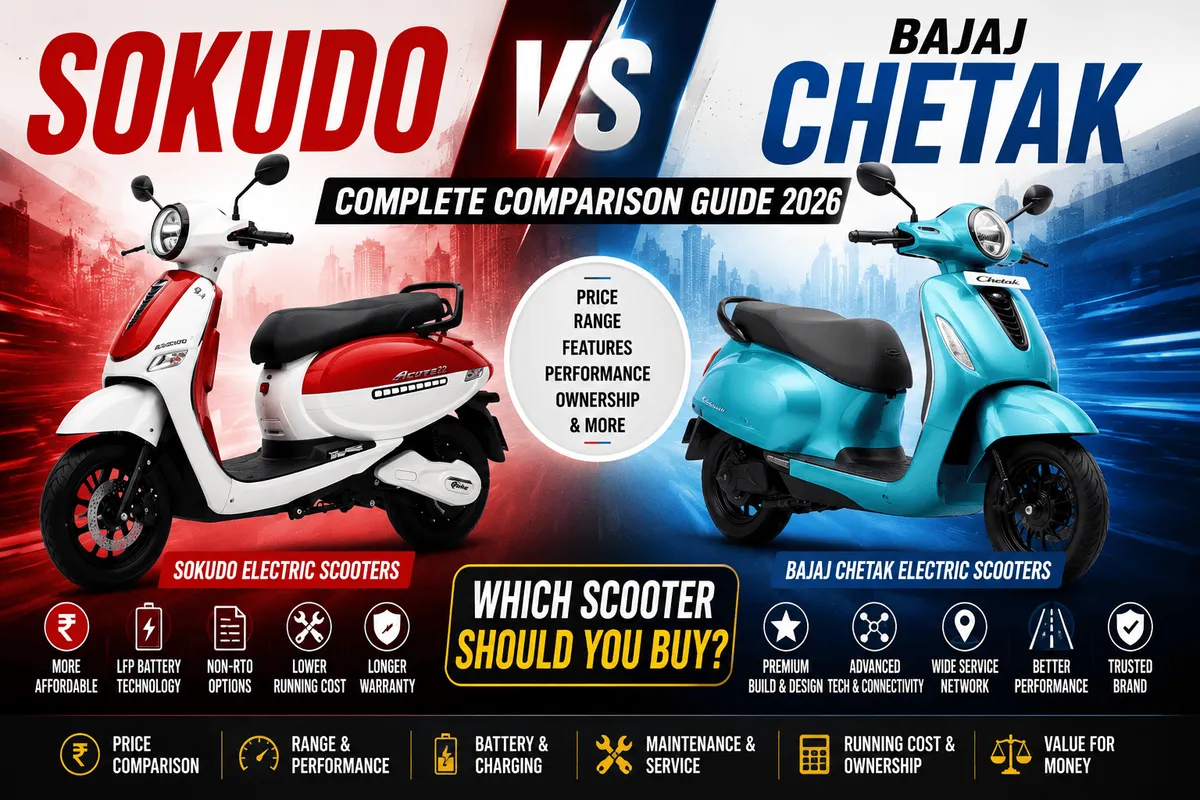
India's electric scooter market in 2026 offers more choice than ever, but that abundance of choice makes comparison harder, not easier. Two brands that frequently appear on the same shortlist are Sokudo and Bajaj Chetak, and they appeal to almost completely different types of buyers.
Bajaj Chetak is one of India's most recognised electric scooter names. It is built on over five decades of brand heritage, a metal body that sets it apart visually from most plastic-bodied competitors, premium connected features, and one of the widest service networks of any electric two-wheeler brand in the country.
Sokudo is a different proposition entirely. It is an ICAT-certified electric scooter manufacturer based in Greater Noida, focused on delivering practical everyday mobility, lower ownership costs, LFP battery technology across its entire range, and a model lineup that covers everything from licence-free city commuting to long-range high-speed travel.
Neither brand is objectively better. The right choice depends entirely on your daily commute, your budget, and what you expect from long-term ownership.
This guide compares every current variant from both brands on verified specifications, confirmed prices, running costs, and real-world ownership value so you can make a clear, informed decision.
| Model | Category | Top Speed | Claimed Range | Battery | Ex-Showroom Price |
| Sokudo Plus | Low-speed, non-RTO | 25 km/h | Up to 100 km | LFP | Rs 67,951 |
| Sokudo Pace | High-speed | 55 km/h | Up to 125 km | LFP | Rs 83,951 |
| Sokudo Rapid 2.2 | High-speed | 70 km/h | Up to 100 km | 2.2 kWh LFP | Rs 97,951 |
| Sokudo Select 2.2 | High-speed | 70 km/h | Up to 100 km | 2.2 kWh LFP | Rs 1,03,951 |
| Sokudo Acute 2.2 | High-speed | 70 km/h | Up to 100 km | 2.2 kWh LFP | Rs 1,04,951 |
| Sokudo Acute | Premium high-speed | 70 km/h | Up to 150 km | 3.1 kWh LFP | Rs 1,25,951 |
| Bajaj Chetak C2501 | Entry-level premium | 55 km/h | Up to 113 km | 2.5 kWh | Rs 91,399 |
| Bajaj Chetak 3001 | Mid-entry premium | 63 km/h | Up to 127 km | 3.0 kWh | Rs 99,990 |
| Bajaj Chetak 3503 | Mid-premium | 70 km/h | Up to 151 km | 3.5 kWh | Rs 1,10,000 (approx) |
| Bajaj Chetak 3502 | Premium | 80 km/h | Up to 153 km | 3.5 kWh | Rs 1,30,306 |
| Bajaj Chetak 3501 | Flagship premium | 73 km/h | Up to 153 km | 3.5 kWh | Rs 1,34,000 (approx) |
All prices are ex-showroom and may vary by city and dealer. Chetak prices sourced from Autocar India, BikeDekho and official Chetak website. Sokudo prices sourced from official Sokudo India backend. Claimed ranges are under IDC or ARAI test conditions. Real-world range in Indian urban riding is typically 20 to 25 percent lower. Verify current prices with authorised dealers before purchase.
Before comparing individual specifications, understanding the approach each brand takes matters significantly for choosing correctly.
Sokudo's approach centres on practical daily mobility with LFP battery technology across the entire range, a manufacturer-confirmed Rs 0.09 per km running cost, competitive pricing, and a 3-year battery warranty plus 1-year vehicle warranty on every model. Sokudo is ICAT-certified and positions itself as accessible electric mobility for students, homemakers, senior citizens, daily commuters, and long-range riders depending on the model chosen.
Bajaj Chetak's approach centres on premium ownership. The all-metal body construction is one of the most distinctive features in the entire electric scooter segment, setting Chetak apart from almost every plastic-bodied competitor. Chetak scooters emphasise connected technology, TFT dashboards on premium variants, Google Maps navigation, hill-hold assist, and Bajaj's nationwide service network spanning thousands of touch points. The Chetak carries genuine brand heritage built over decades of presence in Indian two-wheelers.
Neither approach is wrong. They serve different buyers, and confusing which buyer you are leads to making the wrong purchase.
Sokudo Plus at Rs 67,951
The Sokudo Plus occupies a unique position that no Bajaj Chetak variant can match. It is a certified 25 km/h non-RTO scooter, meaning no driving licence, no registration, no number plate, and no road tax are required. With up to 100 km claimed range, LFP battery technology, a disc front brake, reverse gear, Rs 0.09 per km running cost, 3-year battery warranty, and 1-year vehicle warranty, it is the only scooter in this comparison with those ownership advantages.
Bajaj Chetak has no equivalent in the non-RTO, no-licence category. The most affordable Chetak, the C2501 at Rs 91,399, is a fully registered scooter requiring a driving licence, registration, insurance, and a number plate, and costs Rs 23,448 more than the Plus.
Verdict for this segment: Sokudo Plus is the only option for buyers who want no licence, no registration, and no road tax with meaningful 100 km range and a long warranty. There is no Chetak to compare against here.
For a detailed breakdown of what the non-RTO classification means in practice, see our guide on can you ride an electric scooter without a licence in India.
Sokudo Pace at Rs 83,951
| Specification | Sokudo Pace |
| Top speed | 55 km/h |
| Claimed range | Up to 125 km |
| Battery | LFP |
| Charging time | 4 to 5 hours |
| Licence required | Yes |
| Running cost | Rs 0.09 per km |
| Battery warranty | 3 years |
| Vehicle warranty | 1 years |
| Ex-showroom price | Rs 83,951 |
Bajaj Chetak C2501 at Rs 91,399
| Specification | Bajaj Chetak C2501 |
| Top speed | 55 km/h |
| Claimed range | Up to 113 km |
| Battery | 2.5 kWh lithium-ion |
| Charging time | Approximately 4 hours |
| Kerb weight | 107 kg |
| Licence required | Yes |
| Body | All-metal |
| Vehicle warranty | 5 years or 70,000 km |
| Ex-showroom price | Rs 91,399 |
How they compare:
Both scooters share a 55 km/h top speed, making them suitable for city roads and moderate arterial routes but not for high-speed flyovers or ring roads where traffic flows above 60 km/h.
The Sokudo Pace holds a Rs 7,448 price advantage over the Chetak C2501. It also offers longer claimed range at 125 km versus 113 km and the LFP battery advantage for Indian heat conditions where ambient temperatures regularly exceed 42 degrees Celsius. The Chetak C2501 counters with its all-metal body construction, lighter weight at 107 kg, Bajaj's nationwide service network, reverse mode, and the brand recognition that has made Chetak one of India's best-selling electric scooters.
Choose Sokudo Pace if: Budget efficiency matters, you want LFP battery chemistry and confirmed Rs 0.09 per km running cost, and 125 km claimed range suits your daily distance comfortably.
Choose Chetak C2501 if: You value a metal body, Bajaj's established pan-India service network, lighter handling at 107 kg, and brand confidence, and the Rs 7,448 price premium fits your budget.
This price band is where the most buyers in India sit, and it contains the most direct head-to-head comparison in this entire guide.
Sokudo Rapid 2.2 at Rs 97,951
| Specification | Sokudo Rapid 2.2 |
| Top speed | 70 km/h |
| Claimed range | Up to 100 km |
| Battery | 2.2 kWh LFP |
| Charging time | 4 to 5 hours |
| Kerb weight | 101 kg |
| Brakes | Disc front, Drum rear |
| Running cost | Rs 0.09 per km |
| Battery warranty | 3 years |
| Vehicle warranty | 1 years |
| Ex-showroom price | Rs 97,951 |
Sokudo Select 2.2 at Rs 1,03,951
Shares the same core specifications as the Rapid 2.2, with variant-level feature and positioning differences. The Select 2.2 is Rs 4,000 more than the Rapid 2.2 at the same 70 km/h top speed and 2.2 kWh LFP battery.
Sokudo Acute 2.2 at Rs 1,04,951
| Specification | Sokudo Acute 2.2 |
| Top speed | 70 km/h |
| Claimed range | Up to 100 km |
| Battery | 2.2 kWh LFP |
| Charging time | 4 to 5 hours |
| Kerb weight | 102 kg |
| Brakes | Disc front, Drum rear |
| Running cost | Rs 0.09 per km |
| Battery warranty | 3 years |
| Vehicle warranty | 1 years |
| Ex-showroom price | Rs 1,04,951 |
Bajaj Chetak 3001 at Rs 99,990
| Specification | Bajaj Chetak 3001 |
| Top speed | 63 km/h |
| Claimed range | Up to 127 km |
| Battery | 3.0 kWh lithium-ion |
| Charging time | 3 hours 50 minutes to 80% |
| Brakes | Drum front and rear |
| Body | All-metal |
| Storage | 35 litres under-seat |
| Hill-hold | Yes |
| Bluetooth connectivity | Yes |
| Warranty | 5 years or 70,000 km |
| Ex-showroom price | Rs 99,990 |
How they compare:
The Sokudo Rapid 2.2 at Rs 97,951 and the Bajaj Chetak 3001 at Rs 99,990 are essentially identically priced, making this the most direct rupee-for-rupee decision in the entire comparison.
The Sokudo Rapid 2.2 wins on top speed at 70 km/h versus the Chetak 3001's 63 km/h cap. This matters practically for riders who regularly use arterial roads where traffic flows between 60 and 70 km/h. The Rapid 2.2 also has a disc front brake where the Chetak 3001 uses drum brakes at both ends, and carries LFP battery chemistry.
The Chetak 3001 counters with a larger 3.0 kWh battery delivering 127 km claimed range versus 100 km for the Rapid 2.2. In real Indian riding conditions, that translates to approximately 95 to 105 km for the Chetak versus 70 to 80 km for the Sokudo. The 35-litre under-seat storage, hill-hold assist, Bluetooth connectivity, reverse mode, and Bajaj's nationwide service network are all meaningful ownership advantages at this price point.
The Sokudo Select 2.2 and Acute 2.2 at Rs 1,03,951 and Rs 1,04,951 offer the same 70 km/h performance with variant-level feature differences at Rs 4,000 to Rs 5,000 above the Chetak 3001 price.
Choose Sokudo Rapid 2.2 if: You want 70 km/h capability, a disc front brake, LFP battery chemistry, and confirmed Rs 0.09 per km running cost at the same price as the Chetak 3001. Best for urban commuters who use arterial roads where traffic flows above 63 km/h.
Choose Chetak 3001 if: You want 127 km range, 35-litre storage, hill-hold, Bluetooth connectivity, Bajaj's metal body build quality, and nationwide service confidence at the same price. Best for commuters who prioritise range and all-round convenience.
Sokudo Acute 2.2 at Rs 1,04,951
Specification card as above.
Bajaj Chetak 3503 at approximately Rs 1,10,000
| Specification | Bajaj Chetak 3503 |
| Top speed | 70 km/h |
| Claimed range | Up to 151 km |
| Battery | 3.5 kWh lithium-ion |
| Charging time | 3 hours 25 minutes to full |
| Brakes | Drum front and rear |
| Storage | 35 litres |
| Hill-hold | Yes |
| Warranty | 5 years or 70,000 km |
| TecPac | Optional from Rs 4,000 |
| Ex-showroom price | Approximately Rs 1,10,000 |
How they compare:
Both scooters share a 70 km/h top speed. The Chetak 3503's 151 km claimed range dramatically outpaces the Acute 2.2's 100 km, translating in real Indian riding conditions to approximately 115 to 125 km versus 70 to 80 km respectively. That is a meaningful real-world gap for riders covering 60 km or more daily.
The Sokudo Acute 2.2 at Rs 1,04,951 is approximately Rs 5,000 cheaper and has a disc front brake where the Chetak 3503 uses drum brakes at both ends. The LFP battery chemistry also provides better thermal stability for Indian summer conditions. However, the Chetak 3503's larger battery, 35-litre storage, hill-hold, optional Bluetooth TecPac, and metal body are advantages the Acute 2.2 does not match.
Choose Sokudo Acute 2.2 if: Budget efficiency matters, you want a disc front brake, LFP battery chemistry, 70 km/h performance at a lower price, and your daily commute stays under 60 km.
Choose Chetak 3503 if: You need significantly longer range covering 60 to 100 km daily, value 35-litre storage, hill-hold, and the Chetak's metal build quality, and are comfortable with the approximately Rs 5,000 premium.
This is the flagship comparison where the price gap between the brands narrows to its smallest point in the entire guide.
Sokudo Acute at Rs 1,25,951
| Specification | Sokudo Acute |
| Top speed | 70 km/h |
| Claimed range | Up to 150 km |
| Battery | 3.1 kWh LFP |
| Charging time | 4 to 5 hours |
| Kerb weight | 109 kg |
| Brakes | Disc front, Drum rear |
| Running cost | Rs 0.09 per km |
| Battery warranty | 3 years |
| Vehicle warranty | 1 years |
| Ex-showroom price | Rs 1,25,951 |
Bajaj Chetak 3502 at Rs 1,30,306
| Specification | Bajaj Chetak 3502 |
| Top speed | 80 km/h |
| Claimed range | Up to 153 km |
| Battery | 3.5 kWh lithium-ion |
| Charging time | 3 hours 25 minutes to full |
| Brakes | Disc front, Drum rear |
| Dashboard | 5-inch TFT |
| Storage | 35 litres |
| Hill-hold | Yes |
| Navigation | Optional via TecPac |
| Warranty | 5 years or 70,000 km |
| Ex-showroom price | Rs 1,30,306 |
Bajaj Chetak 3501 at approximately Rs 1,34,000
Shares the 3502's core specifications. The 3501 adds a 5-inch touchscreen TFT dashboard as standard (versus a non-touch TFT on the 3502). It is the top-of-range flagship Chetak.
How they compare:
At Rs 1,25,951, the Sokudo Acute sits Rs 4,355 below the Chetak 3502 and approximately Rs 8,000 below the Chetak 3501. This is the narrowest price gap in the entire comparison, which makes it the most genuinely contested decision in this guide.
Both the Sokudo Acute and the Chetak 3502 and 3501 claim approximately 150 to 153 km range. The Sokudo Acute achieves this with a 3.1 kWh LFP battery versus the Chetak's 3.5 kWh lithium-ion pack. The LFP chemistry means the Sokudo's battery is likely to retain more of its original range after three to four years of daily Indian summer commuting than the Chetak's lithium-ion pack under the same conditions.
The Sokudo Acute is also meaningfully lighter at 109 kg versus Chetak's approximately 134 kg, which affects daily handling ease, parking in tight spaces, and physical fatigue on longer rides.
The Chetak 3502 and 3501 hold clear advantages in features. The 80 km/h top speed on the 3502 is a genuine performance advantage for riders who regularly use fast arterial roads. The TFT dashboard (touchscreen on the 3501), optional Google Maps navigation via TecPac, hill-hold assist, 35-litre under-seat storage, disc front brake, and all-metal body are premium additions that the Sokudo Acute does not offer.
At a Rs 4,355 to Rs 8,000 price difference for comparable claimed range, the decision at this level is primarily about feature preference and service network access rather than budget.
Choose Sokudo Acute if: You want 150 km claimed range with LFP battery durability for long-term Indian climate performance, lighter weight at 109 kg, confirmed Rs 0.09 per km running cost, and maximum range per rupee spent without needing premium connected features.
Choose Chetak 3502 if: 80 km/h top speed, a 5-inch TFT dashboard, optional Google Maps navigation, hill-hold, 35-litre storage, metal body quality, and Bajaj's service network are worth Rs 4,355 more to you.
Choose Chetak 3501 if: You want everything the 3502 offers plus a touchscreen TFT as standard and are comfortable with approximately Rs 8,000 more than the Sokudo Acute.
| Specification | Sokudo Acute | Chetak 3502 | Chetak 3501 |
| Top speed | 70 km/h | 80 km/h | 73 km/h |
| Claimed range | 150 km | 153 km | 153 km |
| Battery | 3.1 kWh LFP | 3.5 kWh Li-ion | 3.5 kWh Li-ion |
| Charging time | 3 hrs 30 min | 3 hrs 25 min | 3 hours |
| Kerb weight | 109 kg | ~134 kg | ~134 kg |
| Brakes | Disc/Drum | Disc/Drum | Disc/Drum |
| Dashboard | TFT | TFT 5-inch | TFT Touchscreen |
| Navigation | No | Via TecPac | Via TecPac |
| Under-seat storage | Standard | 35 litres | 35 litres |
| Hill-hold | Yes | Yes | Yes |
| Body | Polymer | All-metal | All-metal |
| Running cost | Rs 0.09/km | Est. Rs 0.12 to Rs 0.18/km | Est. Rs 0.12 to Rs 0.18/km |
| Battery warranty | 3 years | 5 years or 70,000 km | 5 years or 70,000 km |
| Vehicle warranty | 1 years | 5 years or 70,000 km | 5 years or 70,000 km |
| Ex-showroom price | Rs 1,25,951 | Rs 1,30,306 | Rs 1,34,000 (approx) |
For a rider covering 30 km daily (approximately 10,800 km per year):
| Cost Item | Sokudo (any model) | Bajaj Chetak (est.) | Petrol Scooter |
| Running cost per km | Rs 0.09 | Est. Rs 0.12 to Rs 0.18 | Rs 2.50 to Rs 4.00 |
| Daily cost (30 km) | Rs 2.70 | Rs 3.60 to Rs 5.40 | Rs 75 to Rs 120 |
| Monthly cost | Rs 81 | Rs 108 to Rs 162 | Rs 2,250 to Rs 3,600 |
| Annual energy cost | Rs 972 | Rs 1,296 to Rs 1,944 | Rs 27,000 to Rs 43,200 |
Both brands offer dramatically lower running costs than petrol. Sokudo's Rs 0.09 per km is manufacturer-confirmed. Chetak running costs are estimated based on battery size and typical electricity tariffs in Indian cities.
Over five years at 30 km daily, the running cost difference between Sokudo and Chetak amounts to approximately Rs 1,600 to Rs 4,900 in Sokudo's favour. The more significant financial comparison is the purchase price gap, where Sokudo consistently sits Rs 4,000 to Rs 23,000 lower than comparable Chetak variants.
For the full framework on evaluating total cost of ownership before buying, read our guide on how to choose the right electric scooter in India in 2026.
This is one of the most important differentiators in this comparison and one that most articles on this topic ignore entirely.
Sokudo uses LFP (Lithium Iron Phosphate) battery technology across its entire range. Bajaj Chetak uses lithium-ion batteries across all its variants.
| Battery factor | Sokudo (LFP) | Chetak (Lithium-ion) |
| Thermal stability | High | Moderate |
| Cycle life | 2,000 to 4,000 cycles | 800 to 1,500 cycles |
| Heat degradation risk | Low | Higher |
| Indian summer suitability | Excellent | Good |
| Safety profile | Excellent | Good |
| Energy density | Lower (larger pack needed for same range) | Higher (smaller pack for same range) |
In Indian cities where summer temperatures in Delhi NCR, Rajasthan, Gujarat, Maharashtra, Telangana, and Tamil Nadu regularly exceed 42 degrees Celsius, and where scooters park outdoors for hours under direct sun, LFP chemistry's thermal stability translates into real-world battery longevity rather than accelerated degradation. The International Energy Agency's analysis of global EV battery technology consistently highlights
LFP's thermal stability advantage in high-temperature markets.
Chetak's larger lithium-ion packs (3.0 to 3.5 kWh versus Sokudo's 2.2 to 3.1 kWh) contribute to its higher claimed range figures. However, a lithium-ion battery that degrades faster in Indian heat will deliver progressively less of that claimed range after two to three years of daily use.
LFP batteries are considerably less susceptible to this heat-driven degradation pattern.
For a comprehensive breakdown of EV battery safety and chemistry in Indian conditions, read our guide on Are electric scooters safe in India
Bajaj Auto has one of the largest authorised service networks of any vehicle manufacturer in India, with thousands of touch points spanning metros, Tier-2 cities, and smaller towns. For buyers in cities where Sokudo's dealership and service presence is still developing, the practical ability to get a scooter serviced quickly by trained technicians nearby matters significantly for ownership satisfaction.
Sokudo, as a growing brand, currently has fewer service centres than Bajaj. This is an important ownership consideration, particularly for buyers outside major metros or in cities where Sokudo's network is limited.
Before purchasing either brand, confirm that an authorised service centre is accessible within a reasonable distance of your home or workplace. This single verification step is more important for long-term ownership satisfaction than many specification comparisons.
Both brands cost significantly less to maintain than petrol scooters because electric drivetrains eliminate engine oil changes, spark plugs, air filters, exhaust servicing, and clutch repairs.
For both brands, annual maintenance typically covers tyres, brake pads, bearings, and periodic electrical inspection, all at a fraction of petrol scooter servicing costs.
Sokudo Plus at Rs 67,951 is the clear answer. No licence, no registration, up to 100 km range, Rs 0.09 per km, and the lowest total ownership cost of any scooter in this comparison. For parents buying for a teenager, the 25 km/h speed ceiling provides meaningful built-in safety. Bajaj Chetak has no non-RTO equivalent anywhere in its lineup.
Sokudo Plus for local-only travel under 15 km daily. At 100 kg it is meaningfully lighter than the Chetak C2501 at 107 kg and the heavier 35-series Chetaks at approximately 134 kg. The 25 km/h ceiling creates a calm, confidence-inspiring riding experience. For senior citizens who need 55 km/h capability, the Chetak C2501 at 107 kg is the lightest Chetak option. Our complete guide on the best electric scooters for elderly riders in India covers this use case in full detail with seat height, weight, and model-specific recommendations.
Sokudo Rapid 2.2 at Rs 97,951 for budget-conscious commuters who need 70 km/h capability and a disc front brake. Bajaj Chetak 3001 at Rs 99,990 for commuters who prioritise 127 km range, 35-litre storage, hill-hold, and Bajaj's service network at essentially the same price. These two represent the most direct value-for-value decision in the entire guide.
Sokudo Acute at Rs 1,25,951 for maximum range per rupee spent, 150 km claimed range, LFP battery longevity, and lighter weight at 109 kg.
Bajaj Chetak 3502 at Rs 1,30,306 for riders who want 80 km/h top speed, TFT dashboard, premium features, and Bajaj's service confidence, and are comfortable with the Rs 4,355 premium. At this narrow price gap, the decision is almost entirely about feature preference rather than budget.
For a detailed analysis of what long-distance commuters should prioritise, read our guide on how long electric scooters last in India.
Buyers currently riding an Activa, Jupiter, or Access who want a like-for-like performance replacement should compare the Sokudo Rapid 2.2 at Rs 97,951 against the Bajaj Chetak 3001 at Rs 99,990. Same price. Sokudo wins on top speed and disc brake. Chetak wins on range, storage, and service network. The Sokudo Acute at Rs 1,25,951 versus Bajaj Chetak 3502 at Rs 1,30,306 is the premium replacement comparison, again with Sokudo winning on price and LFP durability, and Chetak winning on features and service network.
Is Sokudo cheaper than Bajaj Chetak?
Yes, across comparable segments. The Sokudo Pace at Rs 83,951 is Rs 7,448 cheaper than the Chetak C2501. The Sokudo Rapid 2.2 at Rs 97,951 and Chetak 3001 at Rs 99,990 are essentially identical in price. The Sokudo Acute 2.2 at Rs 1,04,951 sits approximately Rs 5,000 below the Chetak 3503. The Sokudo Acute at Rs 1,25,951 is Rs 4,355 below the Chetak 3502 and approximately Rs 8,000 below the Chetak 3501 for comparable claimed range.
Which scooter has better range, Sokudo or Bajaj Chetak?
At equivalent price points, Bajaj Chetak generally offers longer claimed range due to its larger 3.0 to 3.5 kWh batteries versus Sokudo's 2.2 kWh battery in most models. The exception is the Sokudo Acute with its 3.1 kWh LFP battery, which matches the Chetak 3502 and 3501's 150 to 153 km claims at a lower price.
Which has better battery technology, Sokudo or Chetak?
Sokudo uses LFP (Lithium Iron Phosphate) chemistry across its entire range, offering better thermal stability, longer cycle life of 2,000 to 4,000 cycles, and a stronger safety profile for Indian summer conditions. Bajaj Chetak uses standard lithium-ion chemistry, which offers higher energy density contributing to longer range from a given pack size, but lower thermal stability in high-temperature environments.
Does Bajaj Chetak have a non-RTO, no-licence option?
No. Every Bajaj Chetak variant requires a driving licence, vehicle registration, insurance, and a number plate. The Sokudo Plus at Rs 67,951 is the only scooter in this comparison that qualifies as a certified non-RTO, no-licence vehicle under India's Central Motor Vehicles Rules.
Which scooter has a better service network?
Bajaj Chetak has a significantly larger and more established service network than Sokudo, with thousands of touch points across India including Tier-2 and Tier-3 cities. For buyers outside major metros, this is an important practical consideration before purchasing either brand.
Does Sokudo have a metal body like Chetak?
No. Bajaj Chetak's all-metal body construction is one of its most distinctive differentiators in the electric scooter segment. Sokudo scooters use standard polymer body panels. For buyers who specifically value metal body durability, this is a clear and genuine Chetak advantage.
Which scooter charges faster?
Bajaj Chetak charges faster across all variants: 3 hours to 3 hours 50 minutes depending on variant, versus Sokudo's 4 to 5 hours across the range. If fast charging turnaround matters for your daily routine, this is a practical Chetak advantage.
Which scooter is better for students?
The Sokudo Plus at Rs 67,951 is the strongest choice for students: no licence, no registration, up to 100 km range, Rs 0.09 per km running cost, and the lowest total ownership cost of any scooter in this comparison. Bajaj Chetak has no non-RTO equivalent.
Which scooter offers better value for money overall?
It depends on what value means for your specific situation. If value means lowest total ownership cost, LFP battery durability, widest model range from non-RTO to high-speed, and lightest weight per price point, Sokudo delivers stronger value. If value means premium metal body build, connected features, the longest range per charge, fastest charging, and the widest service network in India, Bajaj Chetak justifies its higher prices.
Is Sokudo ICAT certified?
Yes. Sokudo is an ICAT-certified manufacturer, meaning its scooters are tested and certified by the International Centre for Automotive Technology, one of India's authorised testing agencies under the Central Motor Vehicles Rules.
Choose Sokudo if:
Choose Bajaj Chetak if:
For most buyers making purely financial decisions based on price, LFP battery durability, running costs, and range per rupee, Sokudo delivers stronger value. For buyers who want a premium, feature-rich, well-connected electric scooter with the backing of one of India's largest automotive manufacturers and the widest service network in the country, Bajaj Chetak justifies the premium.
The right answer is the one that matches how you actually ride every day.
Browse the full Sokudo electric scooter range to compare all models with current pricing and specifications. For the latest Bajaj Chetak pricing and variant details in your city, visit the official Chetak website.