12 September 2026·20 min read
4 November 2025•Rishu
Published: August 26 2026 | Author: Sokudo Electric India Editorial Team | Reading time: 14 minutes
There is no single best electric scooter for everyone. That is the most honest thing anyone writing one of these guides can tell you upfront.
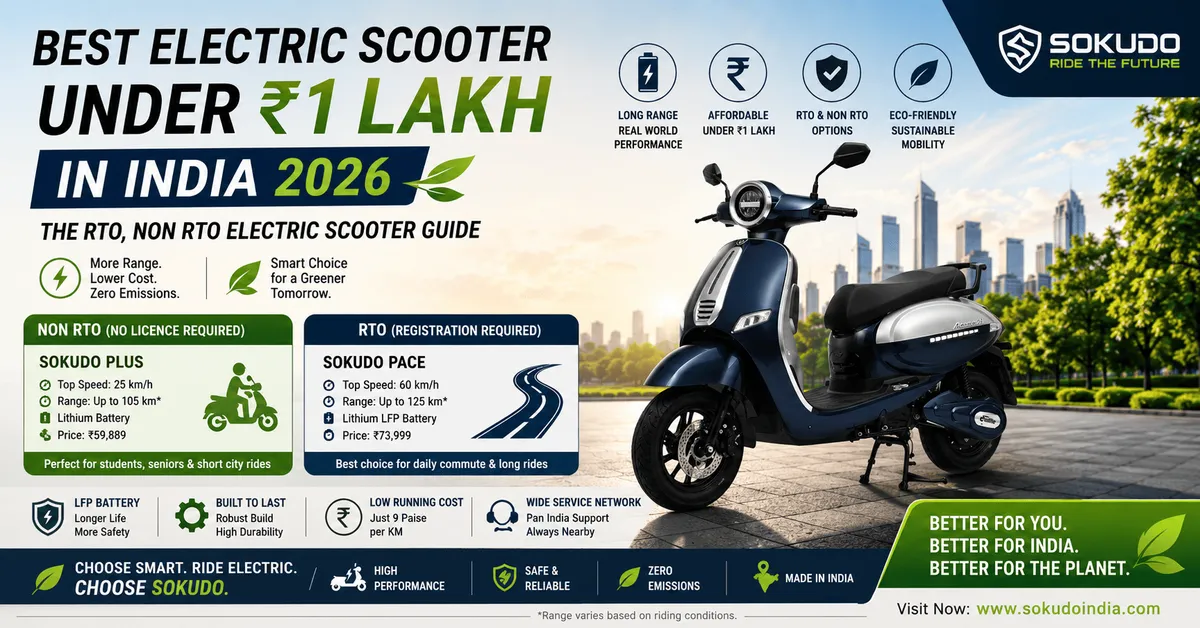
If you do not have a driving licence and just want something easy for short trips around your neighbourhood, the Sokudo Plus at Rs 67,951 is the most affordable lithium battery scooter you can buy right now without any registration paperwork.
If you want a proper high-speed registered scooter that gives you the most range for your money, the Sokudo Pace at Rs 83,951 offers up to 125 km on a single charge with nothing else at this price coming close.
This guide covers everything honestly, including Ola, Bajaj, Hero Vida, TVS, Ampere, and every Sokudo model. Real-world range numbers, not just brochure claims. Three-year savings, not just running cost per km. And a clear picture of which scooter makes sense for which kind of rider.
This is the most confusing part of buying an electric scooter in India, and most guides skip over it completely. Here it is in plain language.
A non-RTO scooter does not need to be registered at the RTO. You do not need a driving licence to ride it. You do not need to pay road tax. And you do not have to wait weeks for registration papers.
This comes from how Indian law works. Any scooter with a motor producing 250W or less and a top speed of 25 km/h or below does not count as a motor vehicle under the Central Motor Vehicles Rules. So all the rules that apply to regular vehicles simply do not apply to it.
In real life this means no trip to the RTO office, no number plate, no compulsory insurance (though getting it is still sensible), no road tax, and you can take delivery and ride the same day.
Roughly 5 lakh non-RTO scooters are sold every month in India. Most buyers are students, homemakers, senior citizens, and people who just need something simple for their local area without dealing with paperwork.
The problem with most non-RTO scooters sold in India is that they run on old lead-acid batteries. Those batteries give 40 to 60 km of actual range when new, start losing capacity within months, and need replacing every 12 to 18 months at Rs 8,000 to Rs 12,000. Sokudo solved this with the Plus, which brings a proper LFP lithium battery into the non-RTO space without a lead-acid compromise. For the full legal explanation of how this classification works and how to verify any scooter's status, read our guide on whether you can ride an electric scooter without a licence in India.
Any scooter going faster than 25 km/h or with a motor above 250W needs to be registered. This covers every major electric scooter you see advertised: the Sokudo Pace, Rapid 2.2, Select 2.2, Acute 2.2, Acute, Ola S1X, Bajaj Chetak, TVS iQube, and Hero Vida VX2.
For these scooters you need a valid driving licence, RTO registration, third-party insurance, and a helmet by law. Most states complete the registration process in two to four weeks. Several states now have faster processing tracks for electric vehicles.
| Your situation | What to go with |
| No licence, daily trips under 25 km, student or senior | Non-RTO: Sokudo Plus |
| Short trips inside a housing society or campus | Non-RTO: Sokudo Plus |
| Daily commute of 30 to 60 km, have a licence | RTO: Sokudo Pace or Rapid 2.2 |
| Long commute of 60 to 100 km, want maximum range | RTO: Sokudo Acute 2.2 or Acute |
| Family scooter, occasional faster roads, need 70 km/h | RTO: Sokudo Select 2.2 or Acute |
Every electric scooter comes with a range figure. The Sokudo Pace claims 125 km. The Ola S1X 2kWh claims 108 km. But what do you actually get in real Indian conditions?
The official range figure comes from a laboratory test on a flat road at perfect temperature with no wind, a single rider, and a controlled speed. That is not your commute. Your commute has traffic signals, speed breakers, 42-degree summer heat, and a colleague sitting behind you on Fridays.
In actual Indian city riding, most people get roughly 15 to 20 percent less than the manufacturer claim, depending on conditions. Here is a realistic breakdown:
| Scooter | Claimed Range | Real City Range | Real Highway Range |
| Sokudo Plus (Non-RTO) | 100 km | Around 90 km | Around 95 km |
| Sokudo Pace | 125 km | Around 115 km | Around 120 km |
| Sokudo Rapid 2.2 | 100 km | Around 90 km | Around 95 km |
| Sokudo Select 2.2 | 100 km | Around 90 km | Around 95 km |
| Sokudo Acute 2.2 | 100 km | Around 90 km | Around 95 km |
| Sokudo Acute | 150 km | Around 140 km | Around 145 km |
| Ola S1X (2 kWh) | 108 km | Around 86 km | Around 95 km |
| Ola S1X (3 kWh) | 176 km | Around 140 km | Around 155 km |
| Bajaj Chetak C2501 | 113 km | Around 90 km | Around 100 km |
| Hero Vida VX2 Plus | 142 km | Around 113 km | Around 125 km |
| TVS iQube S | 100 km | Around 80 km | Around 88 km |
| Ampere Magnus Grand | 95 km | Around 76 km | Around 84 km |
One thing worth noting: a scooter claiming 125 km and one claiming 108 km are not as different as they look. In city riding, the Sokudo Pace gives around 100 km and the Ola S1X 2kWh gives around 86 km. That is a 14 km gap. For someone doing 30 to 40 km a day, both will comfortably last two to three days between charges.
What matters more in the long run is how the battery holds up after a year or two of daily use. Sokudo uses LFP (Lithium Iron Phosphate) battery chemistry across every model. LFP holds its capacity much better after hundreds of charge cycles compared to standard NMC lithium-ion alternatives, specifically in high-temperature Indian conditions. Three years into daily ownership, your Sokudo will still give you range much closer to what it promised when new. For a deeper understanding of why battery chemistry matters for long-term range, read our guide on LFP vs lithium-ion vs lead-acid batteries.
Sokudo Electric India is based in Greater Noida, Uttar Pradesh. Motors and electronic controllers are built in-house at Sokudo's own factory. That means this is not imported parts being assembled and called manufacturing. Sokudo controls what goes into every scooter from start to finish, which is why the spare parts and service response is faster than brands dependent on overseas supply chains. You can read more about Sokudo's company and manufacturing approach at the company page.
Category: Non-RTO, no registration or licence needed
| Spec | Detail |
| Price | Rs 67,951 |
| Battery | LFP (Lithium Iron Phosphate), 60V |
| Claimed range | 100 km |
| Real city range | Around 95 km |
| Top speed | 25 km/h |
| Charging time | 3 to 4 hours |
| Brakes | Front disc, rear drum |
| Weight | 100 kg |
| Load capacity | 180 kg |
| Battery warranty | 3 years |
| Registration needed | No |
| Licence needed | No |
What makes the Sokudo Plus different from the dozens of cheap non-RTO scooters available everywhere is the battery. Almost every other non-RTO scooter at this price runs on a lead-acid battery. Those batteries give 40 to 50 km when new, lose range within months, and need replacing every year at Rs 8,000 to Rs 12,000.
The Plus runs on an LFP lithium battery. You get around 80 km in the city, it charges in 3 to 4 hours, and the battery is built to last. When you add up what a lead-acid buyer spends on replacements over three years, the Plus works out cheaper even though it costs more upfront.
It also comes with genuinely useful features: anti-theft alarm with keyless entry, USB charging for your phone, LED headlight with DRL, reverse mode for tight spots, and three riding modes to stretch range further on Eco when needed.
Who should buy it: Students without a licence. Residents in housing societies or large campuses. Senior citizens who want a simple, slow, manageable ride. Homemakers doing local errands. Anyone who finds the RTO process a barrier and just wants something that works the same day.
Who should not buy it: Anyone who needs to ride on main roads where traffic moves at 40 to 50 km/h. The 25 km/h limit is not safe on busy arterial roads.
For the full comparison of the Plus against other non-RTO options including Hero Electric Flash LX and Ampere Reo, read our best non-RTO electric scooters in India guide.
Category: RTO registered, high-speed
| Spec | Detail |
| Price | Rs 83,951 |
| Battery | 2.2 kWh LFP |
| Claimed range | 125 km |
| Real city range | Around 115 km |
| Top speed | 60 km/h |
| Charging time | 4 to 5 hours |
| Brakes | Front disc, rear drum |
| Weight | Around 101 kg |
| Ground clearance | 210 mm |
| Riding modes | Eco, Normal, Sport |
| Battery warranty | 3 years |
Look at what else is available near this price. The Hero Vida VX2 Go costs around Rs 73,850 and claims 92 km range. The Sokudo Pace at Rs 83,951 claims 125 km range. That is 35 percent more range for Rs 10,000 more money. In real-world city riding that works out to about 100 km for the Pace versus 74 km for the Vida Go per charge.
The Pace is designed for younger riders who want something that performs on the road. Sporty body, sharp headlights, digital display showing speed, battery level, and remaining range. Mobile connectivity built in.
At 60 km/h top speed it handles city roads and residential arterials well. It is not the right choice if you regularly ride on expressways or outer-city roads where everyone is doing 70 to 80 km/h. For that you step up to the Rapid 2.2.
Who should buy it: Young working professionals commuting up to 50 km a day. First-time electric scooter buyers who want enough range to feel relaxed. Riders upgrading from a petrol scooter who are nervous about running out of charge. People who want the most distance per rupee in their budget.
Honest comparison: The only scooter that genuinely competes with the Pace near this price is the Hero Vida VX2 Go, and only if you specifically need a removable battery for apartment charging. On pure range per rupee, nothing else at under Rs 85,000 comes close.
Category: RTO registered, high-speed
| Spec | Detail |
| Price | Rs 97,951 |
| Battery | 2.2 kWh LFP |
| Claimed range | 100 km |
| Real city range | Around 95 km |
| Top speed | 70 km/h |
| Charging time | 4 to 5 hours |
| Brakes | Front disc, rear drum |
| Weight | 101 kg |
| Battery warranty | 3 years |
The jump from 60 to 70 km/h sounds small but makes a genuine difference on certain roads: Delhi's outer ring road, Noida expressways, Pune arterial roads. On those stretches, 60 km/h puts you in the slow lane getting overtaken constantly. At 70 km/h the Rapid 2.2 keeps up properly with traffic.
The trade-off is some range. Claimed range drops to 100 km from the Pace's 125 km because running faster uses more battery. In real city use you get around 80 km. That is still two comfortable days of range for most people doing 35 to 40 km daily.
Who should buy it: Riders in cities with fast-moving traffic where 60 km/h feels too slow. Suburban commuters who mix colony roads with ring roads. Anyone who looked at the Pace but felt they needed more speed.
Honest comparison with Ola S1X: At Rs 84,999, the Ola S1X 2kWh is now confirmed as the comparable rival in this segment. Ola gives 101 km/h top speed, a 34-litre underseat boot, and fast-charging access in larger cities. The Rapid 2.2 at Rs 97,951 gives LFP battery durability and Sokudo's own service. If outright performance and fast charging matter most, go Ola. If long-term reliability and consistent service matter more, go Rapid 2.2.
Category: RTO registered, high-speed
| Spec | Detail |
| Price | Rs 1,03,951 |
| Battery | 2.2 kWh LFP |
| Claimed range | 100 km |
| Real city range | Around 95 km |
| Top speed | 70 km/h |
| Charging time | 4 to 5 hours |
| Brakes | Front disc, rear drum |
| Ground clearance | 210 mm |
| Riding modes | Eco, Normal, Sport |
| Battery warranty | 3 years |
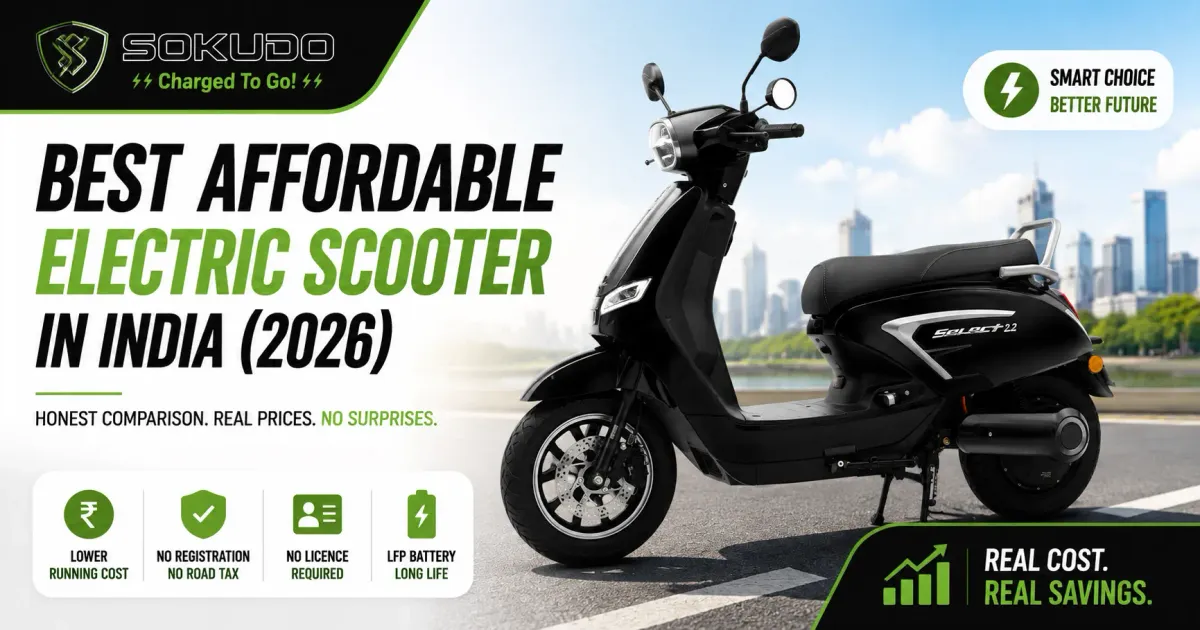
The Select 2.2 shares the same mechanical setup as the Rapid 2.2. Same battery, same motor, same range, same top speed. What changes is the finish quality, design detail, and overall feel when you sit on it and ride. It is built for buyers who want something that looks and feels more premium without crossing Rs 1.1 lakh.
At this price it sits close to the Bajaj Chetak 3001 at Rs 99,650. The Chetak has a metal body and the Bajaj name. The Select 2.2 has a better long-term battery chemistry and Sokudo's service backing it.
Who should buy it: Buyers who want Sokudo's best finish in the 2.2 kWh category. Families looking for a dependable daily scooter that holds up for years. People who think about reliability in year four or five more than brand name recognition.
Category: RTO registered, high-speed
| Spec | Detail |
| Price | Rs 1,04,951 |
| Battery | 2.2 kWh LFP |
| Claimed range | 100 km |
| Real city range | Around 95 km |
| Top speed | 70 km/h |
| Charging time | 4 to 5 hours |
| Brakes | Front disc, rear drum |
| Weight | 102 kg |
| Battery warranty | 3 years |
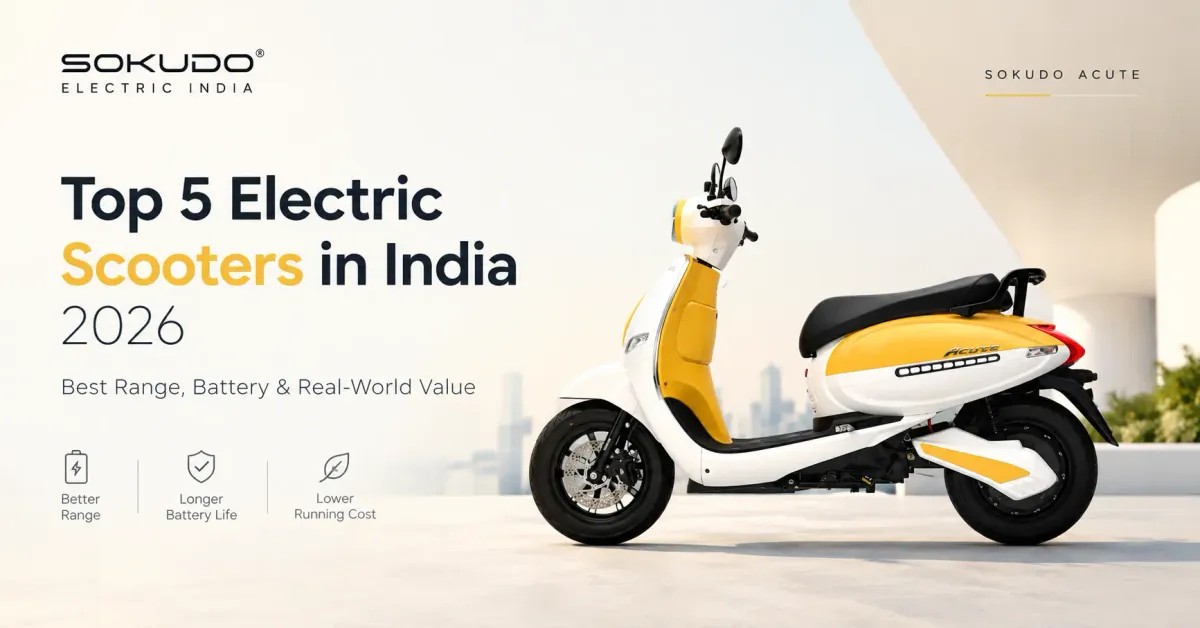
The Acute 2.2 is the top of what Sokudo does in the 2.2 kWh category. Same core specs as the Rapid and Select but with Sokudo's best component selection and most refined finish in the lineup. Riders who have been on this scooter for two or more years consistently report it rides the same as it did when new. That is what LFP chemistry and in-house manufacturing deliver over time.
At Rs 1,04,951 it competes directly with the Bajaj Chetak 3001 at Rs 99,650 and sits near the Hero Vida VX2 Plus at Rs 94,800. The Chetak gives more claimed range at 127 km and a metal body. The Vida gives even more range at 142 km and Hero's massive service footprint.
Honest take: If range is your top priority and you can spend Rs 94,800, the Hero Vida VX2 Plus has better range numbers. If battery reliability and long-term durability under Indian summer conditions matter more, the Acute 2.2 holds its ground.
Category: RTO registered, high-speed
| Spec | Detail |
| Price | Rs 1,25,951 |
| Battery | 3.1 kWh LFP |
| Claimed range | 150 km |
| Real city range | Around 140 km |
| Top speed | 70 km/h |
| Charging time | 4 to 5 hours |
| Motor | 3000W, built at Greater Noida factory |
| Brakes | Front disc, rear drum |
| Weight | 109 kg |
| Ground clearance | 175 mm |
| Battery warranty | 3 years |
This is where things change meaningfully. The Sokudo Acute moves up to a 3.1 kWh LFP battery and 150 km claimed range. In actual city riding that works out to around 120 km per charge. For most people doing 30 km a day, you charge once every three to four days. The habit of checking the battery every morning simply stops being part of your life.
The 3000W motor is the most powerful in the Sokudo lineup. You feel it on slopes, when merging into fast-moving traffic, and on longer rides where you want the scooter to feel effortless.
At Rs 1,25,951 it steps above the Rs 1 lakh mark, but the range jump compared to the 2.2 kWh models is significant enough to justify it for heavy riders. The Hero Vida VX2 Plus at Rs 94,800 claims 142 km, which is close, and is Rs 31,000 cheaper with Hero's service reach. The Acute gives you Sokudo's own in-house service and LFP battery chemistry that the Vida does not match.
Who should buy it: People covering 50 to 80 km every single day. Field executives, delivery supervisors, anyone on the scooter most of the working day. Buyers who have had range anxiety on a previous electric scooter and want it gone permanently.
For a detailed breakdown of how the Acute compares against the Ather Rizta, Bajaj Chetak 3502, and TVS iQube across the full under-Rs-1.5-lakh segment, read our best electric scooters under Rs 1.5 lakh in India guide.
Ola S1X at Rs 84,999 (2 kWh)
What it does well: Very high top speed at 101 km/h, a big 34-litre storage boot, smooth connected interface, and access to fast charging in larger cities. Where it falls short: After-sales service quality has been inconsistent depending on location, and resale value trends lower than established brands in the second-hand market.
Bajaj Chetak C2501 at Rs 87,100
What it does well: All-metal body that feels genuinely solid, IP67-sealed battery for rain riding, one of the deepest dealer networks in India especially outside metros, and charges in 3 hours 45 minutes at home. Where it falls short: 55 km/h top speed is limiting for faster roads, and 113 km claimed range is on the lower side for this price. For the full head-to-head across both brands, read the Sokudo vs Bajaj Chetak comparison guide.
Hero Vida VX2 Plus at Rs 94,800
What it does well: 142 km claimed range is very good value, removable battery is a genuine practical advantage for apartment dwellers, and Hero has over 5,000 service centres across India. Where it falls short: Slightly heavier than some rivals and does not use LFP chemistry.
TVS iQube S at Rs 1,02,000 and above
What it does well: Excellent build quality and comfortable ride, smart connectivity through the app, and TVS has a deep and reliable service network. Where it falls short: Better variants now cost above Rs 1 lakh, which limits direct comparison with the sub-Rs-1-lakh segment.
Ampere Magnus Grand at Rs 89,999
What it does well: 33-litre boot space is generous, comfortable upright riding position, and Greaves Group backing. Where it falls short: 65 km/h top speed feels slow for the price and 95 km claimed range underperforms what you would expect at Rs 90,000.
| Scooter | Price | Battery | Claimed Range | Real City Range | Top Speed | Charge Time | Battery Warranty | RTO |
| Sokudo Plus | Rs 67,951 | 2.2 kWh LFP | 100 km | 95 km | 25 km/h | 3 to 4 hrs | 3 years | No |
| Sokudo Pace | Rs 83,951 | 2.2 kWh LFP | 125 km | 115 km | 60 km/h | 4 to 5 hrs | 3 years | Yes |
| Sokudo Rapid 2.2 | Rs 97,951 | 2.2 kWh LFP | 100 km | 95 km | 70 km/h | 4 to 5 hrs | 3 years | Yes |
| Sokudo Select 2.2 | Rs 1,03,951 | 2.2 kWh LFP | 100 km | 95 km | 70 km/h | 4 to 5 hrs | 3 years | Yes |
| Sokudo Acute 2.2 | Rs 1,04,951 | 2.2 kWh LFP | 100 km | 95 km | 70 km/h | 4 to 5 hrs | 3 years | Yes |
| Sokudo Acute | Rs 1,25,951 | 3.1 kWh LFP | 150 km | 140 km | 70 km/h | 4 to 5 hrs | 3 years | Yes |
| Ola S1X (2 kWh) | Rs 84,999 | 2 kWh | 108 km | 86 km | 101 km/h | 5 hrs or fast charge | 3yr/50,000 km | Yes |
| Ola S1X (3 kWh) | Rs 98,999 | 3 kWh | 176 km | 140 km | 115 km/h | Longer or fast charge | 3yr/50,000 km | Yes |
| Bajaj Chetak C2501 | Rs 87,100 | IP67 LFP | 113 km | 90 km | 55 km/h | 3 hrs 45 min | 3yr/30,000 km | Yes |
| Bajaj Chetak 3001 | Rs 99,650 | IP67 LFP | 127 km | 102 km | 63 km/h | 3 hrs 50 min | 3yr/30,000 km | Yes |
| Hero Vida VX2 Go | Rs 73,850 | 2.2 kWh removable | 92 km | 74 km | 70 km/h | 3.5 hrs | 3yr/30,000 km | Yes |
| Hero Vida VX2 Plus | Rs 94,800 | 3.4 kWh removable | 142 km | 113 km | 80 km/h | 5.4 hrs | 3yr/30,000 km | Yes |
| Ampere Magnus Grand | Rs 89,999 | LFP | 95 km | 76 km | 65 km/h | 5 hrs | 3yr/30,000 km | Yes |
Use the Sokudo compare page to check all Sokudo models side by side on range, speed, and pricing.
This is the section most scooter guides skip entirely. They show you the showroom price and stop there. The showroom price is not what it costs to own and run a scooter.
The numbers below are based on 30 km of daily city riding in Delhi, electricity at Rs 8 per unit, and petrol at Rs 102 per litre. The comparison point is a Honda Activa 6G since that is what most buyers are replacing.
Over three years, a petrol scooter costs roughly Rs 1,80,926 in total including showroom price, insurance, maintenance, and fuel.
| Scooter | Showroom Price | 3-Year Total Cost | Total Savings vs Petrol Over 3 Years |
| Sokudo Plus | Rs 67,951 | Rs 80,431 | You save approximately Rs 1,00,495 |
| Sokudo Pace | Rs 83,951 | Rs 1,08,371 | You save approximately Rs 72,555 |
| Sokudo Rapid 2.2 | Rs 97,951 | Rs 1,22,371 | You save approximately Rs 58,555 |
| Sokudo Acute | Rs 1,25,951 | Rs 1,53,251 | You save approximately Rs 27,675 |
| Ola S1X (2 kWh) | Rs 84,999 | Rs 1,08,699 | You save approximately Rs 72,227 |
| Bajaj Chetak C2501 | Rs 87,100 | Rs 1,11,700 | You save approximately Rs 69,226 |
| Hero Vida VX2 Plus | Rs 94,800 | Rs 1,21,560 | You save approximately Rs 59,366 |
Savings are estimates based on stated inputs. Actual results vary by daily distance, electricity tariff, insurance premium, and maintenance costs in your city.
A few things worth noticing:
The Sokudo Plus saves you approximately Rs 1 lakh in just three years compared to a petrol scooter. And because it is a non-RTO scooter, you do not pay for insurance, road tax, or registration either. The real saving is even bigger.
The Sokudo Pace saves you over Rs 72,000 in three years. That means the scooter practically pays for itself through fuel savings alone within the ownership period.
Even the most expensive Sokudo model, the Acute at Rs 1,25,951, saves you approximately Rs 28,000 over three years. That is money staying in your pocket instead of going to the petrol pump.
Here is another way to look at it. If you ride a petrol scooter for three years, you spend roughly Rs 66,744 just on petrol at 30 km daily. With the Sokudo Pace, you spend roughly Rs 7,920 on electricity over the same period. That is nearly Rs 59,000 extra in your pocket, just from fuel.
This does not count lower maintenance costs. A petrol scooter needs regular oil changes, air filter cleaning, and spark plug replacements. An electric scooter has none of that. For the complete year-by-year ownership cost breakdown, read our real cost of owning an electric scooter in India.
Go with the Sokudo Plus at Rs 67,951. No registration, no licence needed. The 80 km real city range covers any college commute comfortably. Unlike lead-acid alternatives, you will not be spending on battery replacements every year. For the complete student buying framework, read our best electric scooter for students in India guide.
Go with the Sokudo Pace at Rs 83,951. The 100 km real city range covers your round trip with a comfortable buffer. The 60 km/h speed handles city roads well. And the range beats everything else at this price.
Look at the Sokudo Rapid 2.2 at Rs 97,951 or the Ola S1X at Rs 84,999. The Rapid 2.2 gives you 70 km/h and LFP battery reliability. The Ola gives more speed and fast
charging access. Your choice depends on whether outright performance or reliable long-term ownership matters more to you.
The Hero Vida VX2 Go at Rs 73,850 or the Sokudo Plus at Rs 67,951 are your practical options. Both have batteries you can detach and carry to your flat. The Vida is a registered scooter for main road riding. The Plus is non-RTO for shorter daily trips.
Compare the Bajaj Chetak C2501 at Rs 87,100 and the Sokudo Select 2.2 at Rs 1,03,951. If your city has strong Bajaj dealer coverage, the Chetak makes practical sense. If you are in a city with good Sokudo coverage, the Select 2.2 gives you a battery that holds up better in year four and five.
Look at the Sokudo Acute at Rs 1,25,951 or the Hero Vida VX2 Plus at Rs 94,800. The Vida is Rs 31,000 cheaper and has Hero's service reach. The Acute gives you around 120 km of real city range with LFP chemistry that retains more of that range after two or three years. Both solve the heavy commuter problem well.
The Sokudo Pace at Rs 83,951 is the most cost-efficient choice. Best range per rupee, lowest running cost, simple enough to keep maintenance cheap. For the full rent versus buy analysis with real EMI figures, read our electric scooter for delivery riders guide.
Go with the Sokudo Plus. 25 km/h maximum speed means you are never in a situation where the scooter feels out of control. Lightweight at 100 kg. No paperwork at all. Just ride when you need to. For a detailed breakdown across all elderly-friendly options, read our best electric scooter for elderly riders in India guide.
The showroom price is only part of what you pay. On-road price adds road tax, registration, and insurance. The good news for electric scooter buyers is that many Indian states have removed or heavily reduced these charges.
Below are estimated on-road prices for the Sokudo Pace at Rs 83,951 ex-showroom:
| State | Road Tax | Estimated On-Road | Notes |
| Delhi | 0%, full waiver | Around Rs 88,000 | Registration and insurance included |
| Uttar Pradesh | 0%, full waiver | Around Rs 88,500 | |
| Maharashtra | 2 to 3%, reduced | Around Rs 90,500 | Extra charges in Mumbai and Pune |
| Gujarat | 0%, full waiver | Around Rs 88,000 | One of the most EV-friendly states |
| Karnataka | 0%, full waiver | Around Rs 88,500 | Metro surcharges may apply in Bengaluru |
| Tamil Nadu | Full tax waiver | Around Rs 89,000 | Registration waiver also available |
| Rajasthan | Partial waiver | Around Rs 90,000 | |
| Haryana | Varies by district | Around Rs 89,500 | |
| Madhya Pradesh | Incentives available | Around Rs 89,500 |
EV policies change regularly. Always check your state government's current electric vehicle scheme before visiting the dealership.
The Sokudo Plus has zero road tax and zero registration cost in every state. Total on-road price is Rs 67,951 plus a small dealer handling charge of approximately Rs 500 to Rs 1,000. That is the entire cost.
Find your nearest Sokudo dealer and exact on-road pricing at the Sokudo showrooms page or check Sokudo electric scooter prices in your city for your location. You can also calculate your EMI on the Sokudo EMI calculator before visiting.
Yes, completely legally. The Central Motor Vehicles Rules exempt any electric vehicle with a motor at or below 250W and a speed limit at or below 25 km/h from registration and licence requirements. The Sokudo Plus meets both conditions. You can ride it on Indian roads without a licence, without a number plate, without visiting the RTO. Full details in our guide on riding an electric scooter without a licence in India.
In typical Delhi stop-and-go conditions you should expect 95 to 100 km per charge. If you are riding on the outer ring road at a steady 50 to 55 km/h, expect closer to 105 to 110 km. Most people commuting 30 to 40 km a day find they charge every two to three days. Tips on how to maximise that range are in our guide on how to increase electric scooter range.
The Sokudo Acute with its 3.1 kWh LFP battery claims 150 km and gives around 120 km in actual city use. For non-RTO scooters, the Plus claims 100 km and gives around 80 km in city conditions.
Sokudo uses LFP (Lithium Iron Phosphate) batteries because they are more stable at high temperatures, which matters a lot when Indian summers in Delhi, Rajasthan, and central India regularly cross 45 degrees Celsius. LFP also holds its capacity much better after hundreds of charge cycles. The trade-off is slightly less range per kilogram of battery weight compared to some NMC alternatives. Sokudo made that choice deliberately because Indian conditions demand a battery that stays reliable rather than one that performs impressively on day one and fades within two years. The full technical breakdown is in our LFP vs lithium-ion vs lead-acid battery guide. For complete warranty coverage details, visit the official warranty page.
Yes. All Sokudo scooters charge from a regular 15-amp wall socket. Same socket your air conditioner or washing machine uses. No special charger, no electrician, no installation. The Plus charges in 3 to 4 hours. The 2.2 kWh models charge in 4 to 5 hours. The Acute also charges in 4 to 5 hours.
Yes. Sokudo's brushless DC hub motors and electronic controllers are designed and built at the Greater Noida facility. This is not imported parts being assembled. When something needs fixing, Sokudo is not waiting for overseas parts. Spare parts and service response are managed directly. You can learn more about Sokudo's components on the spare parts blog.
They are priced differently, with the Pace at Rs 83,951 and the Vida Go at Rs 73,850. The Pace claims 125 km range and gives around 100 km in the city. The Vida Go claims 92 km and gives around 74 km. That difference is real and meaningful over a year of daily riding. But the Vida Go has a battery you can carry upstairs to charge if you live in an apartment, and it has Hero's enormous service network. Simple decision: if range matters most, go Pace. If you live in an apartment without parking-level charging and want the world's largest two-wheeler service network, go Vida Go.
Sokudo's confirmed running cost is Rs 0.09 per km across all models. Compare that to a Honda Activa running on Rs 102 petrol at 50 km per litre, which costs about Rs 2.04 per km. A Sokudo scooter costs roughly 22 times less per kilometre than a petrol scooter. For the full year-by-year calculation, read our guide on how much it costs to run an electric scooter in India.
There is no single best electric scooter under Rs 1 lakh. If there were, everyone would be buying the same one.
What there is, is the best scooter for your particular situation.
If you need something without a licence or registration process: Buy the Sokudo Plus at Rs 67,951. Nothing else in India gives you LFP lithium battery range without RTO paperwork at this price. It is a genuinely unique product in the Indian market.
If you want the most range for the least money with proper registration: Buy the Sokudo Pace at Rs 83,951. At this price with 125 km claimed range, no competitor comes close on range per rupee.
If the Bajaj name gives you confidence and you live somewhere with strong Bajaj dealer coverage: The Bajaj Chetak C2501 is a solid choice. Metal body, strong build, trustworthy after-sales in smaller cities.
If you live in an apartment and need a removable battery: The Hero Vida VX2 Plus at Rs 94,800 is genuinely hard to argue against. Hero's service network is one of the best in the country.
If you do 60 km or more every single day and want to stop thinking about charging: The Sokudo Acute at Rs 1,25,951 was built for you. Around 120 km of real city range, a 3-year battery warranty, and Sokudo's strongest motor.
Every scooter on this list saves you roughly Rs 55,000 to Rs 60,000 in fuel over three years compared to a petrol scooter. The decision between them is about which total cost fits your budget, which service experience you trust in your city, and which range lets you ride without checking the battery level every morning.