12 September 2026·20 min read
20 June 2026•Sokudo Electic India
Published: June 20 2026 | Author: Sokudo Electric India Editorial Team
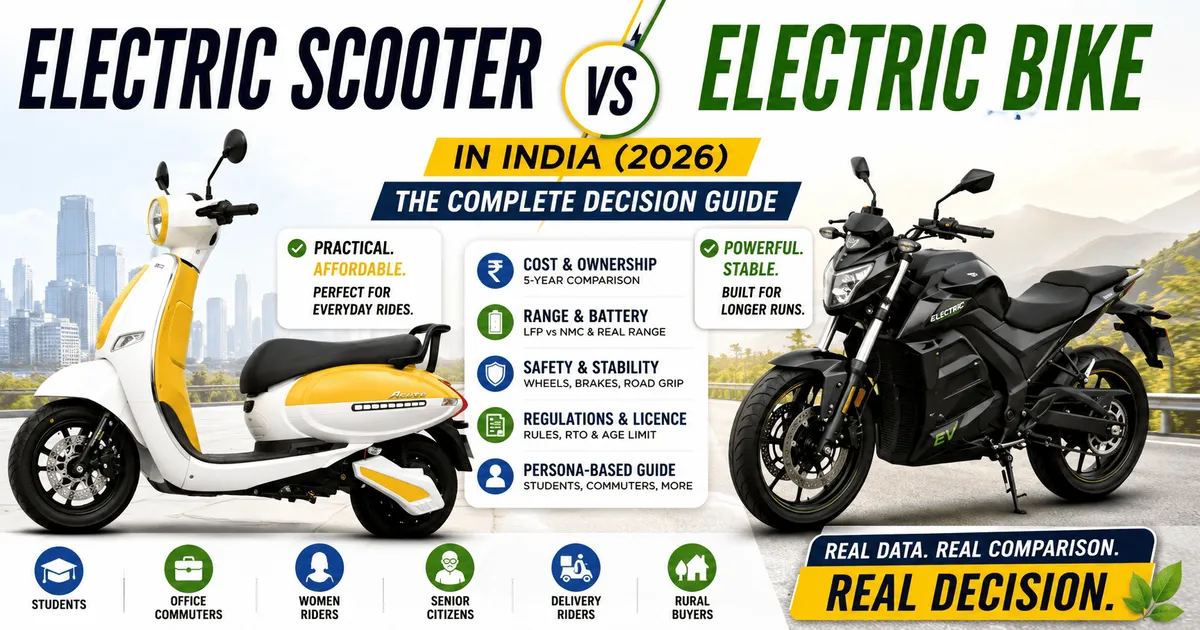
Most guides comparing electric scooters and electric bikes treat India like a smaller version of Europe or the United States. They compare wheel size, suspension travel, and top speed, and stop there. That approach misses almost everything that actually determines whether a scooter or a bike makes sense for an Indian rider.
This guide is built differently. It starts with what "electric bike" actually means in India, where it almost always refers to an electric motorcycle rather than a pedal-assist cycle. It works through real 2026 adoption data, exact regulatory thresholds under the Central Motor Vehicles Rules, five-year ownership cost modelling at Indian electricity tariffs, battery chemistry differences that matter specifically in Indian heat, and detailed persona breakdowns for students, office commuters, women, senior citizens, delivery riders, and rural buyers.
By the end, you will know exactly which category fits your life, not which one a generic global article assumes you want.
For the overwhelming majority of Indian riders, an electric scooter is the more practical, more affordable, and better-supported choice. Scooters dominate over 85 percent of India's electric two-wheeler market for good reason: lower purchase price, step-through frames suited to Indian clothing and carrying habits, flat floorboards for daily loads, easier parking, and a far wider service and charging ecosystem.
Electric bikes (electric motorcycles) make sense for a smaller group: riders who need higher top speed for highway stretches, want a more stable riding posture at speed, prioritise a more powerful and aggressive riding character, or already ride a petrol motorcycle and want a direct equivalent rather than a scooter replacement.
The right answer depends on your daily distance, road type, body posture preference, carrying needs, and budget. The rest of this guide breaks down exactly how to decide.
This is the single most important clarification missing from almost every comparison article on this topic.
In the United States and Europe, "electric bike" usually means a pedal-assist bicycle with a small motor that helps you pedal, typically capped at 25 km/h, used mainly for fitness and short urban trips.
In India, when people search "electric scooter vs electric bike," they are almost always asking about something different: a full electric motorcycle, similar in form factor to a Bajaj Pulsar or Royal Enfield, but battery-powered, made by brands like Revolt Motors, Ultraviolette, Tork Motors, and a small number of others. These are full motor vehicles requiring registration, insurance, and a driving licence, with top speeds of 70 to 150 km/h and motorcycle-style ergonomics rather than a scooter's step-through frame.
This guide addresses both interpretations, but focuses primarily on the electric motorcycle comparison since that is what the overwhelming majority of Indian searches for this term actually mean. Where the pedal-assist electric bicycle comparison applies (mainly for short urban trips and fitness-conscious buyers), it is addressed separately in the relevant sections.
Understanding where the market actually stands helps explain why scooters dominate and bikes remain a smaller niche.
India's electric two-wheeler segment crossed a record 1.4 million units sold in FY 2025-26, up 21.8 percent year-on-year, with penetration crossing 6.5 percent of the total two-wheeler market. Electric scooters account for over 85 percent of that volume. Electric motorcycles remain a small fraction of total e-2W sales, concentrated among a narrower group of performance-focused riders.
This gap is not accidental. Scooters dominate Indian two-wheeler usage generally, electric or otherwise, because most Indian riding is short-distance, multi-stop, urban or semi-urban commuting where a step-through frame, flat floorboard, and lower seat height genuinely matter for daily practicality. Electric motorcycles have struggled to gain equivalent traction partly because the petrol motorcycle segment itself is smaller than the petrol scooter segment in India, and partly because the price premium for electric motorcycles relative to comparable petrol options remains higher than the equivalent premium for scooters.
Industry analysis from McKinsey's research on India's electric two-wheeler consumer base projects electric two-wheelers could account for 60 to 70 percent of all new two-wheeler sales in India by 2030, driven primarily by continued scooter adoption rather than motorcycle growth.
For the broader context on what is driving this shift, including running costs and government incentive history, see our guides on how government subsidies made electric scooters affordable in India and electric scooter advantages and disadvantages in India.
| Factor | Electric Scooter | Electric Bike (Motorcycle) |
| Typical top speed | 25 to 80 km/h | 70 to 150 km/h |
| Typical claimed range | 60 to 150 km | 100 to 200 km |
| Riding posture | Step-through, seated, flat floor | Straddled, motorcycle-style |
| Purchase price | Rs 60,000 to Rs 1.5 lakh | Rs 1.1 lakh to Rs 2.5 lakh+ |
| Service network in India | Wide, expanding rapidly | Limited, concentrated in metros |
| Carrying capacity | Excellent (floorboard, under-seat) | Limited |
| Stability at low speed | Excellent | Moderate |
| Stability at high speed | Moderate | Better |
| Wheel size | Typically 10 to 12 inch | Typically 17 inch |
| Parking ease | Excellent | Moderate |
| Best suited for | Short to medium urban commutes | Longer, faster, highway-inclusive routes |
| India market share (e-2W) | 85%+ | Under 5% |
Most comparison articles quote a rough cost-per-kilometre figure and stop there. A realistic decision needs a full five-year picture covering purchase price, electricity, maintenance, insurance, and one likely battery-related cost.
At a typical Indian residential tariff of approximately Rs 7 to Rs 9 per unit, electric scooters with efficient drivetrains run at approximately Rs 0.09 to Rs 0.20 per km depending on the model and battery efficiency. Electric bikes, being heavier and more powerful, typically run somewhat higher at approximately Rs 0.20 to Rs 0.35 per km due to higher power draw per kilometre, though still dramatically cheaper than petrol at Rs 2.50 to
Rs 4.00 per km.
| Cost component | Electric Scooter | Electric Bike |
| Purchase price | Rs 67,951 to Rs 1,03,951 | Rs 1,30,000 to Rs 1,60,000 |
| Registration and insurance (5 yrs) | Rs 8,000 to Rs 15,000 | Rs 18,000 to Rs 28,000 |
| Electricity (5 yrs, 36,000 km) | Rs 3,240 to Rs 7,200 | Rs 7,200 to Rs 12,600 |
| Maintenance (5 yrs) | Rs 7,500 to Rs 12,500 | Rs 12,000 to Rs 20,000 |
| 5-year total (est.) | Rs 86,000 to Rs 1,38,000 | Rs 1,67,000 to Rs 2,20,000 |
| Cost component | Electric Scooter | Electric Bike |
| Purchase price | Rs 97,951 to Rs 1,25,951 | Rs 1,40,000 to Rs 1,80,000 |
| Registration and insurance (5 yrs) | Rs 10,000 to Rs 16,000 | Rs 20,000 to Rs 30,000 |
| Electricity (5 yrs, 63,000 km) | Rs 5,670 to Rs 12,600 | Rs 12,600 to Rs 22,050 |
| Maintenance (5 yrs) | Rs 9,000 to Rs 15,000 | Rs 15,000 to Rs 24,000 |
| 5-year total (est.) | Rs 1,24,000 to Rs 1,69,000 | Rs 1,87,000 to Rs 2,56,000 |
| Cost component | Electric Scooter | Electric Bike |
| Purchase price | Rs 97,951 to Rs 1,25,951 | Rs 1,40,000 to Rs 1,80,000 |
| Registration and insurance (5 yrs) | Rs 10,000 to Rs 16,000 | Rs 20,000 to Rs 30,000 |
| Electricity (5 yrs, 216,000 km) | Rs 19,440 to Rs 43,200 | Rs 43,200 to Rs 75,600 |
| Maintenance (5 yrs, high usage) | Rs 25,000 to Rs 40,000 | Rs 35,000 to Rs 55,000 |
| Battery replacement likelihood | Possible by year 4 to 5 | Possible by year 3 to 4 (higher cycle stress) |
| 5-year total (est.) | Rs 1,54,000 to Rs 2,25,000+ | Rs 2,38,000 to Rs 3,40,000+ |
| Cost component | Electric Scooter | Electric Bike |
| Purchase price | Rs 67,951 to Rs 97,951 | Rs 1,30,000 to Rs 1,60,000 |
| Registration and insurance (5 yrs) | Rs 8,000 to Rs 15,000 | Rs 18,000 to Rs 28,000 |
| Electricity (5 yrs, 90,000 km) | Rs 8,100 to Rs 18,000 | Rs 18,000 to Rs 31,500 |
| Maintenance (5 yrs, rough roads) | Rs 12,000 to Rs 20,000 | Rs 18,000 to Rs 28,000 |
| Local repair ecosystem access | Generally better, more familiar mechanics | More limited outside metros |
| 5-year total (est.) | Rs 96,000 to Rs 1,53,000 | Rs 1,84,000 to Rs 2,47,000 |
These figures are directional estimates based on representative pricing and typical Indian usage patterns. Actual costs vary by specific model, state electricity tariffs, riding style, and local maintenance pricing. For Sokudo-specific cost breakdowns, see our guide on how to choose the right electric scooter in India.
Across every persona, electric scooters show a lower five-year total cost of ownership than comparable electric bikes, primarily driven by lower purchase price and lower insurance and registration costs, with electricity and maintenance gaps adding further to the difference at higher mileage.
Resale value is consistently missing from comparison articles on this topic, despite being a meaningful factor in total ownership economics.
Electric scooters from established Indian manufacturers generally hold resale value better than electric motorcycles for a structural reason: the used electric scooter market is considerably larger and more liquid than the used electric motorcycle market in India, simply because so many more scooters exist on the road. A buyer looking to resell a scooter after three years has access to a far broader pool of interested second-hand buyers than someone reselling an electric motorcycle.
Battery chemistry and warranty terms also influence resale confidence directly. A scooter with LFP battery technology and a documented 3-year battery and motor warranty gives a prospective second-hand buyer more confidence in remaining battery health than a scooter or bike with an undocumented or shorter warranty period.
As a directional guideline, electric scooters from major manufacturers typically retain a higher percentage of original value at the three-year mark than electric motorcycles in the current Indian market, largely because the motorcycle segment is still niche enough that resale demand has not matured to the same degree. This gap is expected to narrow as the electric motorcycle segment grows, but for 2026 buyers, scooter resale liquidity remains the stronger position.
This is one of the most technically important and most commonly skipped sections in electric scooter versus electric bike comparisons.
Two battery chemistries dominate India's electric two-wheeler market:
NMC (Nickel Manganese Cobalt) batteries offer higher energy density, meaning a lighter pack can store more energy. This makes NMC attractive for electric motorcycles, where weight and packaging are tighter constraints, and contributes to the longer claimed ranges often seen in the electric bike segment. The trade-off is lower thermal stability and a shorter cycle life, typically in the range of 800 to 1,500 charge cycles.
LFP (Lithium Iron Phosphate) batteries offer significantly better thermal stability, longer cycle life typically in the range of 2,000 to 4,000 charge cycles, and a stronger overall safety profile. The trade-off is slightly lower energy density, meaning a somewhat larger or heavier pack is needed for equivalent range.
Summer ambient temperatures in Delhi NCR, Rajasthan, Gujarat, Maharashtra, Telangana, and Tamil Nadu routinely exceed 42 degrees Celsius, with vehicle surface temperatures under direct sun running considerably higher. Stop-and-go urban traffic adds further thermal stress through frequent acceleration cycles. In these conditions, the chemistry of the battery pack has a direct, measurable effect on how much of the original range and capacity remains after two to three years of daily use.
LFP batteries are increasingly being adopted across India's electric scooter segment specifically because of this thermal advantage, while electric motorcycles, prioritising range and power density for higher-speed use cases, have been slower to shift toward LFP chemistry.
| Battery factor | LFP | NMC |
| Thermal stability | High | Moderate |
| Cycle life | 2,000 to 4,000 cycles | 800 to 1,500 cycles |
| Energy density | Lower | Higher |
| Indian summer suitability | Excellent | Good |
| Safety profile | Excellent | Good |
| Long-term range retention | Stronger | Weaker under heat stress |
Almost every comparison article oversimplifies this to "under 25 km/h, no licence needed." That statement is incomplete and can lead buyers to assume the wrong scooter or bike qualifies.
Under Rule 2(u) of the Central Motor Vehicles Rules, 1989, notified by India's Ministry of Road Transport and Highways, an electric two-wheeler is exempt from requiring a driving licence, registration, a number plate, and road tax only when both of the following conditions are certified together:
Both conditions must be true simultaneously. A vehicle meeting only one condition is treated as a full motor vehicle under Indian law.
Step 1: Check the certified thirty-minute motor power rating, not peak power. Is it under 250W?
Step 2: Check the certified maximum speed. Is it under 25 km/h?
If both answers are yes: no licence, no registration, no number plate, no road tax required.
If either answer is no: driving licence required, RTO registration required, number plate required, third-party insurance mandatory.
Almost the entire electric motorcycle segment in India, including models from Revolt, Ultraviolette, and Tork, operates well above both thresholds. Every electric motorcycle on the Indian market today requires full registration, a valid driving licence, and insurance, with no exceptions.
Within the electric scooter segment, the market splits into two distinct categories. Non-RTO scooters such as the Sokudo Plus are certified under both thresholds and require no licence or registration. The large majority of mainstream electric scooters from brands like Ola, Ather, TVS iQube, and Bajaj Chetak exceed these thresholds and require full registration exactly like an electric motorcycle.
This is a critical distinction buyer frequently miss: choosing "a scooter" does not automatically mean avoiding licence requirements. Only specifically certified low-speed, low-power scooters qualify for the exemption.
For exempted low-speed vehicles meeting both Rule 2(u) conditions, standard motor vehicle age and licence requirements do not apply since the vehicle is not legally deemed a motor vehicle. General traffic safety rules around helmets and road conduct still apply to any rider on public roads.
For any vehicle classified as a motor vehicle, whether a registered high-speed scooter or any electric motorcycle, standard Motor Vehicles Act, 1988 age and licensing requirements apply, generally requiring the rider to be at least 18 years old for an unrestricted licence.
For a complete breakdown of this distinction with verification steps for buyers, read our dedicated guide on can you ride an electric scooter without a licence in India.
Most comparison articles mention that bikes "feel more stable" without explaining why, or what it actually means for safety on Indian roads.
Electric scooters typically run 10 to 12-inch wheels. Electric motorcycles typically run 17-inch wheels. Larger wheels handle potholes, broken road surfaces, and speed breakers with less disruption to stability because they cover a larger contact patch and absorb surface irregularities more smoothly. This is a genuine motorcycle advantage on India's frequently uneven roads, particularly outside well-maintained urban arterial roads.
Smaller scooter wheels can feel less planted on rough surfaces at higher speed, though this is rarely a meaningful issue at typical scooter operating speeds of 25 to 70 km/h on city roads.
Braking technology varies more by price point than by category. Entry-level scooters and entry-level electric motorcycles often use drum brakes at one or both wheels. Mid-range and premium models in both categories increasingly use a disc front brake with a Combined Braking System (CBS). True ABS remains relatively rare across both segments in India at mainstream price points.
When comparing specific models, always check the actual braking configuration rather than assuming category determines braking quality.
A scooter's step-through, seated posture with a flat floorboard generally offers easier low-speed control, particularly useful in heavy traffic, tight parking manoeuvres, and stop-and-go conditions. A motorcycle's straddled riding posture offers better weight distribution and control at higher speeds, particularly useful for highway riding and emergency braking at speed.
Both categories handle normal rain adequately when built with sealed electrical components and appropriate IP-rated battery housings. Scooters' lower centre of gravity and step-through frame can offer a slight stability advantage at low speed in wet, slippery urban conditions. Neither category is well suited for riding through flooded roads or deep water crossings, and both should avoid this regardless of IP rating.
For senior citizens and shorter riders, a scooter's low seat height and step-through frame generally offer better confidence and control, particularly at low speed in crowded areas. For highway commuters and delivery riders covering long daily distances on faster roads, an electric motorcycle's stability, braking feel, and lighting at higher speed can offer a genuine safety advantage.
Global comparisons discuss wheel size and suspension generically. They almost never address the practical, India-specific factors that genuinely influence which category fits daily life.
The step-through frame accommodates riders wearing sarees, salwar suits, or any clothing that makes straddling a motorcycle-style frame impractical or uncomfortable. The flat floorboard allows carrying daily loads such as grocery bags, an LPG cylinder, a school bag, or work materials in a way a motorcycle frame simply cannot accommodate. Under-seat storage on most scooters provides secure space for a helmet, documents, or a laptop bag. Lower seat heights, typically 740 to 770mm, work better for shorter riders and make parking and manoeuvring in tight apartment basements, narrow lanes, and crowded markets considerably easier.
Larger wheels and more substantial suspension travel handle rough roads with less jolt to the rider over long distances. The motorcycle riding posture is generally more comfortable over extended highway stretches at higher speed. Taller riders often find motorcycle ergonomics more naturally suited to their build than a scooter's compact frame.
Scooters are generally easier to park in tight basement parking, narrow apartment society lanes, and crowded urban parking spots due to their smaller footprint and tighter turning radius. This is a meaningful daily consideration for apartment residents in dense Indian cities where parking space is often at a premium.
For the large majority of Indian students living within 10 to 20 km of campus, an electric scooter, particularly a non-RTO model for under-18 riders without a licence, is more practical than an electric bike. Lower purchase price, no licence complexity for qualifying models, lower running costs, and easier handling for less experienced riders all favour scooters here. The Sokudo Plus at Rs 67,951 with its certified 25 km/h non-RTO status is purpose-built for exactly this profile.
For commutes of 20 to 40 km daily on a mix of city roads and arterial routes, a high-speed registered electric scooter generally offers the strongest value, combining adequate speed for arterial roads with lower purchase price and running costs than an equivalent electric bike.
Models like the Sokudo Rapid 2.2 or Sokudo Select 2.2 fit this profile well. An electric bike becomes more compelling only if your commute regularly involves sustained highway-speed stretches above 70 km/h.
Step-through frames, lower seat heights, flat floorboards for carrying bags, and the practicality advantage for riders wearing sarees or salwar suits make electric scooters the more practical choice for most women commuters in India, particularly for multi-stop daily routines involving work, errands, and family responsibilities. This is reflected in actual purchase patterns, where scooters significantly outsell electric motorcycles among women buyers.
Low seat height, step-through frame, lighter kerb weight, and lower speed ceilings all favour scooters strongly for senior riders. A non-RTO model like the Sokudo Plus removes registration complexity entirely while offering predictable, low-stress handling. Our dedicated guide on the best electric scooters for elderly riders in India covers this profile in full detail.
This persona requires the most careful analysis because daily distance is high (often 100 to 150 km), battery cycling is intense, and total cost of ownership compounds quickly. Electric scooters generally win on total cost of ownership at this volume due to lower purchase price and lower per-kilometre running costs, but riders should prioritise models with LFP battery chemistry specifically because of the cycle life advantage under intense daily use. Payload capacity, rear rack or delivery box mounting options, and stability with a loaded box should all factor into the model selection within the scooter category.
In rural and semi-urban India, terrain quality is often rougher, distances between charging access points can be longer, and the local repair ecosystem is generally more familiar with scooter mechanics than with electric motorcycle drivetrains, simply due to scooter market dominance.
Electric scooters generally offer a more practical ownership experience in this context due to easier local servicing, lower purchase price, and a simpler repair ecosystem. Grid reliability for home charging should be assessed carefully regardless of which category is chosen.
This is the one persona where electric bikes hold a genuine, meaningful advantage. For riders regularly covering long stretches on highways or ring roads at sustained speeds above 70 km/h, an electric motorcycle's stability, power delivery, and riding posture are better suited to the use case than a scooter, even a high-speed scooter capped around 70 to 80 km/h. Riders in this category should prioritise battery thermal management and charging network access along their typical routes, since electric motorcycles in India remain a newer segment with a less developed charging ecosystem outside major cities.
Is an electric scooter or electric bike better for daily commuting in India?
For most Indian commuters covering 10 to 40 km daily on city roads and moderate arterial routes, an electric scooter is the more practical and cost-effective choice. Electric bikes (motorcycles) make more sense for commuters regularly covering longer distances at sustained highway speeds above 70 km/h.
What does "electric bike" mean in the Indian context?
In India, "electric bike" almost always refers to an electric motorcycle, similar in form to a petrol motorcycle but battery-powered, rather than a pedal-assist bicycle as the term often means in Western markets. This guide addresses both meanings but focuses primarily on the electric motorcycle comparison since that is the dominant search intent.
Do electric bikes need a licence in India?
Yes, virtually all electric motorcycles available in India require a driving licence, RTO registration, a number plate, and insurance, since they exceed both the 25 km/h speed threshold and 250W power threshold that define the non-RTO exemption category under Rule 2(u) of the Central Motor Vehicles Rules, 1989.
Which is cheaper to own, an electric scooter or electric bike, over five years?
Electric scooters consistently show a lower five-year total cost of ownership than comparable electric motorcycles across every persona modelled in this guide, driven primarily by lower purchase price, lower insurance and registration costs, and generally lower running costs per kilometre.
Which has better battery technology, scooters or electric bikes in India?
Electric scooters have moved toward LFP (Lithium Iron Phosphate) battery chemistry faster than electric motorcycles, largely because LFP's thermal stability and longer cycle life suit Indian summer conditions and urban stop-and-go riding patterns well. Electric motorcycles more often use NMC chemistry for its higher energy density, which supports longer range but offers lower thermal stability.
Are electric scooters or electric bikes safer in India?
Neither category is inherently safer. Electric motorcycles generally offer better stability and control at higher speeds due to larger wheels and motorcycle ergonomics. Electric scooters generally offer better low-speed control, easier manoeuvring in traffic, and lower seat heights that improve confidence for shorter and less experienced riders. The safer choice depends on matching the vehicle to your actual riding environment.
Which is better for women riders in India, a scooter or an electric bike?
Electric scooters are generally more practical for women riders in India due to step-through frames suited to traditional clothing, flat floorboards for carrying daily items, and lower seat heights. This is reflected in actual market purchase patterns across India.
Which is better for delivery riders, electric scooters or electric bikes?
Electric scooters generally offer a stronger total cost of ownership for delivery riders due to lower purchase price and running costs, particularly when paired with LFP battery chemistry for durability under intensive daily cycling. Payload capacity and stability with a loaded delivery box should also factor into the model decision within the scooter category.
Do electric scooters or electric bikes have better resale value in India?
Electric scooters from established manufacturers generally hold resale value better than electric motorcycles currently, primarily because the used scooter market is significantly larger and more liquid than the used electric motorcycle market in India.
For the large majority of Indian riders, across nearly every persona examined in this guide, an electric scooter delivers stronger practical value:
lower purchase price, lower five-year total cost of ownership, easier daily handling, better suitability for Indian clothing and carrying habits, a more developed service and charging ecosystem, and generally stronger resale liquidity.
Electric bikes earn their place specifically for riders who need sustained high-speed highway capability, prefer motorcycle ergonomics and stability at speed, or are replacing an existing petrol motorcycle and want a direct electric equivalent rather than a category change.
The right decision starts with an honest look at your actual daily distance, road type, and what you carry, not with which category sounds more impressive on a spec sheet.
For students, homemakers, senior citizens, and most daily urban commuters, browse the full Sokudo electric scooter range to find the model that matches your specific commute, from the licence-free Sokudo Plus to the long-range, high-speed Sokudo Acute.