12 September 2026·20 min read
15 June 2026•Sokudo Electic India
Published: June 15 2026 | Author: Sokudo Electric India Editorial Team | Reading Time: 11 min
Most Indians assume every electric scooter requires a driving licence. That assumption is one of the biggest reasons buyers end up purchasing the wrong scooter, or worse, an unregistered high-speed scooter they did not realise needed registration.
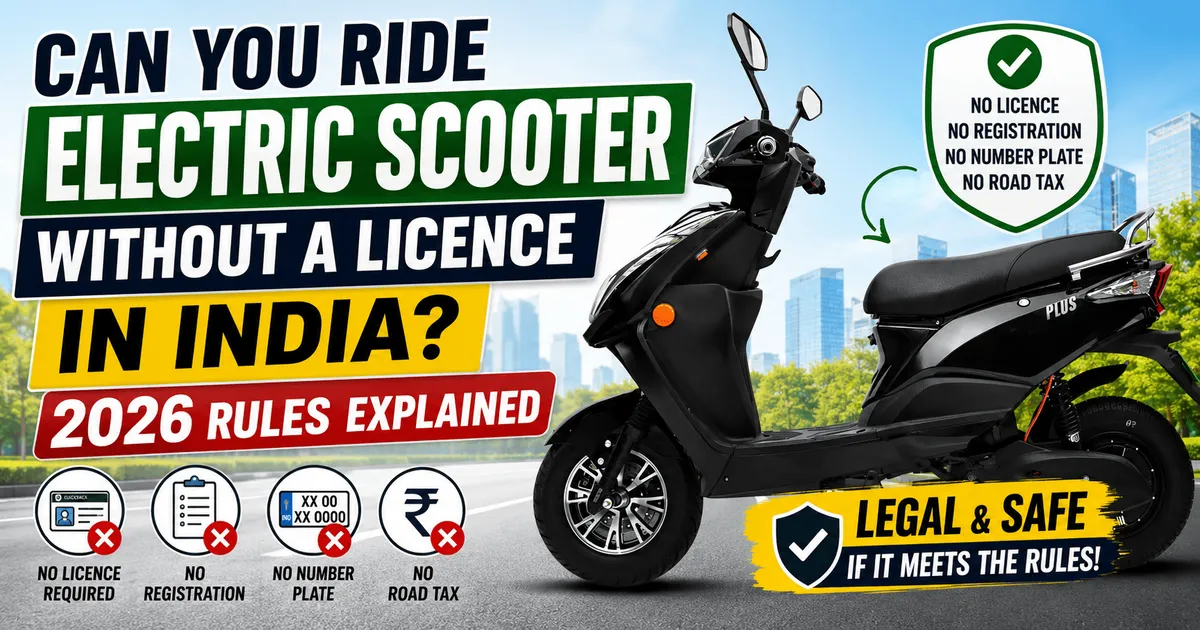
The reality is that Indian law allows certain electric scooters to be ridden legally without a driving licence, registration certificate, number plate, or road tax. These scooters are commonly known as non-RTO electric scooters or licence-free electric scooters.
For students, senior citizens, homemakers, and local city commuters, this category has become increasingly popular because it offers a simple and affordable way to switch to electric mobility without the paperwork associated with registered vehicles.
However, not every electric scooter qualifies for these exemptions. A scooter that exceeds the government's prescribed speed and motor limits immediately falls into the same legal category as a conventional petrol scooter, meaning registration, insurance, and a driving licence become mandatory.
This guide explains exactly what Indian law says, how to verify whether a specific scooter qualifies, who should buy one, and whether a licence-free electric scooter is the right choice for your daily life in 2026.
Electric two-wheelers that meet two specific technical conditions are legally exempt from requiring a driving licence, vehicle registration, a number plate, and road tax in India.
The exemption applies only when both of the following are true:
This exemption is defined under the "Battery Operated Vehicle" clause, Rule 2(u), of the Central Motor Vehicles Rules, 1989, notified by India's Ministry of Road Transport and Highways. A vehicle meeting both conditions, and verified by a testing agency authorised under Rule 126 of the same rules, is not deemed a motor vehicle under Indian law.
If either condition is not met, the scooter is treated as a standard motor vehicle, and a driving licence, registration, number plate, and insurance become mandatory.
Electric scooters in India fall into two legal categories. The distinction is not based on battery size, brand, price, or how a scooter is marketed. It is based entirely on two certified technical specifications.
Licence-free electric scooters (non-RTO) comply with the exemption limits and do not require:
Registered electric scooters exceed exemption limits and are treated as motor vehicles. Owners must have:
| Requirement | Licence-Free Scooter | Registered Scooter |
| Top speed | Less than 25 km/h | 25 km/h or above |
| Motor power (30-min rating) | Less than 250W | 250W or above |
| Driving licence | Not required | Required |
| Registration | Not required | Required |
| Number plate | Not required | Required |
| Road tax | Not applicable | Applicable |
| Insurance | Optional, recommended | Mandatory |
This is the part most articles oversimplify, and it is the most common source of confusion among buyers.
The 25 km/h rule concerns the certified maximum speed of the scooter. For an electric scooter to qualify as licence-free, its maximum speed must be less than 25 km/h under official testing and certification. The word that matters here is certified. A manufacturer description that says "approximately 25 km/h" is not the same as a tested and certified figure on record with an authorised testing agency.
The 250W rule concerns motor power. To qualify for exemption, the motor's thirty-minute power rating, not its peak power rating, must be less than 0.25 kW (250W). Many electric scooters list a higher peak power figure on marketing material while their continuous thirty-minute rating sits below 250W. This distinction between peak power and continuous power is the single most overlooked detail when buyers try to verify compliance themselves.
Both conditions must be satisfied simultaneously. A scooter with a 25 km/h top speed but a motor rated above 250W does not qualify. Equally, a scooter with a 250W motor but a certified top speed above 25 km/h does not qualify either. If either limit is exceeded, the vehicle is treated as a standard motor vehicle under the Motor Vehicles Act, 1988, and the Central Motor Vehicles Rules, 1989.
Before purchasing any electric scooter marketed as licence-free, verify the following directly with the dealer or manufacturer. This check takes less than five minutes and can prevent significant ownership headaches later.
If a dealer cannot produce a compliance certificate confirming both figures, treat that as a warning sign rather than proceeding on the assumption that "all 25 km/h scooters are automatically non-RTO."
Several electric scooters currently available in India fall into the licence-free category. These scooters are specifically designed for students, senior citizens, homemakers, local city commuters, and first-time EV buyers.
The Sokudo Plus is one of the strongest non-RTO electric scooter options available in 2026. Key highlights include:
Unlike many entry-level scooters that compromise on range to stay within the exemption limits, the Plus focuses on delivering substantial range and a long warranty period while remaining within India's licence-free category.
The Hero Electric Flash LX remains a popular option among buyers looking for an established brand presence and nationwide service network. Its non-RTO classification, lightweight 69 kg build, and portable detachable battery make it well suited to basic urban mobility and apartment charging situations.
The Ampere Reo 80 is another well-known non-RTO electric scooter, backed by Greaves Electric Mobility. It is particularly popular among students and elderly riders for its compact dimensions, LFP battery, and low operating cost for short-distance city usage.
For a full side-by-side comparison of these and other non-RTO models across range, battery chemistry, warranty, and running cost, see our complete guide on the best non-RTO electric scooters in India.
| Model | Licence Required | Certified Top Speed | Category |
| Sokudo Plus | No | 25 km/h | Non-RTO |
| Hero Electric Flash LX | No | 25 km/h | Non-RTO |
| Ampere Reo 80 | No | 25 km/h | Non-RTO |
The most important takeaway is not which scooter is cheapest. It is whether your daily commute actually fits the limitations and strengths of a licence-free electric scooter.
One of the biggest reasons buyers choose a non-RTO electric scooter is the ability to avoid registration formalities altogether. The answer depends entirely on whether the scooter is certified within the licence-exempt category described above.
If an electric scooter is certified with a thirty-minute motor power rating below 250W and a maximum speed below 25 km/h, it is exempt from vehicle registration under Rule 2(u) of the Central Motor Vehicles Rules, 1989. That means:
For buyers, this significantly simplifies ownership. You can purchase the scooter, complete delivery formalities, and start riding immediately without waiting for registration approvals.
Because non-RTO scooters are exempt from registration, they are also exempt from standard registration number plates. You do not need white number plates, temporary registration plates, or permanent registration numbers.
By contrast, registered high-speed scooters such as the Sokudo Select 2.2 and Sokudo Rapid 2.2 require the same number plate compliance as any petrol scooter, including the registration process, an assigned registration number, and standard number plate installation.
Road tax is generally not applicable to non-RTO electric scooters because they fall outside the registration framework entirely.
| Cost Component | Non-RTO Scooter | Registered Scooter |
| Registration fee | No | Yes |
| Number plate charges | No | Yes |
| Road tax | No | Yes |
| Mandatory insurance | No | Yes |
| Driving licence | No | Yes |
While exact amounts vary by state, the combined savings on a registered scooter can easily reach several thousand rupees before you ride your first kilometre. Our guide on how government subsidies made electric scooters affordable in India covers how PM E-DRIVE and state-level incentives interact with both registered and non-RTO categories.
Yes. Even though licence-free scooters do not require registration documents, carry the purchase invoice, warranty card, manufacturer documentation, and the compliance certificate or specification sheet confirming the certified speed and motor power. These documents help verify the scooter's legal classification if questions arise during routine traffic checks. Many experienced non-RTO owners keep digital copies stored on their phones for convenience.
A non-RTO electric scooter is an electric two-wheeler that does not require registration with the Regional Transport Office because it is certified within the government's prescribed limits: a thirty-minute motor power rating below 250W and a maximum speed below 25 km/h, as defined under Rule 2(u) of the Central Motor Vehicles Rules, 1989.
You will often hear these scooters referred to by several interchangeable names:
All of these terms refer to the same regulatory category.
No, not all electric scooters require a driving licence in India. Under Rule 2(u) of the Central Motor Vehicles Rules, 1989, an electric scooter is exempt from needing a driving licence, RTO registration, a number plate, and road tax if it meets two conditions together: a certified top speed below 25 km/h and a motor with a continuous (30-minute) power rating below 250W. If a scooter exceeds either limit, it is legally classified as a motor vehicle, and a licence, registration, insurance, and number plate all become mandatory. Buyers should always verify the certified figures on the compliance certificate, not the advertised specs, before assuming a scooter qualifies as licence-free.
Lower upfront cost. Without registration charges, road tax, and mandatory insurance requirements, the total acquisition cost remains lower, making non-RTO scooters attractive for budget-conscious buyers.
Simpler ownership experience. No licence, no registration appointments, no number plate processing, and no annual insurance renewal obligations. For many buyers, simplicity itself is a major selling point.
Ideal for local commuting. Most urban trips in India fall within 5 to 15 km. For these journeys, a 25 km/h scooter is often entirely adequate.
Excellent running costs. The Sokudo Plus, for example, has a manufacturer-confirmed running cost of approximately Rs 0.09 per kilometre, making it dramatically cheaper than petrol-powered alternatives. For a deeper breakdown of how this compares across the full Sokudo range and competitors, see our guides on low-speed vs high-speed electric scooters in India and how long electric scooters last in India.
Lower top speed. A maximum speed below 25 km/h works well on colony roads, school routes, local markets, and internal city streets. It can feel restrictive on flyovers, ring roads, and fast-moving arterial roads.
Not designed for highway use. Highways and expressways involve significantly higher traffic speeds than a licence-free scooter is built for.
Longer travel times for longer commutes. If your daily commute is 35 km or 40 km each way, travelling at under 25 km/h can become impractical even if the battery range is sufficient. In such cases, a registered high-speed electric scooter becomes the better option.
This is one of the most searched questions on this topic, and it deserves a precise answer rather than a generalised one.
For exempted low-speed electric scooters that meet the Rule 2(u) criteria (thirty-minute motor power under 250W and certified speed under 25 km/h), Indian law does not impose the same driving licence age requirements that apply to motor vehicles, since the vehicle is not deemed a motor vehicle in the first place. However, general traffic rules regarding helmets, road conduct, and safe riding behaviour still apply to anyone riding on public roads.
For any electric scooter classified as a motor vehicle (because it exceeds either the speed or power threshold), the rider must meet the standard age and driving licence requirements applicable to two-wheelers under the Motor Vehicles Act, 1988, which generally requires the rider to be at least 18 years old to hold a licence for an unrestricted two-wheeler, or 16 for vehicles up to 50cc equivalent with parental consent.
Why students prefer non-RTO scooters:
Students typically travel 3 km to school, 5 km to tuition, 2 km to sports practice, and 4 km to coaching centres. Very few of these journeys require speeds above 25 km/h. A scooter such as the Sokudo Plus offers low operating cost, easy charging, simple controls, predictable riding characteristics, and no registration hassle, which is precisely why the category has become popular among younger riders.
Important considerations for parents:
Even though a scooter may be licence-exempt, responsible riding practices remain essential. Parents should ensure young riders wear ISI-certified helmets, follow traffic signals, avoid reckless riding, and ride only within their experience level. A lower top speed reduces risk but does not eliminate the need for safe riding behaviour.
State-specific rules can differ in interpretation and enforcement. For this reason, families should always verify current state-specific guidance, particularly regarding minors on public roads, before allowing a teenager to ride any vehicle, licence-exempt or otherwise.
The mistake many buyers make is assuming that a faster scooter automatically delivers better value. In reality, the best scooter is the one that matches your daily travel habits.
Students
A typical student commute, college 4 to 6 km, coaching 2 to 5 km, library 2 km, and local errands 3 to 5 km, often totals 10 to 20 km daily. A scooter capable of 70 km/h provides little practical advantage for these journeys. The Sokudo Plus is particularly well suited because it offers no licence requirement, no registration hassle, up to 100 km claimed range, extremely low running cost, and easy home charging. For parents, the certified speed ceiling also provides additional peace of mind compared to a high-speed registered scooter.
Senior Citizens
Most senior riders use a scooter for medical appointments, grocery shopping, visiting family, community activities, and religious visits, all generally short and local trips. A licence-free scooter fits these requirements well, and the lower speed ceiling can feel more confidence-inspiring for riders uncomfortable with high-performance vehicles. For a detailed breakdown including seat height, weight, and model-specific recommendations, see our guide on the best electric scooters for elderly riders in India.
Homemakers
For homemakers, daily travel built around school drop-off, grocery shopping, medical visits, banking errands, and school pickup rarely exceeds 15 to 20 km combined. Paying extra for registration, insurance, and 70 km/h capability simply does not make financial sense at this distance. A non-RTO scooter delivers a lower purchase price, no registration paperwork, no road tax, no mandatory insurance, and extremely low electricity cost.
Local City Commuters
Many people now work near home, within city limits, or inside local commercial hubs, with daily distances often under 20 km. For these riders, a non-RTO scooter provides nearly all the benefits of electric mobility without the additional ownership burden of registered vehicles.
A trustworthy buying guide should also explain when not to buy a licence-free scooter.
Long-distance daily commuting. If you regularly travel 30, 40, or 50 km daily, a scooter capped under 25 km/h will eventually feel restrictive on travel time, even if battery range is sufficient.
Flyovers and arterial roads. Traffic on flyovers, ring roads, and multi-lane arterial roads often moves between 50 and 70 km/h. Maintaining under 25 km/h in these conditions can reduce safety because surrounding vehicles must continuously overtake. This is exactly where registered scooters such as the Sokudo Select 2.2 or Sokudo Rapid 2.2 become appropriate.
Highway and intercity travel. Licence-free scooters are designed for urban mobility, not national highways, state highways, or intercity touring.
Riders replacing a petrol scooter completely. If you currently ride a Honda Activa, TVS Jupiter, Suzuki Access, or TVS Ntorq and want one vehicle to handle every journey, a registered high-speed electric scooter generally offers a better replacement, with higher cruising speeds and better route flexibility while still delivering EV running-cost savings.
For a complete decision framework covering both categories with real Sokudo specs and cost tables, read our guide on low-speed vs high-speed electric scooters in India.
The savings from a licence-free electric scooter begin the moment you purchase the vehicle and extend well beyond electricity costs.
Upfront savings come from avoided registration charges, number plate costs, road tax, and mandatory insurance premiums, which can easily reach several thousand rupees depending on state and model.
Fuel savings, for a rider covering 20 km daily:
| Vehicle | Cost per km | Daily cost | Monthly cost |
| Petrol scooter | Rs 2.50 to Rs 4.00 | Rs 50 to Rs 80 | Rs 1,500 to Rs 2,400 |
| Sokudo Plus | Rs 0.09 | Rs 1.80 | Approximately Rs 54 |
Annual savings, for a rider covering 7,200 km per year:
| Vehicle | Annual energy cost |
| Sokudo Plus | Approximately Rs 648 |
| Petrol scooter | Rs 18,000 to Rs 28,800 |
That translates to annual savings of approximately Rs 17,000 to Rs 28,000, before maintenance savings are even considered. For the full cost breakdown across all Sokudo models and a five-year ownership comparison, see our guide on how to choose the right electric scooter in India.
This is the most common misconception. Indian regulations specifically exempt battery-operated vehicles meeting the thirty-minute power and speed conditions under Rule 2(u) of the Central Motor Vehicles Rules, 1989. A genuine non-RTO scooter such as the Sokudo Plus falls within this legally recognised category, provided it has been certified by an authorised testing agency under Rule 126.
A 70 km/h scooter is not automatically safer than a scooter capped under 25 km/h. In school zones, residential colonies, market roads, and narrow urban lanes, riding at a lower speed is often more appropriate. Lower speed means shorter stopping distances, easier control, reduced impact severity, and greater confidence for new riders. For a detailed look at battery and structural safety standards including AIS-156 certification.
This may have been true years ago. Modern battery technology has changed this significantly. The Sokudo Plus, for example, offers up to 100 km claimed range with LFP battery technology, a 3-year battery warranty, and a 1-year vehicle warranty. For most daily commuters travelling 10 to 25 km per day, that range is more than sufficient. To understand how range holds up over years of use, see our guide on how to extend the battery life of your electric scooter.
Licence-free electric scooters are widely used by students, homemakers, senior citizens, shop owners, delivery personnel, and local commuters of all ages. Many adults deliberately choose non-RTO scooters because they value lower ownership costs, simpler paperwork, and easier operation. These are purpose-built mobility solutions for local commuting, not children's vehicles.
Do all electric scooters require a driving licence in India?
No. Electric scooters certified with a thirty-minute motor power rating below 250W and a maximum speed below 25 km/h, under Rule 2(u) of the Central Motor Vehicles Rules, 1989, do not require a driving licence.
Can I ride an electric scooter without registration in India?
Yes, if the scooter is certified within the licence-exempt limits described above. These scooters are commonly referred to as non-RTO electric scooters and do not require a Registration Certificate or RTO processing.
What is the maximum speed allowed without a licence in India?
The certified maximum speed must be less than 25 km/h, and the motor's thirty-minute power rating must be less than 250W. Both conditions must be met simultaneously for the exemption to apply.
What is a non-RTO electric scooter?
A non-RTO electric scooter is an electric two-wheeler exempt from RTO registration because it is certified within the government's limits on speed and motor power as defined under the Central Motor Vehicles Rules, 1989. These scooters do not require registration, a number plate, a driving licence, or road tax.
Does the Sokudo Plus require a driving licence?
No. The Sokudo Plus has a certified top speed of 25 km/h and falls within India's licence-exempt electric scooter category. No driving licence, registration, number plate, or road tax is required.
Can a student ride a non-RTO electric scooter in India?
Yes, in most situations. Licence-free electric scooters are among the most popular mobility options for students because of their affordable transportation, low running costs, easy charging, and simple ownership. Parents should still ensure riders follow all safety requirements and applicable local regulations.
Can I take a licence-free scooter on highways?
No. Non-RTO scooters are designed for local commuting and city mobility. Highways involve significantly higher traffic speeds than a sub-25 km/h scooter is built for.
Do non-RTO electric scooters need insurance?
Insurance is generally not mandatory in the same way it is for registered motor vehicles. However, optional coverage against theft, accidental damage, and third-party liability is strongly recommended for any daily-use vehicle.
Are licence-free electric scooters cheaper to own?
Yes. Owners save on registration fees, road tax, insurance costs, and fuel expenses. Combined with extremely low electricity costs, such as the Sokudo Plus's Rs 0.09 per km, non-RTO scooters are among the most economical personal vehicles available in India.
How do I check if a scooter's motor power is actually under 250W?
Check the manufacturer's compliance certificate or specification sheet for the thirty-minute (continuous) power rating, not the peak power figure often highlighted in marketing material. Ask the dealer to confirm the figure used for regulatory certification under Rule 126 of the Central Motor Vehicles Rules, 1989, and look for testing by an agency such as ICAT.
Which type of rider should choose a registered electric scooter instead?
A registered high-speed electric scooter is usually the better choice if daily travel exceeds 25 to 30 km, your route includes flyovers or ring roads, you regularly ride on fast-moving roads, or you want a complete replacement for a petrol scooter. Our guide on low-speed vs high-speed electric scooters in India covers this decision in full detail.
Final Verdict: Should You Buy a Licence-Free Electric Scooter?
If your daily travel is under 25 km, mostly inside city limits, and focused on local roads and residential areas, a licence-free electric scooter may be the smartest purchase you can make.
You avoid driving licence requirements, registration paperwork, number plate formalities, and road tax expenses, while still enjoying the major advantages of electric mobility: extremely low running costs, home charging convenience, minimal maintenance, and quiet, smooth riding.
The Sokudo Plus is one of the strongest examples of this category in 2026, with a certified 25 km/h top speed, up to 100 km claimed range, LFP battery technology, a 3-year battery warranty, a 1-year vehicle warranty, and a Rs 0.09 per km running cost. It provides a practical solution for students, senior citizens, homemakers, and local commuters who want affordable transportation without ownership complexity.
However, if your commute regularly exceeds 30 km, involves flyovers, arterial roads, or higher-speed traffic, a registered electric scooter such as the Sokudo Select 2.2 or Sokudo Rapid 2.2 will serve you better.
The right scooter is not the one with the biggest specification sheet. It is the one that matches how you actually travel every day. Before making a purchase, ask yourself three simple questions: How far do I travel daily? What type of roads do I use most often? Do I actually need speeds above 25 km/h?
Answer those honestly, and the right choice becomes obvious. Browse the full Sokudo electric scooter range to compare every model side by side with current pricing and certified specifications.
The original draft listed three non-RTO models without linking to their official pages or to your own comparison content. This version links every model to its official source and ties the entire piece into your existing topical cluster with nine internal links, strengthening both link equity distribution and topical authority signals across your blog.