19 October 2026•Sokudo Electric India
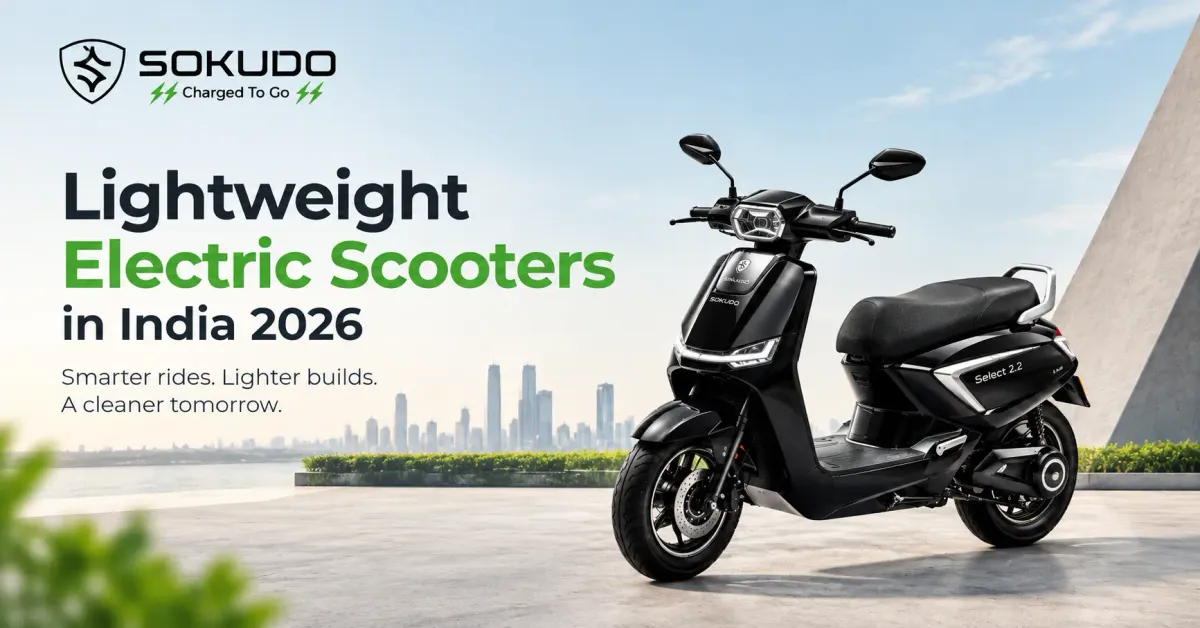
Lightweight Electric Scooters in India (2026): Kerb Weight of Every Popular Model, Compared
Published: 19/10/2028 | Author: Sokudo Electric India Editorial Team | Reading Time: 13 min
Most people don't feel a scooter's weight on the road. They feel it at the gate, when they push it in reverse out of a tight parking spot. They feel it on a slope when the stand has to go up, and in a basement when the scooter tips and has to be lifted. For a first-time rider, a homemaker doing school runs, or a parent in their sixties, those 10 to 20 kg decide whether the scooter gets used every day or stays parked.
That is why "light weight electric scooter" is one of the most searched EV questions in India right now. It is also one of the worst answered. Most lists you will find are written by insurance and loan websites. They mix petrol and electric models, round weights to "approximately 100 kg", or skip the number altogether.
This guide does the opposite. We compared the kerb weight in kg of 11 electric scooters sold in India in 2026, from 60 kg low-speed models to 123 kg family scooters. We then looked at the question that matters more than weight alone: how much range, speed and ground clearance you get for every kilo you have to handle.
Which Is the Best Lightweight Electric Scooter in India in 2026?
Quick answer: The best lightweight electric scooter in India for daily riding is the Sokudo Rapid 2.2. At 101 kg it weighs less than a Honda Activa 6G, yet reaches 70 km/h and gives up to 120 km of claimed range from a 2.2 kWh LFP battery. That is the most range of any electric scooter under 110 kg in this comparison, at Rs 97,951 ex-showroom. Lighter scooters exist only if you accept less: the Honda QC1 (89.5 kg) stops at 50 km/h and 80 km, and low-speed models (60 to 69 kg) are limited to 25 km/h.
The quick picks by need:
- Lightest overall (low-speed, 25 km/h): Sokudo Plus, Ampere Reo, Hero Electric Flash LX (60 to 69 kg)
- Lightest highway-capable scooter: Honda QC1 (89.5 kg, 50 km/h)
- Best range for its weight: Sokudo Rapid 2.2 (101 kg, up to 120 km, 70 km/h)
- Lowest price at about 100 kg: Ola S1 X 2 kWh (101 kg, Rs 74,999)
- Lowest seat among high-speed models: Honda QC1 (705 mm) and Ampere Magnus Neo (712 mm)
The rest of this guide explains how each of them earns that spot, and where each one falls short.
What Counts as a Lightweight Electric Scooter in India?
A lightweight electric scooter in India is one with a kerb weight of about 105 kg or less. For a high-speed, registered model, that means it weighs the same as or less than a typical 110cc petrol scooter. For context, the TVS Scooty Pep Plus weighs about 95 kg and the Honda Activa 6G about 106 kg. Low-speed scooters limited to 25 km/h go much lighter, usually 60 to 70 kg.
The number you should always ask for is the kerb weight. That is the weight of the scooter ready to ride, with the battery fitted and all fluids and accessories in place. Some brochures quote a "dry weight" or "body weight" instead, which can leave out the battery. On an electric scooter, the battery alone can weigh 10 to 20 kg, so a dry figure can make a scooter look much lighter than it feels when you push it.
Why kerb weight matters more on an electric scooter
On a petrol scooter, the fuel tank empties as you ride and the weight drops a little. On an electric scooter, the battery weighs the same whether it is at 100% or 5%. Two things follow from that.
- The weight you push is the weight you always push. If your daily routine involves reversing out of a crowded society parking or wheeling the scooter up a ramp, every kilo counts on every single trip.
- Battery size drives weight. A bigger battery gives more range but adds kilos. The skill is finding a scooter that gives you enough range for your week without carrying battery you never use.
That second point is why this guide compares range per kg, not just weight. A 60 kg scooter that gives you 68 km and stops at 25 km/h is light, but it is not the right scooter for someone crossing a city every day.
Who benefits most from a lighter scooter?
- Women and first-time riders, who often find a heavy scooter tiring to balance at low speeds and in traffic stops
- Senior citizens, for whom pulling a scooter onto its main stand can be the hardest part of the ride
- Students and young riders, who park in tight college lots and need to manoeuvre between other vehicles
- Shorter riders, where low weight combined with a low seat makes it easy to plant both feet
- Anyone parking in basements, narrow lanes or on slopes
If ease of handling is your main concern, also read our guide on the easiest electric scooter to ride in India, which covers seat height, turning and controls in detail.
Low-speed vs high-speed: the 40 kg difference
Indian electric scooters fall into two groups, and their weights are very different.
| Type | Top speed | Typical kerb weight | Registration and licence | Good for |
| Low-speed (non-RTO) | Up to 25 km/h | 60 to 70 kg | Not required | Colony trips, school runs, markets within 10 km |
| High-speed (registered) | 50 to 85 km/h | 89 to 125 kg | Required | Daily commutes, main roads, city-to-suburb trips |
If you never leave your neighbourhood, a low-speed scooter is the lightest option you can buy. We have covered those in detail in our guide to non-RTO electric scooters. The rest of this article focuses mainly on high-speed scooters, where finding a light one is much harder.
Lightweight Electric Scooters in India (2026): Weight in kg Compared
Here are 11 popular electric scooters sorted from lightest to heaviest. The last column shows claimed range per kg of kerb weight, which tells you how much distance each kilo of scooter buys you.
| Scooter | Kerb weight | Top speed | Claimed range | Battery | Ex-showroom price | Range per kg |
| Yulu Wynn | 60 kg | 25 km/h | 68 km | 0.98 kWh | Rs 55,555 | 1.13 km |
| Ampere Reo | 68.5 kg | 25 km/h | 70 to 80 km | 1.3 to 1.44 kWh | From Rs 49,900 | 1.02 to 1.17 km |
| Hero Electric Flash LX | 69 kg | 25 km/h | 85 km | Not disclosed | Rs 59,640 | 1.23 km |
| Honda QC1 | 89.5 kg | 50 km/h | 80 km | 1.5 kWh | Rs 90,708 | 0.89 km |
| Ola S1 X (2 kWh) | 101 kg | 85 km/h | 95 km | 2 kWh | Rs 74,999 | 0.94 km |
| Rapid 2.2 (101 kg) | 101 kg | 70 km/h | Up to 120 km | 2.2 kWh LFP | Rs 97,951 | 1.19 km |
| Vida VX2 Go (2.2 kWh) | 106 kg | 70 km/h | 92 km | 2.2 kWh | About Rs 0.80 lakh | 0.87 km |
| Ampere Magnus Neo | 108 kg | 65 km/h | 95 km | 2.3 kWh | About Rs 91,000 | 0.88 km |
| TVS iQube (2.3 kWh) | 115 kg | 68 km/h | 114 km | 2.3 kWh | From about Rs 1.20 lakh | 0.99 km |
| Ather Rizta S | 119 kg | 80 km/h | 123 km | 2.9 kWh | Rs 1,09,999 | 1.03 km |
| Bajaj Chetak 3001 | About 123 kg | 63 to 70 km/h | 127 km | 3.0 kWh | Rs 1,07,400 to 1,14,270 | 1.03 km |
Weights, ranges and prices are as published by the manufacturers and leading spec sites in October 2026. Prices change often and vary by city, so confirm the on-road price with your dealer. Yulu Wynn's weight differs between sources (60 kg to about 90 kg), so we have used the lower published figure. Real-world range is usually 15 to 25% below claimed figures for every brand.
What the table tells you
- Below 90 kg, you are choosing speed or weight. Every scooter under 90 kg is either limited to 25 km/h or, in the Honda QC1's case, to 50 km/h with 80 km of range.
- The 100 to 110 kg band is where it gets interesting. Five scooters sit here, and they all weigh about as much as a Honda Activa. Their range varies from 92 km to 120 km, which is a 30% difference for practically the same weight.
- Above 115 kg, you get more battery but carry it everywhere. The iQube, Rizta and Chetak are excellent family scooters with bigger batteries. They also weigh 14 to 22 kg more than a Rapid 2.2 or an Ola S1 X 2 kWh.
The lightweight contenders, one by one
Honda QC1 (89.5 kg). The lightest high-speed electric scooter in this list, with a low 705 mm seat. Where it stands out: very easy to balance and park, and backed by Honda's service network. Where it trails: a 50 km/h top speed and 80 km of claimed range make it a city-only scooter, and at Rs 90,708 you pay a premium for that low weight. Best for: short-height riders whose daily trips stay under 30 km.
Ola S1 X 2 kWh (101 kg). The cheapest scooter in the 100 kg band. Where it stands out: 85 km/h top speed and a low price of Rs 74,999. Where it trails: the smallest battery here at 2 kWh gives 95 km claimed, and an 805 mm seat is the tallest in this comparison, which matters for shorter riders. Best for: taller riders on a tight budget who want speed.
Vida VX2 Go 2.2 kWh (106 kg). Where it stands out: a removable, swappable battery you can carry indoors to charge. Where it trails: 92 km of claimed range is lower than other scooters of similar weight, and the seat is 777 mm high. Best for: flat or apartment dwellers without a parking charging point.
Ampere Magnus Neo (108 kg). Where it stands out: a low 712 mm seat for a high-speed scooter, and a practical family design. Where it trails: 65 km/h top speed and 95 km of claimed range for 108 kg. Best for: shorter riders who still need a registered scooter.
TVS iQube 2.3 kWh, Ather Rizta S and Bajaj Chetak 3001 (115 to 123 kg). All three give more than 110 km of claimed range and strong brand networks. They are not lightweight scooters by our definition, but they are worth considering if you ride two-up daily and rarely need to push the scooter by hand.
Why the Sokudo Rapid 2.2 Is the Best Lightweight Pick for Daily Riders
The Rapid 2.2 is not the lightest scooter in this list, and we would rather say that upfront. What it does is give you the most range of any electric scooter under 110 kg, with a 70 km/h top speed that is enough for main roads and flyovers. It does that while weighing less than a Honda Activa 6G.
Key specifications at a glance
| Specification | Sokudo Rapid 2.2 |
| Kerb weight | 101 kg |
| Top speed | 70 km/h |
| Claimed range | Up to 120 km per charge |
| Battery | 2.2 kWh LFP (lithium iron phosphate), 73.6V, 30Ah |
| Charging time | 3 to 4 hours |
| Motor | 2300W peak, brushless DC hub motor |
| Ground clearance | 200 mm |
| Load capacity | 250 kg |
| Brakes and tyres | Front disc brake, tubeless tyres |
| Battery warranty | 3 years |
| Ex-showroom price | Rs 97,951 |
You can see the full Rapid 2.2 specifications and colour options on the product page.
More range per kilo than any scooter in its weight band
In the 100 to 110 kg band, the Ola S1 X 2 kWh gives 95 km, the Vida VX2 Go 92 km and the Ampere Magnus Neo 95 km of claimed range. The Rapid 2.2 claims up to 120 km at the same 101 kg as the Ola. That is about 1.19 km of range per kg of scooter, against 0.87 to 0.94 km for the others in its band.
In daily use, this means fewer charging stops. A rider covering 30 km a day can expect to charge two to three times a week instead of every other day, even allowing for real-world range being lower than the claim.
Why LFP matters on a lightweight scooter
The Rapid 2.2 uses an LFP battery rather than the NMC lithium-ion chemistry common in many scooters. LFP cells are known for three things that suit Indian conditions.
- Heat tolerance. LFP chemistry is more thermally stable, which matters when a scooter is parked in direct sun at 45°C in May.
- Long cycle life. LFP batteries typically handle many more full charge cycles before their capacity drops, so the range you get in year one stays closer to the range you get in year four.
- Safety. LFP is widely considered the safer lithium chemistry because it is far less prone to thermal runaway.
If you want the full technical comparison, read our guide to lead-acid vs lithium vs LFP batteries.
200 mm ground clearance on a 101 kg scooter
Light scooters often sit low, which is a problem on Indian speed breakers, broken village roads and waterlogged streets. The Rapid 2.2 has 200 mm of ground clearance. That is more than the Honda QC1 (169 mm), Ola S1 X (160 mm) and Ampere Magnus Neo (165 mm). It means fewer scraped undersides and more confidence when riding in the rain through shallow water.
What it costs to run
A full charge of a 2.2 kWh battery draws about 2.4 units of electricity including charging losses. At Rs 8 per unit, that is roughly Rs 19 per full charge.
Here is how that compares with a petrol scooter for a rider covering 30 km a day, 26 days a month (780 km).
| Cost | Rapid 2.2 | 110cc petrol scooter |
| Energy cost per km | About Rs 0.19 | About Rs 2.10 (45 km/l at Rs 95/l) |
| Monthly running cost | About Rs 150 | About Rs 1,640 |
| Yearly running cost | About Rs 1,800 | About Rs 19,700 |
Assumptions: electricity at Rs 8 per unit, real-world range of about 100 km per charge, petrol at Rs 95 per litre and 45 km/l real-world mileage. Your figures will vary by city and riding style.
That is a saving of roughly Rs 17,900 a year on running costs alone. If you plan to buy on finance, our EMI calculator shows the monthly payment by down payment and tenure.
Where the Rapid 2.2 stands out
- Most claimed range (up to 120 km) of any electric scooter under 110 kg in this comparison
- LFP battery chemistry with a 3-year warranty
- 200 mm ground clearance, the highest among the lightweight high-speed scooters here
- 250 kg load capacity, so two adults plus shopping is not a strain
- 3 to 4 hour charging from a home socket
Where it trails
- Not the lightest. The Honda QC1 is 11.5 kg lighter, though with a 50 km/h top speed and 80 km of range.
- Not the fastest. The Ola S1 X tops out at 85 km/h against the Rapid's 70 km/h. For city and suburban riding, 70 km/h is enough. If you regularly ride on highways, it may not be.
- Smaller battery than heavier family scooters. The Ather Rizta S and Bajaj Chetak 3001 claim more range, but each weighs 18 to 22 kg more.
Best for: riders who want a scooter they can handle easily every day, without giving up main-road speed or worrying about charging. You can check the Rapid 2.2 price and colours for your city.
Which Lightweight Electric Scooter Is Best for Women?
For most women riders, the two numbers that matter are kerb weight and seat height, in that order. A scooter you can hold upright with one hand while you put the stand down is a scooter you will use every day.
- If you are under about 5 feet 2 inches: look first at the Honda QC1 (705 mm seat, 89.5 kg) or Ampere Magnus Neo (712 mm seat, 108 kg). Being able to put both feet flat matters more than a few kilos.
- If you commute more than 25 km a day or use main roads: the Rapid 2.2 gives you 70 km/h and up to 120 km of range at 101 kg, so you are not choosing between a light scooter and a useful one.
- If your trips are all within your colony or market: a low-speed scooter at 60 to 70 kg is the easiest of all to handle.
We have a dedicated guide to choosing an electric scooter for women that covers comfort, storage and safety features in more depth.
Which Lightweight Electric Scooter Is Best for Senior Citizens?
For riders over 60, the hardest moment is often not the ride but putting the scooter on its main stand and taking it off. A lighter scooter reduces that effort every time. Seniors should also prefer moderate speeds, predictable acceleration and a battery chemistry with a strong safety record.
- For short local trips (under 10 km): a 25 km/h low-speed scooter needs no licence and weighs about 60 to 70 kg.
- For longer trips to hospitals, banks or family across the city: the Rapid 2.2 at 101 kg, with a safer LFP battery and a 70 km/h ceiling, is a sensible balance. The Honda QC1 is lighter but its 80 km range and 50 km/h top speed may feel limiting for cross-city visits.
Read our full guide on the electric scooter for elderly riders for advice on controls, braking and test-riding with a family member.
Which Lightweight Electric Scooter Is Best for Students?
Students need three things: a low running cost, enough range for college plus coaching plus a weekend trip, and a scooter light enough to squeeze into a crowded college parking lot. Budget usually decides the shortlist.
- Lowest purchase price: Ola S1 X 2 kWh at Rs 74,999, if you are tall enough for an 805 mm seat
- Most range for the weight: Rapid 2.2, useful if college and coaching are in different parts of the city
- Under 18 or without a licence: only a low-speed scooter is legally suitable
Our guide to the best electric scooter for students compares budgets and running costs for student riders.
Is a Lightweight Electric Scooter Enough for Daily Use in India?
Yes, for most riders. A modern 100 to 110 kg electric scooter can comfortably handle city commutes, two-up riding and Indian road conditions. The question is which compromises you can live with.
A lightweight scooter is the right choice when:
- Your daily distance is under 60 km
- You park in a basement, narrow lane, crowded society or anywhere you need to push the scooter
- You are a first-time, shorter or older rider
- You mostly ride solo or with one passenger in the city
A heavier scooter makes more sense when:
- You ride more than 80 km a day and want fewer charges
- You regularly ride two-up on highways at 70 km/h or more
- You want a larger boot or more storage, which usually adds weight
- You rarely need to push or lift the scooter by hand
Lightweight Electric Scooter Buying Checklist
Use this list at the showroom. It takes ten minutes and saves years of a scooter that does not suit you.
- Ask for the kerb weight in writing. Not "body weight" or "dry weight". You want the weight with the battery fitted.
- Push it in reverse. Wheel the scooter backwards for five metres, the way you would in your parking. This is the best weight test there is.
- Put it on the main stand. Do it yourself, twice. If it is a struggle in the showroom, it will be a struggle every morning.
- Sit and plant both feet. Check that you can reach the ground comfortably with both feet at a stop.
- Check the battery chemistry and warranty. LFP batteries generally offer better heat tolerance and longer life. Ask how many years and kilometres the battery warranty covers.
- Match range to your week, not your day. Multiply your daily distance by 7 and check how many charges that means, using a real-world range about 20% below the claim.
- Look at ground clearance. Around 200 mm helps with speed breakers and waterlogged roads.
- Ride it on a real road. A short test ride on a road with traffic, a speed breaker and a U-turn will tell you more than any brochure.
You can book a free test ride of the Rapid 2.2 online, or find your nearest Sokudo showroom to try it in person.
Frequently Asked Questions
1. What is the weight of an electric scooter in kg? Most electric scooters in India weigh between 60 kg and 125 kg. Low-speed scooters limited to 25 km/h weigh about 60 to 70 kg. High-speed registered scooters weigh 89 to 125 kg, depending mainly on battery size. A typical 110cc petrol scooter weighs 95 to 110 kg for comparison.
2. Which is the lightest electric scooter in India? Among the scooters compared here, the lightest is the low-speed Yulu Wynn at a published 60 kg. The lightest high-speed electric scooter is the Honda QC1 at 89.5 kg, with a 50 km/h top speed and 80 km of claimed range.
3. Which lightweight electric scooter has the best range? In the under-110 kg group, the Sokudo Rapid 2.2 claims the most range at up to 120 km from a 2.2 kWh LFP battery, at a kerb weight of 101 kg. If you want a lightweight scooter with 100 km range or more and main-road speed, it is the strongest option in this comparison.
4. Are electric scooters lighter than petrol scooters? Not always. Low-speed electric scooters are much lighter at 60 to 70 kg. High-speed electric scooters weigh about the same as petrol scooters, roughly 90 to 125 kg, because the battery is heavy. A 101 kg electric scooter such as the Rapid 2.2 or Ola S1 X 2 kWh is lighter than a Honda Activa 6G at about 106 kg.
5. What is the difference between kerb weight and dry weight? Kerb weight is the weight of the scooter ready to ride, with the battery fitted. Dry weight or body weight may leave out the battery. Since an electric scooter's battery can weigh 10 to 20 kg, always compare kerb weights.
6. Which lightweight electric scooter is best for ladies? For shorter riders, choose a low seat first: the Honda QC1 (705 mm) and Ampere Magnus Neo (712 mm) are the lowest high-speed options. For women who commute longer distances, the Rapid 2.2 combines 101 kg with up to 120 km of range and 70 km/h. For local-only trips, a 60 to 70 kg low-speed scooter is easiest.
7. Is a lightweight electric scooter safe at 70 km/h? Yes, when it is designed for that speed. Weight alone does not decide stability. Wheelbase, tyre size, suspension and brakes matter just as much. Check for a front disc brake and tubeless tyres, and take a test ride on a main road before you buy.
8. Does a heavier battery mean more range? Generally, yes. A larger battery adds both weight and range. But efficiency varies a lot between brands: in the 100 to 110 kg band, claimed range ranges from 92 km to 120 km. Comparing range per kg is a fair way to see which scooter uses its weight best.
9. Can a lightweight electric scooter carry two people? Yes. Most high-speed lightweight scooters are built for two riders. Check the load capacity: the Rapid 2.2, for example, is rated for 250 kg. Expect range to drop when riding two-up, as with any scooter.
10. Do I need a licence for a lightweight electric scooter? It depends on speed, not weight. Scooters with a top speed above 25 km/h need registration, a driving licence and insurance. Low-speed scooters limited to 25 km/h that meet the government's exemption criteria do not.
Final Verdict: Which Lightweight Electric Scooter Should You Buy in 2026?
There is no single lightest-is-best answer. The right scooter is the lightest one that still does everything your week needs.
- Choose a low-speed scooter (Yulu Wynn, Ampere Reo, Hero Electric Flash LX) if every trip is within your neighbourhood and you want the lightest possible scooter with no licence.
- Choose the Honda QC1 if you are a shorter rider, your trips are under 30 km a day, and 50 km/h is enough.
- Choose the Ola S1 X 2 kWh if price and top speed matter most and you are comfortable with an 805 mm seat.
- Choose the Ampere Magnus Neo if you want a low 712 mm seat on a registered scooter.
- Choose the Rapid 2.2 if you want a scooter that is easy to handle at 101 kg without giving up range or speed. It offers the most claimed range in its weight band (up to 120 km), a 70 km/h top speed, an LFP battery and 200 mm of ground clearance, at Rs 97,951 ex-showroom.
For most Indian riders, the best way to decide is simple: push it, park it and ride it. Book a free test ride of the Rapid 2.2 and try the reverse-push test from our checklist yourself.
Comments
Share your thoughts about this article.
Loading comments...