27 October 2026•Sokudo Electric India
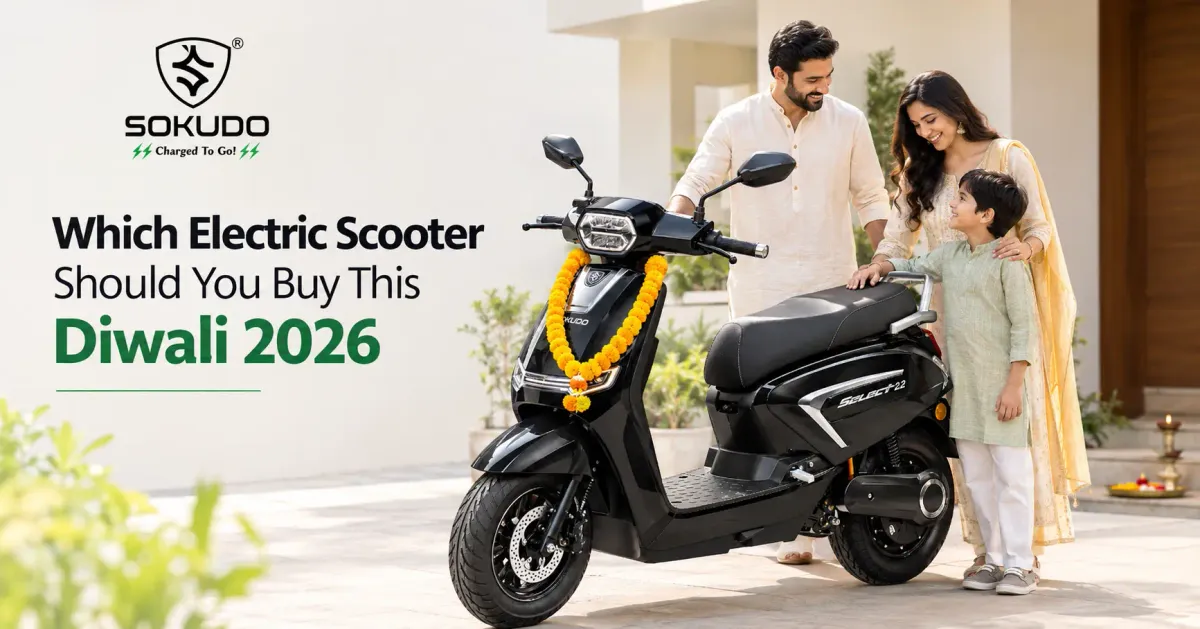
Which Electric Scooter Should You Bring Home This Dhanteras And DIwali? Real Range, Prices and Offers Compared
Created Date: 27 October 2026 | By Faiz Nabi, 35 years researching and building electric scooters | 15 min read
Key takeaways
- Dhanteras 2026 is on Friday, 6 November and Diwali is on Sunday, 8 November. Book by 1 November to get delivery on Dhanteras.
- Pick by daily distance first, then price. Under 40 km a day, almost any scooter in this guide will do. Over 60 km a day, real-world range matters more than top speed.
- Real range is lower than claimed range. Sokudo scooters give about 90% of their claimed range in city riding. Ask every brand for its real figure.
- An electric scooter costs about Rs 0.09 per km to run on a Sokudo, against about Rs 2.10 per km for a 110cc petrol scooter.
- The Sokudo Diwali offer 2026 is a Rs 5,000 cash discount plus Rs 5,000 of free accessories on every scooter, valid till 8 November 2026.
Every year, the week before Dhanteras is when Indian families decide on a new two-wheeler. It is decorated with marigolds, a swastik is drawn on it, and it gets a puja before its first ride. In 2026, more of those scooters are electric. Petrol is close to Rs 95 a litre, and an electric scooter can cover the same distance for a fraction of that cost.
But the choice is harder than it looks. There are now dozens of models, each brand quotes its best range figure, and every showroom has a festive banner. This guide is here to help you cut through that. We compare 18 electric scooters on the things that decide whether you will be happy a year from now: real range, running cost, price after offers, and how well each one suits the way you ride.
Which electric scooter should you buy this Diwali 2026?
Short answer: Buy the electric scooter whose real-world range covers at least three days of your riding. For most city families riding 20 to 50 km a day, that means a 70 km/h scooter with about 90 km of real range, priced under Rs 1 lakh. The Sokudo Rapid 2.2 fits this at an effective Rs 92,951 this Diwali.
Use this table to find your starting point. It is based on how far you ride in a day, because that is the single biggest factor in whether a scooter suits you.
| How far you ride daily | What you need | Starting point in this guide |
| Under 20 km, within your area | Low speed (25 km/h), no licence | Sokudo Plus, effective Rs 62,951 |
| 20 to 40 km, city roads | 55 km/h, long range, low price | Sokudo Pace, effective Rs 78,951 |
| 20 to 50 km, main roads and flyovers | 70 km/h, about 90 km real range | Sokudo Rapid 2.2, effective Rs 92,951 |
| 20 to 50 km, rough or unpaved roads | High ground clearance | Sokudo Select 2.2, effective Rs 98,951 |
| 20 to 50 km, carrying a passenger and load | High load capacity | Sokudo Acute 2.2, effective Rs 99,951 |
| Over 60 km | Biggest battery, about 140 km real range | Sokudo Acute, effective Rs 1,20,951 |
Effective price = ex-showroom price minus the Rs 5,000 Sokudo Diwali cash discount. Other brands' models in each budget are compared further down.
What is the Sokudo Diwali offer 2026?
Short answer: The Sokudo Diwali offer 2026 gives a Rs 5,000 cash discount plus Rs 5,000 worth of free accessories on every Sokudo electric scooter. That is Rs 10,000 in total benefits per scooter, bringing the effective price range to Rs 62,951 to Rs 1,20,951. The offer is valid till 8 November 2026.
The offer is the same on every model, from the entry-level Plus to the long-range Acute. That matters, because many festive offers give the biggest discount on the costliest variant and push you to spend more than you planned. Here you can pick the model that suits you and get the same benefit.
| Model | Ex-showroom price | Cash discount | Effective price | Free accessories |
| Sokudo Plus | Rs 67,951 | Rs 5,000 | Rs 62,951 | Worth Rs 5,000 |
| Sokudo Pace | Rs 83,951 | Rs 5,000 | Rs 78,951 | Worth Rs 5,000 |
| Sokudo Rapid 2.2 | Rs 97,951 | Rs 5,000 | Rs 92,951 | Worth Rs 5,000 |
| Sokudo Select 2.2 | Rs 1,03,951 | Rs 5,000 | Rs 98,951 | Worth Rs 5,000 |
| Sokudo Acute 2.2 | Rs 1,04,951 | Rs 5,000 | Rs 99,951 | Worth Rs 5,000 |
| Sokudo Acute | Rs 1,25,951 | Rs 5,000 | Rs 1,20,951 | Worth Rs 5,000 |
Registration, insurance and local charges are extra and vary by city. Accessory selection may vary by dealer.
Offer valid till 8 November 2026 (Diwali).
What does the Rs 10,000 benefit mean in real terms?
- Five of the six Sokudo scooters now cost under Rs 1 lakh. After the discount, even the Select 2.2 (Rs 98,951) and the Acute 2.2 (Rs 99,951) fall under the Rs 1 lakh mark, which is the budget many families set.
- The accessories cover costs you would have anyway. Most new owners spend in the first month on things like a seat cover, body cover, floor mat or helmet. Getting Rs 5,000 of these free lowers your real cost on day one.
- A smaller loan if you buy on EMI. The Rs 5,000 cash discount reduces the amount you finance, so both your monthly EMI and the total interest go down.
How do you claim the Sokudo Diwali offer?
- Call or WhatsApp +91-8920649555, or visit your nearest Sokudo showroom.
- Book a free test ride of the model you have shortlisted.
- Ask for a written on-road quote that shows the Rs 5,000 discount and lists the free accessories.
- Pay the booking amount and confirm your delivery date in writing.
When is Dhanteras 2026, and when should you book your scooter?
Short answer: Dhanteras 2026 falls on Friday, 6 November, and Diwali (Lakshmi Puja) on Sunday, 8 November. To take delivery of an electric scooter on Dhanteras, book it between 30 October and 1 November 2026. That leaves time for finance approval, registration and getting your colour in stock.
Diwali 2026 dates and shubh muhurat
| Day | Date | Timing (New Delhi) | Why it matters for a vehicle |
| Dhanteras | Friday, 6 November 2026 | Puja muhurat 6:37 PM to 8:37 PM. Trayodashi tithi from 10:30 AM on 6 Nov to 10:47 AM on 7 Nov | The most popular day to buy or take delivery of a vehicle |
| Choti Diwali | Saturday, 7 November 2026 | Not applicable | A good backup day if Dhanteras delivery slots are full |
| Diwali (Lakshmi Puja) | Sunday, 8 November 2026 | Lakshmi Puja 5:32 PM to 7:28 PM | Many families do the vahan puja on this evening |
Muhurat timings differ by city. Check your local panchang.
Why book 5 to 7 days early?
Three things can delay a festive delivery, and all three get slower in the last week before Dhanteras:
- Loan approval. If you are buying on EMI, the paperwork and approval usually take one to three working days. During the festive rush, it can take longer.
- Registration and number plate. Any scooter faster than 25 km/h must be registered with the RTO before it can be ridden on the road. Low-speed scooters such as the Sokudo Plus skip this step entirely.
- Your colour in stock. Dealers get a fixed festive allocation, and popular colours often sell out first.
If you book on Dhanteras itself, you may still get the festive price, but you may not get the scooter that day.
Your Diwali booking timeline
| Date | What to do |
| 27 to 29 October | Shortlist two models using this guide. Book test rides. |
| 30 October to 1 November | Take the test ride, get a written on-road quote, pay the booking amount, start the loan paperwork. |
| 2 to 5 November | Registration, insurance, accessory fitting. Confirm the delivery slot. |
| 6 November (Dhanteras) | Take delivery and do the puja during the muhurat. |
How far does an electric scooter really go on one charge?
Short answer: An electric scooter usually goes less far in daily riding than its claimed range. Sokudo scooters give about 90 to 93% of their claimed range in the city. The Sokudo Rapid 2.2 claims 100 km and gives about 90 km in the city and 95 km on the highway.
The range on a brochure is measured in a controlled test. Real riding adds traffic stops, a passenger, slopes, and the 10°C to 45°C swing of an Indian year, so the number you actually get is always a little lower. Most brands publish only the claimed figure. Here are the real figures for every Sokudo scooter, tested on roads all over India and matched by the experience of thousands of Sokudo customers.
| Scooter | Claimed Range | Real City Range | Real Highway Range |
| Sokudo Plus (Non-RTO) | 100 km | Around 90 km | Around 95 km |
| Sokudo Pace | 125 km | Around 115 km | Around 120 km |
| Sokudo Rapid 2.2 | 100 km | Around 90 km | Around 95 km |
| Sokudo Select 2.2 | 100 km | Around 90 km | Around 95 km |
| Sokudo Acute 2.2 | 100 km | Around 90 km | Around 95 km |
| Sokudo Acute | 150 km | Around 140 km | Around 145 km |
Why is highway range higher than city range?
In city traffic, the motor uses extra power every time you pull away from a stop. On an open road at a steady speed, it uses less. That is why each Sokudo scooter goes about 5 km further on the highway than in the city. It is the same reason a petrol scooter gives better mileage on a long, steady ride.
How often will you need to charge?
For a rider covering 30 km a day in the city:
| Scooter | Real city range | Days between charges | Charges per week |
| Plus, Rapid 2.2, Select 2.2, Acute 2.2 | About 90 km | About 3 days | 2 to 3 |
| Pace | About 115 km | About 3.8 days | About 2 |
| Acute | About 140 km | About 4.6 days | About 1.5 |
A simple rule: choose a scooter whose real city range is at least three times your daily distance. That way you charge every two or three days, and a low battery never catches you out. For ways to stretch every charge, read our guide on how to increase electric scooter range.
How much does it cost to run an electric scooter in India?
Short answer: A Sokudo electric scooter costs about Rs 0.09 per km to run. A 110cc petrol scooter costs about Rs 2.10 per km at Rs 95 a litre and 45 km/l. For a rider covering 30 km a day, that is about Rs 70 a month on a Sokudo, against about Rs 1,650 on petrol.
| Running cost (30 km a day, 26 days a month) | Sokudo electric scooter | 110cc petrol scooter |
| Cost per km | Rs 0.09 | About Rs 2.10 |
| Per month (780 km) | About Rs 70 | About Rs 1,650 |
| Per year | About Rs 840 | About Rs 19,750 |
Petrol figures assume Rs 95 per litre and 45 km/l real-world mileage. Your costs will vary with your city's electricity rate and petrol price.
That is a saving of about Rs 18,900 a year on running costs alone. Add the Rs 10,000 Sokudo Diwali benefit, and a Sokudo bought this Dhanteras saves roughly Rs 28,900 in its first year compared with a petrol scooter. Electric scooters also have fewer moving parts, so there is no engine oil, spark plug or clutch to service. For the full picture, including service, tyres and insurance, see our guide to the real cost of owning an electric scooter.
Which electric scooter is best under Rs 70,000?
Short answer: Under Rs 70,000, the best electric scooters are low-speed models limited to 25 km/h, which need no licence or registration. The Sokudo Plus is our recommendation at an effective Rs 62,951 this Diwali, with about 90 km of real city range, an LFP battery and 235 mm of ground clearance.
What to look for in this budget
- Real range of at least 60 km, so you charge only two or three times a week
- Battery type. An LFP (lithium iron phosphate) battery handles heat better and lasts longer than older battery types
- Ground clearance, because colony lanes and village roads are rarely smooth
- Load capacity, if you will carry a passenger or shopping
Our recommendation: Sokudo Plus (effective Rs 62,951)
The Sokudo Plus is built for school drop-offs, the market, tuition classes and visits within your area. It is limited to 25 km/h, so it needs no driving licence or number plate. It gives about 90 km in the city and 95 km on open roads from an LFP battery. Its 235 mm ground clearance is the highest in the Sokudo range, and it carries up to 200 kg. For most local riders, that means charging just twice a week.
Other low-speed scooters in this budget
- Ampere Reo: 25 km/h, 1.3 to 1.44 kWh battery, 70 to 80 km claimed range, from Rs 49,900 ex-showroom
- Yulu Wynn: 25 km/h, 0.98 kWh battery, 68 km claimed range, from Rs 55,555 ex-showroom
- Kinetic Green Zing: 25 km/h, 1.7 kWh battery, 100 km claimed range, Rs 71,990 to Rs 79,990 ex-showroom
For a deeper comparison of no-licence models, read our guide to the best non-RTO electric scooters in India.
Which electric scooter is best under Rs 1 lakh?
Short answer: Under Rs 1 lakh, look for a 70 km/h scooter with about 90 km of real range and an LFP battery. The Sokudo Rapid 2.2 is our recommendation at an effective Rs 92,951 this Diwali. If you ride only in the city, the Sokudo Pace gives about 115 km of real range at an effective Rs 78,951.
This is the budget most Indian families buy in, and it is where the festive discount makes the biggest difference.
What to look for in this budget
- Top speed of 55 to 70 km/h. 55 km/h is fine for city roads. Choose 70 km/h if you use main roads, flyovers or ring roads.
- Real range of 90 km or more, so a 30 km daily commute needs only two or three charges a week
- Ground clearance of around 200 mm, for speed breakers and waterlogged streets
- Weight around 100 kg, so the scooter is easy to push and park
Our recommendation for most riders: Sokudo Rapid 2.2 (effective Rs 92,951)
The Sokudo Rapid 2.2 is the scooter we suggest to most families this Diwali. It reaches 70 km/h, so it is comfortable on main roads and flyovers. It gives about 90 km in the city and 95 km on the highway from a 2.2 kWh LFP battery that charges in 3 to 4 hours. It has 200 mm of ground clearance and weighs 101 kg, so it is easy to handle in a crowded parking lot.
Our recommendation for city-only riders: Sokudo Pace (effective Rs 78,951)
If you rarely leave city roads, the Sokudo Pace gives the longest real range of any Sokudo under Rs 1 lakh: about 115 km in the city and 120 km on the highway. It tops out at 55 km/h, runs on a 1.8 kWh LFP battery, charges in 3 to 4 hours and carries 250 kg.
Also under Rs 1 lakh from Sokudo
- Sokudo Select 2.2, effective Rs 98,951: 210 mm ground clearance, the highest among Sokudo's 70 km/h scooters, for unpaved and semi-urban roads
- Sokudo Acute 2.2, effective Rs 99,951: 300 kg load capacity for riding with a passenger and shopping, or small business deliveries
Other scooters in this budget
- Vida VX2 Go (2.2 kWh): 70 km/h, 2.2 kWh removable battery, 92 km claimed range, about Rs 80,000
- Ola S1 X (2 kWh): 101 km/h, 2 kWh battery, 108 km claimed range, S1 X range from Rs 80,999 ex-showroom
- Honda QC1: 50 km/h, 1.5 kWh battery, 80 km claimed range, Rs 90,708 ex-showroom
- Ampere Magnus Neo: 65 km/h, 2.3 kWh battery, 95 km claimed range, about Rs 91,000
- Bajaj Chetak 2903: 63 km/h, 3.2 kWh battery, 123 km claimed range, Rs 99,998 ex-showroom
Which electric scooter is best above Rs 1 lakh?
Short answer: Above Rs 1 lakh, you are paying mainly for a bigger battery and more range. The Sokudo Acute is our recommendation at an effective Rs 1,20,951 this Diwali, with a 3.1 kWh LFP battery that gives about 140 km in the city and 145 km on the highway.
Who needs a scooter in this budget?
Most riders do not. If you ride under 50 km a day, a scooter under Rs 1 lakh will serve you just as well. This budget makes sense if you ride 60 km or more daily, run a small delivery or sales route, or want to charge only once or twice a week.
Our recommendation: Sokudo Acute (effective Rs 1,20,951)
The Sokudo Acute has the largest battery in the Sokudo range, a 3.1 kWh LFP pack. It gives about 140 km in the city and 145 km on the highway, which means a 30 km daily rider charges only about once every four to five days. It has alloy wheels with 90/90-12 tubeless tyres, a front disc brake, 70 km/h top speed and a 300 kg load capacity.
Other scooters in this budget
- Bajaj Chetak 3001: 63 to 70 km/h, 3.0 kWh battery, 127 km claimed range, Rs 1,07,400 to Rs 1,14,270 ex-showroom
- Vida V2 Plus: 85 km/h, 3.44 kWh battery, 143 km claimed range, about Rs 1,07,500 ex-showroom
- Ather Rizta S: 80 km/h, 2.9 kWh battery, 123 km claimed range, Rs 1,09,999 ex-showroom
- TVS iQube (2.3 kWh): 68 km/h, 2.3 kWh battery, 114 km claimed range, from about Rs 1.20 lakh ex-showroom
Figures for other brands are claimed range and ex-showroom prices as published by the makers or leading spec sites in October 2026. They do not include any festive offers those brands may be running.
How do electric scooter prices compare this Diwali 2026?
Short answer: Electric scooter prices in India this Diwali range from about Rs 50,000 for 25 km/h low-speed models to about Rs 1.2 lakh for long-range models. Most 70 km/h scooters with around 100 km of range cost Rs 80,000 to Rs 1.1 lakh before offers.
Here are all 18 scooters in this guide in one table, sorted by price. Sokudo prices show the effective Diwali price after the Rs 5,000 cash discount. Other brands show their published ex-showroom price.
| Scooter | Price this Diwali | Top speed | Battery | Claimed range | Licence needed |
| Ampere Reo | From Rs 49,900 | 25 km/h | 1.3 to 1.44 kWh | 70 to 80 km | No |
| Yulu Wynn | From Rs 55,555 | 25 km/h | 0.98 kWh | 68 km | No |
| Sokudo Plus | Rs 62,951 | 25 km/h | LFP | 100 km (real: about 90 km) | No |
| Kinetic Green Zing | Rs 71,990 to Rs 79,990 | 25 km/h | 1.7 kWh | 100 km | No |
| Sokudo Pace | Rs 78,951 | 55 km/h | 1.8 kWh LFP | 125 km (real: about 115 km) | Yes |
| Vida VX2 Go (2.2 kWh) | About Rs 80,000 | 70 km/h | 2.2 kWh | 92 km | Yes |
| Ola S1 X (2 kWh) | From Rs 80,999 | 101 km/h | 2 kWh | 108 km | Yes |
| Honda QC1 | Rs 90,708 | 50 km/h | 1.5 kWh | 80 km | Yes |
| Ampere Magnus Neo | About Rs 91,000 | 65 km/h | 2.3 kWh | 95 km | Yes |
| Sokudo Rapid 2.2 | Rs 92,951 | 70 km/h | 2.2 kWh LFP | 100 km (real: about 90 km) | Yes |
| Sokudo Select 2.2 | Rs 98,951 | 70 km/h | 2.2 kWh LFP | 100 km (real: about 90 km) | Yes |
| Sokudo Acute 2.2 | Rs 99,951 | 70 km/h | 2.2 kWh LFP | 100 km (real: about 90 km) | Yes |
| Bajaj Chetak 2903 | Rs 99,998 | 63 km/h | 3.2 kWh | 123 km | Yes |
| Bajaj Chetak 3001 | Rs 1,07,400 to Rs 1,14,270 | 63 to 70 km/h | 3.0 kWh | 127 km | Yes |
| Vida V2 Plus | About Rs 1,07,500 | 85 km/h | 3.44 kWh | 143 km | Yes |
| Ather Rizta S | Rs 1,09,999 | 80 km/h | 2.9 kWh | 123 km | Yes |
| TVS iQube (2.3 kWh) | From about Rs 1.20 lakh | 68 km/h | 2.3 kWh | 114 km | Yes |
| Sokudo Acute | Rs 1,20,951 | 70 km/h | 3.1 kWh LFP | 150 km (real: about 140 km) | Yes |
Prices are ex-showroom and vary by city and variant. Sokudo prices include the Rs 5,000 Diwali cash discount but not the Rs 5,000 of free accessories. Confirm the on-road price with the dealer before booking.
Three things this table shows
- Top speed and range do not always go together. Some scooters with high top speeds have smaller batteries. Decide which of the two matters more for your route.
- Few brands publish real-world range. The claimed figure is the only number available for most models, so ask the dealer for real figures before you compare.
- Battery type is rarely listed. Every Sokudo uses an LFP battery, which is known for handling heat well and lasting longer. For other models, ask which battery type is fitted. Our guide to lead-acid vs lithium vs LFP batteries explains the difference in plain words.
Which electric scooter is best for students, women, seniors and families?
Short answer: Students and homemakers riding locally are best served by a no-licence 25 km/h scooter like the Sokudo Plus. Office commuters and women riding 20 to 50 km a day suit a light 70 km/h scooter like the Sokudo Rapid 2.2. Families sharing one scooter need a high load capacity, like the 300 kg Sokudo Acute 2.2.
| Rider | Our recommendation | Why it fits |
| College student under 18 or without a licence | Sokudo Plus | No licence needed, lowest price |
| College student with a licence | Sokudo Pace | About 115 km real range for under Rs 80,000 |
| Office commuter, 20 to 50 km a day | Sokudo Rapid 2.2 | 70 km/h for main roads, 2 to 3 charges a week |
| Homemaker, local errands | Sokudo Plus | No licence, easy to handle, charges from a home socket |
| Senior citizen | Sokudo Plus for local trips, Rapid 2.2 for longer ones | Moderate speeds and an LFP battery |
| Semi-urban or village roads | Sokudo Select 2.2 | 210 mm ground clearance |
| Family sharing one scooter | Sokudo Acute 2.2 | 300 kg load capacity |
| Daily rides above 60 km | Sokudo Acute | About 140 km real city range |
Buying a scooter as a Diwali gift?
A scooter is one of the most meaningful Diwali gifts an Indian family can give, whether to a daughter starting college, a spouse, or a parent who wants to stay independent. Before you choose, ask three questions: how far will they ride each day, do they have a driving licence, and can they comfortably push and park the scooter? For more detail, read our guides to the best electric scooter for women and the best electric scooter for elderly riders.
Is there a government subsidy on electric scooters in 2026?
Short answer: Yes. The central PM E-DRIVE scheme was extended in August 2026 and runs until 31 March 2028. It gives Rs 2,500 per kWh of battery, up to Rs 5,000 per scooter, on eligible models with a factory price of up to Rs 1.5 lakh. It is applied on the invoice after an Aadhaar check.
Three points to keep in mind this Diwali:
- It is not a Diwali offer. The subsidy is available all year to eligible buyers, so do not count it as a festive discount.
- Not every model qualifies. Ask your dealer whether the model and variant you want is eligible, and whether the subsidy is already included in the price quoted.
- States may add more. Some states waive road tax or registration fees on electric vehicles. Ask your dealer what applies in your state.
Our guide on how government subsidies made electric scooters affordable explains how central and state benefits work together.
How do you know if a Diwali scooter offer is really a good deal?
Short answer: Compare the final on-road price in writing, not the discount on the banner. Check that the government subsidy is not being shown as a festive discount, put a value on free gifts, and work out the full cost of any zero down payment loan before you sign.
Use these eight checks at any showroom, for any brand:
- Ask for a written on-road quote. It should list ex-showroom price, registration, insurance, charger and accessories. Compare that total across showrooms.
- Check what the discount really is. If the "festive discount" is actually the PM E-DRIVE subsidy that every buyer gets, it is not an extra saving.
- Put a value on free gifts. Free accessories only help if you need them. Ask what each item would cost separately.
- Work out the full cost of zero down payment. Some zero down payment schemes carry higher interest or processing fees. Check the EMI, the number of months and the total you will repay on our EMI calculator.
- Get the battery warranty in writing. The battery is the most expensive part of an electric scooter. Note the warranty period on the invoice or warranty card.
- Ask for real-world range. If the dealer can only quote the brochure figure, ask how far the scooter goes in daily city riding.
- Check charging. Confirm a charger is included, how long a full charge takes, and that it works on a normal 15-amp home socket.
- Get the delivery date in writing, especially if you want the scooter home for Dhanteras.
Most of all, take a test ride. A festive offer is never a reason to skip it. Book a free test ride so you can decide without pressure.
Exchanging your old petrol scooter?
Ask for the exchange value of your old scooter separately from the new scooter's discount. When both are bundled into one number, it is hard to tell whether the exchange price is fair. Compare it with what you would get by selling privately.
What documents do you need to buy an electric scooter?
Short answer: To buy an electric scooter in India you need an Aadhaar card with a linked mobile number, a PAN card, address proof and passport-size photos. For a scooter faster than 25 km/h you also need a driving licence. For a loan, add salary slips and bank statements.
- Aadhaar card, with your mobile number linked, for the subsidy check
- PAN card
- Address proof, if your current address differs from your Aadhaar
- Two passport-size photographs
- Driving licence, for scooters above 25 km/h
- For a loan: last 3 months' salary slips and 6 months' bank statements, or 2 years' income tax returns if self-employed
Keep copies ready before your showroom visit. During the festive rush, missing paperwork is the most common reason a Dhanteras delivery slips.
Should you buy an electric scooter now or wait until after Diwali?
Short answer: If you have decided on a model, buying during Diwali usually makes sense. Festive offers tend to be the strongest of the year, and each month of waiting costs a petrol rider about Rs 1,580 extra in fuel on a 30 km daily commute compared with a Sokudo.
Waiting can make sense in two cases: if you have not yet test ridden the scooter you want, or if you need time to arrange finance. In both cases, it is better to book a few days late than to rush into the wrong scooter. A scooter is a purchase you will live with for years, and the festive discount is a one-time saving.
Frequently asked questions
Do you need a licence for an electric scooter in India?
It depends on top speed. Electric scooters limited to 25 km/h that meet the government's low-speed rules need no driving licence or registration. Any electric scooter faster than 25 km/h needs a driving licence, registration and insurance, just like a petrol scooter. The Sokudo Plus is a no-licence model.
What is an LFP battery, and why does it matter?
LFP stands for lithium iron phosphate. It is a type of lithium battery known for staying stable in high heat and for keeping its capacity over many years of charging. Both matter in Indian summers. Every Sokudo scooter uses an LFP battery. Read more in our LFP battery guide.
Can you charge an electric scooter at home?
Yes. Most electric scooters, including every Sokudo, charge from a normal 15-amp household socket using the charger supplied. A full charge takes 3 to 4 hours on most Sokudo models and 5 to 6 hours on the Sokudo Plus. Charging overnight is the most common routine.
Can you buy an electric scooter on EMI this Diwali?
Yes. Sokudo's finance partners include Axis Bank, Tata Capital and Shriram Finance. The Rs 5,000 Diwali cash discount reduces the amount you borrow, so your monthly EMI and total interest both go down. Use the Sokudo EMI calculator to see your monthly payment before you visit.
Is it safe to ride an electric scooter in the rain?
Yes, electric scooters are built to be ridden in rain. Avoid riding through water deep enough to cover the wheel hubs, and do not charge the scooter while the charging port is wet. Our monsoon riding guide covers this in detail.
What battery warranty do Sokudo scooters come with?
Several Sokudo models, including the Pace, Rapid 2.2 and Acute 2.2, come with a 3-year battery warranty. Always confirm the warranty period for your exact model on the invoice or warranty card at the time of purchase.
Can two people ride an electric scooter?
Yes, high-speed electric scooters are built for a rider and a passenger. Check the load capacity before you buy. The Sokudo Pace, Rapid 2.2 and Select 2.2 carry 250 kg, and the Acute 2.2 and Acute carry 300 kg. Range drops a little with a passenger, as it does on any scooter.
Can you do a vahan puja for an electric scooter?
Yes. Families do the same vahan puja for an electric scooter as for any new vehicle: a swastik, a marigold garland, a coconut and lemons under the wheels. The only difference is to keep water, flowers and diya flames away from the charging port.
How long does delivery take during the festive season?
With stock available, delivery usually takes one to three days after booking and loan approval. Scooters faster than 25 km/h also need RTO registration before delivery. To take delivery on Dhanteras, 6 November 2026, book between 30 October and 1 November.
Which electric scooter is the best Diwali gift for a parent?
For a parent who rides only nearby, a no-licence 25 km/h scooter like the Sokudo Plus is easy and safe. For a parent who travels across the city, a light 70 km/h scooter like the Sokudo Rapid 2.2, at 101 kg with an LFP battery, is easier to handle than heavier models.
Our verdict: which electric scooter should you bring home this Diwali?
The best Diwali scooter is the one that fits your daily ride, not the one with the biggest banner. Decide on the model first, check its real-world range, then let the festive offer bring the price down.
- For local trips with no licence: the Sokudo Plus at an effective Rs 62,951, with about 90 km of real city range.
- For city riders who want the most range for the money: the Sokudo Pace at an effective Rs 78,951, with about 115 km of real city range.
- For most families and office commuters: the Sokudo Rapid 2.2 at an effective Rs 92,951, with 70 km/h and about 90 km of real city range.
- For rough roads: the Sokudo Select 2.2 at an effective Rs 98,951, with 210 mm of ground clearance.
- For a family sharing one scooter: the Sokudo Acute 2.2 at an effective Rs 99,951, with a 300 kg load capacity.
- For daily rides above 60 km: the Sokudo Acute at an effective Rs 1,20,951, with about 140 km of real city range.
Every Sokudo this Diwali also comes with Rs 5,000 of free accessories.
Book your Sokudo before Dhanteras
- Call or WhatsApp: +91-8920649555
- Test ride: book a free test ride
- Showroom: find your nearest Sokudo showroom
- Compare: compare Sokudo models side by side
Book by 1 November to bring your scooter home in time for Dhanteras puja on 6 November.
Shubh Deepavali from all of us at Sokudo.
How we got these numbers
- Sokudo real-world range: tested by Sokudo Electric India on roads all over India and matched by the riding experience of thousands of Sokudo customers. The figures are published exactly as measured. Plus, Rapid 2.2, Select 2.2 and Acute 2.2: around 90 km in the city and around 95 km on the highway. Pace: around 115 km in the city and around 120 km on the highway. Acute: around 140 km in the city and around 145 km on the highway.
- Sokudo prices, running cost and offer: Sokudo Electric India, October 2026.
- Other brands: claimed range and ex-showroom prices from each maker's official website where available, otherwise from Autocar India, 91Wheels, BikeDekho or Smartprix, checked in October 2026. We have not tested other brands' scooters ourselves.
- Festival dates and muhurat: Shubh Panchang and SmartPuja, for New Delhi.
- Subsidy: Autocar India report on the PM E-DRIVE extension, 12 August 2026.
About the author
Faiz Nabi has spent 35 years researching and building electric scooters. His work spans the full journey of an electric two-wheeler, from battery and motor research to building scooters for Indian roads. In this guide, he brings that experience to one of the most common questions Indian families ask every festive season: which electric scooter is right for them.
Comments
Share your thoughts about this article.
Loading comments...