1 October 2026·30 min read
4 November 2025•Rishu
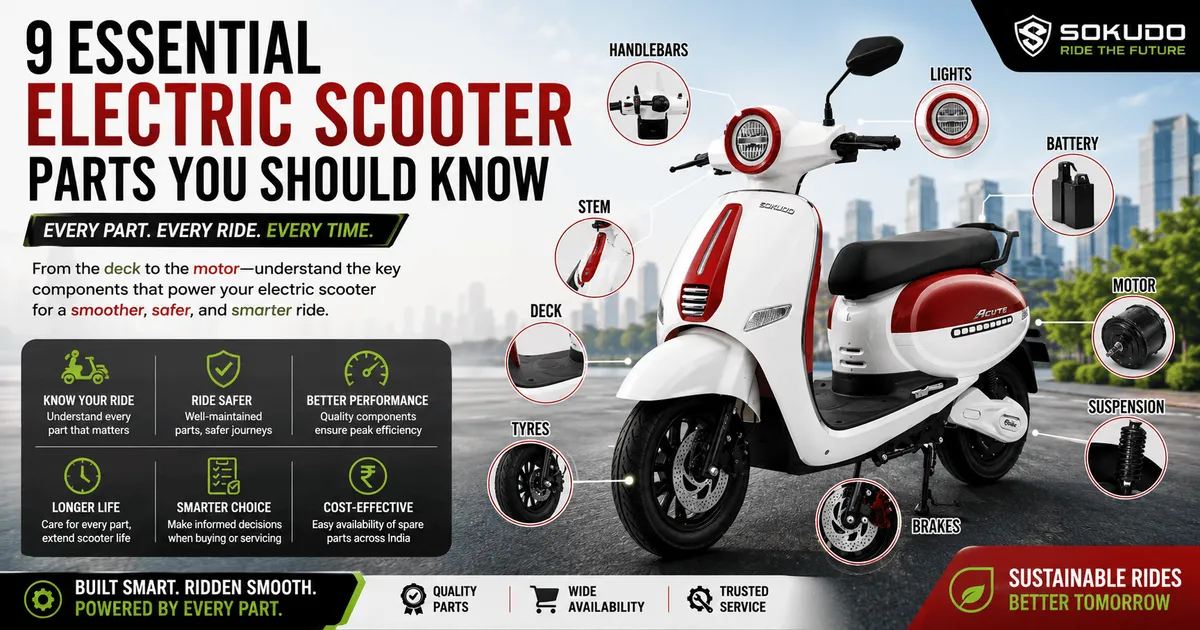
Understanding the parts that make up your electric scooter is one of the most practical things you can do as an owner. It helps you recognise problems early, have informed conversations with service technicians, make better buying decisions when comparing models, and plan your long-term ownership costs more accurately.
This guide covers every major electric scooter spare part, what each one does in daily riding, when it needs attention or replacement, and what typical costs look like in India in 2026. Whether you already own a Sokudo scooter or are still deciding which electric scooter to buy, this breakdown gives you the factual foundation most buyers never get before purchase.
Quick Reference: Electric Scooter Parts and Their Role
| Part | Primary Function | Replacement Frequency |
| Battery | Stores and delivers electrical energy | Every 6 to 8 years with proper care (LFP) |
| Motor | Converts battery energy into forward motion | Long-life component, rarely replaced |
| Brakes | Controls deceleration and stopping | Pads every 1 to 2 years depending on use |
| Tyres | Road contact, grip, comfort, efficiency | Every 2 to 4 years depending on mileage |
| Suspension | Absorbs road impact and vibration | Periodic adjustment, full replacement rare |
| Handlebars and stem | Steering control and rider interface | Long-life, check tightness regularly |
| Deck and footboard | Rider platform and scooter chassis base | Long-life structural component |
| Lights | Visibility and legal compliance | LED units last several years |
| Charger and charging port | Energy input system | Replace if damaged, inspect regularly |
The battery is the most critical component in any electric scooter. It determines your range, influences long-term ownership cost, and is the single most expensive part to replace if it degrades prematurely.
What it does: The battery stores electrical energy and releases it to power the motor, lights, display, and all other electrical systems. The amount of energy stored (measured in kilowatt hours, or kWh) determines how far you can ride on a single charge.
Most electric scooters in India use one of two battery chemistries. Standard lithium-ion (NMC) batteries offer higher energy density, meaning more range from a smaller pack.
LFP (Lithium Iron Phosphate) batteries offer better thermal stability, longer cycle life typically in the range of 2,500 to 4,000 cycles, and a stronger safety profile that is specifically relevant for India's high summer temperatures.
Sokudo scooters use LFP battery technology across the entire range, from the Sokudo Plus at Rs 67,951 to the Sokudo Acute at Rs 1,25,951. The practical difference in Indian conditions is that LFP batteries degrade more slowly under repeated heat exposure, which means the battery retains more of its original range after three or four years of daily riding in cities like Delhi, Jaipur, Nagpur, and Hyderabad where summer temperatures regularly exceed 42 degrees Celsius.
Battery replacement cost in India: Battery replacement is the largest single spare part expense in electric scooter ownership. Costs vary widely depending on battery capacity, chemistry, and brand, typically ranging from Rs 15,000 to Rs 45,000 or more for a full pack replacement. This is why battery chemistry, cycle life rating, and warranty terms matter so much at the time of purchase. Sokudo's 3-year battery and motor warranty provides documented coverage against manufacturing defects and abnormal degradation.
For practical charging habits that extend battery life and delay replacement, read our guide on how to extend the battery life of your electric scooter. For understanding how long a well-maintained battery realistically lasts in Indian conditions, see our guide on how long electric scooter batteries last in India.
What it does: The motor takes electrical energy from the battery and converts it into the rotational force that drives the wheel forward. Most modern electric scooters use BLDC (Brushless Direct Current) hub motors mounted directly inside the rear wheel, which eliminates the need for a chain or belt drive system.
Motor wattage and what it means: Motor output is typically listed in two ways: continuous (or thirty-minute) rated power and peak power. The continuous rating determines how the scooter performs during sustained riding. The peak rating reflects momentary output during hard acceleration. Under Indian regulations, the continuous thirty-minute power rating specifically determines whether a scooter requires RTO registration. Scooters rated at 250W continuous or below and certified at 25 km/h or below qualify as non-RTO vehicles.
For Sokudo's high-speed models including the Rapid 2.2, Select 2.2, Acute 2.2, and Acute, motor output exceeds these thresholds, which is why they require full registration, a driving licence, and insurance. The Sokudo Plus, with its certified 25 km/h speed and motor within the 250W continuous threshold, qualifies as a non-RTO vehicle. For a complete legal explanation of how motor ratings determine licence and registration requirements, see our guide on whether you can ride an electric scooter without a licence in India.
When it needs attention: Hub motors in electric scooters are long-life components that rarely require replacement under normal use. Warning signs that need professional attention include unusual humming or grinding noises from the rear wheel, loss of power output during acceleration, and unexpected motor cutoff during riding.
Motor spare part cost in India: Motor repairs are specialist work and costs depend significantly on the fault type and the specific motor model. Full motor replacement is uncommon during typical ownership periods and is more often relevant for high-mileage delivery riders. Sokudo's 3-year motor warranty covers manufacturing defects during the primary ownership period.
What they do: Brakes convert the scooter's kinetic energy into heat through friction, slowing and stopping the vehicle. Modern electric scooters use one or more of three braking systems: mechanical drum brakes, hydraulic or cable-actuated disc brakes, and regenerative braking through the motor.
Disc vs drum brakes:
Disc brakes offer stronger, more consistent stopping power across a range of conditions including wet roads, and provide better modulation (the rider's ability to control exactly how hard they are braking). Most Sokudo high-speed models including the Rapid 2.2, Select 2.2, Acute 2.2, and Acute use a disc front brake, which provides stronger stopping performance from 70 km/h than a drum arrangement.
Drum brakes are sealed from water and dust, which makes them low-maintenance, but they can fade under sustained hard braking and offer less initial bite than disc systems.
Regenerative braking: On scooters equipped with regenerative braking, the motor acts as a generator during deceleration, converting kinetic energy back into electrical energy and returning it to the battery. This marginally extends range and reduces wear on the friction brakes. It works most effectively at moderate speeds and is a supplement to, not a replacement for, friction braking.
When it needs attention:
Brake spare part costs in India: Brake pads are among the most affordable wear items, typically Rs 200 to Rs 800 per set depending on quality and model. Cable replacement and hydraulic bleed are service work that should be done by an authorised technician. For daily inspection of brake lever feel and pad condition, see our electric scooter maintenance checklist.
What they do: Tyres provide the grip, cushioning, rolling efficiency, and handling stability that determine how the scooter actually feels and performs on Indian roads. They are the only part of the scooter that contacts the road surface, which makes their condition directly relevant to both safety and range.
Tubeless vs tube tyres:
Most modern electric scooters in India, including all Sokudo models, use tubeless tyres. Tubeless tyres are safer because in the event of a puncture, they lose air gradually rather than deflating suddenly. They are also lighter, run at lower pressures, and handle punctures more conveniently because they can often be repaired without removing the tyre from the rim.
Tyre size and what it means: Most commuter electric scooters run 10 to 12-inch wheels. Smaller wheels are lighter and more compact, which suits the urban stop-start use case. Larger wheels, more common on electric motorcycles, handle rough surfaces better at higher speeds. For Indian urban riding, 10 to 12-inch tubeless tyres on well-inflated rims provide adequate comfort and efficiency.
Tyre pressure and range: This connection is more significant than most riders realise. An underinflated tyre increases rolling resistance, meaning the motor works harder for every kilometre. A consistent 5 to 7 PSI below the recommended pressure can reduce real-world range by 5 to 10 percent. For the full range impact breakdown, see our guide on how to increase electric scooter range.
When tyres need replacement:
Tyre spare part costs in India: Replacement tyres for electric scooters in India typically cost Rs 800 to Rs 2,500 per tyre depending on brand, size, and specification. Fitting and balancing adds Rs 150 to Rs 300. Annual tyre spend depends entirely on mileage and road conditions. City commuters covering 25 to 40 km daily in normal urban conditions typically get two to four years from a good quality tubeless tyre.
What it does: The suspension system absorbs the impact energy from road irregularities including potholes, speed breakers, construction debris, and uneven surfaces, before that energy reaches the rider and frame. Without effective suspension, every road imperfection transmits directly through the scooter to the rider's body and the electrical components.
Types of suspension used in electric scooters:
Most electric scooters use telescopic front fork suspension with a spring and oil-damper arrangement. The rear often uses a single or double-sided hydraulic shock absorber. Premium models may offer adjustable preload settings that allow the rider to tune the suspension stiffness for their weight and riding preference.
Why suspension matters for Indian roads specifically: India's urban road network, particularly in cities and on roads under construction, regularly presents electric scooter riders with potholes deep enough to cause wheel damage on poorly maintained tyres, speed breakers of inconsistent height and gradient, and road surfaces that transition from smooth tarmac to broken edges without warning. Suspension quality is therefore not a luxury feature in the Indian context. It is a daily necessity that directly affects ride comfort, component longevity, and rider fatigue on longer commutes.
When suspension needs attention:
Suspension spare part costs in India: Fork seal replacement and oil refill for front suspension typically runs Rs 500 to Rs 1,500 at an authorised service centre. Rear shock absorber replacement varies more widely by scooter model and specification.
What they do: The handlebars are your primary physical connection to the scooter. They transmit steering input from your hands to the front wheel, house the throttle, brake levers, indicator switches, headlight controls, and on most modern scooters, the instrument cluster display showing speed, battery level, range, and riding mode.
The stem is the vertical metal tube connecting the handlebars to the front fork and wheel. It must be tight and correctly aligned at all times because any play in the stem translates directly into unstable steering.
Why stem tightness is a safety issue: Handlebar stem bolts work loose gradually through the vibration of normal riding, particularly on rough Indian roads. A loose stem introduces rotational play between the handlebars and the wheel, which creates delayed and imprecise steering response. This is classified as a critical safety issue and warrants immediate service rather than being monitored and addressed later. The monthly wiggle test described in our 7 maintenance checks guide is the simplest way to catch this before it becomes dangerous.
Display and controls: Most modern electric scooters include a digital instrument cluster showing speed, battery percentage, range estimate, riding mode, and odometer. Higher-end models include TFT touchscreen displays with navigation integration and smartphone connectivity. Handlebar-mounted controls typically include separate brake levers for front and rear, a throttle, indicator switches, a horn button, headlight controls, and a mode selector.
Spare parts and costs: Handlebar grips are inexpensive wear items (Rs 100 to Rs 400) that benefit from periodic replacement when they become worn or slippery. Brake lever replacement typically costs Rs 200 to Rs 600. Full handlebar assembly replacement is uncommon outside of accident damage.
What it does: The deck or footboard is the flat platform between the wheels where the rider places their feet while riding. It is not just a floor panel. It is a structural component that contributes to the overall rigidity of the scooter frame and determines how the rider's weight is distributed across the vehicle.
Deck surface and grip: Most electric scooter decks use a textured or rubber-coated surface to maintain grip between the rider's feet and the deck. This grip becomes especially important in monsoon conditions when footwear is wet and road spray covers the deck surface. Riders should pay attention to the condition of this surface over time, as worn texture can reduce foot stability, particularly during hard braking or emergency manoeuvres.
Under-seat storage relationship: The space beneath the deck and seat in enclosed-body scooters (as opposed to stand-up kick-style scooters) typically houses the battery pack, controller, and sometimes additional storage. The deck design therefore affects how accessible these components are for service and battery health checks.
Structural integrity: Cracks or bending in the deck area, particularly around the stem mounting point or the footboard mounting bolts, are structural concerns that need professional assessment before further riding. These are typically identified during routine service inspections.
What they do: Lighting on electric scooters serves two separate safety functions. Headlights illuminate the road ahead for the rider, and tail lights and brake lights communicate the scooter's presence and braking behaviour to other road users behind.
LED lighting: Virtually all modern electric scooters use LED lighting systems. LED headlights draw significantly less power from the battery than older halogen units, provide stronger and more directional light output, and last considerably longer before requiring replacement. The efficiency advantage is relevant because lights run continuously while riding, and a less efficient lighting system draws energy that would otherwise extend range.
Brake-activated tail lights: A functioning brake-activated tail light is one of the most important safety features for Indian urban riding where rear-end collisions from following traffic are a genuine daily risk. The tail light activates whenever either brake lever is applied and alerts vehicles behind to the scooter decelerating. This should be tested weekly as part of routine checks.
Daytime Running Lights (DRLs): Some premium models include daytime running lights that improve the scooter's visibility to other road users in daylight. This is particularly useful on bright Indian summer days when a single headlight can be difficult to distinguish from ambient glare.
When lights need attention: Individual LED units have long service lives, but damage from impact, water ingress into a poorly sealed housing, or electrical connector corrosion can cause premature failure. A weekly lights check covering headlight, indicators, and brake light takes under three minutes. Indicator bulb failure shows up as a rapid flash rate on the affected side.
Light spare part costs in India: LED headlight assemblies vary significantly by model. Indicator bulb replacement is among the most affordable spare part replacements at Rs 50 to Rs 200 per unit. Full headlight assembly replacement costs more depending on the scooter model and whether the housing itself was damaged.
What it does: The charger converts household AC electricity into the DC voltage required to charge the battery safely. The charging port on the scooter receives this connection and transfers power to the Battery Management System, which controls how energy enters the cells.
Why the charger matters as a spare part: The charger is not an interchangeable commodity. The manufacturer-supplied charger is matched to the specific voltage, current limits, and communication protocol of your battery system. Using a third-party charger that delivers incorrect voltage or lacks proper temperature monitoring can cause incomplete charging, cell damage, or in severe cases a dangerous charging event.
If your original charger is damaged, replace it through an authorised Sokudo dealer or service centre rather than purchasing an uncertified alternative online.
Charging port inspection: The charging port is exposed to dust, water spray, and corrosion over time, particularly in monsoon conditions and dusty riding environments common across North India, Rajasthan, and Chhattisgarh. Weekly inspection of the port for dust buildup, pin corrosion (visible as green or white powder), and heat marks from past events is a simple preventive habit. Full cleaning and inspection guidance is in our electric scooter maintenance checklist.
Charging port spare part costs in India: Charger cable replacement varies by model and typically costs Rs 800 to Rs 2,500 depending on the charger type. Charging port replacement at a service centre varies by the extent of damage. Corrosion or damaged pins should always be assessed by a trained technician rather than cleaned or repaired at home.
For the full monsoon-specific charging protocol that prevents port damage from rain rides, see our electric scooter monsoon guide.
The growing electric scooter market in India has significantly improved spare part availability compared to three or four years ago. Authorised service centres for established brands like Sokudo now stock the most commonly replaced parts, while the broader aftermarket has expanded to cover tyres, brake pads, grips, and lighting components.
That said, availability and pricing vary meaningfully by:
Brand and model: Parts from established manufacturers with organised dealer networks are generally more accessible than parts for smaller or newer brands. This is one of the practical ownership advantages of buying from a brand with an organised service infrastructure.
Part category: Consumables like brake pads, tyres, grips, and cables are widely available and competitively priced. Core components like battery packs, motors, and controllers are more model-specific and typically purchased through authorised channels.
Quality tier: Genuine OEM parts from authorised channels typically cost more than aftermarket alternatives but carry the assurance of correct specification, compatibility, and often a warranty on the part itself.
| Spare Part | Approximate Cost Range in India (2026) |
| Battery pack (full replacement) | Rs 15,000 to Rs 45,000+ depending on capacity and chemistry |
| Motor (hub motor replacement) | Rs 4,000 to Rs 12,000+ depending on model |
| Brake pads (per set) | Rs 200 to Rs 800 |
| Brake lever | Rs 200 to Rs 600 |
| Tyre (per unit) | Rs 800 to Rs 2,500 |
| Suspension fork seal service | Rs 500 to Rs 1,500 |
| LED headlight assembly | Rs 500 to Rs 2,500+ depending on model |
| Indicator bulb | Rs 50 to Rs 200 |
| Charger cable | Rs 800 to Rs 2,500 |
| Handlebar grips (pair) | Rs 100 to Rs 400 |
Prices are indicative ranges for the Indian market in 2026. Actual costs vary by brand, model, dealer location, and part quality tier. Always confirm pricing with an authorised service centre before purchase.
For Sokudo owners specifically: Sokudo's paid service charge is Rs 530 including GST, and the first three services are free. Service and spare parts are available across Sokudo's authorised showroom network spanning Delhi NCR, Uttar Pradesh, Bihar, Haryana, Uttarakhand, Rajasthan, Assam, Madhya Pradesh, Maharashtra, Odisha, Chhattisgarh, and West Bengal. Find your nearest service location at Sokudo showrooms.
Knowing what each part does changes how you evaluate scooters before purchase. Instead of comparing only claimed range and top speed, you start asking better questions:
Battery: What chemistry does the battery use? What is the rated cycle life? What warranty covers it specifically? These questions directly predict long-term ownership cost.
Motor: What is the continuous thirty-minute power rating? This determines both performance and regulatory classification under Indian law.
Brakes: Does the scooter use disc or drum brakes at the front? At the rear? Does it have regenerative braking? These determine safety performance at the speeds the scooter can reach.
Tyres: Are they tubeless? What is the recommended pressure? What size are they? These affect range, comfort, and puncture management in daily use.
Suspension: Is the suspension adjustable? How does it handle an Indian speed breaker at 30 km/h? This is best evaluated on a test ride rather than from a specification sheet.
For a structured framework covering all these buying factors together, read our guide on how to choose the right electric scooter in India. To compare all current Sokudo models across these specifications with confirmed pricing, visit the full Sokudo electric scooter range.
What are the most important spare parts to know about for an electric scooter?
The battery is the most important because it determines range, performance, and long-term ownership cost, and it is the most expensive component to replace. After that, tyres and brakes are the most frequently replaced wear items in normal ownership. The motor, suspension, and lighting systems are durable components that need attention less frequently but are critical for safety and performance.
How long does an electric scooter battery last before needing replacement?
A well-maintained LFP battery like those used across the Sokudo range is rated for 2,500 or more charge cycles with approximately 80 percent capacity retained at end of life. For a rider charging once daily, this translates to roughly 6 to 8 years of practical use before replacement becomes necessary. Premature replacement is usually caused by deep discharge cycles, heat exposure from poor parking habits, or use of uncertified chargers. Our guide on how long electric scooter batteries last in India covers this in full detail.
Are electric scooter spare parts easily available in India in 2026?
For established brands with organised dealer networks, yes. Consumables like brake pads, tyres, charger cables, grips, and indicator bulbs are available at authorised service centres and, for some items, through general auto parts shops. Core components like battery packs and motors are more model-specific and should be sourced through authorised channels to ensure correct specification and compatibility.
Can I replace electric scooter parts myself at home?
Simple items like handlebar grips and indicator bulbs can be replaced at home by riders comfortable with basic tasks. Anything involving the brake system, battery, motor, or suspension should be done by a qualified technician at an authorised service centre. Incorrect brake adjustment is dangerous, and improper battery or electrical work carries safety risks and can void the warranty.
How much does it cost to maintain an electric scooter annually in India?
Routine electric scooter servicing in India typically costs Rs 1,000 to Rs 2,500 per year for basic upkeep, with additional costs for tyre wear, brake pads, and occasional electrical maintenance depending on usage. For Sokudo owners, the first three service visits are free and paid visits cost Rs 530 including GST. Our complete guide on electric scooter maintenance cost in India breaks down every cost category in detail.
What is the difference between disc and drum brakes on an electric scooter?
Disc brakes use a metal rotor and caliper-mounted pads to create friction. They offer stronger, more consistent braking performance across conditions including wet roads, better modulation, and are more suitable for scooters that reach 60 to 70 km/h. Drum brakes are sealed, low-maintenance, and adequate for lower-speed riding but can fade under sustained hard braking. Sokudo's high-speed models (Rapid 2.2, Select 2.2, Acute 2.2, and Acute) use disc front brakes for this reason.
Does tyre pressure really affect electric scooter range?
Yes, significantly. Underinflated tyres increase rolling resistance, which means the motor uses more energy to cover each kilometre. A consistent 5 to 7 PSI below the recommended pressure can reduce range by 5 to 10 percent across a full charge. Checking tyre pressure twice a week is one of the simplest and most effective range-protection habits any electric scooter owner can develop. Our full range improvement guide covers this alongside 14 other practical tips at how to increase electric scooter range.
What should I do if my electric scooter shows a warning light or error code?
Note the exact code or message displayed, photograph the dashboard, and contact your authorised service centre. For Sokudo owners, call +91-8920649555 or visit your nearest Sokudo showroom. Do not reset and ignore persistent error codes. They represent the BMS or controller detecting a specific condition that will typically worsen if left unaddressed.
Knowing what each part of your electric scooter does is not just useful for maintenance conversations. It helps you choose the right scooter in the first place, catch problems before they become expensive, and plan your ownership costs over the years rather than being surprised by them.
The battery, brakes, and tyres are the three components that most directly affect your daily safety and range. The motor and suspension affect how the scooter performs. The charger and charging port are the components most often damaged by avoidable habits. And the handlebars, stem, deck, and lights are the structural and visibility components that should be checked regularly because problems here progress from minor inconvenience to safety risk faster than most riders expect.
For everything Sokudo-specific including confirmed prices, specifications, and service booking, visit the full Sokudo electric scooter range or find your nearest service centre at Sokudo showrooms.